zenpundit.com » cognition

Archive for the ‘cognition’ Category

Wired for Hierarchy ?

Thursday, September 11th, 2008

Here’s an interesting bit of research: the human brain appears to have a serious bias toward hierarchical structures that makes issues of status and rank a distracting and destabilizing variable:

Human Brain Appears “Hard-Wired” for Hierarchy

Human imaging studies have for the first time identified brain circuitry associated with social status, according to researchers at the National Institute of Mental Health (NIMH) of the National Institutes of Health. They found that different brain areas are activated when a person moves up or down in a pecking order – or simply views perceived social superiors or inferiors. Circuitry activated by important events responded to a potential change in hierarchical status as much as it did to winning money.

“Our position in social hierarchies strongly influences motivation as well as physical and mental health,” said NIMH Director Thomas R Insel, M.D. “This first glimpse into how the brain processes that information advances our understanding of an important factor that can impact public health.”

… “The processing of hierarchical information seems to be hard-wired, occurring even outside of an explicitly competitive environment, underscoring how important it is for us,” said Zink. Key study findings included:

  • The area that signals an event’s importance, called the ventral striatum, responded to the prospect of a rise or fall in rank as much as it did to the monetary reward, confirming the high value accorded social status.
  • Just viewing a superior human “player,” as opposed to a perceived inferior one or a computer, activated an area near the front of the brain that appears to size people up – making interpersonal judgments and assessing social status. A circuit involving the mid-front part of the brain that processes the intentions and motives of others and emotion processing areas deep in the brain activated when the hierarchy became unstable, allowing for upward and downward mobility.
  • Performing better than the superior “player” activated areas higher and toward the front of the brain controlling action planning, while performing worse than an inferior “player” activated areas lower in the brain associated with emotional pain and frustration.
  • The more positive the mood experienced by participants while at the top of an unstable hierarchy, the stronger was activity in this emotional pain circuitry when they viewed an outcome that threatened to move them down in status.  In other words, people who felt more joy when they won also felt more pain when they lost.

“Such activation of emotional pain circuitry may underlie a heightened risk for stress-related health problems among competitive individuals,” suggested Meyer-Lindenberg. 

Read the rest here

With such a strong intrinsic reward system, the incentives for maintaining high status in an organization would outweigh those involved in carrying out the organization’s core mission – i.e. ” leaders” have a built-in drive to maintain the status quo at the expense of any possible nominal objective. The predisposition would also be present to look for hierarchical couterparts that do not exist in adversarial organizations that have a network structure and to ” sabotage” networked and “modular structures” on our own side in order to transform them into a hierarchy than can better fulfill the ego-needs of a “high status” individual.

Depth, Breadth and Velocity

Wednesday, August 27th, 2008

I thoroughly enjoyed John Hagel’s post Stupidity and the Internet where he analyzed the implications of the book vs. snippet debate initiated by Nick Carr’s  Atlantic article “Is Google Making Us Stupid?”. Hagel properly broadened the debate away from content format to encompass the social sphere:

But if the concern is about intelligence, thinking and the mind, then isn’t content just one small piece of the puzzle?  Nick and many of the digerati who line up against Nick have one thing in common – they are content junkies.  They consume content voraciously and care deeply about the form that content takes. 

In the heat of debate, they seemed to often lose sight of the fact that most people are not content junkies.  Most people use the Internet as a platform to connect with each other.  Sure, they are exchanging information with each other, but they are doing a lot more than that.  They are learning about each other. They are finding ways to build relationships that expand their understanding of the world and enhance their ability to succeed in their professions and personal lives.

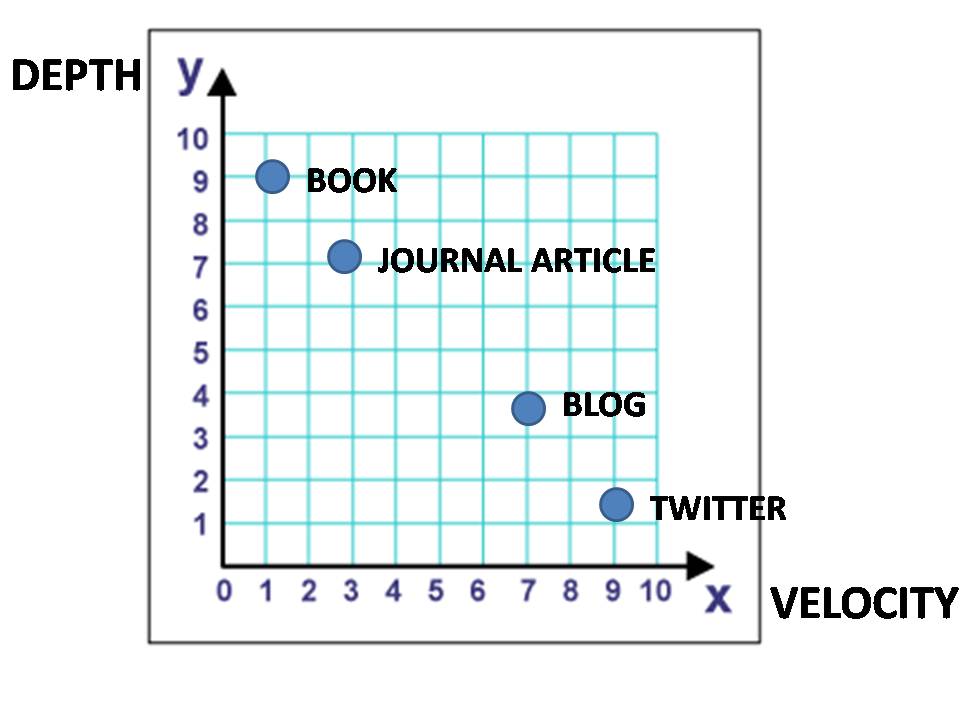
I’m going to back the discussion up a half-step by pointing out that these online relationships are often, initially of a transactional nature. Information is being exchanged and the kind of information used as a “hook” to capture attention may be determinative to the trajectory the social relationship may take and the rate of information exchanged may determine if the social connection can be sustained. To simplify, we are discussing Depth, Breadth and Velocity of information:

graph1.jpg

Books, journal articles, blog posts and Twitter “tweets” ( 140 character microblogging) could have their relative informational and transactional qualities be represented on a simple graph. Books have the greatest potential depth but the least level of timely, qualitatively reciprocal, informational transaction for the author ( primarily gained from the relationship with the editor or a “sounding board” colleague). Peer review journals are next, with a narrow community of experts sanctioning the merit of the article or rejecting it for deficiencies that put the work below or outside the field’s recognized professional standards. Blog posts can potentially generate an enormous volume of feedback, though at the cost of a dramatically inferior “signal to noise ratio“. Microblogging services like Twitter have hyperkinetic transaction rates but unless used strategically ( for example, by Robert Scoble) or within an existing social network, they generate little other than useless noise.

Attention can be attracted by a clever “snippet” – particularly if the concept itself has ambiguity or nuance that would intrigue more people than if it were precisely defined – but the attention will not be held unless the author can sustain the flow of interesting material, something that requires depth of knowledge about a subject.  Even better is to have depth in a subject along with breadth, the ability to think horizontally across many domains to spot emergent patterns, construct powerful analogies and distill a meaningful synthesis. In turn, pulling a willing audience of useful collaborators into a relationship around such intellectual pursuits hinges on first gaining their attention with a comprehensible simplification of complex abstractions and exhibiting a willingness to interact on a reciprocal basis.

It’s not a case here of “Books vs. Google”. Depth, breadth and velocity of information are interdependent and mutually reinforcing.

New Post up at CTLab – Complexity & Simplicity

Friday, July 25th, 2008

After some tech issues were ironed out, I was able to get this “think” piece up at CTLab tonight:

Complexity and Simplicity in Thought and Message

….A greater flow of information at ever higher speed increases the level of complexity as ever more variables are recognized, understood (hopefully), and considered ( possibly). Institutions that cannot process the flow of information and accurately distill the signals from the noise will become less effective in their core missions, less “fit” as organizations and at a disadvantage to those that can.

A useful approach to dealing with vast quantities of information and resultant complexity is to make judicious use of simplification to allow at least the fundamental premises or understandings of complicated subjects to be effectively communicated through the mass media or social media networks. Simplification will be a vital tool in any society that is increasingly organized according to the paradigm of a global complex system of systems.

….Unfortunately, clarity is not the only outcome of simplification wrought by complex thinkers. The reverse is also possible when oversimplification not only creates gross distortions of comprehension but actively slides towards the construction of powerfully emotive and destructive myths….

Read the rest here.

Some call it “Evercrack”: Psychology of MMORPG

Tuesday, July 15th, 2008

Dave “the hand of ” Munger at Cognitive Daily points to a study on the powerful effects of massive multiplayer online role playing games like World of Warcraft, Everquest, Dark Age of Camelot and others :

One type of game — one of the most popular types, in fact — hasn’t been studied nearly as much as the traditional arcade-style game: massively multiplayer online role-playing games, or MMORPGs. One of the studies of this type of game seemed to find that players weren’t more aggressive because the games foster cooperation between players.

But we’ve also heard — and seen, with Jim’s game-play, that MMORPGs like World of Warcraft can be more engaging and distracting than other games, sucking away hours and hours in seemingly endless online quests. Even if it turns out these games don’t promote violent behavior, is it possible that they have other detrimental effects?

….Sleep quality was significantly worse in the MMORPG group than the other groups, and the participants said the game interfered with their academics (although their actual academic performance didn’t suffer compared to the other groups). Yet the MMORPG group was significantly more likely than the other groups to say they planned to continue playing the game after the study was complete.

So is this behavior addictive? Smyth doesn’t offer an assessment, but the fact that the MMORPG appears to be negatively impacting several areas of these students’ lives — and that they continue to play on despite this — suggest it might be. But once again, we must be careful when generalizing results such as this. Just one MMORPG was tested, so we can’t say whether these results apply to other games. What’s more, the students clearly were getting some benefits from the game, building an online social network that was valuable to them. Despite these caveats, to me it’s surprising that such dramatic results occurred even when groups were randomly assigned to the games. Maybe nearly anyone could get “hooked.” Which is why I’m not especially interested in getting started.

We’ve known that gaming is a powerful behavioral tool since the early RAND wargaming studies, making MMORPGs a potential delivery system for education and occupational training in the 21st century

Wass de Czege on Irregular Warfare and the Writing of Doctrine

Tuesday, July 8th, 2008

While I was away, the SWJ Blog ran a thoughtful essay by General  Huba Wass de Czege on the new military doctrine on irregular warfare. Not only is he good on the substance, Wass de Czege demonstrates how one needs to begin with clear thinking when attempting to formulate and apply usefuyl concepts:

A Reflection on the Illogic of New Military Concepts

What is it about the US Military that tends to produce sound, pragmatic, and common sense ideas about the concrete present, and tends toward illogic, faddish paradigms and hyperbole when dealing with the abstract future? Joint Operating Concepts for dealing with post cold war security problems have proven difficult to “get right.” This is because they begin from the wrong logical starting point and thus define the problem incorrectly. It is also because of inattention to historical fact, definitional subtlety and the theoretical logic within which military forces must operate. This inattention overlooks key logical inconsistencies in such documents crafted more to “sell” to constituencies within the Washington “Beltway” the capabilities and programs championed by one military interest group or another rather than to inform current decisions in the field.

….”Beltway” constituencies have been educated to think according to the attractive new paradigms military professionals have used to buttress their budget arguments.

Read the rest here.


Switch to our mobile site