zenpundit.com » youtube

Archive for the ‘youtube’ Category

A most curious YouTube quotation

Tuesday, December 16th, 2014

[ by Charles Cameron — total clash or bizarre agreement? Sydney hostage-taker Man Haron Monis quoted Christian apologist David Wood video on his Twitter feed ]
.

I am really not sure quite what to make of this. Sheikh Haron, aka Man Haron Monis, the disturbed ex-Shia convert to “Islam” who was the Sydney “hostage-taker” had a Twitter-feed, still up as I was researching this piece, which included this tweet:

**

Somewhat to my amazement, Haron is posting a video by the Christian apologist David Wood of Acts 17 Apologetics — a gentleman I’ve run across before, strongly opposed to Islam. Here’s the video in question, as featured on the Acts 17 Apologetics YouTube channel

Is Haron quoting Wood like this because he agrees (??!!) with Wood’s analysis of IS in terms of Quranic injunctions — or to show how disdainfully opposed to Islam, western views or Christian apologetics “really are”? — perhaps even both simultaneously?

No matter how you read Haron’s use of Wood’s video, or the various versions of the two Abrahamic faiths under discussion, the appearance of a Christian apologeticist on Haron’s website should give us pause for thought.

For an insight into Wood himself, the redemptive bio on the Moral Apologetics website under the title On Psychopathy and Moral Apologetics is worth your attention.

**

In case Haron’s feed gets taken down — I’m amazed it hasn’t been taken down already — here is a screen cap of that tweet:

Sheikh Haron's tweet

For more on Haron’s online presence, see Zack Beauchamp quoting Daveed Gartenstein-Ross in Sydney hostage taker Man Haron Monis pledged allegiance to ISIS on his website

Sunday surprise: the country western / blues of Hafez

Monday, December 8th, 2014

[ by Charles Cameron — at the heart not of the political entity, Iran, but of the Persian culture and people, can be found a king’s ransom in poetry and song ]
.

The sensual and the spiritual meet, melt, meld, merge, and dare I say it, emerge to suit each reader of the poetry of Hafez, Sufi poet and mystic — at times erotic, at times ecstatic, the yearning for the beloved sounding in both registers in his poetry, as in the Song of Songs, which is Solomon’s.

These versions, by James Newell, capture the spirit of Hafez far better IMO than the frankly best-sellerized and thus trivial versions of Ladinsky. The most sophisticated translator of Hafez now living is probably Dick Davis, who has this to say in an essay intriguingly titled On Not Translating Hafez:

The second obvious problem faced by a translator inheres in those parts of a text which have clear cultural resonance for the original audience and very little or absolutely no resonance for the linguistic community of the target language. An obvious example of this for translators from almost any Persian text from the sixteenth century on is the lore of Shi’i Islam, an intimate knowledge of the main features of which is automatically assumed by most post-fifteenth-century Persian authors, though this is of course a knowledge almost entirely lacking in the linguistic communities of the West. When we turn to Persian poetry such cultural problems can be particularly intrusive. There is the fact that after the thirteenth century virtually all Persian poetry has at least a tinge of Sufism to it, if it is not outrightly mystical in intent, and mysticism is not a subject accorded particular importance by the poetry of the major Western languages. [ .. ]

A subdivision of this mystical problem is the set of ideas metaphorically expressed in Persian poetry by wine, drunkenness, the opposition of the rend (approximately “libertine”) and the zahed (“ascetic”), and so forth. None of these notions have any force whatsoever in the Western literary tradition. It would never occur to a Western poet to express the forbidden intoxications of mysticism by alluding to the forbidden intoxications of wine, for the simple fact that the intoxications of wine have never (if we exclude the brief and local moment of prohibition in the United States) been forbidden in the West. The whole topos of winebibbing and the flouting of sober outward convention, so dear to Persian Sufi poetry, can seem in earlier translators’ work to be little more than a kind of rowdy undergraduate hijinks, and in more recent versions it can take on the ethos of Haight-Ashbury in the late sixties. But in both cases the deeper resonances of the topos are not obvious for a Western audience: they have to be explained — and to explain a resonance is like explaining a joke; when the explanation is over, no one laughs, except out of pained politeness, and no one is moved.

Here’s a song in which the world-renouncing side of things comes axroo forcefully…

I wrote a poem of my own in somewhat similar spirit yesterday, not too long after listening to that one, and offer it here in counterpoint, with Madhu especially in mind:

Lend me at least an echo
.

If you’re not listening to my poems
how shall I possibly know I’m still alive?
It’s when your heart stops
just for a moment
that my heart begins to race,
when your breath catches
that my breath can return to my heart.
You kill me. I call to you,

nightingale to rose or whatever,
lover to beloved,
thorn, petal, throat, branch —
are you nowhere,
and how can I follow?
Let me know it was you sang my song.

And okay, here’s a third and last Hafez version by James Newell:

**

Dr Newell’s bio can be found here — and yes, in addition to playing with the likes of Muddy Waters, Howlin’ Wolf, Mose Allison and John Mayall, he does indeed hold a doctorate from Vanderbilt. His doctoral dissertation, should you care to read it, is on the ethnomusicology of the Qawwali

Which brings me just the opportunity I need to close this post with Nusrat Fateh Ali Khan singing his signature qawwali, Allah Huu.

To the best of my understanding, Allah is simple the Arabic term for God, just as Dieu is in French — used by mambers of any religion or done who wish to reference the Deity — while the word Hu in Sufism references the breath or spirit — pneuma in Greek, prana in Sanskrit, spiritus in Latin — the wind that “bloweth where it listeth” of John 3.8.

Huu:

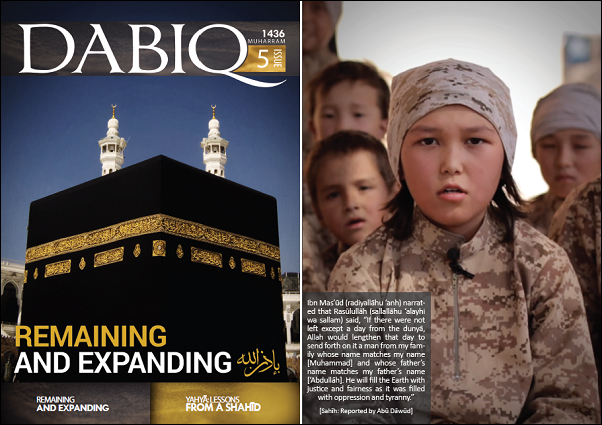
Dabiq issue #5 — the back cover, the hadith, the child, the video

Sunday, November 23rd, 2014

[ by Charles Cameron — once again a Mahdist hadith — and a video link, I’m pretty sure ]
.

dabiq 5 front back pgs

Dabiq issue #5 (front & back covers above) has now been out a day or three.

**

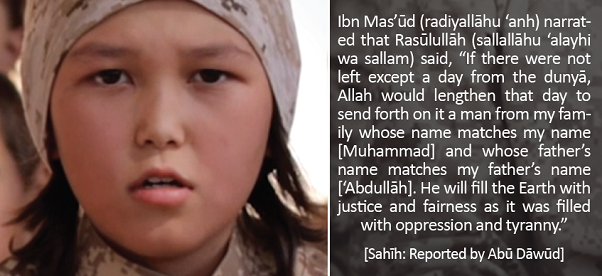
This time, there’s an “end times” hadith that doesn’t mention the title Mahdi while referring to him on the back cover:

face

This particular hadith as quoted requires the Mahdi to have both the name of the Prophet and of his father — which will make it difficult, but not impossible, for the current caliph to receive that title. Mr Orange first suggested this problem to me, and I hope in a future post to discuss it in some detail.

I also hope to continue discussing Dabiq issue #5 as time allows..

**

For now, let me close by saying I am pretty sure the child in the photo above is also “Abdullah” from Khazakstan interviewed in this video:

which I found in Australia’s 9News piece, Child demonstrates frightening firearms proficiency in ISIL video.

Peter O’Toole, RIP — & that goes for TE Lawrence and OB Laden, too

Monday, December 16th, 2013

[ by Charles Cameron — farewell to a great actor, also some curious related videos ]
.

So Peter O’Toole is no longer among us. Film-makers and actors routinely bring three dimensions out of the two-dimensional silver screen, but O’Toole had the gift to show us more dimensions than most, so I thought a small tribute might be in place.

As a Brit with an interest in the local strain of theology, O’Toole’s role as King Henry II in Peter Glenville‘s film adaptation of Jean Anouilh‘s Becket was an obvious choice…

But then, you know, there’s also TE Lawrence, who ties into the fascination hereabouts with strategy, and with the Middle East, and my being a Brit again — so I went looking for a decent clip from David Lean’s “Lawrence of Arabia”, and found…

I mean, why?

Lawrence of Arabia didn’t look at all like that, we all know what he looked like, he looked like this:

**

I’ve been posting about these exceedingly curious YouTube videos meshing bin Laden imagery with great classical music for a while now [see here and here], and wondering what on earth they might mean. I ran across some more of them recently — if the topic is still of interest, let me know, and I’ll post something on my more recent finds.

On Islam 1: Reuel Mark Gerecht

Tuesday, November 26th, 2013

[ by Charles Cameron — on an impressive video, featuring Matt Levitt and Reuel Gerecht on Hezbollah ]
.

Matthew Levitt‘s contribution to a recent panel at the International Soy Museum was a tour de force. Levitt, whose work as a CT analyst has included stints with both the FBI and Treasury, was discussing his most recent book, Hezbollah: The Global Footprint of Lebanon’s Party of God — both the book and his talk are strongly recommended.

It is, however, his colleague Reuel Marc Gerecht‘s contribution to that session that I wish to highlight here, because [starting at 44.40] he made a point about Hezbollah from his own CT experience that he still finds it necessary to make in 2013, some two decades after his service with the CIA commenced in the 1990s:

One of the things I was struck by when I came into the Agency, and I was struck by it on the day that I left the Agency, which was: you almost never had officers either on the clandestine side or in the directorate of analysis, the Directorate of Intelligence, talk about God. You just didn’t have that many people sort of put it together and talk about what actually motivated people.

You know, there was almost an assumption out there, Oh, the Iranians were upset with us because of our dealing with the Shah etcetera, but the actual analysis of the Iranian complaint against the United States was distinctly secular. Even the analysis of the Hezbollah was distinctly secular. And it never made any sense, particularly if you started to have some exposure to these individuals, and you suddenly realized that no, their motivations aren’t secular usually, their motivations are actually deeply spiritual, they’re religious, they’re about God.

— and [starting 53.04]:

There is a profound reflex in the West to look at a group like Hezbollah, and to look at their Iranian sponsors, and to take God out of the equation. Don’t do that. We wouldn’t do it with al-Qaida. Don’t do it with these groups either. If you do that, if you neuter them of their religious belief, if you look at it as just an ethnic movement, if you look at it as just a sectarian movement, if you look at it as just the Shi’a getting even in Lebanon, then you’re making an atrocious analytical mistake, which will bushwhack you, I guarantee you, over and over again. You have to keep God in this equation…

The one bright spot in this dismal account of the secular mindset blinding itself to religious passion is Gerecht’s statement: “We wouldn’t do it with al-Qaida”.

**

For more on the way our own worldviews can blind us to the worldviews of others, see my post on Gaidi Mtaani, together with the two follow ups to that post which I shall be posting here shortly.


Switch to our mobile site