zenpundit.com » feedback

Archive for the ‘feedback’ Category

Equal Time: Bleuer on Jones

Sunday, August 16th, 2009

Michael Innes of CTlab dropped by to strongly recommend this post by Afghan expert Christian Bleuer of Ghosts of Alexander, where Bleuer takes issue with the Seth Jones op-ed in the WSJ. So, in the interest of equal time, here you go:

The Mystery of the Wall Street Journal and the Absentee Afghanists

….There is a lot in the article to choke on, especially his comments on tribes, arbakai and jirgas. But this comment is what got me:

…outside of some anthropologists, few people have bothered to examine Afghanistan’s stable periods.

That’s right. These scholars are missing in action. Perhaps off studying other areas? If only we had more material on “Afghanistan’s stable periods”….

Let’s start with anthropologists: “some”? I’ll stick to those anthropologists who did pre-1979 work. I came up with these, in a rather hasty manner, in no particular order:

  1. Louis Dupree
  2. Robert L. Canfield
  3. M. Nazif Shahrani
  4. Alef Shah Zadran
  5. Audrey Shalinsky
  6. Elizabeth Bacon
  7. Pierre Cenlivres
  8. Micheline Centlivres-Demont
  9. Richard Tapper
  10. Nancy Tapper (Lindisfarne)
  11. David J. Katz
  12. Yusuf Nuristani
  13. Erwyn Orywal
  14. Thomas Barfield
  15. Willi Steul
  16. Jon Anderson
  17. Inger Boeson
  18. A. Christensen
  19. Ashraf Ghani
  20. Takeshi Matsui
  21. Jeffrey Evans-von Krbek
  22. Ingeborg Baldauf (also a linguistic)
  23. Richard Strand (also a linguist)
  24. Khadiya Khashimbekov
  25. Erhard Franz
  26. Shuyler Jones
  27. Jan Ovesen
  28. Lincoln Keiser
  29. Michelle Poulton
  30. Robin Poulton
  31. J.P.S. Uberoi
  32. K. Wutt
  33. H.F. Shurman
  34. Aparna Rao
  35. R.T. Rashidov
  36. Carl-Johan Charpentier
  37. Etc….

This is getting tiring….

Read the rest here.

Also noteworthy, is Bleuer’s Afghanistan recommended reading list, in which I know many readers here would be interested.

Depth, Breadth and Velocity

Wednesday, August 27th, 2008

I thoroughly enjoyed John Hagel’s post Stupidity and the Internet where he analyzed the implications of the book vs. snippet debate initiated by Nick Carr’s  Atlantic article “Is Google Making Us Stupid?”. Hagel properly broadened the debate away from content format to encompass the social sphere:

But if the concern is about intelligence, thinking and the mind, then isn’t content just one small piece of the puzzle?  Nick and many of the digerati who line up against Nick have one thing in common – they are content junkies.  They consume content voraciously and care deeply about the form that content takes. 

In the heat of debate, they seemed to often lose sight of the fact that most people are not content junkies.  Most people use the Internet as a platform to connect with each other.  Sure, they are exchanging information with each other, but they are doing a lot more than that.  They are learning about each other. They are finding ways to build relationships that expand their understanding of the world and enhance their ability to succeed in their professions and personal lives.

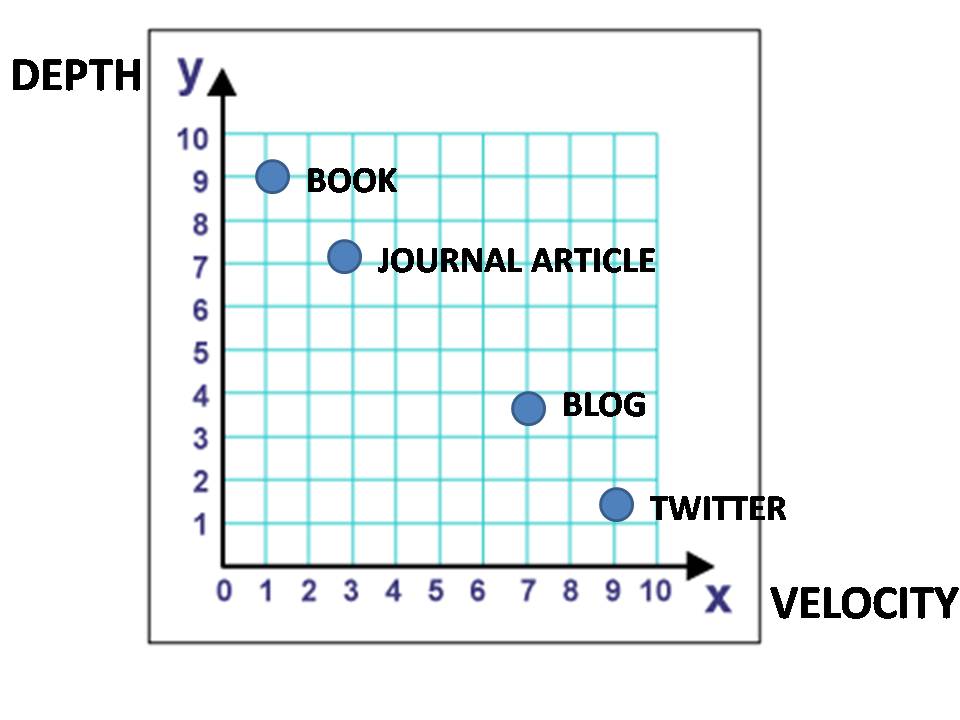
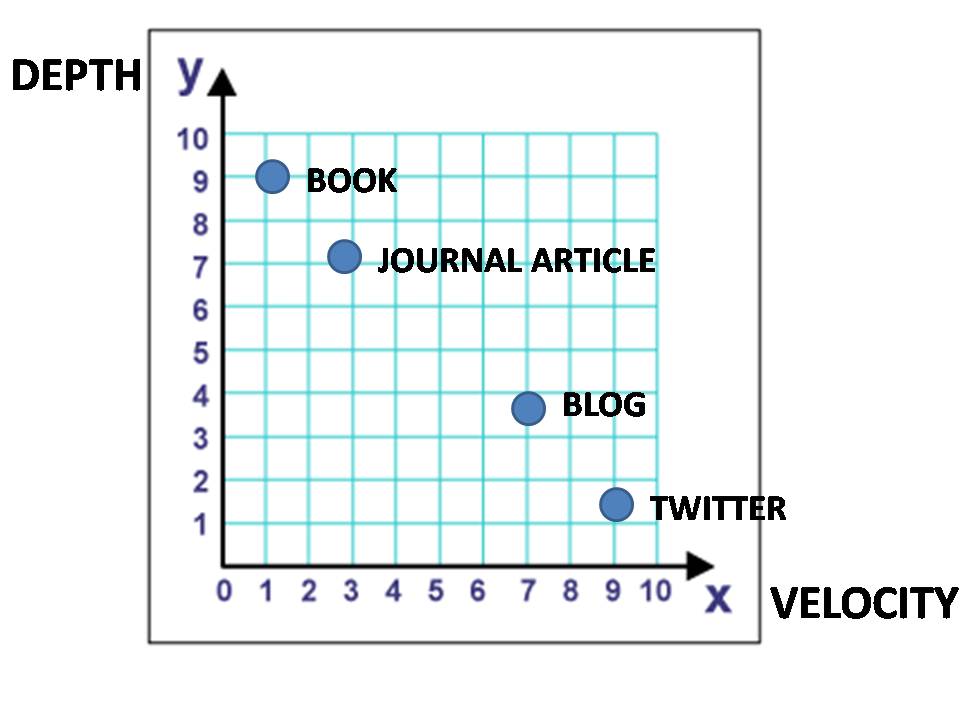
I’m going to back the discussion up a half-step by pointing out that these online relationships are often, initially of a transactional nature. Information is being exchanged and the kind of information used as a “hook” to capture attention may be determinative to the trajectory the social relationship may take and the rate of information exchanged may determine if the social connection can be sustained. To simplify, we are discussing Depth, Breadth and Velocity of information:

graph1.jpg

Books, journal articles, blog posts and Twitter “tweets” ( 140 character microblogging) could have their relative informational and transactional qualities be represented on a simple graph. Books have the greatest potential depth but the least level of timely, qualitatively reciprocal, informational transaction for the author ( primarily gained from the relationship with the editor or a “sounding board” colleague). Peer review journals are next, with a narrow community of experts sanctioning the merit of the article or rejecting it for deficiencies that put the work below or outside the field’s recognized professional standards. Blog posts can potentially generate an enormous volume of feedback, though at the cost of a dramatically inferior “signal to noise ratio“. Microblogging services like Twitter have hyperkinetic transaction rates but unless used strategically ( for example, by Robert Scoble) or within an existing social network, they generate little other than useless noise.

Attention can be attracted by a clever “snippet” – particularly if the concept itself has ambiguity or nuance that would intrigue more people than if it were precisely defined – but the attention will not be held unless the author can sustain the flow of interesting material, something that requires depth of knowledge about a subject.  Even better is to have depth in a subject along with breadth, the ability to think horizontally across many domains to spot emergent patterns, construct powerful analogies and distill a meaningful synthesis. In turn, pulling a willing audience of useful collaborators into a relationship around such intellectual pursuits hinges on first gaining their attention with a comprehensible simplification of complex abstractions and exhibiting a willingness to interact on a reciprocal basis.

It’s not a case here of “Books vs. Google”. Depth, breadth and velocity of information are interdependent and mutually reinforcing.

Extending the Discussions

Sunday, May 4th, 2008

This is the great thing about blogging – the times when other people pick up where you had left off and turbocharge the conversation with their own posts. Some of the best kind of P2P feedback around. Here Younghusband and Lexington Green carry the ball downfield in two different threads. Both posts should be read in full but here are snippets and links:

Coming Anarchy -“History vs. the Future

….A brief glance shows a gap in the qualitative area reflected in your comment that “History is a craft, not a science.” However, futurism is also about the “craft” of qualitative analysis as well, so the two are not necessary diametric. One common aspect of both fields is the philosophic, specifically the epistimelogical consequences (once again I would like to do a double-take at the term “discrete facts”) and the eternal quest to pare down bias. This is an area that I think could be explored more. If you know any good journal articles about this let me know.

Moving on, I would like to challenge one of your statements: “The problem with futurists is that their predictions are all too frequently in error.”

Error denotes precision. Futurists are in the forecasting business not the prediction business. If a futurist constructs a number of variant scenarios, none of which exactly fit the present conditions, but are able to be used to inform decision-making, where is the error? The fact that the scenarios could be drawn upon for guidance makes the futurist a success. Qualifying uncertainty is a key aspect of forecasting, one that is often overlooked by the public. Hey, we all can’t be fans of Sherman Kent

Younghusband is right – the best Futurism involves forecasting and work with intriguing scenarios of reasonable internal validity and the attempt to nail down hard predictions ( frequently demanded by journalists and politicians) often fails because the greater attempt at precision increases the probability of error. Scenarios are tools for guidance, they reduce our “surprise” through mental rehearsals and the extension of our anticipation of possibilities ( Taleb would say turning some black swans into gray ones).

Regarding “discrete facts”, it would have been more accurate for me to have written to say “primary source documentary evidence that is generally regarded as factual support for the narrative itself” by historians as opposed to “speculation” regarding motivations, plausibility, nuances inferred from the documents by the historian. Note that the content of the documents themselves may be decidedly non-factual or fantastic but for historians, what matters in terms of “fact” is that  they represent evidence of what was considered at the time.

Chicago Boyz – “Academia’s Jihad Against Military History: Further Thoughts

A good recent piece on this issue which Zen did not link to is Military Histories Old and New: A Reintroduction by the excellent military historian Robert M. Citino. Citino’s essay was published in the American Historical Review, the flagship journal of the American Historical Association, which modestly describes itself as the major historical journal in the United States. Hence, Citino’s article is a case for the defense, made by a very qualified military historian, in the main forum of the profession.

….Citino concludes his essay by virtually imploring the rest of the profession:

Despite these problems, which no doubt promise to be contentious, military historians today are doing enough good work, based on exciting and innovative approaches, to re-engage the attention of historians in any number of areas. My final advice to my professional colleagues and friends in the broader discipline? Try something genuinely daring, even countercultural, in terms of today’s academy. Read some military history.

There is something grotesquely wrong when the author of many numerous top-quality works feels he has to grovel before his peers. Unfortunately for him, he has to live and function in a shark-tank of political correctness and ideological hostility. I wish him well.

I wish Citino well too, however it’s a quest that I fear is straight out of Cervantes and this example cited by Lex demonstrates how parlous the state of affairs for military history in academia has become. More effectively than my post had done. Lex’s post has stirred some excellent feedback as well as a possible solution from Smitten Eagle in the comments section.

Credit Where Credit is Due

Sunday, March 9th, 2008

After my Two Quite Reasonable Observations post, I had some uncharacteristically swift and well-informed feedback that pointed to IC amd military working groups, quietly engaged in the very kind of strategic futurism that I hoped to see the USG explore. As I cannot share confidential correspondence, I was delighted that the gents at Kent’s Imperative took up the same cudgel in public.

Vision and error

The recurring debate regarding such matters has once again surfaced in a series of blog posts at Global Guerrillas, Fabius Maximus, Zenpundit, and Opposed Systems Design.We must take exception with John Robb’s comment that there “isn’t a single research organization or think tank that is seriously studying, analyzing or synthesizing the future of warfare and terrorism”. Such statements, of course, are a common enough type of criticism which stems from what is also unfortunately a common error – the assumption that because one is not aware of a particular effort, then it must not exist. While not every shop which concerns itself with the problems of contemporary asymmetric conflict looks up from the current fight, there are a number of efforts which have attempted to answer the question of “what next” alongside the other work exploring the “what” and “so what” which tends to dominate current publications. Among just a few of the recent public aspects of such efforts that we can name off the top of our heads are the Proteus project, JFCOM’s Deep Futures project, and several of the publications authored by folks at the USMC’s Center for Emerging Threats and Opportunities, the Naval War College and Army War College, the Naval Postgraduate School, the Air University, West Point’s Combating Terrorism Center, the National Defense Intelligence College, and many other elements within the khaki tower. Of course, to this we should also add the Global Futures Forum effort where it touches upon related areas of interest.

….We would also argue that this is already occurring to some extent within the intelligence community itself, particularly given the emerging style of smaller, more specific papers circulated in an almost academic fashion as discussion points. Indeed, we see this beginning to reshape coordination efforts prior to more formalized, and more visible assessments for major publications. We certainly see a greater role for outside subject matter experts and other thinkers in the process, but while far from perfect, this is quickly evolving given recent emphasis on analytic outreach.In short, the there that these gentlemen appear to be reaching for is already there – just not evenly distributed….”

This is certainly good news, from my perspective. Hopefully, those readers out there – and there appear to be more than I had realized – who have their hands in this process on ” the inside” will continue to push the USG’s intellectual range and bureaucratic boundaries. We are all well-served by their sub rosa efforts and I offer a hearty “Huzzah!” in their honor.

Saturday, April 14th, 2007

STELLAR FEEDBACK

Most bloggers are pleased when a post generates some decent traffic and an intelligent remark or two in their comments section or email box. Therefore, it was quite gratifying to see how many thoughtful and incisive thinkers took the time to critique “Modern Foreign Policy Execution” at Democracy Projectthe other day. ( I’d also like to thank Bruce Kesler for kicking my butt into gear).

While I keep email correspondence private unless the author indicates otherwise, I’ve gathered some excerpts of the rebuttals that have appeared online below:

Dave Schuler at The Glittering Eye– “And Never the Twain Shall Meet“:

“Bureaucracies are not networks. And never the twain shall meet. Bureaucracies are hierarchical, rules-based, static, slow to adapt, and have a single, constant imperative: survival. Networks are flat, conventions-based, highly adaptable, and, consequently, varied. They can spring into existence when a need arises and vanish when the need has ended. Networks are a challenge and a rebuke to bureaucracies.

….I think that Mark’s proposal, while interesting, is doomed. The existing bureacracies will fight any change tooth and nail simply because it is a change, simultaneously insisting that any new institutions be subsumed into their own bureacratic structures, effectively strangling them at birth.”

Steve Schippert at Threatswatch -“Monolithic Foreign Policy Needs A Net-Centric Overhaul

He continues to list the clear (and spot on) advantages that a flatter, net-centric approach affords over the ‘immovable objects’ of today’s bureaucracies. Those who have read Networks and Netwars: The Future of Terror, Crime, and Militancy will have a jump-start and likely a fuller appreciation for his approach.

The crucial issue is the existing institutions’ inability to regularly interact and cooperate with any alacrity, consistency or theater-level effectiveness. As a prime example of the absence of synergy, consider the foreign policy turf war on display recently in Somalia

The apparent current search for a ‘Czar’ to address the same problems is not the solution. The current bureaucratic inefficiencies and ineffectiveness is akin to viewing State, Defense and other institutions as individual trains, bound to their own tracks and propelled by their own inherent inertia.

The solution, as Safranski ably elaborates, needs to be implemented at the 1,000 ft. to ground-level in respective regions and/or theaters. It cannot possibly be effectively employed in this manner from the 25,000 ft. level of a Washington, DC über-bureaucrat.”

Bill’s Bites’s

” Mark Safranski, below, writes a guest post for Democracy-Project readers which is MUST reading: …”

Cernig at NewsHogGood Theory, Shame About The Reality “:

“It sounds great – in theory – and in theory I’m right there with him on this.

But unfortunately, in practise the current administration would see such modular networks as an anathema to their rigid top-down heirarchy unless the whole process of creating these teams could be politically controlled and biased. Thus, team leaders would inevitably be cronies and yes men rather than actual experts. Or if experts at all would be hand-picked from the ranks of the neoconservative think-tankers favored by the likes of the Democracy Project who have made good use of the revolving door between those think tanks and the Bush administration to push their own failed ideology of American hegemony. “

John Burgess of Crossroads Arabia ( in Glittering Eye Comment section)

“A network of really smart people (I’m drawing a best-case here) can certainly come up with policies. But governance isn’t the same as finding the most efficient solution to a traveling salesman problem. It depends on politics and political will and that’s not just a matter of routing the salesman around a broken bridge. It’s also the matter of dealing with the salesman who won’t go over particular bridges because of factors non-essential to salesmanship, but vital for other reasons. It has to deal with the destination that simply won’t accept your salesmen or don’t want your product. When you try to figure out all the potential variables you simply run out of computing time.

I do think that networking as described can play a vital function within bureaucracies. Many–and I put State at the head of the list–are now dysfunctional due to their near-total top-down orientation”

More to come as the conversation develops.

Switch to our mobile site