zenpundit.com » hitler

Archive for the ‘hitler’ Category

Discovering a New Circle of Hell

Monday, March 4th, 2013

There is an understandable buzz when a historical event as well known and deeply investigated as  the Holocaust has suddenly been found to have been underestimated by an order of magnitude.

From The New York Times:

The Holocaust Just Got More Shocking 

….As early as 1933, at the start of Hitler’s reign, the Third Reich established about 110 camps specifically designed to imprison some 10,000 political opponents and others, the researchers found. As Germany invaded and began occupying European neighbors, the use of camps and ghettos was expanded to confine and sometimes kill not only Jews but also homosexuals, Gypsies, Poles, Russians and many other ethnic groups in Eastern Europe. The camps and ghettos varied enormously in their mission, organization and size, depending on the Nazis’ needs, the researchers have found.

The biggest site identified is the infamous Warsaw Ghetto, which held about 500,000 people at its height. But as few as a dozen prisoners worked at one of the smallest camps, the München-Schwabing site in Germany. Small groups of prisoners were sent there from the Dachau concentration camp under armed guard. They were reportedly whipped and ordered to do manual labor at the home of a fervent Nazi patron known as “Sister Pia,” cleaning her house, tending her garden and even building children’s toys for her.

When the research began in 2000, Dr. Megargee said he expected to find perhaps 7,000 Nazi camps and ghettos, based on postwar estimates. But the numbers kept climbing — first to 11,500, then 20,000, then 30,000, and now 42,500.

The numbers astound: 30,000 slave labor camps; 1,150 Jewish ghettos; 980 concentration camps; 1,000 prisoner-of-war camps; 500 brothels filled with sex slaves; and thousands of other camps used for euthanizing the elderly and infirm, performing forced abortions, “Germanizing” prisoners or transporting victims to killing centers.

In Berlin alone, researchers have documented some 3,000 camps and so-called Jew houses, while Hamburg held 1,300 sites.

….The lead editors on the project, Geoffrey Megargee and Martin Dean, estimate that 15 million to 20 million people died or were imprisoned in the sites that they have identified as part of a multivolume encyclopedia

Read the rest here.

Perhaps some of you will recall the controversy in the late 1990’s surrounding the release of Hitler’s Willing Executioners by Daniel Goldhagen where Goldhagen argued that Nazi genocide was only possible with the widespread complicity and often enthusiastic participation of “ordinary Germans” who were not themselves Gestapo agents or Nazi fanatics.  One of the primary charges against Goldhagen by academic historians was his generalizing indictment of a generation of Germans for Nazi policy that was, for all intents and purposes, officially a state secret.  After all, the closest thing to a “public” discussion in the Third Reich of the Final Solution was a terrifying speech by SS-Reichsfuhrer Heinrich Himmler at the Posen Conference to an assembly of Gauleiters  and Reichsleiters who constituted the aristocracy of the Nazi Party.

The sheer geographic density and social ubiquity of the Nazi machinery of repression and genocide documented by researchers severely undermines the critics of Goldhagen. While it is well documented that most Germans, unless they were political opponent or social misfits, did not personally feel the heavy hand of the Gestapo in the way Soviet citizens experienced the NKVD, Germans during the war years irrefutably lived cheek by jowl with the miserably wretched slaves of the Reich.

Some of the shock produced by this investigation is due to an artificial “parsing of genocide” by historians into distinct categories of death-dealing instead of looking at Nazi democide as a whole cloth or continuum.

In the immediate aftermath of the war, there was little interest beyond the Nuremberg  Tribunal in delving into the depths of Nazi crimes. Reconstruction of Europe and “getting on with life” or the exigencies of the Cold War and the ominous threat of the Soviets took far greater precedence. Even among Holocaust survivors themselves, there was initially an effort to “move on” from the unimaginable, or to make a anguished pretense of so doing, as expressed in the critically acclaimed Rod Steiger film, The Pawnbroker. When historians began more serious examinations of Nazi crimes in the 1960’s and 1970’s, there was a tendency to separate the Holocaust from related or similar atrocities due in part to the overriding ideological emphasis the most extreme Nazis placed upon the total and absolute elimination of all Jews – every last one – at all costs,. Even over and above winning the war.

However, that genocidal crusade by the SS against the Jews also facilitated the deaths of millions of others – including the Gypsies (marked for nearly complete extermination), the “useless eaters“, some 700,000 Serbs to please the Ustase puppet regime, political opponents who disappeared into the Night and Fog, and a vast democide of Slavic peoples to feed the Third Reich’s inexhaustible need for slave labor. Albert Speer wrote that Himmler coldly planned a further massive reduction of the Russian and Ukranian populations west of the Urals to build a post-war Nazi racial empire in vanquished Russia.

The scale of murder by totalitarian governments in the 20th century approaches the mythic, a phenomena for which the Holocaust has become a totem.

Graphic matches?

Thursday, September 27th, 2012

[ by Charles Cameron — Netanyahu’s UN speech, Jyllands-Posten cartoon, a nifty film technique, and is there an echo there? ]
.

**

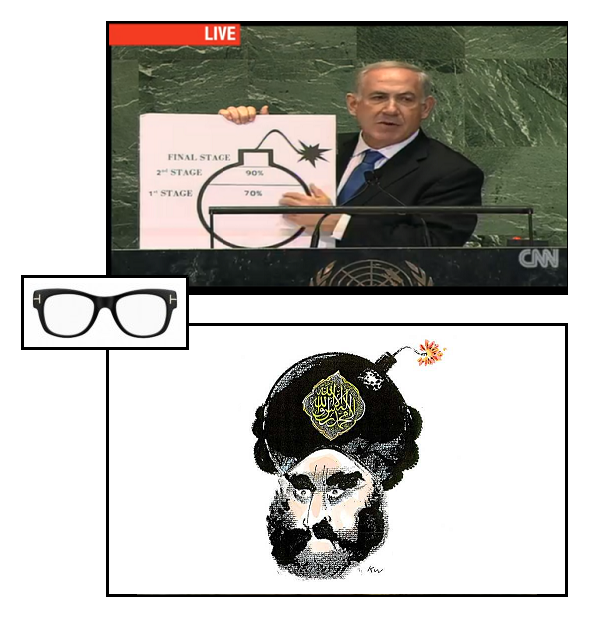
A fair number of people have commented on Israeli PM Netanyahu‘s displaying a cartoonish bomb graphic in the course of his UN address today, and some have complained, fairly IMO, at the choice of photo used to depict Netanyahu during his speech by eg Fox News:

I think it’s important to read graphic messages closely for the cues they contain.

**

Sometimes, as with images of the Virgin Mary seen in grilled cheese sandwiches or oil slicks, the correspondences don’t really mean much more than that the brain is designed for pattern recognition, and a little “imagination” without critical appraisal can get things wrong: the terms commonly used for this are apophenia, patternicity and pareidola.

My own favorite example of this phenomenon is of the wall-stain in a school in the East Bay that was recognized as the Virgin Mary by Catholics and the bodhisattva Kuan-Yin by Buddhists

Nonetheless, I’m reluctant to ridicule such modes of perception without also recognizing the utility of Rorschach blots in psychology and the even more creative uses to which Leonardo put them.

**

Perceived visual similarities, in short, can be the result of creative or merely overheated imagination, but in the visually sophisticated they become much more.

Film-makers, in particular, have several names for the kind of skillful editing by which one scene segues into another via a well-chosen visual similarity: match cut and graphic match.

My personal favorite example is that of Apocalypse Now, where the rotors of the fan in that claustrophobic hotel room in Saigon morph into the rotors of the helicopter coming to take Captain Willard out and away on his mission up river…

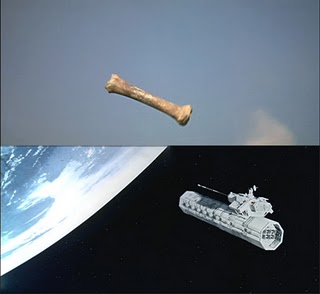
Perhaps even more celebrated, though, is Kubrick’s match between the bone tumbling through the air and the space station tumbling through space, in 2001: A Space Odyssey:

**

To get back to Netanyahu, then — is his hand held out a little above vertical, palm down, really a Hitler salute? I think not.

And does his image of a bomb carry any resonance from the Jyllands-Posten cartoon? I have to admit I’m almost undecided on that one.

And if there’s just a hint of a correspondence, would it be conscious or unconscious?

**

The thing is, politicians have to be extremely careful about tossing graphic matches onto dry kindling.

To my own way of thinking, both Netanyahu’s “cartoonish bomb” graphic and his “mid-heil” salute are potential fodder for incautious speculation — but neither one is even remotely as far-fetched as Jerome Corsi‘s claim in a recent WND that a recent Obama campaign use of the Stars and Stripes (above, upper panel) — in admittedly terrible taste — suggests that Obama in any way favored the decease of Ambassador Christopher Stevens in Benghazi (lower panel).

**

My point here, as so often, lies not in any political content or conclusion, so much as in a general purpose invitation to persons of intelligence (and a fortiori, intel) to watch out for possible graphic matches, to make close and cautious readings of visual as well as textual data — in short, to take a closer look

The Strategic Dilemma of Bitter-Enders

Sunday, April 8th, 2012

Berlin 1945

I have been reading The End by Ian Kershaw and it struck me that the story therein of Hitler’s Reich going down to total destruction is really a recurrent phenomena.

It is interesting that Kershaw, who began his earlier 2 volume biography of Adolf Hitler with the hypothesis that the Fuhrer was more the opportunistic vehicle of grand historical forces, in this study of the Nazi Gotterdammerung has accepted that the pull of Hitler’s inexorable authority over  Nazi and traditional German elites was charismatic, personalized and beyond challenge, even when Hitler was encircled by Soviet forces in his subterranean bunker and hours from suicide. Kershaw details how Hitler and his die-hard Gauleiter apparatchiks repeatedly demanded not only the militarily impossible, but the nonsensically insane, from the Wehrmacht, the Waffen-SS and the German people themselves. Virtually everyone struggled to comply.

This story is far from unique.

The Imperial Japanese, it must be said, surpassed even their Nazi allies in stubborn refusal to accept empirical reality and determination to fight to uttermost ruin. After the destruction of their Navy, loss of 100,000 men in Okinawa (their entire army there, minus a handful, fought to the death), the ruin of their cities, approaching famine, exhaustion of aviation fuel and gasoline stocks, the declaration of war on Japan by the Soviet Union and the atomic bombing of Hiroshima – Imperial Japan’s war cabinet deadlocked on a vote to surrender. The Kamikaze enthusiasts among the flag officers proposed a battle plan for their home islands to the war cabinet picturesquely titled “Honorable Death of 100 Million”, with gruesome implications for Japan’s civilian population.

Emperor Hirohito inspects Hiroshima after the atomic bombing

Many years later, Prime Minister Nakasone, who had been conscripted as a mere boy to meet invading American soldiers and Marines on the beach with a sharpened bamboo stake, credited the two atomic bombs with having saved his life. Without them, Japan’s warlords, with the tacit approval of their Emperor, would have coerced the Japanese nation into a gloriously genocidal defeat. A policy that while irrational,  faithfully followed the cultural spirit of Bushido and Japan’s mythic 47 Ronin.

Then there was the ancient example of Masada, the defiance of Titus by the Jewish Sicarii in 73 AD, as described by Josephus:

…. Miserable men indeed were they, whose distress forced them to slay their own wives and children with their own hands, as the lightest of those evils that were before them.  So they being not able to bear the grief they were under for what they had done any longer, and esteeming it an injury to those they had slain to live even the shortest space of time after them,-they presently laid all they had in a heap, and set fire to it.  They then chose ten men by lot out of them, to slay all the rest; every one of whom laid himself down by his wife and children on the ground, and threw his arms about them, and they offered their necks to the stroke of those who by lot executed that melancholy office;  and when these ten had, without fear, slain them all, they made the same rule for casting lots for themselves, that he whose lot it was should first kill the other nine, and after all, should kill himself. Accordingly, all these had courage sufficient to be no way behind one another in doing or suffering;  so, for a conclusion, the nine offered their necks to the executioner, and he who was the last of all took a view of all the other bodies, lest perchance some or other among so many that were slain should want his assistance to be quite dispatched; and when he perceived that they were all slain, he set fire to the palace, and with the great force of his hands ran his sword entirely through himself, and fell down dead near to his own relations. So these people died with this intention, that they would leave not so much as one soul among them all alive to be subject to the Romans.

….Now for the Romans, they expected that they should be fought in the morning, when accordingly they put on their armor, and laid bridges of planks upon their ladders from their banks, to make an assault upon the fortress, which they did,  but saw nobody as an enemy, but a terrible solitude on every side, with a fire within the place as well as a perfect silence So they were at a loss to guess at what had happened. At length they made a shout, as if it had been at a blow given by the battering-ram, to try whether they could bring anyone out that was within;  the women heard this noise, and came out of their underground cavern, and informed the Romans what had been done, as it was done, and the second of them clearly described all both what was said and what was done, and the manner of it:  yet they did not easily give their attention to such a desperate undertaking, and did not believe it could be as they said; they also attempted to put the fire out, and quickly cutting themselves a way through it, they came within the palace,  and so met with the multitude of the slain, but could take no pleasure in the fact, though it were done to their enemies. Nor could they do other than wonder at the courage of their resolution and the immovable contempt of death, which so great a number of them had shown, when they went through with such an action as that was.

What does the phenomenon of bitter-end political leadership mean in terms of strategy?

To the extent that war is a contest of wills or a form of bargaining between two political communities, the fanaticism of bitter-enders simplifies strategy while often complicating the warfare necessary to execute it.  Strategy is simplified because, to borrow a term from labor relations, the “last, best offer” has been refused. No bargaining is taking place – one or more sides refuses peace at any price short of total victory (“unconditional surrender”) or complete defeat. This represents movement away from a limited war for limited ends closer toward Clausewitz ‘s theoretical “Absolute War” by becoming, for the losing party, an existential conflict. The implicit threat to fight to the bitter end in any war – assuming the resources and will to make good on the threat exist – is really a primitive form of psychological deterrence; most states seeking limited objectives will avoid getting trapped in this dynamic.

This means the strategic calculus is altered by such a stance. The war itself and the driving need to wage it to it’s ultimate conclusion may have come to outweigh the value of the original “End” over which the conflict began; perhaps a policy concession or bit of territory or admission by a state’s rulers of a subordinate place in the diplomatic pecking order. While adopting a “bitter-end” position logically seems disadvantageous to the weaker party, it presents the enemy with a new set of problems. The “Means” or costs required to wage a war of conquest and lengthy occupation may be economically or attritionally prohibitive, or even physically impossible. Israel has a fine military and nuclear weapons but the Jewish state is too small to subdue and rule over the Arab states; Imperial Japan, for all it’s martial ferocity and cruelty, could not swallow the vastness of China, divided by civil war and fighting without allies, even before Pearl Harbor. Reach can exceed grasp.

Likewise, the moral burden and diplomatic friction of waging war not only against the opposing army, but the enemy population as well – of bombing or blockading into starvation women, children and the elderly – may be more than a political community or it’s leadership are able to bear and remain unified. As callous and narcissistic leaders of great countries usually are, few of them (fortunately) aspire to follow in the footsteps of Hitler, Stalin or Mao and openly spill an ocean of blood.  The impressive firepower of the bombing campaigns of Lyndon Johnson and Richard Nixon did not break Hanoi’s will to fight the Vietnam War, they broke the Eastern Establishment’s will to pursue anticommunist Containment by force in Vietnam or elsewhere. The brutal counterinsurgency tactics of the French Army in the Algerian War destroyed the Algerian rebels militarily, but it shattered the Fourth Republic politically.

Insurgency, the “war of the weak”, is powerful because it inherently contains elements of bitter-endism. To rise up against one’s own society usually is an act of politically burning your boats and wearing, so far as the state is concerned, the mantle of treason and all that it entails. A desperate act by desperate men and conversely,  many of the leaders of states, being tyrants, are in no better position. Tyrants are widely despised; the Gaddafis or Mussolinis know that their power is their only guarantee of safety and their fate, if they fall into the hands of their people, would be terrible, so any rebellion must be crushed immediately, lest it gain traction. The Shah by contrast, was a congenital coward but a realist. He knew what might happen if he and his family fell into the hands of his political opponents, so the Pahlavi dynasty preemptively fled at the first sign of trouble (twice).

Finally, a word must be said about the position of a people under the leadership of  bitter-ender rulers in a war. Caught between a rock and a hard place, they essentially have three choices, none of them attractive:

1. Make a supreme effort to win the war.

2. Make a supreme effort to overthrow the government and sue for peace.

3.  Desert the cause as quietly as they can on an individual basis and hope for the best.

The best almost never happens. Kershaw’s history of the fate of the Germans in 1945 would have been well understood by Thucydides, even if the Melians were as blameless as the Germans were deserving of their fate:

….About the same time the Melians again took another part of the Athenian lines which were but feebly garrisoned. Reinforcements afterwards arriving from Athens in consequence, under the command of Philocrates, son of Demeas, the siege was now pressed vigorously; and some treachery taking place inside, the Melians surrendered at discretion to the Athenians, who put to death all the grown men whom they took, and sold the women and children for slaves, and subsequently sent out five hundred colonists and inhabited the place themselves.

If you want the bitter end, be prepared to drink the last drop.

The Said Symphony: Meditation / moves 10 and 11

Sunday, June 26th, 2011

[ by Charles Cameron – extended analytic game on Israeli-Palestinian conflict — continuing ]

Meditation part 1 / Move 10

.

What to say? There are two sides to the game, darkness and light, and the light encompasses the darkness, and the darkness threatens the light.

I promised a meditation on the state of the game, and it comes in the form of two moves: Move 10: Piano Lesson, by Haim Watzman, addresses the light, and my sense that the game is as much a gift to me as a gift from me to you, while Move 11: Auschwitz and Theodor Adorno raises the darkest question of all, whether art can still function in situations as terrible as those where humans hate to the fullest extent of their powers.
____________________________________________________________________________________________

Move 10: Piano Lesson, by Haim Watzman
move-010.gif

Move content:

The content of this move is Haim Watzman‘s story Piano Lesson which comes from his Necessary Stories series, on the South Jerusalem blog he shares with my friend and colleague Gershom Gorenberg. It concerns young Felix Mendelssohn, the grandson of the rabbinic scholar Moses Mendelssohn, composer – and the man who revived Bach‘s St Matthew Passion after it had lapsed into obscurity for a century or so.

Links claimed:

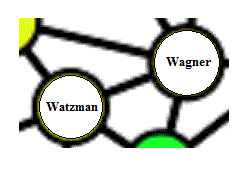
With Wagner, in complete refutation of the latter’s opinions about Judaism and musicianship – Watzman’s story opens with the words:

I am impressed. You play like a Jew, Felix. What I mean by that is that you have Johann Sebastian Bach in your heart as well as in your fingertips…

contains this more detailed assertion:

This piece you have played so beautifully for me this morning, the Partita No. 5 in G Major, can only be played properly, in our falscherleuchtung age, this time of false enlightenment, by a person of Jewish sensibility. Please do not interrupt me. At your age you are to listen to your elders first. After you listen you may disagree, you may do whatever you want. But first you must listen.

Sebastian Bach was a devout Lutheran, true, but he wrote Jewish music. I do not say this simply to embellish the repute of my ancestral people. The nation Israel needs no trills. I say this after long years of study and performance of Bach’s music, during which I have come to know this remarkable man. Better, I hazard to say, than his own sons did.

What is Jewish about the music? To see that, you have to know music. Which, of course you know. You also have to know what Judaism is. Which, thanks to my niece, you do not. This is scandalous. The grandson of the great Moses Mendelssohn knows nothing of his own people’s special relationship with God.

and closes with:

Remind me to show you the “St. Matthew Passion.” It is such wonderfully Jewish music!

Comment:

I read this story a day or two after completing moves 8 (Wagner) and 9 (Golgotha) and posting the game thus far to Zenpundit, and was astonished and delighted to find that a mind and heart in Jerusalem – friend of a friend – was touching on the same territory: the relationship of music, especially that of Bach, and Judaism.

But not only does Watzman deftly refute Wagner’s position on Judaism and music as presented in move 8, he also specifically discusses the contrapuntal aspect in both music and religious understanding, and the power of dissonance at times to work towards resolution.

This he accomplishes through a discussion of the two “laws” of Judaism, and the complexities of their musical relationship with one another:

I kept working on the piece and the morning prior to the performance I had my epiphany. Here, let me play it for you.

So where is the stress? Yes, here. And here too. At the end of the melodic line. And at the end of the harmonic progression. Which do not coincide.

You see, the underlying harmonics here are the Torah, the Written Law. And the melody playing above it is the Oral Law. The melody would be hollow, meaningless without the underlying harmony, and the underlying harmony would be incomplete and useless without the melody above it.

The simple-minded might think that the two laws should coincide. What good is a God if his message is not clear?

Yet it is the lack of clarity, the occasional dissonance, the unsynchronized phrases that move us forward, that propel us toward the final resolution. And that final tonic itself sends us off into new melodic and harmonic firmaments, from which we again return to our G major chord. One idea begins before the previous idea has been completed. As when you interrupt your Great Aunt Sara.

There is thus an uncanny melodic line here, running from Said through Bach, Gould, Wagner, to Watzman.

said-watzman.gif

Whatever I am doing here – and it feels at times quite lonely, I am not sure how many people will find this game an easy work to follow – in reading Watzman’s tale of Felix Mendelssohn I felt again my kinship with what has been termed the “invisible cloud of witnesses”…

Indeed, my sense of the gracious synchronicity involved in my stumbling across this particular story of Watzman’s at this particular time can only deepen as Watzman concludes his story – and I my move – with this rendition of the Bach Partita No. 5 in G major BWV 829, played by one Glenn Gould

____________________________________________________________________________________________

Meditation part 2 / Move 11

If the first part of this meditation relates to the game <as a whole, and to the fabric of grace of which, it seems, the universe as a whole is woven, this second part addresses the sense — as bitterly merciless to those who suffer it as grace is merciful to those who receive it — that the fabric of grace is itself picked at and torn by humans, in danger at any point (and perhaps in this moment more than most) of unravelling.

In my personal perspective, I should no more ignore the threat than ignore the grace — for love extends itself in compassion to the one, even as it extends in gratitude to the other.

____________________________________________________________________________________________

Move 11: Auschwitz and Theodor Adorno
move-011.gif

Move content:
Theodor Adorno famously said: “To write a poem after Auschwitz is barbaric.”

*

Think of this move as a sort of metaphysical black hole, an anti-game.

To expand on this idea a little: Adorno was a musical advisor to Thomas Mann while Mann was writing his novel Doctor Faustus — a copy of which he inscribed to his friend Hermann Hesse with the words “To Hermann Hesse, this glass bead game with black beads, from his friend Thomas Mann, Pacific Palisades, January 15, 1948” – featuring a composer named Adrian Leverkuhn, whose intention in his final work was to retract — cancel, annul — Beethoven‘s Ninth Symphony, and in particular its Ode to Joy with his own oratorio, The Lamentation of Doctor Faustus.

 “I find,” he said, “that it is not to be.”
“What, Adrian, is not to be?”
“The good and the noble, what we call the human, although it is good, and noble. What human beings have fought for and stormed citadels, what the ecstatics exultantly announced — that is not to be. It will be taken back. I will take it back.”
“I don’t quite understand, dear man. What will you take back?”
“The Ninth Symphony,” he replied.

Herbert Marcuse — another modernist philosopher of the left — is quite clear on the power of this Faustian attempt, which he approves as liberating us from “illusion” and indeed “making us see the things which we do not see or are not allowed to see, speak and hear a language which we do not hear and do not speak and are not allowed to hear and to speak”:

The present situation of art is, in my view, perhaps most clearly expressed in Thomas Mann’s demand that one must revoke the Ninth Symphony. One must revoke the Ninth Symphony not only because it is wrong and false (we cannot and should not sing an ode to joy, not even as promise), but also because it is there and is true in its own right. It stands in our universe as the justification of that ‘illusion’ which is no longer justifiable.

Links claimed:

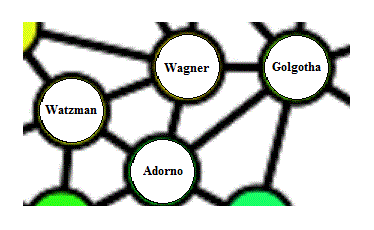
To Wagner, because the mythology of blood and race which he promulgated so stirred one Adolf Hitler that the latter carried out the Shoah, in face of which Adorno finds poetry – hence Orpheus and the muses — speechless.

To Golgotha, because Christ is banished and beaten from the city, Jerusalem, whose name is The Abode of Peace — because there is no more despairing cry than his cry at Golgotha: “My God, My God, why hast Thou forsaken Me?” — because the Descent of Mercy in human form is then brutally executed as a common criminal – because the very veil that protects the holy of holies in the JerusalemTemple is then torn asunder, as his body is broken – because all this marks the darkest moment in the Christian narrative – and because such desolation, felt by the Marys gathered at the foot of the cross, is nowhere so closely mapped in the history of the arts as by the silence of poetry and the arts before atrocity.

And to Watzman, because despite the Shoah — the Golgotha of my civilization and Hesse’s and Bach’s — and despite Adorno, there is poetry in his voice — an Israeli voice, speaking after Auschwitz, in an Israeli State, in Jerusalem.

Comment:

As I was setting out the ground-rules for this game, my friend Lexington Green made what I’d like to call “the essential objection”. He wrote:

Pals send their teenagers to be suicide bombers. That is beyond dissonant. There is no symphony where one group of musicians is committed to a relentless campaign of murder and terror. Said was using this as one more way of playing make-believe, and claiming moral equivalence. In other words, it was a sophisticated move in an elaborate scheme to help disarm his opponents so his fellow Palestinians could kill them.

There is another point of view, which sees the Israelis enforcing a mutant form of apartheid with attendant horrors on an occupied population – indeed, I have Israeli friends who hold some version of this view — but Lex’s point is crucial:

There is no symphony where one group of musicians is committed to a relentless campaign of murder and terror.

This cuts to the heart of the work, as it cuts to the heart of our world. It is, in essence, the issue of theodicy, and which Lex’s permission I am addressing it in this meditation, within the work itself …

My linking of the cry of Golgotha –“My God, My God, why hast Thou forsaken Me?” – with the cry of Adorno – “To write a poem after Auschwitz is barbaric” – is my presentation of the most godforsaken of despair of which we are humanly capable, and I present it within that opposite extremity of human possibility represented by Bach’s motto which I invoked earlier, Soli Deo Gloria.

It is precisely in the context of free will that both possibilities arise, and theodicy becomes an issue. Here, then, is the relationship of darkness to light as described by St John in the Prologue to his gospel:

the light shines in the dark, darkness does not blot it out.

I can say no fairer than that.

____________________________________________________________________________________________

Conclusion:

Oliver Sacks in Musicophilia tells the story of a Manhattan psychiatrist who lived immediately opposite the Twin Towers, and whose otherwise rich interior musical life went blank for months after he witnessed the 9-11 attacks:

My internal life was dominated by a dense and silent pall, as if an entire mode of existence were in an airless vacuum. Music, even the usual internal listening of especially beloved works, had been muted…

“Music”, the psychiatrist said, “finally returned as a part of life for and in me” after an absence of several months. The first music to return was Bach‘s Goldberg Variations.

Again, I must admit it was by no skill of mine but some grace of god or muse that I stumbled on Sacks’ book today, while searching my cramped and overflowing shelves for something else entirely.

There are, it seems true, periods of silence in the arts, while we absorb horrors of our human doing.

There is also a return from those horrors to the arts — even Marcuse admits this — and as forgiveness, mercy and compassion alike claim, to that great possibility, “a happy issue out of all our afflictions”.

Or so the mystics tell the realists — and time grinds all to dust.

[ next ]
Rapturous times, neh?

Saturday, May 21st, 2011

[ By Charles Cameron — apocalyptic movements, best readings, budget shortfalls, lack of support for scholarship in crucial natsec areas — and with a h/t to Dan from Madison at ChicagoBoyz for the video that triggered this post ]
.
.
What with rapture parties breaking out all over, billboards in Dubai proclaiming The End and thousands of Hmong tribespeople in Vietnam among the believers, this whole sorry business of Harold Camping‘s latest end times prediction is catching plenty of attention. I thought it might be helpful to recommend some of the more interesting and knowledgeable commentary on Camping’s failed prophecy.

*

First, three friends and colleagues of mine from the Center for Millennial Studies at Boston University, about which I will have a further paragraph later:

Richard Landes of BU has a text interview here, and a TV interview here. His forthcoming book, Heaven on Earth, is a monumental [554 pp.] treatment of millenarian movements ranging “from ancient Egypt to modern-day UFO cults and global Jihad” with a focus on “ten widely different case studies, none of which come from Judaism or Christianity” — and “shows that many events typically regarded as secular–including the French Revolution, Marxism, Bolshevism, Nazism-not only contain key millennialist elements, but follow the apocalyptic curve of enthusiastic launch, disappointment and (often catastrophic) re-entry into ‘normal time'”.

Stephen O’Leary of USC wrote up the Harold Camping prediction a couple of days ago on the WSJ “Speakeasy” blog. He’s the rhetorician and communications scholar who co-wrote the first article on religion on the internet, and his specialty as it applies to apocalyptic thinking is doubly relevant: the timing of the end — and the timing of the announcement of the end. His book, Arguing the Apocalypse, is the classic treatment.

Damian Thompson of the Daily Telegraph is a wicked and witty blogger on all things Catholic and much else beside — the normally staid Church Times (UK) once called him a “blood-crazed ferret” and he wears the quote with pride on his blog, where you can also find his comments on Camping. Damian’s book, Waiting for Antichrist, is a masterful treatment of one “expecting” church in London, and has a lot to tell us about the distance between the orthodoxies of its clergy and the various levels of enthusiasm and eclectic beliefs of their congregants.

Three experts, three highly recommended books.

*

Two quick notes for those whose motto is “follow the money” (I prefer “cherchez la femme” myself, but chacun a son gout):

The LA Times has a piece that examines the “worldwide $100-million campaign of caravans and billboards, financed by the sale and swap of TV and radio stations” behind Camping’s more recent prediction (the 1994 version was less widely known).

Well worth reading.

And for those who suspect the man of living “high on the hog” — this quote from the same piece might cause you to rethink the possibility that the man’s sincere (one can be misguided with one’s integrity intact, I’d suggest):

Though his organization has large financial holdings, he drives a 1993 Camry and lives in a modest house.

*

Now back to the Center for Millennial Studies.

While it existed, it was quite simply the world center of apocalyptic, messianic and millenarian studies. CMS conferences brought together a wide range of scholars of different eras and areas, who could together begin to fathom the commonalities and differences — anthropological, theological, psychological, political, local, global, historical, and contemporary — of movements such as the Essenes, the Falun Gong, the Quakers, Nazism, the Muenster Anabaptists, al-Qaida, the Taiping Rebellion, Branch Davidians, the Y2K scare, classic Marxism, Aum Shinrikyo and Heaven’s Gate.

And then the year 2000 came and went, and those who hadn’t followed the work of the CMS and its associates thought it’s all over, no more millennial expectation, we’ve entered the new millennium with barely a hiccup.

Well, guess what. It was at the CMS that David Cook presented early insights from his definitive work on contemporary millennial movements in Islam — and now we have millennial stirrings both on the Shia side (President Ahmadinejad et al) and among the Sunni (AQ theorist Abu Mus’ab Al-Suri devotes the last hundred pages of his treatise on jihad to “signs of the end times”)…

Apocalyptic expectation continues. But Richard Landes’ and Stephen O’Leary’s fine project, the CMS, is no longer with us to bring scholars together to discuss what remains one of the key topics of our times. When Richard’s book comes out, buy it and read it — and see if you don’t see what I mean.

Or read Jean-Pierre Filiu‘s Apocalypse in Islam.  Please. Or Tim Furnish‘s recent paper.

*

And while it may not see Judgment Day or the beginning of the end of the world as predicted, what this week has seen is the end of funding of Fulbright scholarships for doctoral dissertation research abroad.  But then as Abu Muqawama points out:

hey, it’s probably safe to cut funding for these languages. It’s hard to see Iran, Afghanistan, Pakistan or anywhere in the Arabic-speaking world causing issues in terms of U.S. national security interests anytime soon.

Right?

So the CMS isn’t the only significant scholarly venue we’ve lost to terminal lack of vision.


Switch to our mobile site