Still too Busy to Blog Properly….But Hey, Look What I’m Reading!
Tuesday, November 24th, 2009Were it not for guest posts, November would have seemed like I went on hiatus 🙂 Normal blogging will resume in a few weeks.
I did find time to pick up a few new books to read in the late hours of the night, one of which will be the subject of a book review by a new guest poster.


The Genius of the Beast: A Radical Re-Vision of Capitalism
The Shia Revival: How Conflicts within Islam Will Shape the Future
Nixonland: The Rise of a President and the Fracturing of America
The only thing these three tomes have in common is that the authors have a penchant for contradicting conventional wisdom, at least to a degree.
Howard Bloom is an offbeat, pop science to pop culture master of horizontal thinking whose earlier work, Global Brain, I very much enjoyed and highly recommend. Bloom’s intellectual reach is first rate and he is one of the few writers who can take very difficult concepts from wildly disparate fields and tie them together for a lay audience with comprehensible analogies and anecdotes .
I put Vali Nasr’s The Shia Revival on my list back after the high praise Thomas P.M. Barnett gave Nasr in his book, Great Powers – in my experience, Tom does not hand out comments of “brilliant” all that often ( Great Powers, BTW, is also a “must read” book for those interested in strategy and geoeconomics). I am approximately 80 pages in to The Shia Revival and I will say that as a writer, Nasr does not waste time getting to key points in explaining his subject – concise but not simplified.
Rick Perlstein, while far to the Left, has the uncommon quality among leftwingers of working very, very hard at the scholarship of attempting to understand conservatism and leading conservatives ( must be a legacy of attending the University of Chicago). Much like Orangemen in Ulster, eavesdropping on a Catholic mass, I suspect the essence of conservatism eludes Perlstein, but at least he takes the ideas seriously. That Richard Nixon is Perlstein’s subject is an added draw, since Nixon’s foreign policy was an area of historical research for me. Very interested to see how Perlstein’s take on Richard Nixon compares to that of Robert Dallek and Richard Reeves.
“Let me make one thing perfectly clear….”


 by Steven Johnson
 the reader to an understanding how bottom-up, “blind”, systems work and the principles behind them. Highly readable and next to no jargon. Probably due soon for an updated edition though, given the scientific advances in research in network and complexity studies.
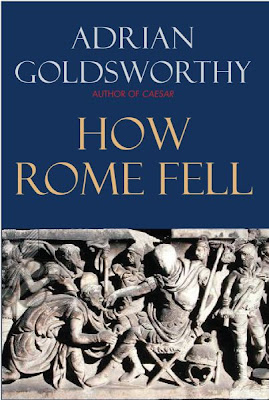
 by Adrian Goldsworthy
 centuries as it was during the golden age of philosopher-warrior-emperor Marcus Aurelius. Or that there was no fall of the empire at all, just a gentle “transformation” into something new. Goldsworthy discusses the likelihood of Late antquity “paper legions” of Roman armies which, in any event, scarcely resembled in elan, tactics or fighting strength the ones that Julius Caesar wielded in Gaul. A tour de force marred only by a weird epilogue that ranges from pedestrian to ( in it’s last sentences) truly awful – was it it tacked on as an afterthought? Did the editor of the rest of the book die before it was completed? Regardless, How Rome Fell is a worthy addition to an collection of popular ancient histories.
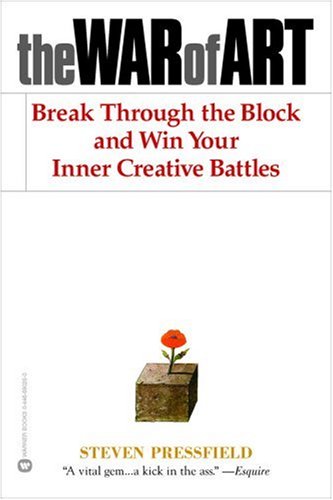
 by Steven Pressfield
 is brilliant but because it is profound. Utilizing select personal vignettes and other anecdotes, Pressfield distills in everyday language the essence of what creative people need to understand if they are to succeed – concepts of “resistance”, which seductively undermine your efforts, and being a “professional”, which is the mindset that will get you there.


