zenpundit.com » black swans

Archive for the ‘black swans’ Category

Richards Reviews Black Swan

Wednesday, April 2nd, 2008

Dr. Chet Richards gives his take links to a review by Robert D. Brown III. on The Black Swan: The Impact of the Highly Improbable ( my apologies to Mr. Brown):

The Black Swan: The Impact of the Highly Improbable

The scandalous malpractice, as Taleb shouts, is that the rules that apply to Mediocristan are too often misappropriated to understand and manage systems that don’t obey such laws, often at the expense of lives and immense fortunes. The most pointed cases involve applications of options and modern portfolio theory in which billions of dollars of investors’ fortunes are lost by the malpractice of Nobel “intellectuals” who should know better (anyone remember the tragedy of the Amaranth fund or the trading company Long-Term Capital Management?); the poignant disaster of the unsinkable Titanic; the current woes of Bear Stearns and the sub-prime lending industry; and, in Taleb’s case, the decade and a half long civil war in his centuries-long peaceful Lebanon, a war that he and all too many others sadly believed would end soon after it started.

How does understanding the black swan inform our understanding of maneuver conflict? Consider the martial arts version of the Ludic Fallacy offered by Mark Spitznagel.

Organized competitive fighting trains the athlete to focus on the game and, in order not to dissipate his concentration, to ignore the possibility of what is not specifically allowed by the rules, such as kicks to the groin, a surprise knife, et cetera. So those who win the gold medal might be precisely those who will be most vulnerable in real life. (Black Swan, pg. 127)

John Boyd leads us to understand that conflict is often a non-cooperative contest for limited resources by novelty generating agents. Novelty is the black swan of conflict. When we become convinced that our side will win on the basis of strength or numbers, when we believe that the other side will follow our rules of engagement, we will be exposed to cruel novelty. This is precisely what Chet Richards describes as a disease of orientation called fixation: “…attachments to appearances, conclusions, institutional positions, dogmas, ideologies – pretty much anything that keeps the people inside the organization from recognizing that the world is changing or being changed by competitors.”

Munzenberg’s Viral Post: What is in your Antilibrary?

Thursday, March 27th, 2008

The other day, I was having a conversation in the comments section regarding ancient Chinese philosophers with my learned friend Lexington Green, when I had cause to quote Nassim Nicholas Taleb, from his most recent book The Black Swan: The Impact of the Highly Improbable:

The writer Umberto Eco belongs to that small class of scholars who are encyclopedic, insightful, and nondull. he is the owner of a large personal library ( containing thirty thousand books), and separates vistors into two categories: those who react with ‘Wow! Signore professore dottore Eco, what a library you have! How many of these books have you read?’ and others – a very small minority- who get the point that a private library is not an ego boosting appendage but a research tool. Read books are far less valuable than unread ones. The library should contain as much of what you do not know as your financial means, mortgage rates, and the currently tight real estate market allow you to put there. You wil accumulate more knowledge and more books as you grow older, and the growig number of unread books on the shelves will look at you menacingly. Indeed, the more you know, the larger the rows of unread books. Let us call the collection of unread books an antilibrary.

A passage that immediately made me feel better about having resigned myself to falling further and further behind in reading the books that I keep purchasing ( I’m now also periodically finding myself going to IKEA to buy shelf extensions. I’ve resigned myself to that too).

The obscurely named Munzenberg of Soob, also enjoyed Taleb’s take on the proper function of a book collection and has begun a viral post What is in your Antilibrary?:

I’d like to pose a question to those who read this blog entry: What are three to five books on your shelf that lay unread and what knowledge do you hope to retrieve from them? [ ed.- see Munzenberg’s antilibrary here]

….I suppose I may have to tag people to get a widespread antilibrary booklist going. Feel free if you are reading this blog entry to start your own entry (the more books the better right?). I’ll link to you here if I catch it. I shall tag:

Tdaxp
Ortho
Zenpundit
Adam Elkus
Ymarsakar

As Munzenberg has graciously “tagged” me, here is a fraction of my current antilibrary (the antilibrary appears to be a dynamic state with a definite phase transition to library status) I decided to avoid those recently acquired books at the top of my pile and use some finely-aged examples:

On the Origins of War: And the Preservation of Peace by Donald Kagan

Bought it after I enjoyed reading his revisionist The Peloponnesian War with the intent of getting into Kagan’s head on strategy and military history in general. I was reading a flood other military books at the time and it was lost in the shuffle

HO CHI MINH: A LIFE by William J. Duiker

This is a critically acclaimed biography by a highly respected scholar which I intended to read in tandem with recent biographies of Chiang Kai-Shek and Mao ZeDong, in order to get a feel for the interlocking social networks these leaders shared (Zhou Enlai was a hub for each man for a time). I finished those books but have not begun this one yet.

The Growth of the Mind: And the Endangered Origins of Intelligence by Stanley Greenspan, MD

I actually started this one but it was thrown into a packing box during a year I was building a house, selling another and moving several times. It then spent several years in storage before making it back on to a shelf. The purpose was to learn more about cognitive development in children.

Pillar of Fire : America in the King Years 1963-65 (America in the King Years) by Taylor Branch

Refresher on social, African-American and political history. Like the Kagan book, it was crowded out of the must-read bookpile by the deluge of military history and strategy books that I was reading at the time

The House of Rothschild: Volume 2: The World’s Banker: 1849-1999 by Niall Ferguson

As I am one of those freaks who actually enjoys economic history, I read Ferguson’s first volume years ago and thought it was lucidly written. This book too, fell victim to the packing box

It’s a rare opportunity to be on the ground floor of one of these viral posts and to be able to watch how far afield it travels, so I am selecting my “tags” with great care:

Sean Meade

Pundita

Brad DeLong

Valdis Krebs

Dave Dilegge

Dave Schuler

UPDATE:

Younghusband opines on The Traveller’s Library

Fisking McCaffrey’s Futurism

Monday, March 24th, 2008

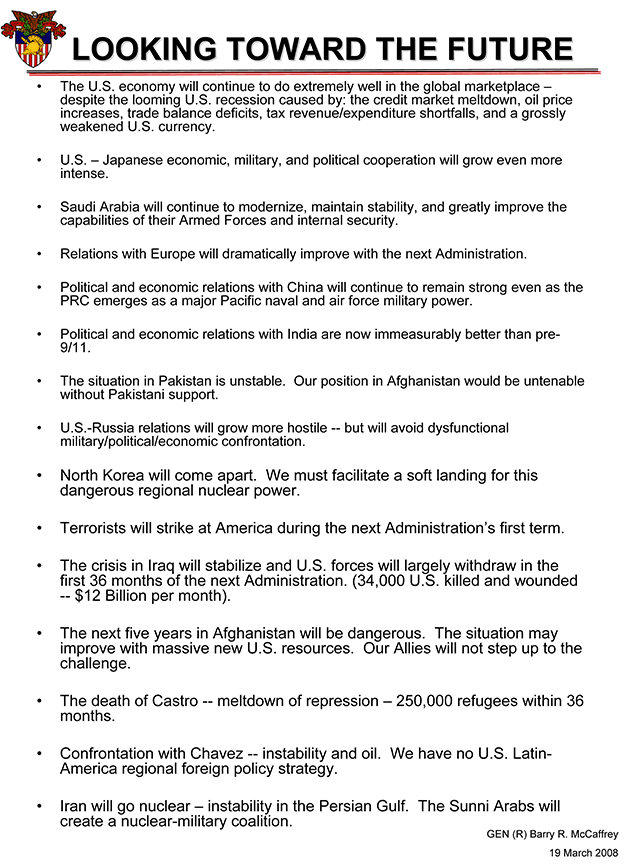
Yesterday, The SWJ Blog ( and blogfriends on Twitter, one of whom characterized it as “weak”) aleted me to a futurist slide by General Barry McCaffrey with his predictions of potential national security events faced by the United States in the near term. I’m certain this was in the context of a much larger presentation, given to a specific group with stated policy concerns; unfortunately, those particulars are unknown to me:

futurism.gif

My commentary:

First of all, one notes the number of “safe” predictions in the sense that none of these represent even the likeliest of outliers much less scenarios representing true, statistical rarity, “Gray Swans”. There’s a certain probalistic logic to doing so – the status quo more often than not in any given scenario will continue uninterrupted except by minor adjustments. On at least half of this list, given the breadth and/or vagueness, I’m certain that McCaffrey will be able in five years to say that he was more right then wrong. Unfortunately, the narrow number of domains from which he is extrapolating – nothing on cutting edge tech, applied science, the environment, macrodemographics, religious fundamentalism or interesting “intersectional” possibilities – leaves  policy makers with a vision that may be more susceptible to a Black Swan event than before by reinforcing previously held expectations.

Sidebar: I’d love to see Art Hutchinson, Tom Barnett, John Robb , Michael Tanji and the gents at Kent’s Imperative also critique the slide.

Now, in fairness, to the good General, a few of his bullet points are more interesting than others. I think McCaffrey’s called a hard landing for Cuba correctly unless Raul Castro has a secret admiration for Deng Xiaoping and the comprehension of economics to execute a Deng-like transition. It will be difficult for Cuba to really open up without the economic logic of the American market and favorable asylum policies for Cubans immediately kicking in as it did for the East Germans when the other Soviet bloc states ceased cooperating with Honecker’s repressive policies. With Chavez too, I think General McCaffrey is correct given that there is a little remarked friction between Venezuela the oil producer and America the refiner of Venezuelan oil ( refining capacity is itself a choke point along with oil production nor is all crude created equal; some is more expensive to refine than others). Finally, the temptation for al Qaida to “send a message” to the new administration and create downstream political effects may prove well-nigh overwhelming; it may even override their present policy of waiting until to pull off a catastropic level act of terror.

How do you see it ? Comments, questions, rants are all welcome.

The Black Swan

Tuesday, March 11th, 2008

 I finally started reading Nassim Nicholas Taleb’s  The Black Swan: The Impact of the Highly Improbable today and I’m already impressed with it. Taleb’s very straightforward in attacking the limitations of Bell Curve assumptions and the common assumptions regarding the extent of uncertainty ( most people, unless they are futurists or, say, design computer models, seldom contemplate questions of deep uncertainty that might be in play). The book is really a tutorial on epistemology.

I’ll review this one when I’m finished.

Superempowered Individuals…After Dark

Wednesday, November 28th, 2007

Adam Elkus was kind enough to cite one of my old posts on superempowered individuals as a foil to develop the concept further in his DNI article “Night of the Lone Wolves“:

“Who is the “super-empowered individual?” He is talented, alienated from society, and willing to kill large numbers of people. The technological revolution has given him destructive tools unimaginable to the anarchists and terrorists of old. He is an innovator-he creates new doctrines, tactics, and operations. A “brittle” infrastructure that lacks redundancy and resiliency gives him a perfect target. Living off the grid, he is invisible to authorities. The unprecedented nature of his attack ensures that no counter-measures are in place to prevent it. And when he strikes, his attack will not only kill massive amounts of people, but also profoundly change the financial, political, and social systems that govern modern life.

This is a frighteningly plausible vision. As blogger and futurist Mark Safranski gloomily noted, “the world is but one self-sacrificing genetic microbiologist away from a super-empowered suicide bomber riding international air routes to a new black plague”. That being said, many scientists and security experts note the immense difficulty involved in acquiring, maintaining, and deploying weapons of mass destruction. One expert, Bruce Schneier, is especially vehement in deriding what he calls “movie-plot” threats.

Who is right? Both sides. For now, the probability that a super-empowered individual will trigger a extreme mass casualty event is extremely low. But the high odds against such a catastrophe occurring will ensure that when it happens we will be taken totally by surprise. If a mass-murdering microbiologist is indeed preparing to make engineered smallpox complimentary to the in-flight meal, there is little we can do to stop him. Confused? With apologies to The Matrix, it’s time to take the red pill. “

Read the whole thing here.

Elkus is correct, as he goes on to develop his thesis,  in assessing the mass psychology aspect of superempowerment as as aspect that will often be more significant than any kinetics in future SEI events. look at the societal shock delivered to the Netherlands by the murder of Dutch film maker, Theo van Gogh, a perturbation of Dutch society made possible not by the death of a single man but the reportage amplified through a modern mass media.  Often but not always. Aside from the microbiological example, the disruption or destruction of certain complex systems, such as financial markets, by an SEI, will have ripple effects of a significant magnitude.

Elkus closes with a positive prescription, one rooted in the strategic ideas of John Boyd, to which I can add my hearty assent:

“In any event, we have always lived with danger and always will. And the threat posed by murderous, alienated individuals, with or without weapons of mass destruction, will also always be with us. But the good news is that the key to overcoming these threats lies in two bedrock American values-hope and pragmatism: hope for a better world and the determination to create such a world; and the pragmatism that has helped us continuously innovate to overcome seemingly insurmountable challenges.

What is needed is leadership at the top level that encourages and channels those values within the American people, instead of leadership that burdens them with fear. True leadership will recognize that strategy is not just wanton destruction-it is also, as John Boyd stated, “a pattern for vitality and growth“. If we recognize this, we can all be “super-empowered individuals” instead of victims huddling in fear of the sound of anything beyond the campfire.”


Switch to our mobile site