zenpundit.com » complex systems

Archive for the ‘complex systems’ Category

The Games People Play

Wednesday, January 23rd, 2008

Fabius Maximus has hit his stride as a blogger with a highly informative set of posts on wargaming that later expanded to DNI.

War games, the antidote to “Victory disease”

Are war games a competitive edge of conventional forces vs. non-state 4GW foes?

The Achilles’ Heel of military simulations

At DNI:

During Millenium Challenge 2002

It is generally underestimated by the public (and even academics) how powerful games – especially free-play games- can be as a tool for learning; the cognitive potential of a well-constructed and rigorously moderated game is literally immense. ( and when coupled with mass-collaboration, social-networking, MMORPG  technology a level of validity might be realized that the old Prussian Grossgeneralstab or RAND apparatchiks could only have dreamed. Unfortunately, a rigged game becomes a powerfully persuasive lie, so integrity is key if gaming is to guide decision-making in the real world) A few examples:

” The gamers argued that insights arose from immersion in play. In 1956 Joseph Goldstein noted that the war game demonstrated ‘ the organic nature of complex relationships’ that daily transactions obscured.War-gaming gripped its participants, whipping up the convulsions of diplomacy ‘ more forcefully…than could be experienced through lectures or books’.”

” A team from the Social Science Division [ at RAND ] posed a number of questions which they hoped the unfoldig month of gaming would resolve. Chief among them was whether gaming could be used as a forecasting technique ‘ for sharpening our estimates of the probable consequences of policies pursued by various governments’. Would gaming spark “political inventiveness“, and more importantly, how did it compare to conventional policy analysis? Did gaming uncover problems that might otherwise be neglected? And invoking the emerging touchstone of intuition, did the experience impart to policy analysts and researchers “ a heightened sensitivity to problems of political strategy and policy consequences?”

  Sharon Ghamari- Tabrizi, The Worlds of Herman Kahn [ emphasis mine]

Another example:

“What we encountered, though, once our game-called Therapy, as it happens-was finished, were two remarkable things, both of which Colin Powell and Richard Duke might have told us. First, of all the professions, psychiatrists and psychologists tended to do worst at the game; secondly, the synthetic process worked even better in reverse. Playing the game expanded people’s grasp of human nature in general and their particular group’s dynamics. But even more, watching people play revealed a depth of information about them, and about the world at large, that you would ordinarily expect only from months of official therapy

The quote comes from an article “Wanna Play ?” in Psychology Today. Further insights in the article:

“In fact, the phrase “just a game” is a masterpiece of cognitive dissonance. Games are anything but “just” anything. They cover the gamut of human endeavor and come in every package and medium you can imagine. Last year in the United States alone, 126 million board-style games were sold for $1.14 billion; video and computer games accounted for another $5 billion. It is impossible to calculate how much people benefit from games:

* Games are primers on turn-taking, the basis of all relationships.

* They can solve major crises in industry and teach people not to pilfer pencils from the company storeroom; in fact, companies spend hundreds of millions of dollars a year on them for that.

* They can be training grounds for legendary generals and make the difference between winning and losing wars.

* Finally, and most important, games can reopen doors into the world of pretending and childhood, reminding us of unadulterated fun, sparking creativity

Psychologically speaking, games have a knack for setting us free”

Instead of reading about games, you should be playing one 🙂
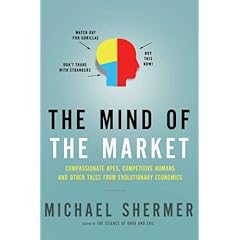
Marxist Gorillas and Chimpanzee Capitalists?

Wednesday, January 2nd, 2008

Caught my eye today: The Mind of the Market: Compassionate Apes, Competitive Humans and other Tales From Evolutionary Economics by Michael Shermer.  A premise that intuitively makes sense to me ( and therefore, I’ll have to read it with a critical eye).

Going to have to pick this one up.


Robb on Radical Privatization

Saturday, December 29th, 2007

John Robb puts on his futurist hat and engages in some imaginative scenario thinking (PDF) over at Global Guerillas. Note John’s comment:

“The goal of this brief is to get people thinking about the future in a way that helps them make decisions today.”

John has the methodology right. Most experts, habituated to the over-use of analytical thinking, will try to nit-pick scenarios like these to death from the inception , either reflexively or intentionally in order to avoid having to reexamine cherished ideological assumptions, instead of engaging in the thought experiment. This is the major cultural-cognitive reason bueaucracies and academic institutions are notoriously poor at thinking outside the box or anticipating anything other than directly linear outcomes of policies. 

Analytical-reductionism was a reasonable enough epsitemological approach for the 19th and 20th centuries of the “Second Wave”, “Mass Man”  industrial-bureaucratic nation-states. It’s not enough for the more heterogeneous, alinear, high-velocity, “complex networks as evolving ecologies” of the 21st century. We need other cognitive tools in our kit alongside analysis.

Superempowered Individuals…After Dark

Wednesday, November 28th, 2007

Adam Elkus was kind enough to cite one of my old posts on superempowered individuals as a foil to develop the concept further in his DNI article “Night of the Lone Wolves“:

“Who is the “super-empowered individual?” He is talented, alienated from society, and willing to kill large numbers of people. The technological revolution has given him destructive tools unimaginable to the anarchists and terrorists of old. He is an innovator-he creates new doctrines, tactics, and operations. A “brittle” infrastructure that lacks redundancy and resiliency gives him a perfect target. Living off the grid, he is invisible to authorities. The unprecedented nature of his attack ensures that no counter-measures are in place to prevent it. And when he strikes, his attack will not only kill massive amounts of people, but also profoundly change the financial, political, and social systems that govern modern life.

This is a frighteningly plausible vision. As blogger and futurist Mark Safranski gloomily noted, “the world is but one self-sacrificing genetic microbiologist away from a super-empowered suicide bomber riding international air routes to a new black plague”. That being said, many scientists and security experts note the immense difficulty involved in acquiring, maintaining, and deploying weapons of mass destruction. One expert, Bruce Schneier, is especially vehement in deriding what he calls “movie-plot” threats.

Who is right? Both sides. For now, the probability that a super-empowered individual will trigger a extreme mass casualty event is extremely low. But the high odds against such a catastrophe occurring will ensure that when it happens we will be taken totally by surprise. If a mass-murdering microbiologist is indeed preparing to make engineered smallpox complimentary to the in-flight meal, there is little we can do to stop him. Confused? With apologies to The Matrix, it’s time to take the red pill. “

Read the whole thing here.

Elkus is correct, as he goes on to develop his thesis,  in assessing the mass psychology aspect of superempowerment as as aspect that will often be more significant than any kinetics in future SEI events. look at the societal shock delivered to the Netherlands by the murder of Dutch film maker, Theo van Gogh, a perturbation of Dutch society made possible not by the death of a single man but the reportage amplified through a modern mass media.  Often but not always. Aside from the microbiological example, the disruption or destruction of certain complex systems, such as financial markets, by an SEI, will have ripple effects of a significant magnitude.

Elkus closes with a positive prescription, one rooted in the strategic ideas of John Boyd, to which I can add my hearty assent:

“In any event, we have always lived with danger and always will. And the threat posed by murderous, alienated individuals, with or without weapons of mass destruction, will also always be with us. But the good news is that the key to overcoming these threats lies in two bedrock American values-hope and pragmatism: hope for a better world and the determination to create such a world; and the pragmatism that has helped us continuously innovate to overcome seemingly insurmountable challenges.

What is needed is leadership at the top level that encourages and channels those values within the American people, instead of leadership that burdens them with fear. True leadership will recognize that strategy is not just wanton destruction-it is also, as John Boyd stated, “a pattern for vitality and growth“. If we recognize this, we can all be “super-empowered individuals” instead of victims huddling in fear of the sound of anything beyond the campfire.”

Tuesday, August 14th, 2007

ROBB’S COMING URBAN TERROR

New article in The City Journal by John Robb.

John is in the important post-publication stage of proselytizing his work and worldview which he introduces well to City Journal readers. As someone more familiar with Global Guerillas, I especially liked John’s neat summative explanation of networks, tight coupling and cascading effects in a social-political-economic-infrastructural complex system.

Network theory is one of the key concepts for the intelligent public to understand for the 21st century.


Switch to our mobile site

