zenpundit.com » economics

Archive for the ‘economics’ Category

Recommended…Reads.

Sunday, December 21st, 2008

              boydbook.jpg       

 Need a last minute gift idea for….yourself?  Some highly recommended books that I’ve perused in the past year or so:
Great Powers: America and the World After Bush by Thomas P.M. Barnett 

Having read an advanced copy, this is easily Tom’s best work, surpassing his bestselling The Pentagon’s New Map in sweep and historical depth. A book with a provocative analysis that is definitely going to challenge the comfortable assumptions of the defense and foreign policy establishments and enrage not a few partisans. I will have a full review in mid-January after I see the “final edit” version.

Caesar: Life of a Colossus by Adrian Goldsworthy

Goldsworthy, a British military historian, gives Julius Caesar the same comprehensive and magisterial treatment that Alan Schom rendered with his landmark biography of Napoleon (Napoleon Bonaparte, incidentally, was an admirer of Hannibal, not Caesar) A biography and work of military history that is a page turner.

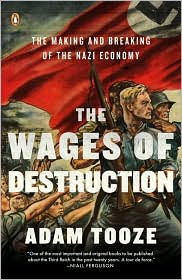
The Wages of Destruction: The Making and Breaking of the Nazi Economy by Adam Tooze

Dan from Madison at Chicago Boyz has reviewed Wages of Destruction, which led me to pick up a copy recently and start reading. Like Niall Ferguson, Tooze puts economic history into a dramatic explanatory context. If you have doubts, pick up a copy and flip to the chapter entitled “The Grand Strategy of Racial War” and read. You’ll walk out of the store with it.

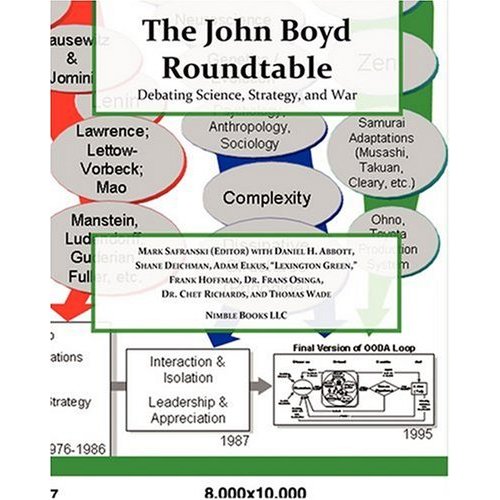
The John Boyd Roundtable: Debating Science, Strategy, and War by Mark Safranski, Daniel Abbott, Chet Richards, Shane Deichman, Thomas Wade, Frans Osinga, Adam Elkus and Frank Hoffman. Foreword by Thomas P.M. Barnett

A refinement and extension of the online roundtable at Chicago Boyz dedicated to reviewing Science, Strategy and War by Col. Frans Osinga (see below) and debating the ideas of the late strategic theorist Colonel John Boyd. Great for both the “Boyd expert” and those wanting a quick primer before tackling Osinga’s monumental work of strategic studies and intellectual history [ Full Disclosure: for newer readers who may not be aware, I was the editor and I’m shamelessly self-promoting here  🙂 ] 

Science, Strategy and War: The Strategic Theory of John Boyd (Strategy and History)  by Frans Osinga

Dr.Osinga has delivered a meticulously researched tome that William Lind called “the book Boyd would have written” that explains Colonel John Boyd as “the first postmodern strategist”. Osinga walks the reader through Boyd’s intellectual journey into fields as far removed from classical military studies as cybernetics, knowledge theory and the work of mathematician Kurt Godel and explains how Boyd distilled a strategic worldview on the nature of conflict and competition.


The Culture of War by Martin van Creveld

Eminent and controversial Dutch-Israeli military historian Martin van Creveld expands upon his body of work that is often described as “prophetic” these days in order to argue the intrinsic cultural value of war.

The Black Swan: The Impact of the Highly Improbable by Nassim Nicholas Taleb

This was the “must read” book of the blogosphere in 2007- 2008, widely cited (though perhaps first by John Robb) for the Black Swan concept itself. Taleb is an idiosyncratic, wide-ranging, writer interested in counterintuitive perspectives and is deeply skeptical of the validity of existing epistemological methodologies. Parts of the book will be of interest only to those with advanced backgrounds in probabalistic analysis and mathematics but there is much else that is intriguing and entertaining along the way while Taleb explains the characteristics of Extremistan and Mediocristan. A friend who moves among quite a few “thought leaders” described Taleb to me as “arrogant” but with something of value to say. Agreed.

On War (Oxford World’s Classics) by Carl von Clausewitz

Pick up a copy and join us during the Clausewitz Roundtable in January!!

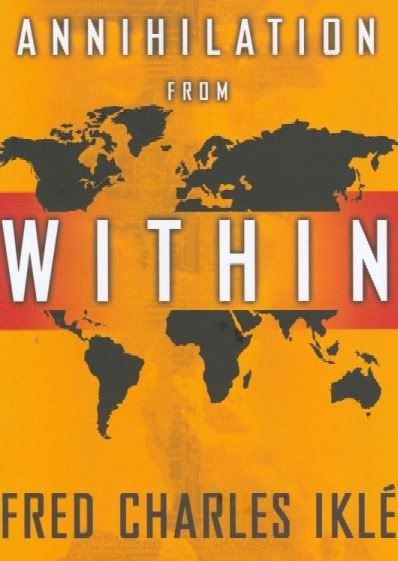
Annihilation from Within: The Ultimate Threat to Nations by Fred C. Ikle

Ikle, a senior Defense Department official in the Reagan administration tackles apocalyptic threat scenarios including the one coming from our own best efforts to avoid them. A gloomy but thought-provoking read.

The Cold War: A New History by John Lewis Gaddis

Gaddis intended to write a book for the college undergraduate or layman that concisely explains the Cold War and the “why ?” of the victory of the West and generally does a superb job of it.  The undercurrent or background that may not be obvious to the layman is that Gaddis is sticking a thumb in the collective eye of the revisionist diplomatic historians of the New Left – notably Walter LaFeber, Lloyd Gardner, Gabriel Kolko and Robert Buzzanco and others descending at least vaguely from the school of thought founded by William Appleman Williams.

Stalin: The Court of the Red Tsar by Simon Sebag Montefiore

A brilliant example of Soviet studies scholarship. I’ve read innumerable books on Stalin and the USSR and I still learned things from  Montefiore. Highly recommended.

The Third Reich in Power, 1933-1939 by Richard J. Evans

The second book in his trilogy on the history of Nazism, Evans looks at the Nazi state and party apparatus and German society during the years of peace. Evans, along with Michael Burleigh, Ian Kershaw and Adam Tooze are revising our understanding of the Third Reich and illuminating that as evil as Hitler’s regime was in fact, it ultimately was intended to be several orders of magnitude worse had Germany won the Second World War.

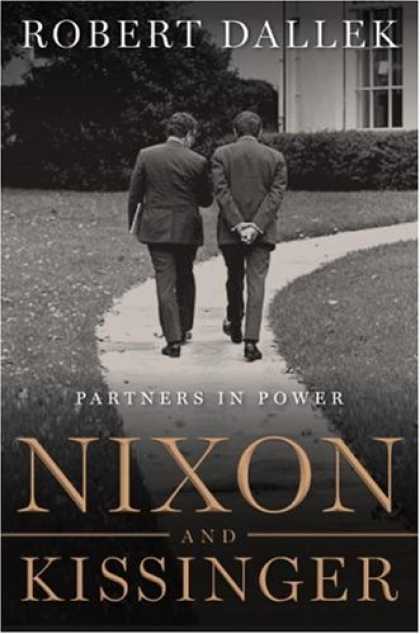
Nixon and Kissinger: Partners in Power by Robert Dallek

A deeply partisan work of history, Dallek makes little effort to be fair (especially in the first half of the text) to either Richard Nixon or Henry Kissinger, both whom he characterizes as mentally and emotionally unstable, if highly intelligent, personalities and makes an argument that Nixon’s mental state during the Watergate crisis required his removal from office under the 25th amendment. It’s difficult to imagine Dallek treating Bill Clinton or LBJ in similar fashion, regardless of their personal behavior or abuses of power because seldom does Nixon ever get the benefit of the doubt ( in comparison Richard Reeves’ devastating profile, Nixon: Alone in the White House is a work of hagiography).

Why read Nixon and Kissinger then ? Because Dallek, despite his biases, has done an outstanding job in presenting new sources and evidence and his delving into the China Opening and Nixon and Kissinger’s very complicated personal relationship, remains a first-rate work of scholarship. Therefore, I say “Read it” ( just do not let it be the only book you read on Richard Nixon).

That’s it!


Congrats!

Friday, October 31st, 2008

To Fabius Maximus for being crossposted at RGE Monitor. A snippet:

Causes of this crisis

These financial shocks are byproducts of deeper trends, in my opinion.  The world has begun a process of regime change, as the foundations of the post-WWII geopolitical order decay.  Here are some of the major trends forging a new world.  Each of these has played a role in bringing us to this point; some will play an even bigger role forcing events during the next few years.

(a)  The transition from a bipolar (or unipolar) world to a multi-polar world.

(b)  Entering the transition period to peak oil, as global oil production peaked (not necessarily the peak) in 2005.  Since then biofuels have provided most of the growth in liquid fuel consumption.  Rapid GDP growth (almost 5%) required high prices to match ex ante demand with flattish liquid fuel production.

(c)  The replacement of the US dollar as the reserve currency (by what we do not yet know), after 30 years of foreign borrowing – 30 years of increasing current account deficits.

(d)  The exhaustion from overuse of monetary and fiscal policy.  Persistently too-low interest rates yielding serial investment bubbles.  The long decline to near zero of the marginal elasticity of GDP with respect to debt.

(e)  Structural weakness:  Funding long-term businesses with “hot” (aka liquid) capital, from the disintermediation of household savings.  Money shifted from vehicles where institutions bear the risk (insurance, annuities, CD’s, etc) to direct participation (owning stocks and bonds either directly or through mutual funds).   See this post for an explanation.

(f)  The Thomas Kuhn-type paradigm crisis in Keynesian economics, by which the world economies have been steered for fifty years.  The aggregate debt level of an economy is not a significant variable; attempts to integrate into orthodox theory by radical Keynesians (e.g., Hyman Minsky) were unsuccessful.  Sometime after 2000 we reached and broke though the edge of the “operating envelope” of Keynesian theory.  We ran like Wile E. Coyote off the cliff and beyond – a few exhilarating years – and now we fall.

Read the rest here

From small wars to global economies.

Addendum:

Vimothy is correct – FM informs me that RGE Monitor has covered 45 of his posts, in particular:

Financial crisis – what’s happening? how will this end?

Peak Oil and Energy

New Post up at CTLab Review

Friday, October 31st, 2008

Trying to shake off the dust and attend to my other sites in the next few weeks. Here’s one at CTLab Review:

What is al Qaida’s Post-Bailout Balance Sheet ?

The unprecedented global turmoil in financial markets is a subject that goes beyond the normal scope of CTLab but it raises an interesting question – what is al Qaida’s “balance sheet” in the aftermath of the greatest financial meltdown since 1929? 

Read the rest here.

Mandelbrot and Taleb on the Economic Crisis

Thursday, October 23rd, 2008

Go here.  Hat tip to Chadmalik.

They are talking not “Great Depression” but a system perturbation  on an epochal scale that causes an economic Black Hole.

Makes John Robb look like Pollyana on antidepressants.

Musings on the Economic Crisis and the Day After

Saturday, October 11th, 2008

The scale of the economic crisis has begin to sink in to the point where leaders of the G-8/G-20 have begin to realize that everyone dwelling on the welfare of parochial, politically favored, financial interests ( Goldman Sachs in the case of the U.S.) is not going to get the world out of this crisis. Coordination of macroeconomic levers will be the key. Some good posts that I strongly encourage you to read,  before I comment:

Status report on the financial crisis: we’re at a critical point in time by Fabius Maximus

Encouraging signs – coordination appearing by Robert Paterson

Notes to Self: What Are We Doing? by Brad DeLong

The world is at severe risk of a global systemic financial meltdown and a severe global depression  by Nouriel Roubini

Equities, Pay Caps, Liquidity: Structuring a Bailout–Posner & Government Equity in Private Companies: A Bad Idea-Becker by Becker and Posner Blog

Geopolitical Consequences of the Credit Crunch by Niall Ferguson

How to view this system perturbation by Thomas P.M. Barnett

Wolfgang Munchau: Policy Errors Risk Turning Credit Crunch Into Depression  and Are Hedge Fund Margin Calls Leading to Stock Rout? by Naked Capitalism ( HT to John Robb)

National Orientation by Chet Richards

JOURNAL: Cascading Bubbles by John Robb

What is to be done ?

Aside from shortsightedness that comes from playing primarily to domestic political inside interests, there is another reason that G-7 leaders in particular are moving slowly in coming to terms with reality of this crisis: the interconnectedness wrought by globalization implies that the long term solution involves a considerable erosion of sovereignty to a global entity that can coordinate and shape macroeconomic policies of the central banks of the world’s largest economies. And to an extent, fiscal and regulatory policy as well. If the G-7 leaders are bold, they will approximate such meta-policy activity this weekend to get us over this crisis but we will be back to square one for the next crisis in two or five or ten years down the road.

I am uncomfortable, make that opposed, to any Brussels style global authority. Given the predisposition of much of the world politically, representatives of such an authority will prefer to misuse their authority to micromanage to achieve social and political engineering rather than stick to a narrow mission of tending to macroeconomic trends. Yet the fact that the sum of the global capitalist system now exceeds the ability of any part, even the U.S., to control it, requires a mechanism be put into place to transnationally leverage macroeconomic policies for maximum systemic benefit during hard times.

Better to set up a simple WTO like structure today for a “coordination council” that rules natonal monetary policies in or out of international consensus against a clear rule-set yardstick, than to wait until some emergency creates a crisis large enough where we wake up some day with vast portions of our sovereignty ceded to unaccountable international bureaucrats. Sort of a “Concert of Economies” that preserves the flexibility and freedom of of capitalism and national sovereignty instead of instituting a global GOSPLAN.

The crisis points to creating a level playing field in terms of financial rule-sets with agreed upon “circuit-breakers” are put into place now. This requires various states yield on all sorts of national comparative advantages for the benefit of the system as a whole. Something that goes against every career instinct of a politician.


Switch to our mobile site