zenpundit.com » economics

Archive for the ‘economics’ Category

Fallows’ $ 1.4 Trillion Question

Monday, January 21st, 2008

Both Tom and John have weighed in on the important piece by James Fallows in The Atlantic Monthly, entitled “The $1.4 Trillion Dollar Question“:

Dr. Barnett:

What Fallows doesn’t address in China’s vast surplus/savings is the huge and very real current sovereign debts and future mandates that are hidden in this development scheme: overseas resource dependencies demanding investment stakes, future aging costs, current and future enviro costs, future requirements to build out (and up) the poor interior, and so on.

Those are real sovereign liabilities because the people will expect some/much government help in these matters over time to ensure continued development and sustained movement up the product chain (gotta get as rich as possible before getting old).

Having said all that, Fallows’ analysis of the government’s logic is dead on. I suspect that, with all his time spent in China, we’ll see a book that does a big turn in explaining China to America. That will be a huge journalistic endeavor, and most welcome from someone with his considerable narrative talents.

As for the larger strategic question, we owe China a quiet international security order within which to develop, and sufficient partnership so as to obviate too much defense spending on their part. Eventually, Deng’s “grand compromise” of 1992 (PLA supports him on market acceleration in return for money and cover to modernize) must be tempered so that China doesn’t field a military for a war that should never happen and which it could never win. It needs to field a SysAdmin-heavy force that partners with us in mutual dependence: we can’t rule the peace with our Leviathan-heavy force, but they can’t rule war with their Leviathan-lite force either, so we must cooperate in extending and protecting globalization to our mutual advantage.”

John Robb:

Fallows runs through the details of the “financial balance of terror” between the US and China and concludes that it won’t last long. However, of the reasons he listed for a collapse of the balance, he didn’t include the most likely: that China will need the money to shore up its domestic economy as the US heads into a lengthy and severe recession.

Remember, China hasn’t endured anything other than growth pain for over a decade. Further, the average Chinese citizens hasn’t reaped much from that boom. They don’t have the financial reserves to weather a crisis (and many of those that do will lose their shirts when China’s market bubble tanks). So where will this cash go over the next two years? Not into Blackstones or US Treasuries. Instead, it will be invested domestically. Into jobs and projects to shore up the little bit of legitimacy the Chinese government still has (we see a similar pattern with many of the globe’s marginally legitimate governments, from Saudi Arabia to Russia).

Frankly, I’m not sure that $1.4 trillion (the normative value of which is evaporating with each plunge in the dollar) will be enough to prevent China from disintegrating if this crisis becomes a panic.”

My two cents:

China holds enormous reserves in dollars because their financial strategy – parking surplus cash in Treasury securities – also represents an internal political strategy of deferring acrimonious, major, spending and investment choices that might precipitate division among the elite. China’s leaders are acutely aware of their nation’s deficiencies and historical tendency toward centrifugal, regional, disintegration and keeping the country intact and the state in charge is right up there in terms of priority with sustaining a fantastic rate of GDP growth. The dollar surplus represents an agreeable, strategic, “rainy day fund” consensus choice of the elite and significant changes here will only be in response to pressures or needs that the elite of the CCP can get behind as a whole. Likely, cautious changes but possibly also too little too late.
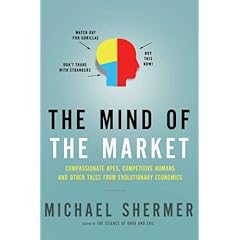
Marxist Gorillas and Chimpanzee Capitalists?

Wednesday, January 2nd, 2008

Caught my eye today: The Mind of the Market: Compassionate Apes, Competitive Humans and other Tales From Evolutionary Economics by Michael Shermer.  A premise that intuitively makes sense to me ( and therefore, I’ll have to read it with a critical eye).

Going to have to pick this one up.


Book Note

Friday, December 28th, 2007

One of the pleasures of  Christmas is that a majority of my friends and relatives with whom I exchange gifts save themselves trouble and get me something I can actually use, i.e. – gift cards for new books.  That, coupled with accumulated Amazon gift certificates from the past year, means I will be on a book-buying bonanza next week. Huzzah!

Helpfully, Dr. Barnett has been on a reading marathon lately in preparation for writing the body of Book III and has published an extensive bilbiography of his effort with micro-reviews of most of the books. Worth checking out if you are a bibliophile like me:

More and more books

Four more books

More books

Blowing through books

Taking August to read …

ADDENDUM:

Ha! Could not wait, so I just ordered the following from Amazon:

The Black Swan: The Impact of the Highly Improbable by Nassim Nicholas Taleb

Globalized Islam: The Search for a New Ummah  by Olivier Roy

Hybrid New Deal-Military Keynesianism for Iraq?

Sunday, December 16th, 2007

Steve DeAngelis of ERMB had an excellent post on Iraq that I believe has a lot of resonance for historians:

Dealing with Iraq’s Great Depression

“When Americans think about the Great Depression of the 1930s, they think about soup kitchens, unemployment, and Franklin Delano Roosevelt’s New Deal. Those people who managed to remain employed during the depression were considered fortunate. To some extent that is the situation facing people in southern Iraq (the northern Kurdish sector is booming in comparison). The U.S. just announced a new approach for dealing with the lack of jobs and the lack of security in the south. It is a mixture of Roosevelt’s New Deal and Lyndon Baines Johnson’s Great Society programs [“U.S. Plans to Form Job Corps For Iraqi Security Volunteers,” by Karen DeYoung and Amit R. Paley, Washington Post, 7 December 2007]. Once again it is the U.S. military leading the way.

“The U.S. military plans to establish a civilian jobs corps to absorb tens of thousands of mostly Sunni security volunteers whom Iraq’s Shiite-dominated government has balked at hiring into local police forces. The new jobs program marks a sharp departure from one of the most highly touted goals of the so-called Sunni awakening, which was to funnel the U.S.-paid volunteers, many of them former insurgents, into Iraq’s police and military.”

The program aims at alleviating two of the most crucial challenges facing southern Iraq — jobs and security. As DeYoung and Paley report, the program is aimed primarily at Sunni citizens who have been unable to find work under the Shi’ite regime. The program has raised questions, however.

“President Bush and Gen. David H. Patraeus, the U.S. commander in Iraq, have said the volunteers have played a major role in the recent downturn in violence and would provide a key element of local security as U.S. forces draw down. Plans to reconfigure the program raise new questions about the permanence of security and political structures the United States has sought to impose on Iraq.”

The Bush administration’s program seems to be based on three assumptions. First, people need jobs so they can once again feel good about themselves and support their families. Second, jobs help the security situation by eliminating many unhappy and unemployed people from the list of potential insurgent supporters and, by giving them a stake in the future, Sunnis will get involved in the war against the insurgents. And third, the job program reduces sectarian violence by getting Sunni and Shi’ites working side by side.

Read the whole thing here.

The period of the Great Depression and the later postwar occupation is rich with potential lessons and analogies for exercises in state-building in Iraq or elsewhere. Steve mentioned the Civilian Conservation Corps as a model, probably one of the most popular public memories of the New Deal. a program where adolescents and young men of all backgrounds did public works and environmental projects under the supervision of active and retired U.S. Army NCO’s .

Iraq certainly does not lack for oportunities to repair or improve infrastructure, something that would both create jobs and future platforms to facilitate economic growth as well as enmeshing local elites in positive partnerships with coalition forces. My suggestion here, to build on Steve’s New Deal paradigm, would be to complement any physical construction -jobs effort with one of the New Deal’s least appreciated major programs which would be even more appropriate for Iraq today than it was for the United States in the 1930’s, the Reconstruction Finance Corporation.

What makes the RFC, originally created by the Hoover administration but given expanded powers under FDR, different from other New Deal agencies was the focus on reestablishing liquidity and the extension of lines of credit to private banks and businesses on a sound financial basis but one with a realistic adaptation to the conditions of the Depression. This was made possible by the astute judgment of the imposing Texas financial wizard who headed the RFC, Jesse H. Jones. Chairman Jones, historian Jordan Schwarz wrote:

“He could be an expedient lender; frequently he accomodated schemes of dubious creditworthiness, and New Dealers remained suspicious of Jones’ personal coziness with bankers and big business. Ironically, RFC-financed programs such as rural electrification were dear to their hearts and made possible profounder consequences for American society than those of almost any other New Deal program” [1]

Jones’ discernment  of  a borrower’s viability was such that out of the $ 2 billion 1930’s gold dollars in credit extended to banks, local governments, corporations and small business concerns during the Depression, nearly every loan was repaid. More remarkably, Jones disproportionately targeted the relatively undeveloped South and West for the RFC assistance in building networks of finance capitalism that made possible the later Sunbelt Boom of the 1960’s.  In his person, Jones combined a wealth of experience in entrepreneurial capitalism and banking with an intimate “local knowledge” of the political, social and economic conditions giving him a degree of success that made him irreplaceable to FDR.

A RFC on the Euphrates could only work in close collaboration with Iraqis who possess the prized “local knowledge” that we lack – mostly former Iraqi central bank types leavened with key Kurdish and Shiite equivalents with an American holding the pursetrings but the Iraqis vetting borrowers for viability rather than collateral, much the way Jones himself did in the cash-poor South and West. The effort could be enhanced by a separate microloan program, perhaps funded by NGO’s, attached to coalition commands to get smaller enterprises off the ground and help revive local economies.

If great care is exercised, state capitalism in Iraq can become a catalyst for the growth of the liberal markets of actual capitalism.

1. Schwarz, Jordan  The New Dealers:Power Politics in the Age of Roosevelt.  Alfred A. Knopf. New York 1993

Sunday, September 30th, 2007

A BOOK REC FROM TOM

Tom Barnett pointed out this tome to me in the comment section of his blog:

As I have not read a new economics book since Freakonomics came out, I’ll grab this the next time I run over to Border’s ( despite Col. Frans Osinga’s Science, Strategy and War, sent courtesy of Shane, sitting there, staring me in the face, taunting me). Idoru needs to be finished too and…

So many books. So little time.


Switch to our mobile site

