zenpundit.com » intellectuals

Archive for the ‘intellectuals’ Category

A White Oak for Public Diplomacy

Saturday, February 21st, 2009

The chronically poor state of American public diplomacy has been a topic of discussion in the foreign policy-mil-national security blogosphere for years. As with COIN on the military side of things, pressure has built from conversation to a greater public awareness of the inadequacy of American public diplomacy toward strategic planning and lobbying for reform. Few people have been more active on this important issue than my blogfriend Matt Armstrong, who recently participated in formulating the….

White Oak Recommendations: Rethinking Public Diplomacy (Updated)

Over the weekend of January 30 through February 1, the Howard Gilman Foundation, Meridian International Center, and The Public Diplomacy Council brought together seventy people – public and private sector stakeholders frustrated with this demise and determined to restore public diplomacy as a viable tool of foreign policy – to discuss the structure of America’s global engagement at the White Oak Conference Center in Florida.

The product of the conference is a short, easily read document of common sense recommendations that would otherwise be in larger reports. All but three of the conference participants endorsed the report. Those who abstained did so because their employers do not permit even personal endorsements. The report is simple and straight forward, so much so that the endorsements run longer than the report.

Download the Recommendations here (26kb PDF).

Download the Endorsements here (84kb PDF).

Matt also organized a blogger’s roundtable with members of the White Oak Conference ( he was kind enough to invite me but unfortunately, I had a schedule conflict that day):

On February 19, I moderated a sixty minute roundtable discussion between Doug Wilson of the Howard Gilman Foundation and Bob Coonrod of The Public Diplomacy Council. Tara Sonenshine was originally scheduled to attend but had a scheduling conflict at the last minute. The participants were Pat Kushlis of WhirledView, Shawn Powers of Intermap.org, John Brown of PDPBR (and now Notes and Essays), Kim Andrew Elliot of http://www.kimandrewelliott.com/, Steve Corman of COMOPS, Jennifer Bryson of Public Discourse, Chris Tomlinson of the AP, and Danielle Kelton from PD 101.

White Oak-Related posts:

Read the rest here.

American public diplomacy is beyond broken – it borders on non-existent. There’s a great deal of building that needs to be done and the White Oak Conference was an important step forward.

IRrelevant ?

Friday, February 20th, 2009

Longtime blogfriend Bruce Kesler, posting at Maggie’s Farm points to the growing disconnection between our largest  group of academic foreign policy specialists and…..our actual foreign policy.

Wonder why International Relations professors are ignored?

International Relations professors “are often the last people a president turns to for advice on running the world. At least, that’s what the professors say,” in a 2008 survey of 1743 IR faculty at every 4-year college and university in the US.   “Most revealing? Nearly 40 percent of respondents reported that these scholars have “no impact” on foreign policy or even the public discourse about it.”  Foreign Policy reports the results. 

If they, or you, are wondering why they are so irrelevant, just look at their top priority: “It’s a largely liberal internationalist agenda, one that names the most important foreign-policy priorities facing the United States as global climate change (37 percent).”

….Still wondering?  Read on:

“In 2008, for instance, we see fewer than half as many scholars (23 percent of respondents in 2008 compared to to 48 percent in 2006) describing terrorism as one of the three most significant current foreign policy challenges facing the United States.  Most surprisingly, while 50 percent of U.S. scholars in 2006 said that terrorism was one of the most important foreign policy issues the United states would face over the subsequent decade, in 2008 only 1 percent of respondents agreed….Concern over several other foreign policy issues is also declining markedly: when asked about the most important problems facing the country over the next ten years 18 percent fewer respondents chose WMD proliferation, 12 percent fewer said armed conflict in the Middle east, and 13 percent fewer indicated failed states.  At the same time, 17 percent more respondents in 2008 than in 2006 believed that climate change will pose a serious challenge…”

I suspect political ideology, intellectual fashion and academic tenure and promotion requirements for increasingly fractionated specialization all play a role in creating a worldview divorced from the actual community of senior foreign policy practitioners, career and appointee, Democrat and Republican. As for impacting public discourse, you have a few, august, “big names” who command a wide respect in and outside of the field and then some younger professor bloggers (like Daniel Drezner or our friends at Duck of Minerva) with a demonstrated ability to communicate effectively in normal, well-written, English. The vast, jargon -enamored, academic IR mainstream goes unheard and would probably not be understood by the average voter if they were ( my field, history, is no shining example of persuasive writing either).

Speaking of Drezner, he points to the Obama administration raiding academia to fill second through fifth tier foreign policy appointments. Will they change the game ? Probably not enough of them nor are they as a group as Left as the IR professoriate as a whole.

Israel’s Half-Mad Genius of Mil-Theory

Saturday, February 14th, 2009

Just read this profile of Dr. (Gen.) Shimon Naveh, via Soob via Ubiwar.

….Naveh describes his last and perhaps most important military-academic project, OTRI, as a chronicle of failure. “It was a failure of the group and also my personal failure, but in a far deeper sense it was the IDF’s failure. The IDF has not recovered because it doesn’t have the ability, unless it undergoes a revolution.”Naveh, who established OTRI together with Brigadier General (res.) Dov Tamari, draws on imagery from the world of construction to explain the project. “We wanted to create an intermediate level between the master craftsman, the tiling artisan or the electrician, who is the equivalent of the battalion or brigade commander, and the entrepreneur or the strategist, the counterpart of the high commander, who wants to change the world, but lacks knowledge in construction.”Between the two levels, he continues, is the architect/commander-in-chief, whose role is “to enable the system to understand what the problem is, define it and interpret it through engineers.” In the absence of this link, he maintains, armies find themselves unable to implement their strategic planning by tactical means. “Entrepreneurs and master craftsmen cannot communicate,” he says.Already in his first book, “The Operational Art,” published in 2001 and based on his doctoral dissertation, he described the level of the military architect: “The intermediate level is the great invention of the Russians. [The military architects] occupy the middle, and make it possible for the other fields, from politics to the killers, to understand, plan and learn.”
An interesting and to me well constructed analogy by General Naveh that rings true to me from what I know of the Soviet history. Naveh perfectly describes the peculair adaptive requirements forced on the Red Army by the nature of the Soviet political system, especially as it existed under Stalin from the time of the Great Terror forward ( 1936 -1953). Stalin wiped out much of his senior military leadership of the Red Army during the Yezhovschina in 1937 and decimated the junior officer corps to boot, leaving it thoroughly demoralized and rigidly shackled to political comissars who were, like the military commanders, completely paralyzed with fear ( the Red Navy officer corps was basically exterminated en masse).

When Operation Barbarossa commenced in June, 1941, the dramatic Soviet collapse in the face of the Nazi onslaught was due in part to Stalin’s maniacal insistence that Germany was not going to attack and that assertions to the contrary were evidence of “wrecking” and “provocation” – crimes liable to get one immediately shot. Even a high ranking NKVD official, Dekanazov, whom Stalin made ambassador to Berlin, was personally threatened by Stalin for daring to warn the Soviet dictator about Hitler’s imminent attack.

That being said, Stalin quickly realized during the 1941 retreat that he had debilitated his own army by decapitating it and his own judgment as supreme warlord was no substitute at the front lines for what Naveh terms “operational art”. Stalin the entrepreneur-grand strategist needed competent military architects like Zhukov and Rossokovsky to plug the gap with the craftsmen and Stalin not only promoted and protected them, he tolerated their dissent from his own military judgment and sometimes yielded to their concerns. Very much unlike Hitler who could seldom abide criticism or deviation from his general officers or learn from them. Stalin improved as a war leader from interaction with his generals; Hitler did not and if anything grew worse over time – as did the Wehrmacht’s tactical-strategic disconnect.

The above anecdote represents the rich level of depth behind Naveh’s offhand and seemingly disjointed references. There’s a lot of meat there behind the dots Naveh is connecting but the uninitiated will have to be willing to dig deep. I’m cool toward Naveh’s reliance upon French postmodernism but I admire the breadth of his capability as a horizontal thinker and theorist. However, Naveh needs an “architect” of his own to translate for him and make his complex ideas more readily comprehensible to the mainstream. I will wager that few Majors or Lt. Colonels, be they U.S. Army, IDF or Russian, read much Focault these days.

ADDENDUM:

The SWJ had an interview with Dr. Naveh on his theory of Systematic Operational Design in 2007

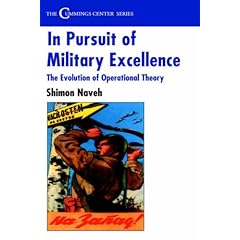
Dr. Naveh’s book is In Pursuit of Military Excellence: The Evolution of Operational Theory (Cummings Center Series)

Joint Force Quarterly (via Findarticle) -“Operational art

Jerusalem Post – “Column One: Halutz’s Stalinist moment

SWJ: My Interview with Tom Barnett

Thursday, February 5th, 2009

The Small Wars Journal has published an interview I conducted with Dr. Thomas Barnett regarding his new book Great Powers: America and the World After Bush.

Ten Questions with Thomas P.M. Barnett

…. 4. In Great Powers, you delve deeply into American history. What lessons did you find in our nation’s past that the diplomat overseas, the Army colonel in Afghanistan or the U.S. Aid worker in Africa should know to navigate their mission today?

This is all about frontier integration. Globalization is like America’s rapid and aggressive push Westward across the 19th century: a lot of the same bad actors and a lot of the same tools applied. So don’t be surprised when the Pinkertons show up, or when the covered wagons are attacked, or when the Injuns head to the Badlands for sanctuary. Thus, the goals of our frontline players are fairly straightforward: create the baseline security to allow the connectivity to grow. Focus on social trust and institutions as much as possible, but co-opt existing structures whenever and wherever you can. It doesn’t have to be perfect and it sure as hell doesn’t have to measure up to America’s mature standards. This is a frontier setting within globalization-treat it as such. The good news is, the settlers are already there, with more uncredentialed wealth than we realize (see Hernando DeSoto), if you respect their existing rule-sets and realize they will change only when the locals see the need themselves, so no instant rule-set packages applied by outsiders, please. Finally, acknowledge that with growing connectivity with the outside world, you will see more nationalism, more ethnic tensions, and more religious identity. These are all natural reactions, and not signs of your failure, so patience is the key.

Read the whole thing here.

Special thanks to Dave Dilegge for providing the forum and to Sean Meade and Lexington Green with editorial assistance and astute advice.

Hoffman -What is Irregular Warfare?

Sunday, February 1st, 2009

I saw this fantastic “ask the basic question” thread at SWJ this morning due to a comment by SWC member Ken White:

 Frank HoffmanAn IW “Bottle of Scotch” Challenge

I loved the paper by a team of guys trying to tackle a thorny issue – Irregular Warfare: Everything yet Nothing by Lieutenant Colonel (P) William Stevenson, Major Marshall Ecklund, Major Hun Soo Kim and Major Robert Billings.

In over a year of effort, and two separate meetings of OSD’s most senior officers; we failed to come up with a good solid definition for Irregular Warfare (IW). It’s like porn, we know IW when we see it. I do take exception to the unfounded statement made about historical research. The IW JOC (Irregular Warfare Joint Operating Concept) may not show it, but there is a lot of good history referenced by both the IW team and counterinsurgency guys, with lots of cross fertilization and common members. We may not have gotten it right, but it wasn’t due to a lack of intellectualism. I’ll be a bit blunter, people who live in glass houses, need to be careful where they throw their rocks. That said, I agree with the conclusion that we could use a better definition.

….All in all – the beginnings of a good debate. Yes, we need a definition better than what we have. Yes, concur with the point about populations (very COIN centric). But out of a dozen or so definitions that exist in the foreign literature, and the six or so developed by OSD, Army, Booze Allen etc, this is not an improvement. Sorry about that – so it’s back to the white board. I will put up a bottle of scotch to the best definition.

Great comments in this thread – read the whole thing here.

Irregular warfare historically coexists with conventional warfare to varying degrees whether we are discussing the Civil War, Vietnam War or even WWII where, for example, the Ukranian Nationalist partisans of Stepan Bandera could field reasonably large semi-regular units with light artillery or fight in classic guerilla syle. WWI is of course, famous for COIN patron saint Lawrence of Arabia’s campaign against the Ottoman Turks in his advisory capacity to the forces of the Sherif of Mecca and his allied Bedouin tribes of the Nejd.


Switch to our mobile site

