zenpundit.com » intellectuals

Archive for the ‘intellectuals’ Category

D’Este on Churchill at HNN

Saturday, January 31st, 2009

Military historian Carlo D’Este had an inspiring piece up at HNN last week on Sir Winston Churchill, drawn from his book Warlord: A Life of Winston Churchill at War, 1874-1945:

The Power of Oratory: Why Churchill is Still Relevant

….From the time he became prime minister, until December 1941, when Pearl Harbor brought the United States into the war, Churchill’s strongest weapon was oratory. As a young army officer stationed in India in 1897 he wrote that: “Of all the talents bestowed upon men, none is so precious as the gift of oratory.”

His speeches of 1940 become legendary, not only for their magnetism but more importantly for their effect on public morale. To counter both the disastrous news in France and to put to rest any notion that Britain might capitulate, Churchill delivered one of his many patriotic speeches to Parliament on June 18 that was also broadcast by the BBC. He made no effort to sugarcoat the extent of the dire situation Britain faced. The struggle that lay ahead from the air and likely from invasion would be met with every means and would be rebuffed. Of Hitler and the nations now under the Nazi jackboot, he said, “If we can stand up to him, all Europe may be free . . . But if we fail, then the whole world, including the United States . . . will sink into the abyss of a new Dark Age … Let us therefore brace ourselves to our duties, and so bear ourselves that, if the British Empire and Commonwealth last for a thousand years, men will say, ‘This was their finest hour.’

Read the rest here.

Churchill was an inordinately creative military leader, deeply interested in all facets of warfare from intelligence to technological innovations in armaments ( famously a proponent of the development of the tank in WWI) to military tactics. The amphibious landing at Gallipoli was a disaster but Normandy a generation later, despite Churchill’s misgivings, was a providential success. When in political disgrace – mostly undeserved – as a result of Gallipoli, Churchill did not retire to the shadows but donned a uniform and went to the Western Front ! Moreover he demonstrated there exemplary bravery under fire.

Can anyone imagine a politician doing that today? Or the public expecting him to do so ?

In the Second World War, in 1940 -1941, Churchill was the  indomitible rock upon which Western civilization rested. A lesser man as Prime Minister would have taken easy terms from Hitler and made Great Britain a satellite empire of the Greater German Reich, akin to the Phonecians’ relationship to ancient Persia. Few people alive today realize how dire the situation was in the Spring of 1941 and how close liberal democracy came to vanishing from history. 

Thanks to Churchill and the bravery of the RAF, the West had a chance to catch it’s breath.

When Old Government Intersects with New Media

Thursday, January 22nd, 2009

Galrahn at Information Dissemination:

Admiral, Do You Tweet Sir?

….In no small part due to a comment in the article by John Nagl, the Small Wars Journal gets an honorable mention in this article as an example where new media is having influence in the national security debate. While it is possible other areas of new media are having a similar effect, I would argue the Small Wars Journal is the exception, not the rule, and is the only place this is happening. What makes the Small Wars Journal unique?Because it is where active and retired members of the military want to debate their ideas, want their opinions in the open source on any given topic, and Dave has tapped into a community that has become comfortable with their ideas debated in an open forum. The Small Wars Journal has the capacity to “help shape the public debate about national security policy” primarily because those involved in the debate have found value participating in the public debate.

As I have noted in the past, each military service has taken a unique approach to new media. The article highlights unique examples where our military leadership has found utility within new media to introduce and discuss their message. I follow all of these discussions, and they have all met the same challenge: the discussion is still one way and while there is a network, it is yet to become a truly interactive network of idea sharing, or just as relevant, idea shaping.

….What is the role of new media in the national security debate? I have asked this question on the blog since I began blogging, and have seen some brilliant answers in my email and in the comments. This CSM article added another slide to a brief I am building that answers this question. I think it is a really good brief, but the question I still haven’t answered is whether the better audience for the brief is the military services, or the think tanks. That John Nagl hasn’t suggested CNAS buy the Small Wars Journal from Dave suggests to me that the think tanks somehow believe the Web 1.0 model they all currently use will somehow stay relevant in the rapidly evolving information age.

Read the rest here.

Very interesting thoughts by Galrahn and I agree with his assessment of the value of SWJ as it evolved under the stewardship of Dave Dilegge and Bill Nagle though I’m not certain SWJ is unique so much as it is  a succcessful “first” because Dave and Bill did everything right. They allowed a community to form from the ground-up without trying to ramrod an ideological agenda. Sure, SWJ is primarily about COIN but opposing views are invited, welcomed, heard and debated because the moderators are honest brokers and that imparts credibility to the entire enterprise. Intellectual integrity begets quality as well as quantity in terms of readership and submissions.

Tradtional think tanks are not set up to do what SWJ does because they come with either ideological baggage (Heritage, Brookings Carnegie) or institutional affiliations (SSI, CNA, Hoover) that preemptively circumscribe membership, discussion and research interests for fear of drying up the revenue stream. Few large donors, be they Uncle Sam, Richard Mellon Scaife or George Soros, are motivated to open their checkbook by the idea of unfettered inquiry and unlimited time horizons or providing a platform to their professional or political opponents. Attempts by official orgs to imitate SWJ will result in costly but sterile echo chambers. Genuine Web 2.0 interactivity is not desired because it is spontaneous and unpredictable but without that interactivity there’s no spark, no insight and no intellectual productivity.

The Obama White House just started a “blog” but despite the sleek visual design, “The Briefing Room” is a very Web 1.0 format. Media expert Jay Rosen of Press Think  on Twitter described it as “press releases” and scanning the posts leads me to agree with him. It’s very hard for established legacy entities – even one now filled with techies – to embrace the risk of uncontrolled discussion. Perhaps the blog should be farmed out to whatever Obama is calling his private political action group; lacking comments or an authentic, personal, voice The Briefing Room is likely to become a tepid EOB version of Dipnote – except even less interesting.

The SWJ Model can be replicated for other fields but the requirements of independence, community-building, intellectual diversity, relative transparency, openness to membership and free debate appear to be non-negotiable elements. Features, not bugs. 

New Adds for the Antilibrary

Saturday, January 17th, 2009


Dr. Chet Richards Certain to Win

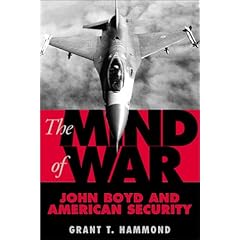
Dr. Grant T. HammondThe Mind of War: John Boyd and American Security

Say 5GWhaaaat ?

Tuesday, January 13th, 2009

David Axe of War is Boring has a piece in World Politics Review on 5GW that summarizes the extended journal article “Fifth-Generation War: Warfare versus the nonstate” in the Marine Corps Gazette by LTC Stanton Coerr that I linked to previously:

War Is Boring: U.S. Wages First Battles in New Generation of War

War has evolved rapidly in the last 100 years, prompting historians and strategists to come up with new terms for new ways of fighting. They call mechanized warfare, which originated in the early 20th century, the third “generation” of war, and ideological warfare waged by guerilla groups the fourth.But what about guerilla-style warfare waged by non-ideological groups against traditional states — pirates, for instance, whose attacks can destabilize trade-dependent nations, but who don’t have strategic goals beyond just getting rich? Free-for-all violence, with indirect global effects, represents a fifth generation of war, according to some experts. And when it comes to defeating fifth-gen enemies, “the old rules of warfare do not apply,” declared Marine Lt. Col. Stanton Coerr, writing in Marine Corps Gazette, a professional journal.

So the U.S. military and its government partners are writing new rules, and putting them to the test on the first of the fifth-generation battlefields emerging in Africa.

Fifth-gen enemies do not have traditional “centers of gravity” — armies, governments, factories, charismatic leaders — that can be destroyed by military attacks. By their mere survival, these enemies undermine the notion that nation-states, their ideals and their economies are viable in the modern world.

To the extent that 5GW can be characterized at all, I think both Axe and Coerr are incorrect here because the term “Fifth-Generation War” makes little sense except in relation to “4GW” and the strategic school of thought associated with William Lind, Col. Thomas X. Hammes and others in the circle of DNI. As Axe and Coerr use “5GW” it is indistinguishable from how Lind has described “4GW” since 1989. To follow the logic of the 4GW theory, as Hammes did in The Sling and the Stone: On War in the 21st Century
, 5GW would be the strategy and tactics that developed in opposition to 4GW as 3GW “Blitzkrieg” emerged from the “Stormtroop tactics” used to counter static and linear 2GW of the Western Front in WWI. Without this context “5GW” is just a placeholder term.

That said, the articles by Coerr and Axe are otherwise praiseworthy for bringing the many nuances and potential dangers of rapidly evolving irregular warfare and associated concepts to describe it, to the attention of a wider audience. That’s useful for generating further debate and bringing more sharp minds to the table.  Complex, “hybrid” wars of mixed regulars, insurgents, terrorists and criminals will be here for some time to come and the entire panopaly of the national security establishment needs to come to grips with that threat, regardless of what we ultimately choose to call it. Labels matter less than substance.

Dan of TDAXP, who has voiced his own skepticism about Coerr’s and Axe’s pieces, has issued a call for papers on behalf of Nimble Books to debate the scope and legitimacy of 5GW which will be assembled into an anthology on this subject. It would be nice to have those people who have writtten previously on fifth -generation war a list that includes Thomas P.M. Barnett, John Robb, Thomas X. Hammes, William Lind as well as myself, the cast of Dreaming5GW and others, contribute old or new pieces to that project. Let’s bring it all under one roof for interested readers instead of having posts and articles scattered all over the internet.

ADDENDUM:

Bibliography – The Timeline of 5GW Theory

On “Learning Organizations”

Monday, December 29th, 2008

The SWJ Blog published an op-ed by Colonel David Maxwell entitled “Random Thoughts on Irregular Warfare and Security Assistance (Full PDF Article)“. Like a lot of more open-ended, ruminating pieces, Maxwell’s post was “generative” in the sense of trying to articulate insights regarding a complex situation, which Col. Maxwell accomplished. Here’s the section that raised my eyebrow:

…First we need to look at ourselves critically and ask if we have been able to develop effective strategies and campaign plans and then support and execute them, respectively. I think that most all of our challenges can be attributed to our strategies and campaign plans (and I will caveat this and say we need to understand that in this world of irregular warfare, complex operations and hybrid warfare there is no cookie cutter strategy or campaign plan template that will work the first time, every time. We need to be agile and flexible and be able to adapt to constantly morphing conditions). But I would say that this is where we need to focus most of all because our forces at the tactical level from all Services have proven very adept and capable and have demonstrated that they are truly learning organizations

Why would the “tactical”level have acheived “learning organization” status and not the “operational” and “strategic” levels of military command? Some possibilities:

  • The social networks within the official hierarchical org at the tactical level can effectively leverage both weak and strong ties 
  • Greater degree of shared purpose and sense of mission
  • The tactical level, being a “smaller world” in systems terms than the operational or strategic levels, has a much better “signal to noise” ratio.
  • The social networks within the hierarchical org at the tactical level create an environment of greater transparency -discussion may be squelched but situational awareness can’t be.
  • Encouragement of critical discussion and incentives for problem-solving.
  • Greater tolerance for uncertainty and ambiguity.
  • Tacit knowledge is likely to quickly become explicit organizational, knowledge through “shop talk”, the grapevine, de-briefing and formal “lessons learned” dissemination procedures.
  • The stress and danger of the tactical evironment itself is an incentive to adapt and learn – “Depend upon it, sir, when a man knows he is to be hanged in a fortnight, it concentrates his mind wonderfully.” Dr. Samuel Johnson.
     

Can the operational and strategic levels of the military ( or any organization with a bureaucratic structure – schools, corporations, government agencies etc.) become a “learning organization” despite greater scale, distance from events, degrees of abstraction and other obstacles? Of course. However it depends greatly on two things – creating a “tighter” network with a high velocity of meaningful communication and a new kind of leadership committed to the hard work of re-engineering the organizational culture around adaptive “fitness” and learning.


Switch to our mobile site