zenpundit.com » john boyd

Archive for the ‘john boyd’ Category

Boyd & Beyond 2011, Quantico, VA

Monday, October 17th, 2011

 [by J. Scott Shipman]

324279_10150418011486383_641676382_10211686_198667620_o1.jpg 

Following the remarkable enthusiasm of the participants of Boyd & Beyond 2010, the expectations with respect to this years’ second annual event were high and in my estimation, no one was disappointed. Both days began at 0800 and went until 1800, with large groups of participants meeting after the meeting over food and beverages to continue the conversations. For me, the adrenaline was running so high, I got less than 8 hours sleep in the two days; as winding down was easier said than done.

Through the good offices of Mr. Stan Coerr, GS-15 and Colonel of the USMCR, our group met at the USMC Command and Staff college for the two day, no-PowerPoint event. Unlike last year, there were no initial retrospectives on John Boyd’s life. Instead, our agenda moved directly to broad themes derived from Boyd’s work and legacy. After lunch on Friday, the 29th Commandant of the USMC, General Al Gray made a surprise visit and spoke for two hours on his friendship and association with Boyd and the period when the USMC was integrating Boyd’s ideas on maneuver warfare. Those two hours went by in a flash, and I believe our group would agree, Gen Gray could have kept our attention for the remainder of the afternoon.

The morning began with speakers discussing Boyd’s legacy to the military services. Don Vandergriff lead off with an excellent review of methods he has adopted to help train leaders in adaptive decision making. Picking up where he left off last year, Don demonstrated the power of his methods. Don was followed by a presentation that challenged our group on the power of context and relationships between law enforcement and the community. Using a vehicle of an evolving story narrative of a historic event, our group was provided facts in a method akin to peeling an onion—after all the facts of the story had been shared, opinons were solicited; not surprisingly the conclusion was a surprise, but illustrative of a leader who “sees” (think: the Observe of OODA).

We were very fortunate to have uniformed representatives of Boyd’s US Air Force, and a representative from the US Navy. Speaking separately on different topics, these three bright young men provided observations from within their respective services on leadership, learning, and organizational adaptability. They reviewed the perils of a zero-defect culture where metrics and hardware are more important than people. [Reminded of Boyd’s famous quote: People, ideas, hardware: in that order!”]

Marcus Mainz, Major USMC, followed-up and extended on his observations made last year with respect to Boyd’s continuing influence on professional military education in the Marine Corps. He emphasized time and fighting on the three levels of the physical, mental, and moral, and the importance of deception in the disruption of any enemy’s OODA. He also provided an excellent quote:

“Training is for the known, education is for the unknowns.”

Maj Mainz was followed by Mark Williams in a discussion on the epistemology and ontology of Boyd’s OODA, and the implications for warrior training. Mark is a former fighter pilot and spoke with passion about the importance of continuous learning and adaptability. Using riveting example from his experience in the cockpit, Mark illustrated the need for fluidity between the Observe and Orient.

Bruce Greene, Major, USMC, presented on the topic of unmanned vs manned aircraft in relation to Boyd’s theories. This presentation provoked a lively discussion on the both the moral and practical aspects of unmanned vehicles—particularly in light of fratricidal events involving UUVs and US ground troops. Major Greene emphasized the “morality of attitude” with respect to decisions in this arena.

Day two had a lively start requiring our group to orient on the fly. We arrived to find power was out in the Command & Staff College building. Maj Mainz, in a deft move of Boydian orientation, suggested we decamp to the Expeditionary Warfare School, about a mile away. We moved coffee, bagels, coolers, books, bags and people in about half an hour and picked up where we left off.

Dr. Terry Barnhart led off with a remarkable exercise using questions to determine real needs. Terry contends that questions elicit more information and buy-in than statements, and with this exercise proved his point. Terry divided participants into two groups to tackle two problems ad hoc using a simple and straight-forward process. This robust exercise worked quite well and many remarked they were taking the experience and example back to their respective organizations.

World-renowned law enforcement expert and combat Marine, Sid Heal used a rare-for-B&B PowerPoint presentation to discuss Forecasting With Density. Sid’s presentation was engaging and informative and covered how law enforcement can use density in nature, urban areas, and data for law enforcement—particularly riot control. The presentation was rare in that the slides truly complimented the topic. Sid also offered a notable quote:

“All human understanding can be boiled down to comparison and metaphor.” {Regular zenpundit readers perhaps know the appeal to me of patterns, metaphors and analogies, so this quote will be remembered and used.}

Fred Leland, longtime user of Boyd’s ideas, offered a riveting presentation on interaction and isolation in police operational art. During his talk Fred reiterated the hazards of a culture driven by policies and procedures at the expense of thinking and common sense.

Chip Pearson, owner of a software company in Minnesota, spoke again this year, providing updates from last years’ presentation and insight into the evolution of his company. Chip made a distinction between those “in business to make money, or those in business to satisfy customer needs.” This comment reminded me of Boyd’s “to be or to do” challenge. During his talk, Chip emphasized the importance of common understanding for organizational harmony. It was also during Chip’s talk that Sid Heal offered another quote to remember:

“Mediocrity and controversy cannot peacefully coexist.”

Michael Moore gave his much anticipated presentation on his Win Bowl concept. Michael’s ideas tie directly to Sun Tzu’s:

“Military actions are like water, flowing from high to low points…And just as water adapts to the ground it flows over, so a successful soldier adapts his victories to the specific foe he faces.”

(Section 6:29, 31)

Michael demonstrated how his Win Bowl concept captures the fluidity of tracking goals. He says the model has been used in the learning environment and demonstrated the simplicity and approachability of the model. Michael suggested his outline offers a “”mental tapestry” metaphor Boyd was seeking in military strategy” and I believe he he is right.

Longtime friend of this blog, Adam Elkus followed with a powerful talk on Boyd’s influence on campaign planning and the influence of design theory. Adam emphasized the importance of simplicity in the development of strategy and the avoidance of tools, jargons, and excuses that more often than not decrease clarity of purpose.

Katya Drozdova of Seattle Pacific University was our concluding speaker. She offered her expert insight into alternative strategies in the Afghan theater that would be revolutionary in scope and a significant change to current US government policy. For instance, she offered the US should consider granting autonomy to those areas of Afghanistan that have demonstrated a capability to sustain and secure themselves.

This review did not include all of the speakers. Last year I took over five pages of notes, however for this event my notes were more sketchy, so my apologies in advance for the speakers and topics not covered. I would encourage those who attended to fill in blanks that I no doubt missed or neglected. Also, last year I published the reading list recommended by participants. I will do this in a update to this post in the days to come, so stay tuned.

We have every intention of having another event the same weekend in October next year, so stay tuned and keep the dates open on your calendar for Boyd & Beyond 2012.

An OODA Loop Made of Straw

Saturday, October 8th, 2011

From AFJ:

…This notion that there are specific knowable causes that are linked to corresponding effects dominates military thinking and manifests in our drive to gather as much information as possible before acting. This concept was captured by Air Force Col. John Boyd’s decision loop: observe, orient, decide and act. In this OODA Loop, an endless cycle in which each action restarts the observe phase, it is implied that collecting information would allow you to decide independent of acting. Also implied is the notion that you can determine measures of effectiveness against which to observe each action’s movement toward achievement of your goal so you can reorient. The result of this type of thinking is to spend a lot of time narrowing the focus of what we choose to observe in order to better orient and decide. This drives one to try and reduce the noise associated with understanding the problem. We do this by establishing priority information requests or other methods of focused questions aimed at better understanding the core problem so we can control it.

No.

The OODA Loop is not a linear process, orientation is the key and the OODA Loop does not by default “narrow your focus”. WTF?

Maybe the military or, more likely, some brigade commander, instituted a process like this in Iraq for their information-intel analysis, maybe not, but if they did it was not what Colonel John Boyd argued they ought to do. Nor is it an understanding of what the OODA Loop is or how it works.

Here’s an OODA Loop for Dummies level brief from Dr. Chet Richards intended for businessmen but there are more sophisticated explanations out there by Chet and others. Google is your friend. 🙂

Operating Inside Their OODA Loops

This post might help as well:

Chet on TEMPO….Rao on OODA

The OODA of Fouche

Wednesday, August 17th, 2011

Did not want this fine graphic of Joseph Fouche lost in the dread comment section:

The fog and friction is a nice touch.

Chet on TEMPO….Rao on OODA

Tuesday, July 26th, 2011


At Fabius Maximus, Dr. Chet Richards reviews TEMPO by Dr. Venkat Rao, enjoying the book as much as I did, if not more. Chet has some particularly incisive comments, positive and critical, in his review, which I suggest you read in full:

Book Review: Tempo

…Rao draws on Boyd in several places, as well on sources ranging from the topical, such as Gladwell and Taleb, to the foundational (e.g., Camus and Clausewitz), to the downright obscure – know anything about The Archeology of Garbage? Do the words wabi and sabi ring a bell?

The result is a synthesis, what Boyd called a “snowmobile,” that combines concepts from across a variety of disciplines to produce a cornucopia of new ideas, insights and speculations. You may be confused, challenged, outraged, and puzzled (some of the language can be academic), but you’ll rarely be bored because every chapter, often every page, has something you can add to the parts bin for building your own snowmobiles.

Let me highlight just a couple, of special interest to folks familiar with Boyd’s concepts. Near the end of the book, Rao introduces an expanded version of “legibility”:

A piece of physical reality is legible if it is obviously the product of coherent human agency, a deliberate externalization of a mental model. When human and natural sources of order are harder to tease apart, you get greater illegibility (p. 133 – and I warned you about the academic language).

Then a couple of paragraphs later, he claims that:

Used with adversarial intentions, Boyd’s OODA can be understood as a deliberate use of illegibility to cause failure.

At first, this seems silly. Boyd only considers conflict between groups of human beings (Patterns of Conflict, 10), so all uses of his strategic concepts would seem to be prima facia examples of legible phenomena. On the other hand, and this is an example of what makes Rao’s little book so valuable, some commentators, such as Stalk and Hout in 1990’s Competing Against Time, point out that victims of a Boyd-style attack can rarely identify the cause of their problems – often blaming bad luck or incompetent, self-serving and treacherous idiots in their own organizations. Boyd made this clear in his own work, such as in Patterns of Conflict, 132, when he suggested that his victims would exhibit a variety of traumatic symptoms including confusion, disorder, panic, chaos, paralysis and collapse – indicating unrelenting attack by forces outside the scope of their own mental models…

Chet concludes with a suggestion for Venkat (with which I concur):

…As for where to go from here, Rao might write more about tempo. This will seem strange to him, I’m sure, but pages go by with hardly a mention of the concept. This means that we need another book from him. I’d suggest expanding on some of the concepts that he raises but doesn’t find space to develop. Here are three ideas: […]

But you will have to go over to Fabius Maximus to read the rest. Venkat, in turn responded to Chet over at his blog, Ribbonfarm:

Chet Richards’ Review of Tempo on Fabius Maximus

….Overall, Chet comes to the conclusion that Tempo resonates with the Boydian spirit of decision-making. I don’t entirely get out of jail free though:

Perhaps his unfamiliarity with the original briefings, however, led him to  make one characterization that is incorrect, although widely believed:

The central idea in OODA is a generalization of Butterfly-Bee: to simply operate at a higher tempo than your opponent. (118)

Guilty as charged. I didn’t spend enough time exploring how OODA gets beyond merely “faster tempo” to “inside the adversary’s tempo.” That’s something I hope to explore in a more nuanced way in a future edition. Over the last 6-8 months, I think I’ve come to understand the subtleties a lot better, and the challenge is to now spend more time thinking through clear definitions and examples….

I think everyone who has explored the OODA Loop concept, including John Boyd himself, initially gravitated to the aspect of cycling “faster” than one’s oponent because it is a natural assumption that resonates with our own experiences. We have all seen competitions where one player or athlete was “quicker” in reading situations and arriving at the right intuitive decision – usually most of us have been both the faster as well as the slower and more hesitant person. It’s the first scenario that springs to mind and being “faster” gives an obvious comparative advantages. Obvious does not mean “only” though.

What made the “faster” interpretation of OODA Loop really stick in the culture though, IMHO, was this unfortunate but easily understood graphic:

NOT THE REAL OODA LOOP

As a result, we get critical arguments that the OODA Loop is really something germane only to binary situations similar to the high pressure aerial combat that Boyd experienced in the Korean War or as a tactical fighter pilot instructor (or Musashi’s sword fighting) and not something generally useful in military strategy. An odd argument, given that Clausewitz liked to use binary metaphors to describe the nature of war.

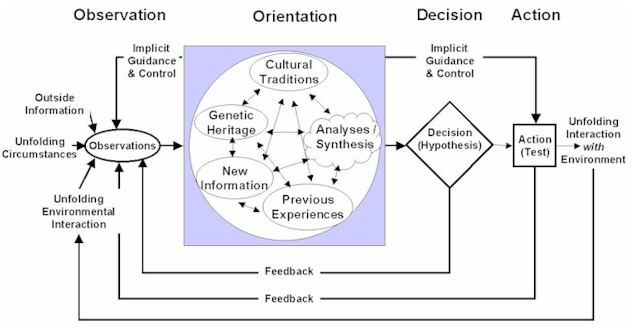
The next graphic, which better illustrates the simultanaeity and dynamic nature of the OODA Loop, with other potential avenues of exploitation than just going “faster” (which will swiftly hit diminishing returns in any event) does not lend itself as easily to nearly instant comprehension:

THE ‘OFFICIAL” OODA LOOP:

With these cognitive relationships operating continuously, mostly subconsciously with automaticity and in an iterative fashion, a different set of meanings to the phrase “inside your oponent’s OODA Loop” than just going “faster”, like a formula one race car zooming around a track.

Patterns, Language, and Knowledge

Monday, June 6th, 2011

[by J. Scott Shipman]

John Boyd’s work led me to zenpundit a few years ago, and I am flattered and grateful to be small part of such an intellectually stimulating community.

One Boydian theme that has driven my reading is the “observe” node of his OODA (observe, orient, decide, act). While “orientation” gets most of the attention in Boydian circles, I have come to consider “observe” to be the foundation of knowledge, thus action.  “What” we see, or as my friend Dr. Terry Barnhart points out, what we “sense” directs orientations, decisions, and actions.

This short post is something of a preview (and an opportunity to try-out WordPress which does not like Safari—I’m using an old laptop that is slower than slow). I’d like to share four books that have influenced my thinking and I plan to review the first two of them here in the coming weeks.

patterns.jpg

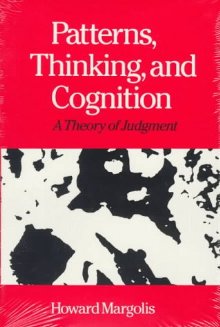
Patterns, Thinking, and Cognition, A Theory of Judgment, by Howard Margolis

Margolis’ thesis is “thinking and judgment…everything is reduced to pattern recognition.” Accordingly, he offers what he calls a P’ Cognition spiral, where the “spirals” represent a cognitive cycle and at the tops of the cycles represent a pattern recognition process. A review is in the works.

language.jpg

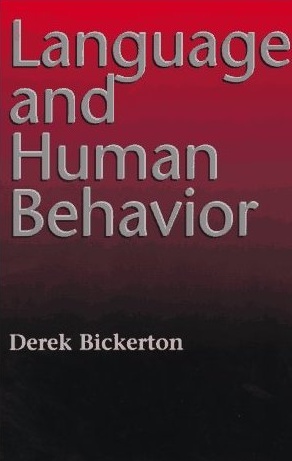
Language and Human Behavior, by Derek Bickerton Bickerton’s thesis is that “human cognition came out of language.” In this work, he defines language, explains the connection of language and evolution, and how language is integral to intelligence and consciousness. A review is in the works.

The final two books are  Personal Knowledge: Towards a Post-Critical Philosophy, and Meaning, by Michael Polanyi

“We know more than we can tell.” Michael Polanyi

There are several points of intersection between Polanyi’s work and that of Margolis and Bickerton, but what I found interesting were Polanyi’s treatment of what he refers to as two types of awareness; subsidiary and focal awareness. In Personal Knowledge, he offers an example of driving a nail, “I have a subsidiary awareness [also called from awareness in Meaning] of the feeling in the palm of my hand which is merged into my focal awareness of my driving the nail.” Subsidiary and focal awareness, according to Polanyi, are mutually exclusive where if one diverts one’s attention to the “feeling in the palm” one is likely to miss the nail. Musicians will recognize the distinction of “looking” at one’s hands will almost always divert from the music on the sheet.In Meaning, Polanyi goes further and assembles what he calls “three centers of tacit knowledge: first, the subsidiary particulars; second, the focal target; and third the knower who links the first to the second. We can place these three things in the three corners of a triangle. Or we can think of them as forming a triad, controlled by a person, the knower, who causes the subsidiaries to bear on the focus of his attention.”

Synthesis: I believe these ideas connect. For if Margolis is correct, then the “awareness” expressed by Polanyi would be apprehended using pattern recognition; recognition of patterns using Bickerton’s ideas with respect to language. Language is pattern-based, and we use language patterns in sense-making/creation of meaning.

More to come.


Switch to our mobile site