zenpundit.com » education

Archive for the ‘education’ Category

The 35 Greatest Speeches Ever

Tuesday, December 29th, 2009

Well, some at least would make every historian’s greatest hits list and all are, by any objective standard, excellent examples of oratory. A lost art.

They are from the highly enjoyable The Art of Manliness site, recommended a while back by stalwart blogfriend and sometimes collaborator, Historyguy99.

The 35 Greatest Speeches in History – Brett and Kate McKay

The Art of Manliness thus proudly presents the “35 Greatest Speeches in World History,” the finest library of speeches available on the web.

These speeches lifted hearts in dark times, gave hope in despair, refined the characters of men, inspired brave feats, gave courage to the weary, honored the dead, and changed the course of history. It is my desire that this library will become a lasting resource not only to those who wish to become great orators, but to all men who wisely seek out the great mentors of history as guides on the path to virtuous manhood.

I know that readers of blogs are often more likely to skim than to read in-depth. But I challenge you, gentlemen, to attempt a program of study in which you read the entirety of one of these great speeches each and every day. I found the process of compiling and reading these speeches to be enormously inspiring and edifying, and I feel confident that you will find them equally so.

How did we compile this list?

Great oratory has three components: style, substance, and impact.

Style: A great speech must be masterfully constructed. The best orators are masters of both the written and spoken word, and use words to create texts that are beautiful to both hear and read.

Substance: A speech may be flowery and charismatically presented, and yet lack any true substance at all. Great oratory must center on a worthy theme; it must appeal to and inspire the audience’s finest values and ideals.

Impact: Great oratory always seeks to persuade the audience of some fact or idea. The very best speeches change hearts and minds and seem as revelatory several decades or centuries removed as when they were first given.

Read, listen and/or view the 35 greatest speeches here.

A special bonus, How to Run a Meeting. By God, I wish I could make this mandatory…….

ADDENDUM:

Blogfriend and cybersecurity guru Gunnar Peterson points us to 100 Incredible Lectures from the World’s Top Scientists . Nice!

Reader Recommended Reading

Tuesday, December 15th, 2009

From reader Chris, of the USMC. Ties in well with prior discussions here of the need for cultural-educational-cognitive renovation in American society and the marked inadequacy of the current elite: 

National Affairs -“Keeping America’s Edge” – Jim Manzi

….Reconciling these competing forces is America’s great challenge in the decades ahead, but will be made far more difficult by the growing bifurcation of American society. Of course, this is not a new dilemma: It has actually undergirded most of the key political-economy debates of the past 30 years. But a dysfunctional political dynamic has prevented the nation from addressing it well, and has instead given us the worst of both worlds: a ballooning welfare state that threatens future growth, along with growing socioeconomic disparities.

Both major political parties have internal factions that sit on each side of the divide between innovation and cohesion. But broadly ­speaking, Republicans since Ronald Reagan have been the party of innovation, and Democrats have been the party of cohesion.

Conservatives have correctly viewed the policy agenda of the left as an attempt to undo the economic reforms of the 1980s. They have ­therefore, as a rhetorical and political strategy, downplayed the problems of cohesion – problems like inequality, wage stagnation, worker displacement, and disparities in educational performance – to emphasize the importance of innovation and growth. Liberals, meanwhile, have correctly identified the problem of cohesion, but have generally proposed antediluvian solutions and downplayed the necessity of innovation in a competitive world. They have noted that America’s economy in the immediate wake of World War II was in many ways simultaneously more regulated, more successful, and more equitable than today’s economy, but mistakenly assume that by restoring greater regulation we could re-create both the equity and prosperity of that era.

The conservative view fails to acknowledge the social costs of unrestrained economic innovation – costs that have made themselves ­powerfully apparent in American politics throughout our history. The liberal view, meanwhile, betrays a misunderstanding of the global economic environment.

…. The level of family disruption in America is enormous compared to almost every other country in the developed world. Of course, out-of-wedlock births are as common in many European countries as they are in the United States. But the estimated percentage of 15-year-olds living with both of their biological parents is far lower in the United States than in Western Europe, because unmarried European parents are much more likely to raise children together. It is hard to exaggerate the chaotic conditions under which something like a third of American children are being raised – or to overstate the negative impact this disorder has on their academic achievement, social skills, and character formation. There are certainly heroic exceptions, but the sad fact is that most of these children could not possibly compete with their foreign counterparts.As the lower classes in America experience these alarming regressions, wealthier and better-educated Americans have managed to re-create a great deal of the lifestyle of the old WASP ascendancy – if with different justifications for it. Political correctness serves the same basic function for this cohort that “good manners” did for an earlier elite; environmentalism increasingly stands in for the ethic of controlling impulses so as to live within limits; and an expensive, competitive school culture – from pre-K play groups up through graduate school – socializes the new elite for constructive competition among peers. These Americans have even re-created the old WASP aesthetic preference for the antique, authentic, and pseudo-utilitarian at the expense of vulgar displays of wealth. In many cases, they live in literally the same homes as the previous upper class.

Read the rest here.

Brief Metacognition

Tuesday, December 1st, 2009

Very, very busy but the following two items struck me as useful advice for sharpening our mental edges.

First, John Robb linked to a series of posts by Eric Drexler of Metamodern. Al of them were good but I particularly liked the following one:

How to Understand Everything (and why)

….Formal education in science and engineering centers on teaching facts and problem-solving skills in a series of narrow topics. It is true that a few topics, although narrow in content, have such broad application that they are themselves integrative: These include (at a bare minimum) substantial chunks of mathematics and the basics of classical mechanics and electromagnetism, with the basics of thermodynamics and quantum mechanics close behind.

….To avoid blunders and absurdities, to recognize cross-disciplinary opportunities, and to make sense of new ideas, requires knowledge of at least the outlines of every field that might be relevant to the topics of interest. By knowing the outlines of a field, I mean knowing the answers, to some reasonable approximation, to questions like these:

What are the physical phenomena?
What are their magnitudes?
What are their preconditions?
How well are they understood?
How well can they be modeled?
What do they make possible?
What do they forbid?

And even more fundamental than these are questions of knowledge about knowledge:

What is known today?
What are the gaps in what I know?
When would I need to know more to solve a problem?
How could I find it?

It takes far less knowledge to recognize a problem than to solve it, yet in key respects, that bit of knowledge is more important: With recognition, a problem may be avoided, or solved, or an idea abandoned. Without recognition, a hidden problem may invalidate the labor of an hour, or a lifetime. Lack of a little knowledge can be a dangerous thing.

Secondly, reading through Richard Nisbett’s Intelligence and How to Get It: Why Schools and Cultures Count ( see this monster, two-partbook review by James McCormick at Chicago Boyz), the intriguing findings of the “Venezuela Project” run by none other than the late Richard Herrnstein of Bell Curve fame. Nisbett writes (74-75):

Herrnstein and his coworkers devised a very advanced set of materials geared to teaching seventh-graders fundamental concepts of problem solving that were not targeted to any particular subject matter. In effect they, they tried to make the children smarter by giving them handy implements for their intellectual tool kits.

What were those non-subject specific, cognitive skills?

  • Basics of Classification
  • Hypothesis Testing
  • Discovery of Properties of Ordered Dimensions
  • Analogies
  • Simple Propositions
  • Principles of Logic
  • Constructing and Evaluating Complex Arguments
  • Weighing opportunity costs vs. probability of success for a goal
  • Evaluating credibility and relevance of data

I would have added metaphors, pattern-recognition and intuitive thinking games but it was a fine set of skills and the results were remarkable, according to Nisbett:

The instruction resulted in big changes in children’s ability to solve problems that the new skills were designed to improve….for language comprehension, .62 SD [ standard deviation]; for learning how to represent ‘”problem spaces,” .46 SD; for decision making, .77 SD; for inventive thinking, .50 SD. In short, general problem solving skills can be taught, and taught moreover in a brief period of time.

In psychometric terms, for a 13 year old, these scores represent phenomenal improvements in cognitive performance and indicate the plasticity of some aspects of measured intelligence. Why have such activities not become commonplace in public schools? Or universities?

Why indeed?

American Public Schools and History

Friday, September 4th, 2009

My amigo and blogging colleague Lexington Green had an excellent post this week on the anniversary of the invasion of Poland by Nazi Germany, abetted by Joseph Stalin’s Soviet Union, which set off WWII in Europe. Lex laments the state of historical knowlege in public schools and asks readers for their recommendations for books on the Second world War. As of this writing, there are already 47 comments:

September 1, 1939

World War II started (in Europe) 70 years ago today.

There are two sorts of people in the USA today. A tiny minority who are very interested in military history and know a lot about World War II, and a vast majority who can barely even tell you who was in it (“was that the one with Hitler?”), when it occurred (“the Seventies?”), or what it was about, or even who won (“Japan?”). American children whom I talk to are apparently taught two things and two things only about our participation in World War II: (1) The Japanese Americans were imprisoned, and that was racist and wrong, and (2) we dropped atomic bombs on Japan, and that was racist and wrong. Some know about the Holocaust. College age youth are taught that the war was an exercise in American imperialism, meant to spread expoitative capitalism across the world, and that it is a myth that the GIs went to Europe to liberate the conquered countries or to bring democracy and freedom. Even depictions that are not entirely negative, such as Saving Private Ryan, depict the war solely as a personal tragedy and pointless death and destruction, and not about anything, and certainly not about anything good or admirable. Fed exclusively on this diet for over a generation, we now have a population that sees the war in this way.

This is precisely what Pres. Reagan warned us about:

We’ve got to do a better job of getting across that America is freedom-freedom of speech, freedom of religion, freedom of enterprise. And freedom is special and rare. It’s fragile; it needs [protection]. So, we’ve got to teach history based not on what’s in fashion but what’s important-why the Pilgrims came here, who Jimmy Doolittle was, and what those 30 seconds over Tokyo meant. You know, 4 years ago on the 40th anniversary of D-Day, I read a letter from a young woman writing to her late father, who’d fought on Omaha Beach. Her name was Lisa Zanatta Henn, and she said, “We will always remember, we will never forget what the boys of Normandy did.” Well, let’s help her keep her word. If we forget what we did, we won’t know who we are. I’m warning of an eradication of the American memory that could result, ultimately, in an erosion of the American spirit.

Reagan was right. I have gone beyond being distressed about all this to being fatalistically resigned. With historical memory either non-existent or actively corrupted, those of us who care about these things will have to preserve the record as best we can.

At The Corner (updated here) they are asking people to list their favorite books on World War II. This is a good idea, and I solicit your suggestions in the comments. The Boyz readership always suggests something I have not heard of already. Please list two or three favorites, in the comments. I could spend all day doing this, but I will abide by my own rule, and limit myself to three.

Read the rest here:

You should read the rest, as well as the comments, many of which are informative and a few of which qualify as entertaining. While I am very tempted to discuss books and historiography, I will instead address the teaching of history in our public schools.

The ideological Marxoid craziness of which Lex writes does indeed exist, though it is far more common in university courses than in secondary school classrooms ( Oak Park, though, is a pretty liberal UMC burg) and more common in urban school districts on the coasts than in the Midwest or South. In particular, I have seen firsthand at national conferences, teacher-zealots from California who appear to have been kicked out of Trotskyite Collectives for excessive radicalism and who are more like the mentally unsound homeless than someone entrusted with the education of children. They are largely scary exceptions though. The main problem with the teaching of history in our public schools is that as far as subjects go, history is a tertiary concern of government officials, administrators and school boards; as a result, most of history instructors are hard working and well-meaning people who are by education, totally unqualified for the positions they hold.

This is not to say that these history teachers do not have college degrees, They do, usually they are education or English lit majors with a scattering of PE and business majors whose main career concern is becoming varsity football or basketball coach. A few were punitively reassigned to history departments out of fields they are highly qualified to teach because they are good teachers and administrators saw them as capable of filling a gap in the master schedule, credentials be damned.

Nor would I say that these teachers do not care about children or shirk their responsibilities. By and large they are professionals who are dedicated to and care about the welfare of their students. The problem is that they don’t know much history – and it is very difficult to teach something well that you yourself do not even know enough about to be aware of the parameters of your own ignorance.

In 1997, education scholar Diane Ravitch wrote:

…Of those teachers who describe themselves as social studies teachers, that is, those who teach social studies in middle school or secondary school, only 18.5% have either a major or a minor in history. That is, 81.5% of social studies teachers did not study history in college either as a major or as a minor. In case you thinkyou didn’t hear me correctly, let me say it again: 81.5% of social studies teachers did not study history in college either as a major or a minor. This figure helps to explain why history is no longer the center of the social studies, since so few social studies teachers have ever studied history

What? “Well that was twelve years ago!” you say? My friend, the vast majority of that 81 % of unqualified teachers are still teaching today. And most of that remainder are still as unqualified now as they were in 1997. Imagine the state of our buildings and bridges if 81% of the professors of engineering had majored in, say Art Criticism or Women’s Studies.

Aggravating matters, even if a prospective teacher did major in history in college, fewer of their professors were full-time history instructors than ever before, meaning that even the quality of the small minority of teachers who are history majors is going into decline! NCLB scorns history as a subject, so school districts across the nation will continue to starve it. Poorer districts will fire all the social studies teachers in coming years and parcel out the history sections to unwilling English teachers in order to save the jobs that will preserve reading scores (assuming those are making AYP in the first place). After that, the science teachers will start to get the axe.

Students know a few bare minimum things about WWII, what can be gleaned from dumbed-down, turgidly written, textbooks that are long on glossy pictures and short on engaging prose, plus what they might catch on the History Channel which is seldom short of Nazi-related documentaries. It is unsurprising that most high school students are ignorant of their own nation’s history – given the state state of the field, it would actually be surprising if they knew anything at all.

We are deliberately cultivating a level of societal ignorance that is a deadly longitudinal threat to the continuance of democratic governance and individual liberties in this country. Maybe that was always part of the plan.

Cantigny Museum

Wednesday, July 22nd, 2009

tank.jpg

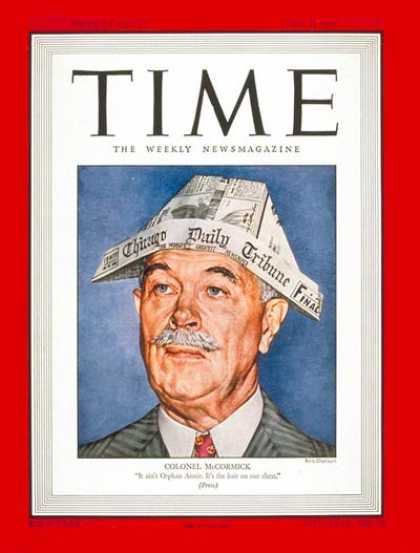
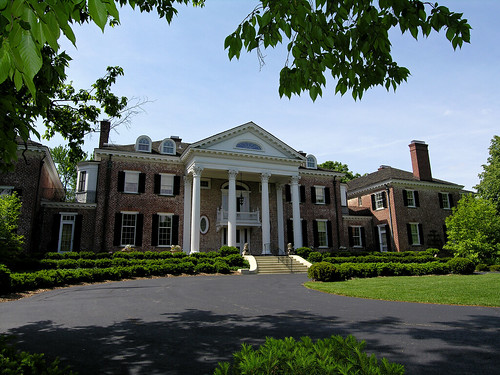
Spent a pleasant afternoon at Cantigny, the estate of legendary Chicago Tribune publisher, broadcast pioneer and ardent isolationist,  Colonel Robert McCormick. After his death in 1955, McCormick had willed that the 500 acre grounds located in Wheaton, Illinois,  be turned into a memorial to the 1st Infantry Division of the US Army, in which he had served ( McCormick was a veteran of the Mexican Expedition and the Great War). Operated by the McCormick Foundation, a charitable and educational trust with an endowment that rivals that of Yale or Harvard universities, Cantigny now is home to an opulent garden, golf course, mansion museum, several restaurants, a greenhouse, a tank and artillery park, a children’s playground, visitor’s center and the Museum of the First Division.

The grounds contain an array of armor on display for the tank aficianado, including the Sheridan, Sherman and variations of the Patton series up to the M-1 Abrams, including several “experimental” models plus a selection or artillery pieces going back well before WWI. Just added was a fully restored D-Day landing craft (still being unloaded from the trailer).  Aside from children’s tours and families present, I saw not a few veterans today, some very elderly and in wheelchairs, reminiscing together quietly by particular tanks or displays.

The museum has a collection of artifacts that run the gamut from the Revolutionary War to the Iraq War but the major sections are concerned with the two World Wars and the Vietnam War. Museum staff are friendly and helpful but unobtrusive and the basement contains a military library and archive that is open to the public for research.

The grounds are very extensive and the landscaped garden, which covers many acres,  is a world class feature in itself. The fee for admission is a mere $ 5 to park – the amenities and facilities (except the golf course and restaurants) are all free of charge.


Switch to our mobile site