zenpundit.com » 21st century

Archive for the ‘21st century’ Category

Rethinking Fortification

Monday, August 13th, 2012

John Robb now has a Facebook page for Global Guerrillas, where he posts quick snippets of big ideas. It seems to be a replacement for his old, informal, personal blog which served a similar purpose some years back. In any event, John had a spectacular picture of Mexico City and an intriguingly dystopian caption:

Mexico City. 

Future of warfare. Megacities + millions of drones.

I wandered into a Mexican shantytown once, back in the 1990’s . Not sure I would care to repeat the experience at the present time.

Robb’s facebook post started me thinking. If drones of all sizes and functions become ubiquitous someday, it creates a great incentive for the powerful, at least to safeguard their privacy, to apply human ingenuity toward concealment, countermeasures and postmodern “citadels”.

All the moreso, if “megacities’ are all girdled in vast seas of slums. Imagine the LA or London riots with 20 times the underclass population. The bloody experience of the New York City Draft Riots during the Civil War taught the Robber Barons of the Gilded Age to support the building of public and private armories to defend the gentle classes from the great uprising that never came.

Fortification is something of a lost art, but it was up until recent history, a critical military capability. After castles went into a temporary decline with the advent of cannons blasting apart their high walls, post-renaissance architects redesigned European fortifications to endure the new bronze siege guns and defense again triumphed over offense. Military engineers like Vauban were more valuable than field marshals and kings staked their strategies on the strength of chains of fortifications and arsenals.  Obsolete by the time of the Napoleonic wars, massive fortresses nonetheless enjoyed a long twilight march to military irrelevance, ending in WWII with the ignominious capture of Belgium’s mighty Eben-Emael fortress by 75 lightly armed Germans and the utter uselessness of the extremely expensive Maginot Line during the Battle of France.

Fortification began to receive renewed interest as governments sought defensive measures to allow their leadership to survive a nuclear attack, such as the Cold War era secret bunkers for USG officials at Greenbrier or Raven Rock or efforts by rogue dictatorships to build facilities carved deep into a mountain to protect their leadership or nuclear weapons programs from American attack. The ancient arms race of defense and offense continues with the designers of “bunker-busters” as a peripheral military activity.

Governments and occasionally corporations and superwealthy individuals will continue to build and tweak these doomsday bunkers but as strategic investments they do not offer very good ROI. For one thing, if your national leadership is cornered fifty stories underground, it will be little comfort to you and your fellow citizens as the nuclear bombs are exploding; the game is pretty much over at that point. Secondly, the ultimate risk they are hedging against is far more remote and the benefits infinitesimal compared to what rethinking fortification as a concept would do to minimize more mundane and probable risks faced by the rest of us.

A great fortress conjures the idea of impregnability and, ironically, usually achieves eternal fame for falling or being breached – the walls of Constantinople,  the Great Wall of China, Masada, Alamut, Murud-Janjira and the aforementioned Maginot Line. “Impregnability” is a misnomer, what a good fortification really does is raise operational costs for adversaries, hopefully high enough to discourage them from making the effort to attack in the first place. Raising costs for those who bear us ill-will by adaptation and a priori design should be our paradigm.

What are the primary risks we will face in coming years as individuals and societies? Erosion of privacy and the security of our persons, property and data at the hands of criminals, avaricious elites, government and private surveillance and bouts of civil disorder, all in a number of forms. For example

  • Drones: As John Robb suggested in his FB post and at Global Guerrillas, drone usage could potentially become ubiquitous by governments, corporations and individuals with an axe to grind or an interest in stalking, terrorism or committing mayhem.  Imagine the Unabomber or Osama bin Laden with a drone swarm controlled from a laptop – superempowerment will go robotic.Drones will/are becoming semiautonomous. They are easily modified to carry cameras, recording/SIGINT devices, imaging systems, weapons, toxic substances or explosives.
  • Civil Unrest: The UK Riots were an excellent reminder that, as with the LA Riots, in the case of dangerous criminal-class rioting, elites will be unable to reestablish order or rescue law-abiding citizens until their reticence becomes a political debacle (and they may, as in Britain, initially restrain law enforcement personnel from suppressing the rioters). This contrasts with elite willingness to mobilize vast police and paramilitary forces against mere embarrassing political protests.
  • Cybersecurity: This adds a new dimension to fortification that is not limited to a physical space and place, even securing your home networks, but to your identity.

How might we adapt individually and collectively to these risks?

First, we are managing risk within reasonable costs and means while living a normal life. If you imagine something to hold off  an angry mob indefinitely or that will allow you to defy the US government then you need to come out of fantasyland or have a Bill Gates budget to play with. Here are some more practical possibilities:

Privacy architecture: Building design embedded with the idea of  promoting privacy, adjusted to the surrounding environment, which today includes thwarting advocates of a panopticon society. You want a structure that breaks clear fields of vision from the outside to the interior. Overhangs, angled exterior surfaces, material surface to reflect heat and light, ornaments/catwalks/netting and  landscaping to break up spatial fields. Perhaps layered walls of different materials to diffuse or mislead spectral/thermal imaging. This could be incorporated in public spaces in neighborhoods or campuses improving both aesthetics as well as privacy.

Underground: Increasing useful space by building down to sub-basement level gives you more possible points of egress, protection from surveillance technologies, storage and living quarters while concealing the true extent of your property from street level view. Best of all, it usually does not count toward your property tax assessment. Substreet complexes, like the system at Disneyworld, could easily planned into the development stage of residential and commercial construction.

Unobtrusive but Unconventional:  Attracting large amounts of attention is helpful in commerce or branding but generally disadvantageous to security. A home should be designed to frustrate opportunistic predators and delay determined ones with the most interesting elements reserved for the interior and (if possible) the rear with the street view presenting a target that is visually more bland than adjacent structures and also unattractive for forced entry. Windows should be treated to make it more difficult to see in or observe when residents are home vice away.

Defensive Security: This is something to consider individually and cooperatively. I once lived in a house in a town with a modestly high crime rate but never had a problem because the house was in a cul-de-sac with a wide oblong court and a long bottleneck entry. The neighbors knew one another and it was impossible (unlike on a conventional street) to not notice a strange car or pedestrian as every home faced the court.  Aside from alarm systems, simple things like better quality doors and locks buys you time to react. If multilevel, you should have at least two ways to escape from an upper floor (when I designed my second home, there were three) which also increases the interior complexity for an unfamiliar intruder. First floor windows should be out of easy reach from ground level.

Manage your Connectivity: Aside from normal cybersecurity precautions, you might consider managing, blocking or at least being aware of your geolocational activity by being selective about tracking devices (like smart phones) and your exposure to “the internet of things”. Do you really need to hook your fridge up to the internet or pay for everything with a debit card?

Fortification is largely about thinking ahead to put objects and systems between yourself and the world.
Warlords Revisited

Monday, July 23rd, 2012

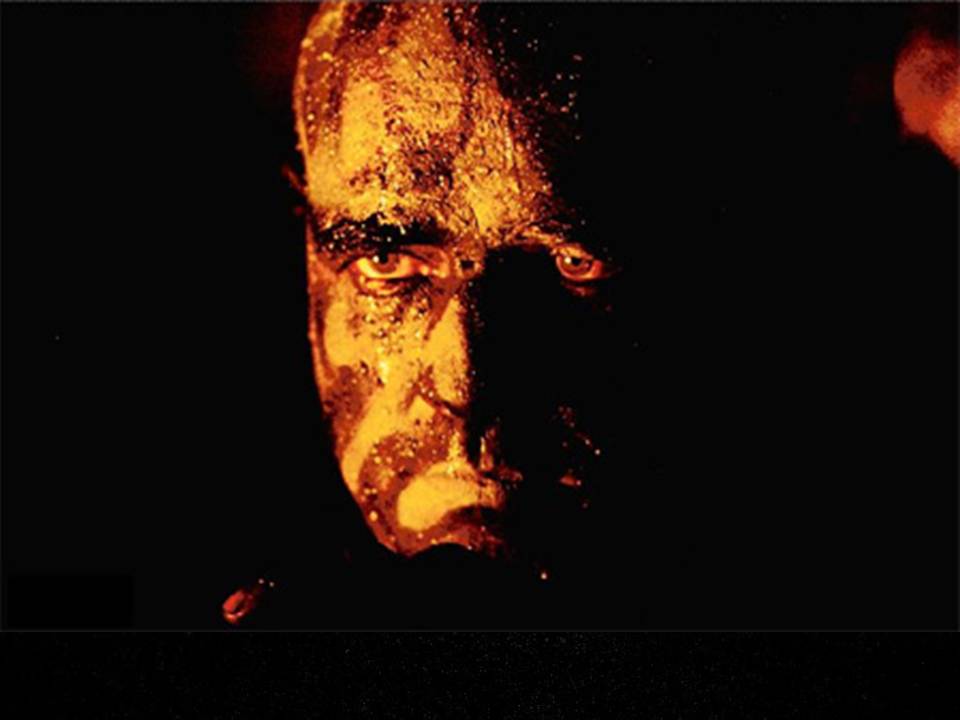
“The horror! The horror!

Charles Cameron sparked a discussion with his doublequotes post on two colonels, the late strategist John Boyd and the fictional monster,  Walter Kurtz from Francis Ford Coppola’s classic Vietnam War film homage to Joseph Conrad Apocalypse Now.  Kurtz is a disturbing figure, one who is recurrent in literature and history going back to Homer’s Iliad. A superlative warrior who excels above all others who nonetheless sheds all trace of civilization in his descent into barbarism. While the fall of a heroic individual can take many narrative forms, Kurtz is of a particular and dreaded kind of fallen man, the warlord.

Warlords are fascinating and repellent figures who seem to thrive best when the normal order of a society is breaking down, permitting the strong and ruthless to carve out their reputations in blood and infamy. As I have written previously:

Kent’s Imperative had a post up that would have been worthy of Coming Anarchy:

Enigmatic biographies of the damned 

“….Via the Economist this week, we learn of the death of an adversary whose kind has nearly been forgotten. Khun Sa was a warlord who amassed a private army and smuggling operation which dominated Asian heroin trafficking from remotest Burma over the course of nearly two decades. In the end, despite indictment in US courts, the politics of a failed state permitted him to retire as an investor and business figure, and to die peacefully in his own bed.

The stories of men such as these however shaped more than a region. They are the defining features of the flow of events in a world of dark globalization. Yet these are not the biographies that are taught in international relations academia, nor even in their counterpart intelligence studies classrooms. The psychology of such men, and the personal and organizational decision-making processes of the non-state groups which amassed power to rival a princeling of Renaissance Europe, are equally as worthy of study both for historical reasons as well as for the lessons they teach about the nature of empowered individuals.

….There are no shortage of warlords for such a study. Among the living we have Walid Jumblatt, the crafty chief of the Druze during the 1980’s civil war in Lebanon, the egomaniacal and democidal Charles Taylor of Liberia, Gulbuddin Hekmatyar the Islamist mujahedin commander and a large assortment of Somali, Colombian, Indonesian and El Salvadoran militiamen and paramilitaries. The history of the twentieth century alone offers up such colorful characters as “The Dogmeat General“, the ghoulishly brutal Ta Mok of the Khmer Rouge, “The Mad Baron” Ungern von SternbergCaptain Hermann Ehrhardt and Pancho Villa among many others.

What would such a historical/cross-cultural/psychological “warlord study” reveal ? Primarily the type of man that the German journalist Konrad Heiden termed “armed bohemians”. Men who are ill-suited to achieving success in an orderly society but are acutely sensitive to minute shifts that they can exploit during times of uncertainty, coupled with an amoral sociopathology to do so ruthlessly. Paranoid and vindictive, they also frequently possess a recklessness akin to bravery and a dramatic sentimentality that charms followers and naive observers alike. Some warlords can manifest a manic energy or regularly display great administrative talents while a minority are little better than half-mad gangsters getting by, for a time, on easy violence, low cunning and lady luck.

Every society, no matter how civilized or polite on the surface, harbors many such men within it. They are like ancient seeds waiting for the drought-breaking rains.

There are occasionally positive portrayals of warlords. Ahmed Shah Massoud, “the Lion of Panjshir” who fought tenaciously first against the Soviets, then later against the murderous Gulbuddin Hekmatyar’s army of thugs and the Taliban’s fanatics, providing a modicum of civilized governance to ordinary Afghans wherever his power ran, until his assassination by al Qaida. The cagey and mercurial Walid Jumblatt, made the transition from Druze warlord in the 1980’s to Lebanese politician and something of an elder statesman.

In literature, Xenophon was the de facto strategos of the retreating Greek mercenaries in The Anabasis of Cyrus, cut a noble example, but like Massoud, this is a rarity. In recent fiction, Stephen Pressfield created as an antagonist in The Profession, General James Salter, a totemic and caesarian figure who takes on the great powers with his PMC forces with impressive ruthlessness. In the popular fantasy series of George R.R. Martin that began with The Game of Thrones, the notable warlord is the outlandish, cruel and somewhat demented Vargo Hoat, who leads a freebooting company of misfit brigands “The Brave Companions“, whose nonstop atrocities and ludicrous pretensions lead all the other characters to call them “the Bloody Mummers“.

Given the world’s recent experiences with the Lord’s Resistance Army, General Butt Naked and the uprisings in Syria and Libya, I think Martin and Coppola have captured warlordism in it’s most frequent incarnation.

The Twilight War—a review

Monday, July 23rd, 2012

[by J. Scott Shipman]

The Twilight War, The Secret History of America’s Thirty-year Conflict with Iran, by David Crist

When President Obama made a heartfelt opening, a smug Iranian leadership viewed it as a ruse or the gesture of a weak leader. Iran spurned him. Obama fell back on sanctions and CENTCOM; Iran fell back into its comfortable bed of terrorism and warmongering. Soon it may no longer be twilight; the light is dimming, and night may well be approaching at long last. [emphasis added]

Thus concludes senior government historian David Crist’s The Twilight War, and be assured Crist’s language is not hyperbole. Crist masterfully details the tumult of U.S.-Iranian relations from the Carter administration to present day. Using recently released and unclassified archived data from principals directly involved in shaping and making American foreign policy, Crist provides the reader an up-front view of “how the sausage is made;” and, as with sausage, the view often isn’t pretty for either side. Crist’s access wasn’t limited to U.S. policy makers, as he conducted interviews with principles on the other side as well, for instance, he had secret meetings/interviews with pro-Iranian Lebanese officials in south Beirut. In all, Crist estimated he interviewed over “four hundred individuals in the United States and overseas.”

Crist begins his story with the Shah of Iran in the last days of his leadership, as popular sentiment was turning against both his regime, as well as his American enablers. He reveals the Carter administration’s fleeting notion of military intervention following the fall of the Shah, and includes details how the clerics reigned in professional Iranian military members, purging the “unreconstructed royalists.” From the start, the U.S. learned how difficult, if indeed impossible, relations were going to be with the new Iranian leadership. One State Department report summed up the situation:

It is clear that we are dealing with an outlook that differs fundamentally from our own, and a chaotic internal situation. Our character, our society are based on optimism—a long history of strength and success, the possibility of equality, the protection of institutions, enshrined in a constitution, the belief in our ability to control our own destiny. Iran, on the other hand has a long and painful history of foreign invasions, occupations, and domination. Their outlook is a function of this history and the solace most Iranians have found in Shi’a Islam. They place a premium on survival. They are manipulative, fatalistic, suspicious, and xenophobic.

While I am certain the writer of this report was not intending to be prophetic, as it turns out this paragraph captures the essence of our conflict. Each American president has thought himself equal to the challenge and each has thus far failed.

The Twilight War includes the birth of Hezbollah, accounts of the Marine barracks bombing in 1983 (from the men who were there), and the details of the Kuwaiti request for American protection of their tanker fleet from the Iranians. From this decision, the U.S. committed military force to protect Middle East oil—a difficult and at times, contentious decision. This decision resulted in continued sporadic confrontations between the U.S. and Iranian forces in the Persian Gulf.

Crist’s book is an illustration writ-large of a book previously reviewed here at Zenpundit.com; Derek Leebaert’s Magic and Mayhem, The Delusions of American Foreign Policy—as both “magic” and “mayhem” figure large in our on-going relationship with Iran. Most U.S. administrations when dealing with Iran came to rely on the “magic, ” and often divorced, or worse, ignored the realities.

At 572 pages, the fast paced narrative is a must read for anyone wanting insight into the origins and issues that remain in the ongoing U.S.-Iran conflict. The Twilight War is exhaustively sourced.  Crist says in the Notes his book was twenty-years in the making and it shows. Further, this book comes with excellent maps, so keeping up with the geography is made easier.

Tom Ricks said, “this is the foreign policy book of the year, perhaps many years,” and Ricks may be right. The Twilight War is an important and timely book on a vital topic, and comes with my strongest recommendation.

Postscript:

A copy of The Twilight War was provided to this reviewer by the publisher.

On the Limits of Human Intelligence

Monday, July 16th, 2012

IQ as a concept (and specifically “g“) and the psychometric instruments used to quantify them has provoked fierce political and scientific debate for decades. The political debate tends to be heatedly emotional and revolve around the inescapably inegalitarian societal implications of crafting policy (education, public health etc.) in light of a wide spectrum of IQ scores being unevenly distributed through the population. Scientific debate tends to be more focused on defining or identifying the parameters of intelligence, the relationship between physical brain structure, cognition and human consciousness,  heritability, neuroplasticity, the accuracy of psychometric instruments and more specialized topics beyond my ken.

What’s usually seldom disputed by scientists is that large differences in IQ are significant and that a very, very small number of individuals – the top 1% to .0001% of the Bell Curve, have unusually gifted and varied cognitive capacities.  It is technically more difficult to measure people who are such extreme outliers with accuracy as their intelligence might very well exceed the parameters of the test. Stephen Hawking’s IQ is frequently estimated in the media to be in the 160’s and Albert Einstein’s in the 150’s but those are speculative guesses. Most of the people touted as being “smarter than Einstein” with astronomical IQ scores, like Marylin vos Savant or Christopher Langan do not (for whatever reason) produce any tangible intellectual work comparable to that of Stephen Hawking, much less Albert Einstein. Maybe we really ought to use that cultural comparison with greater humility until there’s a better empirical basis for it 🙂

[If you are curious what the extremely smart do think about, browse the Noesis journals of The Mega Society]

It is being asserted that any evolutionary improvements to human intelligence are apt to come with (presumably undesired) tradeoffs or deficits. That we are “bumping up against” our “evolutionary limits”. I’m not qualified to evaluate that hypothesis, but it’s assumptions are not stable as advanced societies are already radically changing their cognitive environments as well as approaching the ability to directly manipulate our genetic legacy. Whether it is Kurzweil’ssingularity” or not matters less than these things change the “natural” probability of our evolutionary trajectory. A one in a billion random genetic mutation is no longer so if you can design it in a lab.

How much higher could we push cognition? Or could we expand the existing range by adding a new dimension of senses?

Why would a dictatorship not bound by ethical scruples not do this, even at considerable cost to the individual subjects of such experiments, in order to systematically harness the results of “a genetic arms race” for the benefit of the state? Though a growing body of supersmart people would eventually become difficult to control if your secret police were not intelligent enough to comprehend what they were doing .

The potential economic rewards of increasing human intelligence would inevitably outweigh any risk assessment or ethical constraints.

Putin and Syria: Siloviki Realism in Geopolitical Strategy

Thursday, July 12th, 2012


Russian President Vladimir Putin made a foreign policy speech to Russia’s ambassadors and Foreign Ministry officials that is very much worth reading in context of his dispatch to Syria of a fleet of warships, including a battleship, to the modest Russian naval base in Tartus. Under Putin’s hand, Russian support for the bloody regime of Bashar Assad has consistently been more about safeguarding and expanding Russia’s strategic place in world than about Syria:

….We are forced to admit that no reliable solution for overcoming the global economic crisis has been found yet. Indeed, the prospects are looking more and more worrying. The debt problems in the Eurozone and its slide towards recession are just the tip of the iceberg as far as the global economy’s unresolved structural problems go. The traditional powerhouses of global development – the USA, the EU, and Japan – are seeing their leadership erode, but the absence of new development models is putting a brake on global growth. There is increasing competition for access to resources, and this provokes abnormal fluctuations on the raw materials and energy markets. The traditional Western economic powers are being weakened by the crisis, which has exacerbated social and economic problems in the developed economies, and by the multi-vector nature of global development today. We can already see this for a fact now. 

Colleagues, this is no cause for joy. We should not take delight in this turn of events, and much less feel malicious glee. On the contrary, we cannot but worry over these developments, because the consequences of these tectonic shifts in the global economy are not yet clear, nor are the inevitable shifts in the international balance of power and in global policy that will follow. 

We are all the more worried when we see attempts by some actors in international relations to maintain their traditional influence, often by resorting to unilateral action that runs counter to the principles of international law. We see evidence of this in so-called ‘humanitarian operations’, the export of bomb and missile diplomacy, and intervention in internal conflicts.

We see how contradictory and unbalanced the reform process is in North Africa and the Middle East, and I am sure that many of you still have the tragic events in Libya before your eyes. We cannot allow a repeat of such scenarios in other countries, in Syria, for example. I believe that we must do everything possible to press the parties in this conflict into negotiating a peaceful political solution to all issues of dispute. We must do all we can to facilitate such a dialogue. Of course this is a more complex and subtle undertaking than intervention using brute force from outside, but only this process can guarantee a lasting settlement and future stable development in the region, and in Syria’s case, in the country itself….

It would be harder for Putin to have been more clear about what his priorities were, or that for Russia, R2P as a doctrine has no standing whatsoever in international law [ incidentally, he’s correct on that point] and Syria is not going to be allowed to go the way of Libya, if the Kremlin can prevent it.

Generally, the media reported this speech, highly misleadingly, as Putin’s prediction of “Western decline” when the message was Russia’s opposition to Western military intervention in Syria to remove Assad from power. Putin neither overestimates the means at Russia’s disposal to accomplish his limited objective (blocking intervention) nor inflates his objective to an unrealizable, vaguely defined, abstraction.

Contrast, with the speech on Syria made recently by SECSTATE Hillary Clinton. Here is a snippet that gives the tenor of her remarks:

….What was accomplished in Geneva by the action group was, for the very first time, to enlist not only all five permanent members of the Security Council including Russia and China, but also important leaders in the region and in the Arab League in support of such a transition. The issue now is to determine how best to put into action what was accomplished there and is continuing here. And I really hope everyone reads the communique from Geneva, because for example, one of the earlier speakers from Syria expressed concern there was nothing about political prisoners. Well, indeed there is. And a call for the release from detention. So it would be very helpful to get everybody on the same page if we’re going to work together about what we have already done and what we need to be doing as we move forward.

Under the Geneva communique, the opposition is for the first time put on an even basis with the government. They are given equal power in constituting the transition governing entity that will have, as we just heard, full executive authority. That could not have been imagined three months ago, let alone a year ago.

So although none of us here is satisfied or comfortable with what is still going on inside of Syria, because it is against every norm of international law and human decency for a government to be murdering its own people, there has been in the last several months, starting in Tunisia, a steady, inexorable march toward ending this regime. What we need to do is to follow through on what each of us can contribute to the end of the Assad regime and the beginning of a new day for Syria. 

….Now what can every nation and group represented here do? I ask you to reach out to Russia and China and to not only urge, but demand that they get off the sidelines and begin to support the legitimate aspirations of the Syrian people. It is frankly not enough just to come to the Friends of the Syrian People, because I will tell you very frankly, I don’t think Russia and China believe they are paying any price at all – nothing at all – for standing up on behalf of the Assad regime. The only way that will change is if every nation represented here directly and urgently makes it clear that Russia and China will pay a price, because they are holding up progress – blockading it – that is no longer tolerable. 

First of all, the Secretary of State needs a more effective speechwriter. Period.

Secondly, there is a substantive problem here with an obsession with the minutia of process, possibly because the legal principle behind American policy on Syria is a novelty of intellectuals and is not accepted by two veto-wielding great powers that sit on the UN Security Council. Moreover this focus on minutia of process obstructs clear thinking in regard to the larger geopolitical picture and the ways to get to the end in mind – the removal of Assad’s regime – or the consequences for opposing American policy. Russia and China are told their continued support for the Assad regime, which they see as being in their own interests, is “intolerable” – an outburst of unseemly frustration as we have no stick and strangely offer no carrots for these states to change their positions. Instead we choose to moralize  in public, a diplomatic technique with a long pedigree of failure.

The comparison of statecraft between Russia and the United States is unflattering. Russia has vastly fewer cards to play, but because  Putin has grounded his policy in a siloviki assessment the realities of power, has limited his objectives to those within Russia’s means and related those to the larger diplomatic context that would appeal to other powers, he has played those cards well. Moreover, Putin has positioned Russia to be an indispensable party in a peaceful resolution of the conflict in Syria at very little cost, as Secretary Clinton herself has admitted and capped it off with a naval show of force in the eastern Mediterranean.

We, who have a wealth of resources to employ, have squandered them ineffectively and navigate the ship of state with our heads in the clouds. We forced a vote in the UNSC on Syria, ignoring all signals that the end result would be failure. Syria shoots down a Turkish warplane intruding in it’s airspace (likely at our request) and we had no plan to capitalize on the incident. We gratuitously leak information or disinformation about covert operations that serves more to make us look amateurish than to intimidate our opponents. We do not even appear to be well-informed about the Syrian opposition we are aiding inside Syria, as opposed to expatriate organizations. Some of the fighters in the opposition are as morally objectionable as Assad’s militia thugs and secret police killers.

We play at tactical geopolitics while the Russians do strategy.


Switch to our mobile site