Now Using the POINT of the Spear….
Thursday, May 21st, 2009My esteemed colleague, Michael Tanji, goes knuckles over Think Tank 2.0.
Tanji has my 100 % endorsement.
My esteemed colleague, Michael Tanji, goes knuckles over Think Tank 2.0.
Tanji has my 100 % endorsement.
In line with the vigorous discussion in the comment section of the previous post, Tom Barnett weighs in on Obama’s nuclear utopianism in Esquire Magazine:
3. An America with fewer nukes breeds a new class of military powers.
By reducing “barriers to entry” to the marketplace called great-power war, I believe we would actually encourage the proliferation of nuclear weaponry. If Obama and his successors were to withdraw America’s virtually global nuclear umbrella, numerous middle powers would become highly incentivized to fill that security gap.
Of course, the dream would be to include all such states in a global rejection of nuclear weaponry, but that’s not likely if the system’s clear Leviathan (the United States) demotes itself to the status of a de-nuclearized great power. That scenario (Obama’s scenario) instantly elevates a slew of suddenly “near-peer” military powers in a manner that smaller states will likely find strategically unpalatable. As in, they could be blown into oblivion — strategic or literal — at any moment.
4. A new class of military powers breeds a new round of local wars.The fallout from the collapse of our nuclear umbrella would be as frightening as it would be immediate: the resumption of great-power rivalries and proxy wars in regions once again subject to profound spheres of influence. That would further complicate the strategic landscape and undo so much of the Obama administration’s diplomatic success between now and then.
Read the rest here.
I think that Tom belted it out of the park here. Good policy seldom emerges from bad premises.

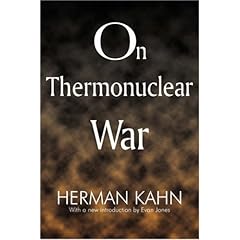
The post title is tongue in cheek. Herman Kahn was anything but wrathful and came across in his day as a remarkably cheerful strategist of the apocalypse and deep futurist. Long time readers have noted my admiration for Kahn’s metacognitive strategies but for those unfamiliar with Herman Kahn, he was one of those polymathic, individuals of the WWII generation who, like Freeman Dyson and Richard Feynman, could jump into high level nuclear physics research without bothering to first acquire a PhD in the field (Feynman later received a doctorate, Dyson and Kahn never did). Kahn was noted for his forthright willingness to consider humanity’s long term prospects despite the worst calamities imaginable – unlike most optimists, he assumed the events most terrible could happen – but life nevertheless would go on. A position that caused many of his critics to go ape, including the editors of Scientific American.
I bring this up because his daughter, Deborah Kahn Cunningham, emailed to say that Kahn’s classic On Thermonuclear War

This could not come at a better time. The Obama administration is making grandiose gestures with America’s nuclear deterrent based less on a hardheaded and comprehensive strategic analysis than self-serving political showmanship, tailored to mollify a Left-wing base deeply resentful of the COIN strategy the administration is starting to take in Afghanistan. Nuclear weapons affect the strategic calculus across the entire spectrum of potential decisions, they’re not just shiny, anachronistic, bargaining chips but the overwhelming reason that great power war came to an end in 1945. Period.
Human nature has not made much moral progress since the end of the Third Reich but its very worst instinct for total destruction has, so far, been held at bay by the certainty of self-destruction.
We need someone to remind us again of how to think about the unthinkable.

The MSM has bumped up against the internet – and lost.
Clay Shirky called it a while ago in Here Comes Everybody: The Power of Organizing Without Organizations
but big media, if they wish to make the leap to to Web 2.0 life, have to leverage the one thing they do better than everyone else, original investigative reporting, that’s where they create value. Instead they are looking for government protection, subsidies or both.
Rupert Murdoch envisions a walled garden strategy but news has a brief shelf life. A high price on all content is a barrier to entry for older news items that just interest a few people. A flat rate drives down their market share for attention, their traffic and in turn, the market value of all the content they own. A sliding scale would be needed that rapidly discounts toward free as public attention on a news item waned.
Right now the media are like a brontosaurus that has just realized it waded into a tar pit.
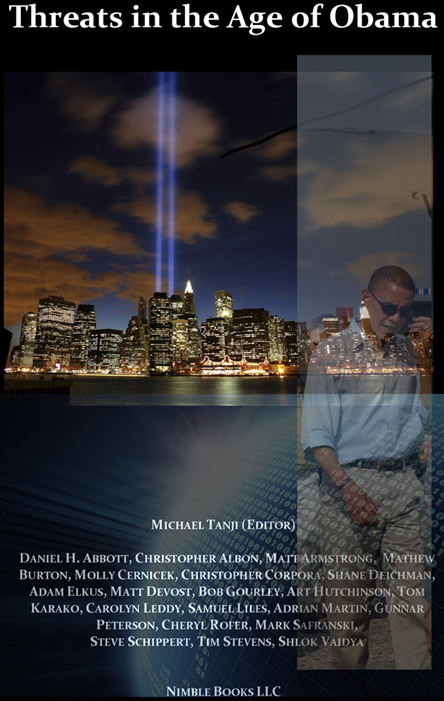
Editor:
Authors:
Dan tdaxp, Christopher Albon, Matt Armstrong, Matthew Burton, Molly Cernicek, Christopher Corpora, Shane Deichman, Adam Elkus, Matt Devost, Bob Gourley, Art Hutchinson, Tom Karako, Carolyn Leddy, Samuel Liles, Adrian Martin, Gunnar Peterson, Cheryl Rofer, Mark Safranski, Steve Schippert, Tim Stevens, and Shlok Vaidya.
President Barack Obama has hit the 100 day mark which has become a traditional (if unfairly high) bar for measuring a new President of the United States during his “honeymoon” period, ever since the historic “first hundred days” of President Franklin Roosevelt, that ushered in the New Deal. At the time, the United States and the world was on the precipice of financial implosion and the Congress effectively permitted Roosevelt to rule by decree, ratifying his crisis management by passing 15 bills of such sweeping scope that the  relationship of the Federal government to the states and the American people was changed forever.
The United States and the world is again in the grip of a great economic crisis, though not quite of the magnitude of the Great Depression, it can be said that only a few presidents in the last century – FDR, Truman, Nixon and Reagan – inherited a similar number of gravely serious problems from their predecessor as did Barack Obama. I was part of the collection of authors of Threats in the Age of Obama
The publisher of Nimble Books, W. F. Zimmerman suggested that the authors take a moment today and asses what we each got right, what we got wrong and what has surprised us regarding Barack Obama’s first 100 days and where we think we are headed.
This request puts me in an odd position because having the last chapter in the book, I opted for a deep futurist perspective to try to cover the “first one hundred years” of Obama with an essay entitled “A Grand Strategy for a Networked Civilization“. Here is an excerpt:
….The difference between leaders today and those in the past – not only past centuries but as recently as the Cold War – is a certain loss of perspective as to longitudinal scale and societal fundamentals. American politicians think primarily in terms of the present, mentally cycling with the nightly news or the upcoming elections, which gives more weight to superficial, tactical, objectives than they deserve, and waste time, resources and opportunities. Not only has the political will to make long term, strategic investments in the national interest faded, it is questionable as to the degree to which they are even considered. The current economic crisis requires action, naturally, but if the incoming Obama administration wishes to make their mark on history, they should give at least as much thought to 2100 as they do to 2010.
….Moral legitimacy of the state, the nature of the homeland it governs and the political economy that satisfies the needs of the people are the fundamentals of strategic calculation; the longer the time frame to be considered, the more that getting the fundamentals right matters.
It is premature for me, given the nature of my chapter, to make a hard and fast judgment yet about where I went right or wrong. I will say that the Obama administration does seem to be taking “moral legitimacy” seriously, as they understand it from their political perspective. Many of President Obama’s gestures in foreign policy, agree or disagree with them, have been designed to recalibrate the global opinion of America’s moral standing as a world leader without costing too much in terms of concessions or cash.
Changing Bush administration policy on Gitmo, “harsh interrogations” and “no negotiations” with adversarial states is an intentional signal that the Obama administration has a different diplomatic posture. On the other hand, the Obama administration has refused to formally sign onto infinitely expensive, utopian, schemes such as Gordon Brown’s “global new deal”. Unlike the Clinton White House in its early days, the administration has also cleverly avoided trying to hand its conservative opponents an outrageous “bright red line” issue like “Gays in the Military” or “Whitewater”, around which Republican activists could galvanize public support and media attention.
What surprised and pleased me is the degree to which the Obama administration has lined up their national security positions behind the leadership of Secretary of Defense Robert Gates, embracing the “military reform” and “COIN” factions as their own. Secretary of State Hillary Clinton is trying to step up the role of the State Department in shaping policy; this is a long term necessity but State isn’t up to the task without a major cultural and organizational overhaul. If Clinton does not invest the effort early, she will be a “road show Secretary” without the supporting cast to be a success. The NSC, by contrast, is being reorganized to maximize presidential control, perhaps to the point of going overboard with micromanagement, if the Somali pirate incident is a representative example. The only senior figure in the administration who seems both out of political step and out of her depth is the Secretary of Homeland Security, Janet Napolitano.
What worries me, naturally, is the political economy aspect and the profound centralization of power over the economy being ushered in by Obama, that is accumulating in the hands of very few people as the response to the economic crisis. The inevitable ripple effect, if such a concentration of power were to become the new status quo, would be one of stasis and stagnation. A globalized economy is too complex an “ecosystem” for top-down, ad hoc, hierarchical management to be an efficient or adaptive response. A re-focus on the fundamentals of new growth and not just legacy dinosaurs is in order.

Zenpundit is a blog dedicated to exploring the intersections of foreign policy, history, military theory, national security,strategic thinking, futurism, cognition and a number of other esoteric pursuits.
Customized Web Site & Blog Design



