zenpundit.com » America

Archive for the ‘America’ Category

Of films, riots and hatred II: when islands are the issue

Monday, September 17th, 2012

[ by Charles Cameron — comparative riotology, with sidelong glances at goats and a single mole ]
.


.

It’s not always disrespect for the Prophet that causes people to burn flags and attempt to break into embassies

This week, the disputed sovereignty of some uninhabited islands has done the trick quite nicely in Beijing, where rioters have attempted to breach the Japanese embassy and burned the Japanese flag (upper image, above) in a manner that’s somehow reminiscent of the breaching of the US embassy and corresponding burning of the US flag (lower image) in Cairo .

I imagine that if one was Japanese or Chinese, one might consider the Beijing protests over the ownership of the Senkaku / Diaoyu / Tiaoyutai Islands to be the primary troubling news-story about embassies, rioting and gross breaches of diplomatic protocol this week.

There’s a strange kind of parallax involved here, I think. Or perhaps: what’s in the foreground depends on where you stand.

But that’s not to say there’s an exact equivalence between the situations, just that bearing one in mind may shed some light on the other.

**

I hope to get into the layers and layers of motivation that feed a riot in a subsequent post, but for now I’d just like to point to one similarity between the two situations. In each case, there’s an undertow of strong feeling that surfaces at a certain point — and astonishes us by its force.

In the case of the disputed islands, it may be Chinese feelings about Japanese behavior towards them in World War II that are triggered by Japanese claims on the islands. As China Daily USA says:

Japan has to recognize China’s sovereignty over the Diaoyu Islands and atone for its past aggressions and atrocities, and take measures to punish those Japanese who deny the country’s violent past, in the way that Germany has been doing for decades. Only if Japan does that will China and other Asian countries see it as a normal country. Otherwise, China should prepare for a long-term struggle.

Or as the Israeli Arutz7 puts it:

As

The dispute with Japan is now part of the legacy of World War II and China claims that under the Potsdam Declaration of 1945, Japan was obligated to return all the territories seized illegally.

The above means that the dispute over the islands is now connected to one of the most highly charged issues in Sino-Japanese history, making it a matter of national honor for the Chinese that is not subject to negotiation.

Note here that the question is expressly one of honor.

It is significant, too, that the Chinese can be described as lenient towards their protesters attaching the sovereign embassy of a sovereign nation, just as the Egyptian government has been described as lenient towards their protesters attacking the sovereign embassy of the United States:

In the interim, China has allowed anti-Japanese demonstrators a relative freehand (“Their feelings are perfectly understandable” explained the Chinese Foreign Ministry) and the Japanese Embassy in Beijing has issued warnings to Japanese citizens and businessmen to take precautionary measures.

**

I strongly believe that undertows, as I am calling them here, are among the most important topics for monitoring and analysis — and that the fact that they so often take us by surprtise is a good reason to pay them closer analytic attention.

They surface in dreams, in graffiti, in conspiracy theories, in all the liminal spaces. And they can have game-changing impact: Great Game Changing impact.

That, btw, is why Cass Sunstein‘s paper on conspiracy theories is one we should consider in detail here on ZP one of these days.

**

Of course, as this recent map from the Economist shows

— there are also oil and gas fields nearby.

What drives a crowd to riot and what interests the powers that be may be two very different sides to the same affair.

**

Curious Goat Fact accompaning the above map:

In the 1970s Japanese ultra-rightists took two goats on a 2,000km (1,250-mile) trip southwest from Tokyo to a group of uninhabited rocks near Taiwan called the Senkaku Islands. In the absence of humans willing to live in such a remote outpost, the hardy creatures would be the vanguard of a new push to solidify Japan’s hold over the islets, which are also claimed by China and Taiwan.

Supplementary Mole Fact:

The Senkaku mole is an endangered species.

**

Does comparing Beijing 2012 with Cairo 2012 change the emphasis with which you view recent events in Cairo and elsewhere?

Do you find the analogy between Cairo 2012 (upper panel above) and Tehran 1979 (lower panel) more convincing?

Look, I think the making of analogies is one of the chief ways — if not the chief way — in which we make “instinctive” judgments, which we then back up with appropriately selected data and reasoning. If you like, it’s subject to our own mental version of undertow in terms of what analogies we chose and how strongly we then weigh them — unless we take responsibility for the process, and begin to explore how it actually works in our own minds, and in the public mind…

Analogy is an extremely powerful instrument of thought — and it’s about time we understood it as well as we understand linear logic.
New Book: Mission Revolution by Jennifer Morrison Taw

Sunday, September 16th, 2012

Mission Revolution: The US Military and Stability Operations by Jennifer Morrison Taw

Columbia University Press just sent me a review copy of Mission Revolution: The US Military and Stability Operations by Jennifer Morrison Taw, an assistant professor of IR/Security Studies at Claremont McKenna College.  Taw has written a very timely book given the looming threat of sequestration – she has investigated and analyzed the institutional and strategic impact of the US having elevated MOOTW (military operations other than war) in 2005 to a DoD mission on par with war-fighting, terming the change a “Revolution”.

[ Parenthetical aside: I recall well Thomas Barnett loudly and persistently calling for the Pentagon to deal with MOOTW by enacting an institutional division of labor between a heavy-duty Leviathan force to handle winning wars and a constabulary System Administration force to win the peace, manage stability, defend the connectivity. Instead, in Iraq and Afghanistan we had one Leviathan force trying to shoehorn in both missions with a shortage of boots, a river of money and a new COIN doctrine. Soon, if budget cuts and force reduction are handled badly we could have one very expensive, poorly structured, force unable to do either mission.]

Thumbing through Mission Revolution, it is critical and well focused take on the spectrum of problems the US has faced in the past ten years trying to make a “whole of government” approach an effective reality in stability operations and counterinsurgency. Taw covers doctrine, training, bureaucratic politics, procurement, policy, grand strategy, mission creep, counterterrorism and foreign policy visions of the civilian leadership, all with generous footnoting.

I am looking forward to reading Mission Revolution and giving it a detailed, in-depth, review in the near future.

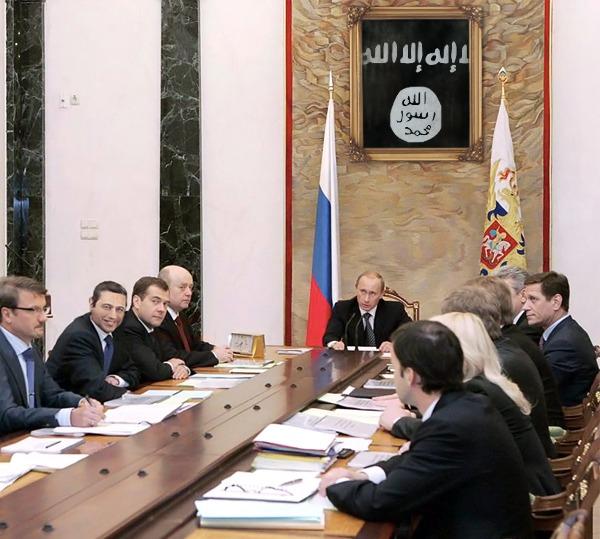
A slight change of ideology at the Kremlin?

Monday, September 10th, 2012

[ by Charles Cameron — with irony, skepticism, and just a dash of dry humor ]
.

image from the Ansar forum, h/t to Aaron Zelin

**

You’re probably familiar with the idea of a jihadist flag flying over the White House. Anjem Choudry, the British radical Islamist preacher told Christiane Amanpour on ABC This Week a while back:

Indeed, we believe that one day the flag of Islam will fly over the White House. Indeed, there’s even a narration of the prophet where he said that ‘the Judgment will not come until a group of my Ummah conquered the White House’.

I’ve dealt with this hadith before as it happens, and pointed out that in one telling the Prophet is asked which “white palace” he’s referring to and replies that he’s referring to the palace of Khosrau (Chosroes) I of Persia:

Jabir b. Samura said:

I heard the Messenger of Allah (may peace be upon him) say on Friday evening, the day on which Ma’ez al-Aslami was stoned to death (for committing adultery): A small force of the Muslims will capture the white house. I said: Kisra? he replied Kisra.

**

Never mind, Choudary thinks the jihadist flag will fly over the White House on Pennsylvania Avenue — and like-minded protesters in New York even carried a photoshopped image of the concept (below) as a placard at a 2006 rally in New York.

**

Hey! Put those two ideas together — a little “more of the same” photoshopping should do the trick — and you’d have a magnificent end to the Cold War, eh?

Maybe that’s what Choudary meant when he said, earlier in the same conversation with Amanpour:

Well, just let me say that Islam has a solution for all of the problems that mankind faces.

I suppose that’s one way to avoid a clash of civilizations — have just one guy holding both cymbals, right?

When the rivers run red

Sunday, September 9th, 2012

[ by Charles Cameron — science and / or apocalypse, quirky, not analytic ]
.

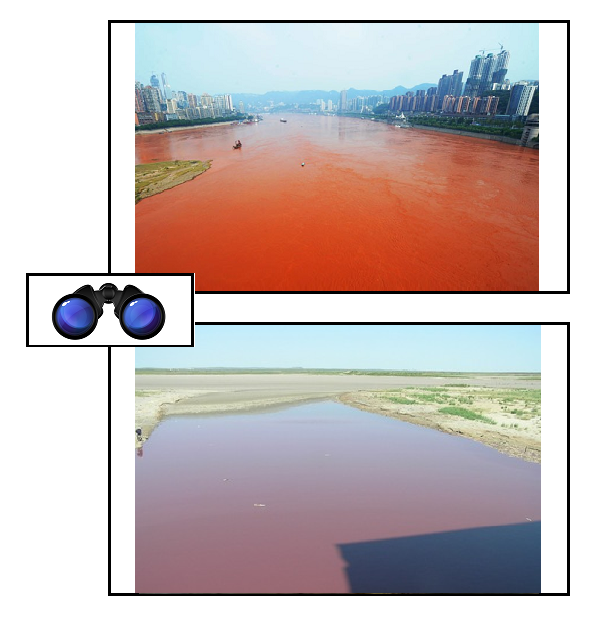
The upper image of this par shows the Yangtze River recently, as reported by the Daily Telegraph under the delightful header, Red China:

I got it from Scence, Space & Robots, which commented:

NDTV reports that Chongqing’s Environmental Protect Bureau is blaming sand for the color change in the river. They claim flooding upstream washed sand downstream which turned the river red.

Okay, so as anyone who has stirred watercolors with their fingers knows, water can be all kinds of colors…

But what it it’s the apocalypse?

That was one possible conclusion Live Science found whehn they asked people about the red color of a lake in Texas (lower image):

The color has some apocalypse believers suggesting that OC Fisher is an early sign of the end of the world, but Texas Parks and Wildlife Inland Fisheries officials say the bloody look is the result of Chromatiaceae bacteria, which thrive in oxygen-deprived water.

So — when you see red water, do you think “aha! daub time” or “ooh, chromatiaceae” — or “OMG, it’s the end, it must be”?

**

Do you prefer to get your explanations for curious events from science, or from religion?

As Caitlin Fitz Gerald — who has an impressive acquaintance with watercolors as the artist behind the Clausewitz for Kids project — kindly tweeted:

John the Revelator puts it this way, in Revelation 16.4:

And the third angel poured out his vial upon the rivers and fountains of waters; and they became blood.

Even the Onion mentions the streets running red, though out of concern for good taste, I won’t quote…

Harvey Mansfield on Elections and Democracy

Friday, August 31st, 2012

Professor Harvey C. Mansfield of Harvard University and a fellow at the Hoover Institution is famous for his scholarship on classical political philosophy (I often recommend his edition on Machiavelli’s Discourses on Livy) as well as his provocative commentary on social and political issues.  While I liked his take on Machiavelli, I warmed to him further when, after his book on manliness came out and some reporter asked Mansfield if it was “manly” to carry a gun? He answered to the effect, “Yes, but not as manly as carrying a sword”.

Mansfield has a new article out in Defining Ideas  on the nature of elections and democracy worth reading:

Are You Smarter Than a Freshman? 

….Machiavelli believes that human beings are divided into the few who want to rule and the many who do not care to rule themselves but do not want to be ruled by others either. Then those who want to rule must conceal their rule from the many they rule if they wish to succeed. How can they do this? Machiavelli went about conceiving a “new mode of ruling,” a hidden government that puts the people “under a dominion they do not see.” Government is hidden when it appears not to be imposed on you from above but when it comes from you, when it is self-imposed.

Machiavelli recounts a psychological truth about humans: “wounds and other evils that a man does upon himself spontaneously and by choice hurt much less than those that are done to you by someone else.” It sounds crazy to claim that it hurts less when you break your leg yourself than when someone or something else does it. But when you do it yourself, the hurt is less because it doesn’t include resentment against whoever or whatever did it to you.

A further step in the argument: The many, the common people, resent government because of the necessary hurts it imposes—as people say, death and taxes. Government demands sacrifices in return for the peace, comfort, and justice it provides. But government hurts less, and is even hidden from you, when it comes from you—when it comes from an election.

An election is not so much a positive choice, as you might suppose from Aristotle, as the purging of resentment against government and the humbling of the few who run for office. As we see in the contest between Obama and Romney, an election forces the rulers to seek our approval, our vote. It enables us to choose one, and perhaps more important, to deny the other. Partisanship often shows itself less in having your side win than in defeating the other side.

In this way, an election allows people to think that their government comes from them, when in fact it remains pretty much the same whether it’s Obama or Romney. The particular candidate may win or lose, but the class of “politicians” that we decry, the few who desire to rule, always wins. For their part, the people indulge in the luxury of throwing out the losing candidate, expressing their resentment against being governed, while (almost) incidentally electing the winner, who then governs in their name with their consent. 

A while back, I had an interesting discussion in the comment section with “SZR” , Duncan Kinder and LC Rees over Donald Kagan’s interpretation of the Athenian statesman and general Nicias.  Kagan’s version of Nicias was a man who feared “the resentment of being governed” of the Mob and who therefore flattered the people with his own modest pretense and that this apprehension led to the disasters that befell Athens in Sicily.  Pericles, too, comes in for criticism by Kagan who is unsympathetic to the advocacy that Thucydides showed toward the former’s defensive strategy.

I think as a rule, Machiavelli’s view of politics proves to win out wherever the system of government is not actively coercing politicians toward’s Aristotle’s ideals of governance. The gravity of the lowest moral common denominator exerts a strong pull in politics in the absence of a countervailing power.


Switch to our mobile site