[ by Charles Cameron — in homage to Admiral Lord Nelson turning a blind eye ]
.
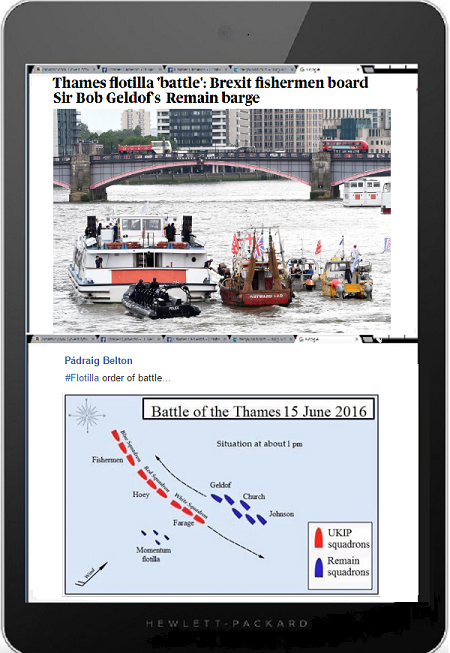
Foolish persons, having no understanding of Britain’s long and cherished history of naval warfare, nor of the contemporary relevance of the Monty Python mode of doing battle, have had the temerity to mock today’s splendid outings or innings on the Thames:
Foolish persons may be satisfied with the visual splendor depicted in the upper panel, but Zenpundit‘s core strategic following will also appreciate the order of battle below.
Reading that tweet set me wondering, not for the first time, what punishments were like in the Royal Navy, say 150 or 200 years ago — not so very many generations in the grand torrent of time.
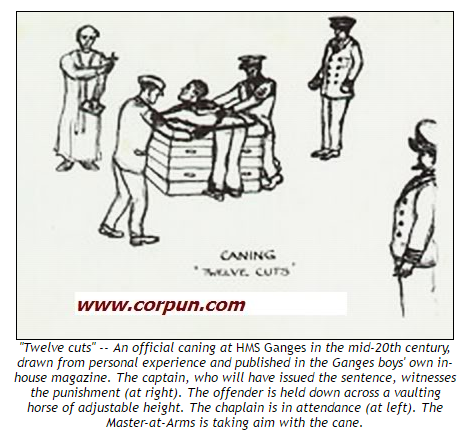
I hail from a Royal Naval family, and hadn’t until today realized quite how recently fierce corporal punishment had been a part of RN training. This image shows the punishment known as Twelve Cuts administered on HMS Ganges, as recalled from his own early years by the singer Jimmy Lee of the Edge of Chaos Orchestra:
A few pertinent details:
Before receiving his punishment, the young man would be given a medical inspection (“the boy’s buttocks are examined and his general physical condition observed” — Admiralty, 1950). He was then marched to the ship’s tailor to be fitted into a pair of extra-thin tropical-weight white cotton duck trousers, with — at least on HMS Ganges — no underwear allowed. (The Admiralty wrote in 1950 that the latter provision “allows the strokes of the cane to be as painful as need be”. They seem not to have been following their own rules, because the King’s Regulations in 1943 had amended the wording to “Caning on the breech, duck trousers with pants being worn”, but perhaps this was intended to apply only to seagoing ships and not the training ships.)
Perhaps some idea of the fruits of such training can be found in this impressive video of Ganges
:
**
That image of the “cuts” brings back sore memories.. though my own treatment was far more lenient.
In my own youth, I was caned as early as age 6 and as late as age 17, the latter beating administered with sincere expressions of regret by my housemaster, the great archaeologist of the Assassins’ castles, Maj. Peter Willey. I’d admitted to doing the (London) Times crossword puzzle in the time allotted for my maths homework, and school regulations left him with no option — I had no option, either.
Six with a bamboo cane was the worst I suffered, so I can barely imagine what twelve cuts, let alone a hundred lashes with a cat-o’-nine-tails, would be like.
In the past, computers have won such games as Pong and Space Invaders:
Google’s AI system, known as AlphaGo, was developed at DeepMind, the AI research house that Google acquired for $400 million in early 2014. DeepMind specializes in both deep learning and reinforcement learning, technologies that allow machines to learn largely on their own. Previously, founder Demis Hassabis and his team had used these techniques in building systems that could play classic Atari videos games like Pong, Breakout, and Space Invaders. In some cases, these system not only outperformed professional game players. They rendered the games ridiculous by playing them in ways no human ever would or could. Apparently, this is what prompted Google’s Larry Page to buy the company.
I can’t corral all the games they’ve played into a single, simple timeline here, because the most interesting discussion I’ve seen is this clip, which moves rapidly from Backgammon via Draughts and Chess to this last few days’ Go matches:
Jeopardy should dfinitely be included somewhere in there, though:
Facing certain defeat at the hands of a room-size I.B.M. computer on Wednesday evening, Ken Jennings, famous for winning 74 games in a row on the TV quiz show, acknowledged the obvious. “I, for one, welcome our new computer overlords,” he wrote on his video screen, borrowing a line from a “Simpsons” episode.
What’s up next? It seems that suggestions included Texas Hold’em Poker and the SAT:
Artificial intelligence experts believe computers are now ready to take on more than board games. Some are putting AI through the ringer with two-player no-limit Texas Hold’ Em poker to see how a computer fairs when it plays against an opponent whose cards it can’t see. Others, like Oren Etzioni at the Allen Institute for Artificial Intelligence, are putting AI through standardized testing like the SATs to see if the computers can understand and answer less predictable questions.
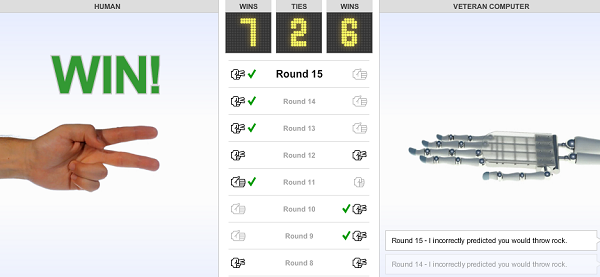
And of course, there’s Rock, Paper, Scissors, which you can still play on the New York Times:
**
Now therefore:
In a follow-up post I want to present what in my view is a much tougher game-challenge to AI than any of the above, namely Hermann Hesse‘s Glass Bead Game, which is a major though not entirely defined feature of his Nobel-winning novel, Das Glasperlenspiel, also known in English as The Glass Bead Game or Magister Ludi.
I believe a game such as my own HipBone variant on Hesse’s would not only make a fine challenge for AI, but also be of use in broadening the skillset of the analytic community, and a suitable response also to the question recently raised on PaxSIMS: Which games would you suggest to the US Navy?
As I say, though, this needs to be written up in detail as it applies to each of those three projects — work is in progress, see you soon.
At first, Fan Hui thought the move was rather odd. But then he saw its beauty.
“It’s not a human move. I’ve never seen a human play this move,” he says. “So beautiful.” It’s a word he keeps repeating. Beautiful. Beautiful. Beautiful.
The move in question was the 37th in the second game of the historic Go match between Lee Sedol, one of the world’s top players, and AlphaGo, an artificially intelligent computing system built by researchers at Google.
[ by Charles Cameron — an experiment in blogging — morality transcending laws, the pope, battleships, jellyfish, & Catholic politicians ]
.
There’s simply so much going on that I need to try a few way of sifting and posting my daily catch. So here’s my experiment. Each day I’ll open a Simply so much post at the start of the day, adding things that catch my eye as I go, and posting either late in the day or the next morning.
The granting of asylum does not fall within the usual logic of statecraft in which a policy is considered from the perspective of the political interests of a governing party, taking into account how it will play to popular prejudices, how it fits with internal party disputes, its consistency with budgetary and other manifesto promises, its influence on the viability of other policies the government wants to pursue, and so on. None of these have standing in the face of the moral emergency of aiding refugees to regain their lives.
It is the “human right” of government officials to say they cannot discharge duties that they believe go against their conscience, Pope Francis told reporters aboard the papal flight back to Rome on Monday.
“I can’t have in mind all cases that can exist about conscience objection,” the pope told reporters on the plane. “But, yes, I can say the conscientious objection is a right that is a part of every human right. It is a right.
“And if a person does not allow others to be a conscientious objector, he denies a right.”
On the most widely accepted account of civil disobedience, famously defended by John Rawls (1971), civil disobedience is a public, non-violent and conscientious breach of law undertaken with the aim of bringing about a change in laws or government policies. On this account, people who engage in civil disobedience are willing to accept the legal consequences of their actions, as this shows their fidelity to the rule of law. Civil disobedience, given its place at the boundary of fidelity to law, is said to fall between legal protest, on the one hand, and conscientious refusal, revolutionary action, militant protest and organised forcible resistance, on the other hand.
I am here representing Jordan, and as a God-fearing, God-loving human being. I am here as a father who wants his children, like yours, to live in a compassionate and more peaceful world.
Such a future is under serious threat from the khawarej, the outlaws of Islam that operate globally today. They target religious differences, hoping to kill cooperation and compassion among the billions of people, of all faiths and communities, who live side-by-side in our many countries. These outlaw gangs use suspicion and ignorance to expand their own power. Worse still is the free hand they grant themselves to distort the word of God to justify the most atrocious crimes.
That phrase, the outlaws of Islam, nicely finesses the ongoing dispute as to whether IS should be termed “nothing to do with Islam” or “Islamic”.
**
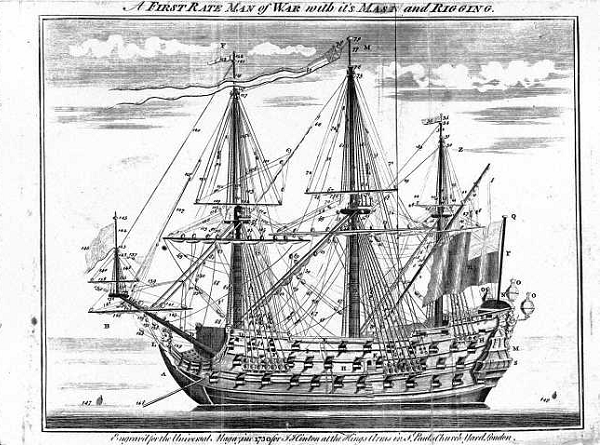
Three variants on the meaning of Man of War:
The British Man of War, c 1750
The Portuguese Man of War:
GF Handel‘s The Lord is a Man of War, from his oratorio Israel in Egypt, 1739:
Zenpundit is a blog dedicated to exploring the intersections of foreign policy, history, military theory, national security,strategic thinking, futurism, cognition and a number of other esoteric pursuits.





.jpg)


