zenpundit.com » navy

Archive for the ‘navy’ Category

The Admirals — a brief review

Thursday, June 7th, 2012

[by J. Scott Shipman]

The Admirals, by Walter R. Borneman

If you have any interest in the lives of the only five-star admirals to serve in the US Navy, this is the book to begin your reading. Mr. Borneman does a masterful job of describing the admirals (LeahyKingNimitz, and Halsey), their lives and contributions to the US victory in WWII. Borneman uses a thematic approach, beginning with short chapters describing the lives of the four subjects and how the admirals came to attend the United States Naval Academy at Annapolis, MD (which they all attended).

Borneman follows with modest chapters on the admirals’ areas of expertise, to include: battleships, submarines, and aircraft carriers. These chapters offer a glimpse into both the strengths and weaknesses of these ships following WWI and how the ships’ roles changed in the years leading up to WWII. Intermixed with the descriptions of the ships, Borneman weaves the admirals into the story illustrating their tastes in ships and their leadership methods.

Borneman follows with a fast-paced story of how these men worked together (and with other big name colleagues like Roosevelt, MacArther, Marshall, and Spruance, to name a few) to achieve victory. From the intricacies of a cogent strategy for the early days of the Pacific, to the conferences between Allied leaders (Roosevelt and Churchill, primarily), to the battles and tactics that shaped the war’s outcome, Borneman’s fine writing presents the admirals, warts and all. As mentioned previously, they were all different, but they were all talented and driven. Borneman quotes retired Vice Admiral Roland N. Smoot, who was in the thick of the Pacific war, speaking after the four had died:

“I’ve tried to analyze the four five-star Admirals that we’ve had in this Navy…You have a man like King—terrifically ‘hew to the line’ hard martinet, stony steely gentleman; the grandfather and really lovable old man Nimitz—the most beloved man I’ve ever know; the complete and utter clown Halsey—a clown but if he said ‘Let’s go to hell together,’ you’d go to hell with him; and then the diplomat Leahy—the open-handed, effluent diplomat Leahy. Four more different men never lived and tehy all got to be five-star admirals, and why?”

Borneman says, “Smoot answered his own question with one word: “leadership.” Smoot continues that each had “the ability to make men admire them one way or the other.” Borneman suggests King got there by “bluster and verve; Nimitz by putting his hand on your shoulder and saying, Let’s get this thing done; Halsey—still the fullback—by rushing through the line in such a way that everyone on the team wanted to go through with him; and Leahy by never letting his own personal feelings, or those of others, interfere with the long-range objectives and best interests of his country.”

If these men sound interesting, it is because they are; the lessons and examples they left behind could use some attention from many of today’s military leaders. The four were smart, tough, and unafraid.

The Admirals is a about 475 pages long, with lots of reference material in the multiple appendixes. Borneman’s writing is so fluid and eloquent, I was able to read in two sittings, and his fine book comes with my strongest recommendation.

Crossposted at tobeortodo.com.

UPDATE: My apologies for a post with so many typos; I was in a hurry, but wanted to get this recommendation out. That said, I’ll try to edit more carefully going forward.

Between the warrior and the monk (i): my father

Tuesday, May 22nd, 2012

[ by Charles Cameron — a warrior, a monk, and where that leaves me ]
.

Like one of those toy acrobats who flips up, over and under when you squeeze or release the two sticks he’s strung on, I’m strung between these two fellows…

and flip up, over and under on the string that stretches from war to peace.

So here I am at Zenpundit, and I thought it might be time for me to give you a little more background about myself, where I’m coming from, and where I hope to be going…

*

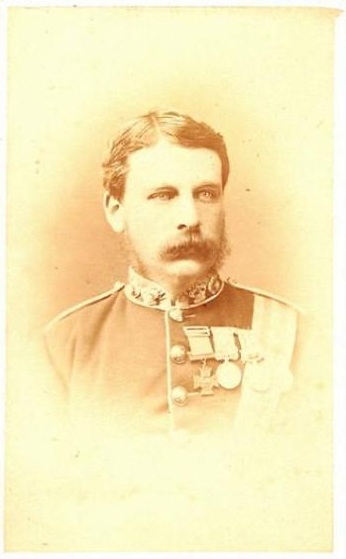
To get to the figure on the left of the image above, Captain Orford Gordon Cameron DSC, RN, my father, we have to track back a couple of generations deeper into family history, to this gentleman whose first name I bear as my own second name.

Col. Aylmer Spicer Cameron, VC, CB, my great-grandfather, earned his Victoria Cross during the Sepoy Rebellion:

For conspicuous bravery on the 30th of March, 1858, at Kotah, in having headed a small party of men, and attacked a body of armed fanatic rebels, strongly posted in a loop-holed house, with one narrow entrance. Lieutenant Cameron stormed the house, and killed three rebels in single combat. He was severely wounded, having lost half of one hand by a stroke from a tulwar.

There’s pride in that, passed down from his son to my father and so on down the line…

*

There’s pride, too, in the story of my own father’s DSC.

HMS Sheffield in Battle of the Barents Sea, stamp design, oil on canvas, Brian Sanders

As gunnery officer of HMS Sheffield in the Battle of the Barents Sea, Lt. Cdr. Cameron’s guns and those of Jamaica crippled the German heavy cruiser Hipper. When the news arrived in Germany, Hitler “with veins standing out on his neck” excoriated Admiral Raeder:

This operation only confirmed what he had instinctively felt all along — that the surface fleet was completely useless and that it was poorly staffed and ineptly commanded. The three battleships Tirpitz ,Schleswig-Holstein and Schlesien , the two pocket battleships Admiral Scheer and Lützow , the battle-cruisers Scharnhorst and Gneisenau , the heavy cruisers Hipper and Prinz Eugen , and the light cruisers Emden , Köln , Leipzig , and Nürnberg would all be decommissioned and summarily scrapped. To the extent possible their guns would be converted to land use. Henceforth, the largest navy ship would be a destroyer and all emphasis would be on the u-boat fleet.

Churchill wrote:

This brilliant action fought by the Royal Navy to protect an Allied convoy to Russia at the end of the year (1942) led directly to a crisis in the enemy’s naval policy and ended the dream of another German High Seas Fleet.

*

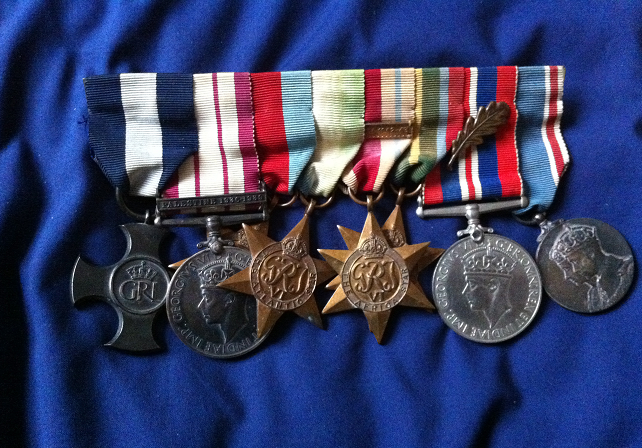
I have been thinking about my father quite a bit recently, since his medals arrived from England about ten days ago:

His DSC, left, was awarded for gallantry in the Barents Sea engagement, for which Cpt. Sherbrooke, on Onslow, was awarded the Victoria Cross, and Rear-Admiral Burnett, on Sheffield, the DSO.

There’s pride there, too.

Gallantry: what a word.

*

And the military strain in the family runs deep…

This photo of my parents’ wedding shows, from left to right in uniform, my grandfather Col. Sir Henry Clayton Darlington KCB, CMG, TD; John Wise; my great uncle Gen. Sir Clement Armitage KCB, CMG, DSO; Jan Newnham (best man); my father, Lt. Cdr. OG Cameron; my grandfather Brig. Orford Somerville Cameron, DSO, RA; my uncle Glenton Roslyn Williams; my uncle Colonel Henry John Darlington, OBE, DL; and Rev. Aylmer Peter Cameron, also my uncle.

Quite the gang — and not a civilian among them, although admittedly the photo was taken in 1942.

My varied aunts — brilliant, eccentric, elegant, delightful, take my word for it — are there too.

*

So that’s my father, and the pole that pulls me towards gallantry and the martial side of things. The other pole is represented by Fr. Trevor Huddleston CR, to the right of my father in the image at the top of this post.

I’ll return to Fr. Trevor in my next installment.

High Ground

Monday, May 21st, 2012

Hat tip to Kanani Fong of Kitchen Dispatch

The award -winning film HIGH GROUND  is due for release in August 2012:

Since 2002, almost 50,000 U.S. soldiers have returned home from Iraq and Afghanistan with their lives radically altered by war. With the improvement of battlefield medical treatments, these soldiers return alive yet not whole, and face long painful paths to recovery.

Full integration back into their community and the civilian world is a treacherous road, fraught with obstacles and pitfalls. After initial rehabilitation, these veterans are often left to fend for themselves, and struggle with physical and mental roadblocks, depression, and alienation.

This issue affects every aspect of society, not just families and hometown communities, but our national character and our legacy. How these wounded soldiers transition is one of the most important repercussions of these wars and an adversity with which we will contend for generations.

igh Ground was a showcase expedition bringing together disabled war veterans with world recognized mountain climbers to demonstrate what could be achieved by climbing a Himalayan giant. A key outcome of the expedition was to produce a documentary film that would tell the inspiring stories of these heroes and spread a healing message to a national audience.

This film, featuring stunning cinematography and capturing powerful emotions, will touch the hearts of concerned citizens, military families, outdoor enthusiasts and most of all, soldiers who find themselves wondering how to face the days and months and years ahead. It is an honest and gripping portrayal of our American warriors, telling an action packed story that unfolds in unexpected ways as the team makes their way high into the mountains, through the villages of Nepal, over raging rivers and up terrifying steep terrain risking injury and death for a chance at the summit.

A second and equally important goal is to continue to impact those thousands of injured soldiers in the midst of their own daunting recoveries through the use of the film at veteran’s hospitals and military bases around the United States. In the fall of 2011, a multi-city nationwide tour will be launched to welcome our soldiers home, celebrate their spirit and sacrifice, and to encourage them to pursue their dreams.

Efforts are currently underway to assess the potential of additional expeditions and to create a long-term strategy as a non-profit organization. By getting involved and supporting this project you can participate directly in this vital process and connect your company to the message that our soldiers can indeed… return home to live again.


“No one is really listening, they are just pretending.” – Madhu

Wednesday, May 2nd, 2012

[by J. Scott Shipman]

As mentioned recently, I’m reading Inventing Grand Strategy and Teaching Command, by Jon Tetsuro Sumida. Chapter 2 is complete, however Sumida included one sentence at the end of the Introduction that has been nagging me. Professor Sumida said, speaking of Alfred Thayer Mahan:

“It remains to be seen whether readers exist with the mind and will to accept his guidance on what necessarily is an arduous intellectual and moral voyage into the realm of war and politics.” (emphasis added)

The phrase “whether readers exist with the mind and will” jumped off the page. Over the last few days I’ve seen several articles of warning of the West’s decline, and while many shed light on symptoms that would indicate decline, most are tired old bromides masquerading as “new thought.” For instance, a few days ago, a friend on Twitter (an Army officer) shared a Tweet from The New Atlanticist of an article called, “Why We Need a Smart NATO.” He tweeted, “Call me a cynic, but haven’t we ALWAYS needed a smart NATO?” Good question. In my estimation, “smart NATO” is yet another venture into sloganeering. While it may call into question my judgement, my first thought on reading “smart NATO,” was a line from the cult movie Idiocracy (if you haven’t seen it, get it) and one scene where the time traveling protagonist is attempting to explain the importance of water to plants to people of the future who use a sports drink instead. Here is the clip:

but it’s got electrolytes…

We’re living in a world of unprecedented availability of information, yet our meta-culture seems indifferent to anything that takes more than a few minutes to consume. Among too many military colleagues I know, it is not uncommon to hear the phrase, “I’ve not read Clausewitz through….nobody does…” And I respond, “But if not you, then who will?” If the practitioners of a profession as serious as the profession of arms don’t read and think deeply, who will? And what will become of the timeless principles learned and recorded at the cost of blood and treasure and how those principles translate into how we fight? I have an abiding fear our military, not out of malice but neglect, is cutting the intellectual cord with the past by making it culturally acceptable to be intellectually indifferent and incurious, to sloganeer instead of think, allowing slogans and PowerPoint as woefully inadequate substitutes. There is no app for intellectual development.

We can’t afford to allow the profession of arms to be anything but intellectually robust and challenging. Zen wrote an excellent summation of the recent posts on disruptive thinkers (which may for some have the ring of sloganeering). However these posts are evidence a lot of the young guys “get it” and want more. Good news, but recognition of the problem is not enough; action is required. Action that may damage a career.

I’m a member of the US Naval Institute, and an on-going concern of the Institute is relevance to the young folks. Yep, relevance. Relevance with a mission statement like this:

“To provide an independent forum for those who dare to read, think, speak, and write in order to advance the professional, literary, and scientific understanding of sea power and other issues critical to national defense.”

Reading, thinking, speaking, and writing requires what Sumida referred to as “mind and will.” Leaders create this condition and desire by example, unambiguous expectations, and by listening, adapting, and sharing their knowledge with subordinates and encouraging them to push their intellect. Good leaders will create a space where deep thinking is expected, where curiosity isn’t the exception, but the rule. Many of our folks in uniform compete in the physical fitness arena and do the hard work necessary to be the best physically, but we need more intellectually rigorous competition in both formal schools and at the unit level. Leaders create this environment, for the best leaders want their people to think. Robert Leonhard in his excellent book, The Principles of War for the Information Age said it best:

“The greatest legacy that a leader can leave behind is a subordinate who is not afraid to think for himself.”

While we can’t pretend to be in good condition or physically fit, some may be tempted to pretend on the intellectual front. Which brings me back to Madhu’s quote: “No one is really listening, they are just pretending.” Doc Madhu, a blog friend and frequent commenter at zenpundit, was commenting on an excellent essay by Mike Few at Carl Prine’s Line of Departure. The essay was titled Finding Niebuhr, and Mike reminds us of Niebuhr’s famous Serenity Prayer:

“Lord, grant me the serenity to accept the things that I cannot change, the courage to change the things that I can, and the wisdom to know the difference.”

Courage and wisdom are virtues enabled by a well-developed, well-rounded, curious intellect. “Pretending” in the profession of arms can have deadly consequences, and more often than not, the pretenders are trying to “be someone” instead of “doing something.” More often than not, this is a group effort, enabled by a crippled culture dominated by groupthink.

Boyd’s challenge continues to ring true:

“To be somebody or to do something. In life there is often a roll call. That’s when you will have to make a decision. To be or to do. Which way will you go?”

This is cross-posted at To Be or To Do.

Supporting Our Troops by Treating them as Children and Drunkards

Friday, March 16th, 2012

Secretary of the Navy, Ray Mabus

This is one of the more inane, disrespectful and lavishly wasteful ideas to come out of the Federal government in some time.

Secretary of the Navy Ray Mabus, who should have more sense, has proposed in his “21st Century Sailor and Marine Initiative” the idea of normalizing a breathalyzer test (!) for Sailors and Marines reporting for duty. Yes, that’s correct. Showing up for duty is going to be regarded as probable cause for drug testing, as if our AVF were composed primarily of skid row derelicts.

Nice move Mr. Secretary. Stay classy.

That this is yet another example of the demeaning, exploitative, contempt towards normal Americans by our Creepy-state bipartisan elite goes without saying, but the reaction of those so insulted is worth noting:

Best Defense (guest post):

….This is among the most paternalistic, professionally insulting concepts I’ve seen in all my years of service, and I’m not sure I will submit. Yes, I know my options, and I just may exercise them and go right over the side the first time the duty blowmeister shoves a plastic tube in my face and treats me like a drunk driver for daring to report for duty. To the CNO, CMC, CMC of the Navy, and SgtMaj of the Marine Corps, here’s my question:  At what point will one of you four exercise your duty to tell the Secretary of the Navy, “Hey, Boss, WTF, over?” and that he really ought to fire whichever clown came up with this idea to screen everyone to identify serial alcohol abusers who are readily identifiable through other means.  One or more of you needs to find the moral courage to recommend relegating this part of the initiative to the dustbin of really bad naval ideas.

USNI Blog (BJ Armstrong):

….Recently a string of new policies and programs have washed over the decks of our Navy. We’re told they are designed to address everything from the surge in CO firings, to alcohol abuse, to the identified need to increase “diversity.” Training, trackers, new layers of bureaucratic offices, and new ways of testing/identifying the “bad apples” are all in the works. Some of the initiatives appear more connected to reality than others. The issues, like sexual assault and substance abuse, are serious and are challenges that our Navy should be addressing. In many cases, however, we are attempting to install programmatic and bureaucratic solutions to what are essentially humanistic problems. These are problems of leadership, character, and integrity and must be addressed with wisdom as much as programs and bureaucracy.

I suspect, if we were to scrape away the insincerely saccharine and frankly deceptive rhetoric offered by Mabus for this kind of a camel’s nose in the tent program, we will see old fashioned venality at work.  Off the shelf commercial breathalyzers are not exactly cheap and testing 500,000 active duty personnel who make up the Navy and Marine Corps daily,(!) the DoD civilian contractor support for counseling and “training” program development, supplemental extensions for testing the reserves and so on, will represent lucrative paydays in the billions for somebody.

Will those “somebodies” be friends of the current administration? Let’s place our bets now.

[ Sidebar: Let’s also guess how long before this initiative is extended elsewhere, in the civilian world, with results, recorded, tracked and shared without your consent by your employer. Can’t happen here? Oh, Really? I bet you once never expected to have government employees demand to take nude pictures of you at the airport either]

The diversion of resources this proposed insanity represents from warfighting, acquisition, real military training or PME, medical care for our wounded or a thousand other authentic needs of the Navy or Marine Corps would be a scandal in an earlier era.  But we do not live in an earlier era, and the defense budget is just another pile of seed corn to eat as far as the beltway boomer oligarchy are concerned.

Arthur Wellesley, the Duke of Wellington, Great Britain’s greatest military hero, when asked about his soldiers, described them as “The scum of the Earth, enlisted for drink”.  Winston Churchill, over a century later, said the culture of the Royal Navy was based upon “Rum, sodomy and the lash”. This encapsulates an aristocratic worldview of rulers toward their servants and comprises a long military tradition in whose footsteps Navy Secretary Mabus is following.

It just isn’t an American military tradition.


Switch to our mobile site