zenpundit.com » symmetry

Archive for the ‘symmetry’ Category

The Year of Living Memory

Wednesday, April 6th, 2011

[ by Charles Cameron ]

*

Some people’s — and more to the point, some peoples’ — living memory appears to be longer than others. China, for instance, has what you might call long term living memory.

*

But first, the Crusades. When Bush 43 first used the word “crusade” in reference to the US response to 9/11, I went to Google and checked, and the first listing for “crusade against” that came up was to The Crusade Against Dental Amalgam. I’m the suspicious type, and as I suspected, the word “crusade” simply doesn’t have the same valence for most twenty-first century Americans that it has for many in the twenty-first century Arab world. In the US, a crusade is a concerted effort to change just about anything, the use of mercury in dental fillings being just one example.

Across the Arab world, however, the word has very different connotations: thus Amin Maalouf writes in The Crusades through Arab Eyes:

The Turk Mehmet Ali Agca, who tried to shoot the pope on 13 May 1981, had expressed himself in a letter in these terms: I have decided to kill John Paul II, supreme commander of the Crusades. Beyond this individual act, it seems clear that the Arab East still sees the West as a natural enemy. Against that enemy, any hostile action — be it political, military, or based on oil — is considered no more than legitimate vengeance. And there can be no doubt that the schism between the two worlds dates from the Crusades, deeply felt by the Arabs, even today, as an act of rape.

That’s long term living memory for you.

*

I’m writing this because I just read a fascinating article by Robert Barnett on the New York Review of Books blog titled The Dalai Lama’s ‘Deception’: Why a Seventeenth-Century Decree Matters to Beijing — need I say more?

The title will suffice for those who don’t have much time today — I understand, we’re all under the fire-hose one way or another — while those with the ability to sneak in ten or fifteen minutes laterally while the clock’s not watching can and should definitely read the whole thing…

*

I have just one side-observation though — the article tells us, among many other things directly relating to Tibet and the history of the Dalai Lamas:

And again, when Jiang Zemin made a brutal decision to annihilate the basically harmless Falungong cult in 1999, it is believed that he saw it as analogous to the religious movement that had started the Taiping Rebellion and nearly toppled the Qing in the mid-19th century.

I think that’s right — but what Barnett doesn’t mention, since Taiping is only an aside for him, is that the rebellion was only eventually quelled at the cost of between twenty and thirty million lives…

I mentioned my own hunch that memories of Taiping were behind the Chinese government’s fierce response to Falun Gong in question time after Ali A Allawi‘s talk on Mahdist movements in Iraq at the Jamestown Foundation a few years back, and he responded that similarly, the reason the Iraqi government took such fierce action against a small Mahdist uprising near Najaf — even calling in US air support as I recall, for an incident perhaps best compared in US terms with Waco — was that they remembered the Babi movement in their own neck of the woods, and the tens of thousands who died back in the 1850s, around the same time as the Taiping in China.

*

Living memory — which could almost be a definition of history, or at least of what historical research aims to create — can itself be long term or short, perishable or perennial.

And then there’s Psalm 90, which declares “For a thousand years in thy sight are but as yesterday when it is past, and as a watch in the night.”

Now (and I’m being playful here, albeit with a touch of serious intent) does that suggest a Memory that reaches back in perfect detail through the eons to the Big Bang and perhaps before it? Or … “twentieth century? nineteenth? the Crusades?.. it’s all a bit of a blur, I’m afraid — it all rushes by so fast…”

*

There seems to be a choice set before us as individuals — and more to the point, as peoples:

Shall we choose Lethe, and the restfulness of oblivion, or Mnemosyne — the mother of all Muses? There are, you know, immediate educational implications, and serious geopolitical implications down the road, for the choice we make…

The etiquette of inflight prayer

Saturday, April 2nd, 2011

[ by Charles Cameron ]

*

The other day, three Orthodox Jews prayed aloud with “something that appeared to the flight attendants to be strapped under their clothing” on Alaska Airlines Flight 241 from Mexico to Los Angeles, and were greeted by the FBI on landing…

Just for the record, this is not the first time that a Jew wearing tefillin and praying in Hebrew on an airliner has been suspected of being a terrorist – just the most recent. AS CBS News reported on January 21st of last year:

A religious Jew wearing a series of black boxes and leather straps called tefillin or phylacteries inadvertently set off a bomb scare on a US Airways flight to Kentucky.

And apparently it doesn’t matter too much what language you pray in, or which of the Abrahamic faiths you belong to…

quo-inflight-prayers.gif

Islam, Judaism, Hebrew, Arabic… even the Christian Lord’s Prayer in English can do the trick if you shout it loud enough:

Maria Busuttil, 60, said a burly Caribbean man in his early 30s put all the passengers on edge on Tuesday when just before take-off from London Heathrow he left his seat, knelt down in the aisle and started bellowing the Our Father in English. [ … ] The man, who had dark skin and dreadlocks, was holding an orange Sainsbury’s plastic bag, which some passengers feared could have contained some sort of explosive. “He didn’t want to take his seat. He was on his knees, shouting ‘Our Father who art in heaven’, as if he were a preacher… It was like he was saying his last prayer before he dies… it was very scary.”

Jesus recommends praying in private rather than standing up and doing it publicly in synagogues – “pray to thy Father which is in secret; and thy Father which seeth in secret shall reward thee openly” – or, by implication, surely, jetliners… And any agnostic passengers can breathe a sigh of relief…

Of the Mahdi and the Matrix

Saturday, April 2nd, 2011

[ by Charles Cameron ]

*

There’s a book by Douglas Harding that I very much doubt Samir Khan has read, which may still be relevant to the ad in Inspire #4 that Jarret Brachman pointed to in this piece on Cronus Global — in which he notes the parallel between Inspire‘s ad featuring the choice between paradise and hell, and the choice featured in The Matrix between the blue and red pills…

jarret.jpg

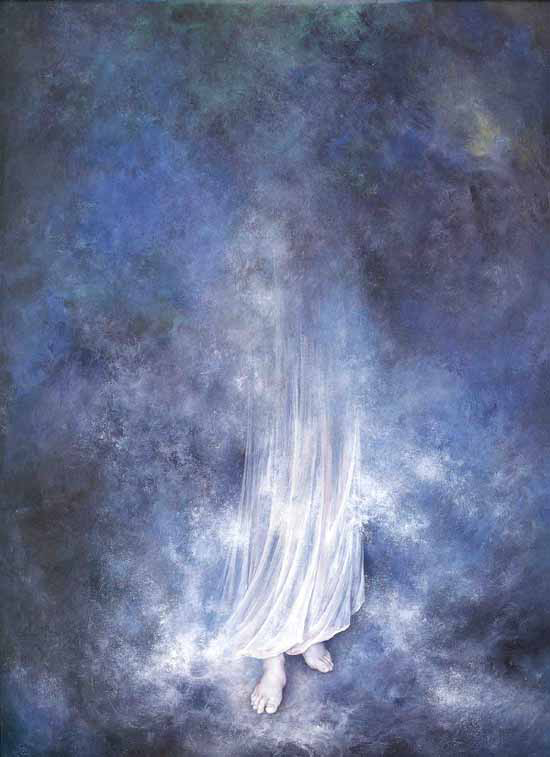
That image, with its headless figure, put me in mind of another image that greatly interests me — a portrayal of the Imam Mahdi by Mahmud Farshchian — so I rescued it from my files to see if it was a good enough match with the ad for me to suggest a possible second graphic influence to Jarret:

16_imam-zaman2.jpg

Not surprisingly perhaps — considering that Samir Khan’s work is, putting it crudely, an advertising graphic, whereas Farshchian’s is a work of devotional art, and that furthermore Inspire is a Salafi-jihadist journal while Farshchian is a pious Shi’ite — the match isn’t close enough for me to argue influence…

But it did set me thinking.

*

The title of the Harding book to which I referred above is On Having no Head, and although it now carries the subtitle Zen and the Rediscovery of the Obvious it actually draws on Islamic traditions quite a bit, quoting Rumi:

Behead yourself! … Dissolve your whole body into Vision: become seeing, seeing, seeing!

and Attar:

Cover your breast with nothingness, and draw over your head the robe of non-existence.

and proposing — I’m putting this into my own words, now — the notion that the physical form of a human face is in some sense no more than a mask, veil or hijab over that light “which lighteth every man that cometh into the world” (John 1.9) — a light too profound for the conventional gaze.

And it is this profundity, attributed in Islam to the prophets in general and superlatively to Muhammad, which makes their literal portrayal a matter of some controversy…

*

Farshchian’s Imam Mahdi, like Khan’s Islamist Morpheus, is headless, I’m suggesting, because, to speak figuratively, radiance has taken the place of the face.

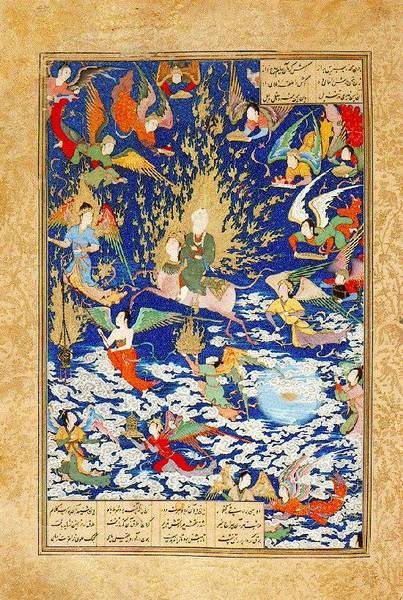
Which is also why, in this image of what must be for Muslims one of the holiest nights in the history of the world, the Night of the Mi’raj, the Prophet is portrayed without a face — or veiled — in this Persian miniature:

miraj_by_sultan_muhammad.jpg

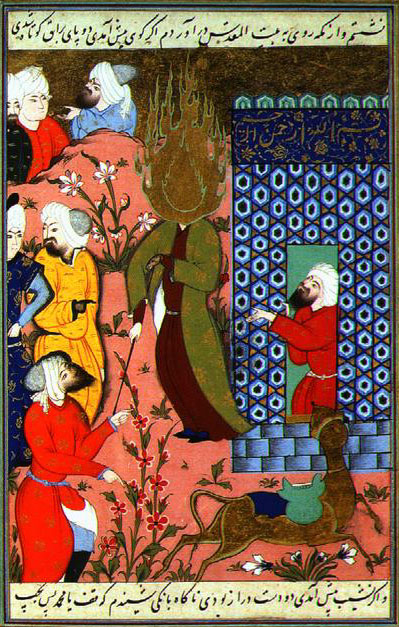
and transfigured by his own fiery “halo” of illumination in this one:

muhammad_miraj1.jpeg

Of the tsunami and Mt. Fuji

Friday, April 1st, 2011

[ by Charles Cameron — cross-posted from ChicagoBoyz ]

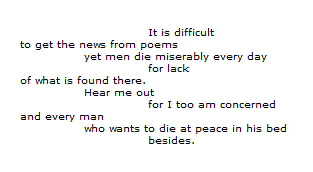
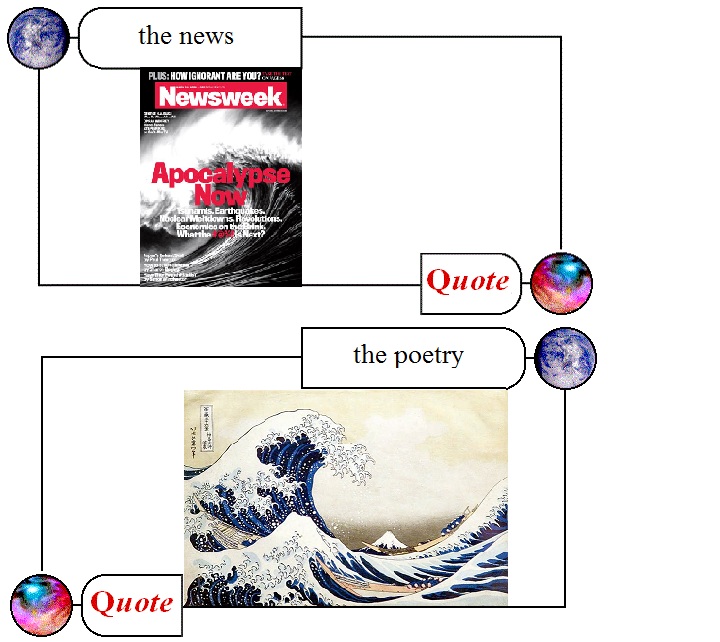
I’ve been thinking quite a bit about William Carlos Williams and his observation in Asphodel, That Greeny Flower:

Our news media blare with (apocalyptic but not revelatory) trumpets…

while Hokusai, painting circa 1831, conveys the vulnerability of the (Japanese and human) situation with his image of boats in a storm.

*

Here’s Dr. Barnett, in my own transcript of his video this week:

The surprise factor here really shouldn’t exist in our minds. I mean the mega-disaster of a tsunami plus and earthquake plus a nuclear meltdown in Japan – well, those three are already highly linked. Japan highly depends on nuclear power, it’s one of the most seismically active island chains in the world, and tsunami is a Japanese word. So if you are going to put a forty year old very aging early technology nuclear power plant right on the coast in Japan, the only mega-disaster you’re going to get there is an earthquake-triggered, tsunami-delivered nuclear meltdown. So these are not surprising connections, we’re just bumping into the connectivity that’s natural and only becoming more expansive as globalization advances.

That’s exactly right – and Hokusai should have been an early warning.

The only thing missing from Barnett’s analysis, and present in Hokusai, is Mt. Fuji – or what TS Eliot (to circle back again to “verbal” poetry) would call “the still point of the turning world”.

Duel in slow time

Friday, April 1st, 2011

[ by Charles Cameron ]


In slomo –

as in the slow rotating
backseat of a hurtling flipping car –

at that most divine of speeds at which
concentration arrives and
all is revealed –

as when Krishna himself bears
each arrow loosed from his
left-handed archer Arjuna’s drawn bow
to some fine warrior’s

doom

we see: all contest is
cooperation,
each edged duel, a true duet…


Switch to our mobile site