zenpundit.com » art

Archive for the ‘art’ Category

Intelligence vs the Artificial

Friday, January 16th, 2015

[ by Charles Cameron — who believes that detours are the spice of life ]
.

Craig Kaplan:
Craig Kaplan

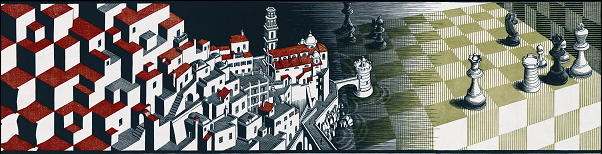
Maurits Escher:

M Escher

**

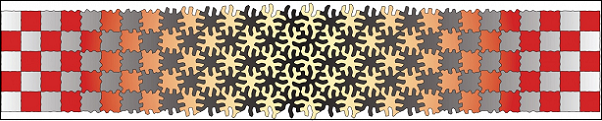
There’s a fasacinating article about Craig Kaplan and his work with tiling that I came across today, Crazy paving: the twisted world of parquet deformations — I highly recommend it to anyone interested in pattern — and I highly recommend anyone uninterested in pattern to get interested!

Kaplan himself is no stranger to Escher’s work, obviously enough — he’s even written a paper, Metamorphosis in Escher’s Art — the abstract reads:

M.C. Escher returned often to the themes of metamorphosis and deformation in his art, using a small set of pictorial devices to express this theme. I classify Escher’s various approaches to metamorphosis, and relate them to the works in which they appear. I also discuss the mathematical challenges that arise in attempting to formalize one of these devices so that it can be applied reliably.

I mean Kaplan no dishonor, then, when I say that his algorithmic tilings, as seen in the upper panel above, still necessarily lack something that his mentor’s images have, as seen in the lower panel — a quirky willingness to go beyond pattern into a deeper pattern, as when the turreted outcropping of a small Italian town on the Amalfi coast becomes a rook in the game of chess

**

Comparing one with the other, I am reminded of the differences between quantitative and qualitative approaches to understanding, of SIGINT and HUMINT in terms of the types of intelligence collected — and at the philosophical limit, of the very notions of quantity and quality.

Sunday surprise: ways of viewing

Sunday, January 11th, 2015

[ by Charles Cameron — asymmetries, for your delectation ]
.

SPEC DQ ways of looking

**

Sources:

  • 36 Views of Mount Fuji, Hokusai Katsushika
  • Thirteen Ways of Looking at a Blackbird, Wallace Stevens [link corrected]
  • Paris, the Prophet and his veiled face

    Sunday, January 11th, 2015

    [ by Charles Cameron — the role of iconography vs idolatry within Islam and Christianity ]
    .

    Karim Sadjadpour of the Carnegie Endowment for International Peace tweeted an image of Muhammad today:

    This image, according to Wikipedia, is not merely Persian but specifically Shiite, “reflecting the new, Safavid convention of depicting Muhammad veiled”. It is also non-satirical.

    As such, it is neither offensive in the sense of insulting the person of the Prophet, nor does it in fact show the features of his face, nor is it the product of the Sunni “mainstream” branch of Islam.

    **

    In considering the revulsion that many Muslims feel at the images of their Prophet in Charlie Hebdo, it may be helpful to understand the respect in which the Prophet is held within their faith.

    The Qur’an says of the Prophet:

    And We have not sent you but as a mercy to the worlds.

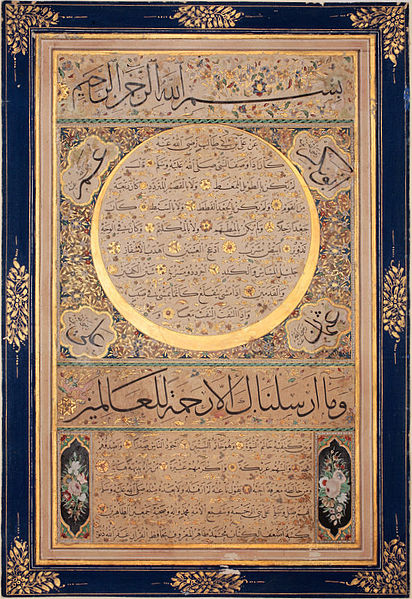
    Muhammad is sent “as a mercy”, and thus whatever representation of the Prophet, his words and deeds serves to carry human thought towards the divine participates in that divine mercy, whereas whatever representation scorns that mercy or merely distracts us from it is to be avoided.

    The normative manner in which the Prophet is represented within Islam, then, is abstract and calligraphic, with the artist showing devotion and respect for the Prophet through the care with which the work itself is endowed with beauty:

    412px-Hilye-i_serif_7

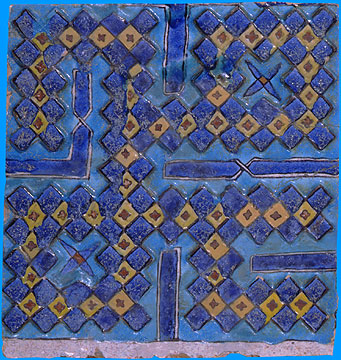
    Simpler, and in its own way no less beautiful, is this calligraphic representation of the Prophet’s name in tile from Samarkand:

    Muhammad_calligraphy_tile

    **

    Icon or idol?

    One facet of the controversy over Charlie Hebdo has to do, then, with a deep issue in representation, which crops up elsewhere in the jihadists’ relish in destroying “idols” — the Bamiyan Buddhas, yes, but also the tombs of Muslim prophets and saints; there has even been discussion within Saudi circles of the destruction on the Prophet’s tomb and relocation of his remains to an anonymous grave.

    Within Christianity, there have been those who encouraged the painting of icons, believing that they carry the minds and hearts of believers deep into the mysteries of faith — and those who would tear them down, holding them to be “graven images” (via Judaism, Exodus 20.4) that give mind and heart a resting place far short of those same mysteries: iconodules and iconoclasts.

    Wars have been fought in Christendom too over such questions [in both East and West].

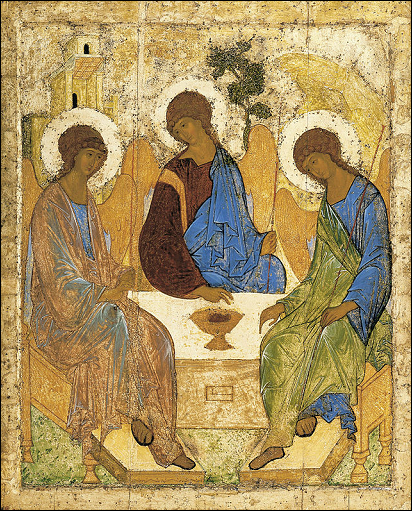
    The great Russian iconographer Andrei Rublev‘s most celebrated icon is often referred to as The Trinity — though literally (or should I say, figuratively) speaking, it portrays the three angels who visited Abraham at the Oak of Mamre (Genesis 18. 1-15):

    Rublev Trinity icon

    It is significant for our context that Rublev has not in fact attempted to portray the Trinity, a mystery deemed beyond human comprehension — the Athanasian Creed, speaking of the Three Persons in one God says explicitly “there are not three incomprehensibles .. but one incomprehensible” — but these three angels, considered as “types” or foreshadowings of the Trinity, which can therefore both veil and represent it.

    Paris: pen and sword

    Thursday, January 8th, 2015

    [ by Charles Cameron — my father was a gunnery officer & I’m a writer — sword > word > world? ]
    .

    The pen and sword issue is fundamentally that of word and deed, isn’t it? Only in this case, the “pen” is “pen and paint”.

    **

    and then again:

    **

    Will we ever get to the bottom of this complex of koans, in which our thoughts are part of the very reality they purport to represent?

    You remember Goethe‘s Faust wanted to translate In the beginning was the Word as In the beginning was the deed?

    In the beginning was the..

  • hush
  • thought

  • image

  • word

  • deed

  • fact
  • The relationship between thought and world — word and world, image and world — is of utmost importance and, I suspect, far from easily grasped by anything less than battering one’s head against reality.

    Paris: cartoons on cartoons

    Thursday, January 8th, 2015

    [ by Charles Cameron — free speech, speech balloon style ]
    .

    This one’s background, so we understand the vibe of Charlie Hebdo:

    **

    Here’s Charlie Hebdo‘s last cartoon before the massacre — probably too recent to be the source of what looks to have been a carefully planned attack:

    **

    And a suggestion: the shortest distance between prediction and prophecy is via instinct:

    It’s the sense that a scenario is uncannily close to what actually happens later that gives us, in hindsight, the sense that it was prophetic rather than predictive: it’s the frisson, the shiver, that makes the cognitive difference.


    Switch to our mobile site