Intelligence vs the Artificial
Friday, January 16th, 2015[ by Charles Cameron — who believes that detours are the spice of life ]
.
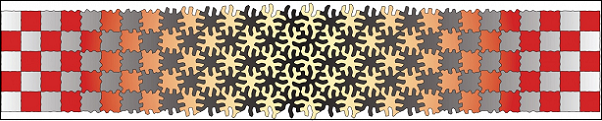
Craig Kaplan:
Maurits Escher:
**
There’s a fasacinating article about Craig Kaplan and his work with tiling that I came across today, Crazy paving: the twisted world of parquet deformations — I highly recommend it to anyone interested in pattern — and I highly recommend anyone uninterested in pattern to get interested!
Kaplan himself is no stranger to Escher’s work, obviously enough — he’s even written a paper, Metamorphosis in Escher’s Art — the abstract reads:
M.C. Escher returned often to the themes of metamorphosis and deformation in his art, using a small set of pictorial devices to express this theme. I classify Escher’s various approaches to metamorphosis, and relate them to the works in which they appear. I also discuss the mathematical challenges that arise in attempting to formalize one of these devices so that it can be applied reliably.
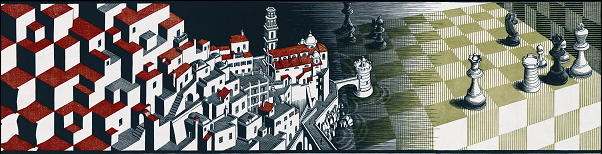
I mean Kaplan no dishonor, then, when I say that his algorithmic tilings, as seen in the upper panel above, still necessarily lack something that his mentor’s images have, as seen in the lower panel — a quirky willingness to go beyond pattern into a deeper pattern, as when the turreted outcropping of a small Italian town on the Amalfi coast becomes a rook in the game of chess…
**
Comparing one with the other, I am reminded of the differences between quantitative and qualitative approaches to understanding, of SIGINT and HUMINT in terms of the types of intelligence collected — and at the philosophical limit, of the very notions of quantity and quality.