zenpundit.com » military

Archive for the ‘military’ Category

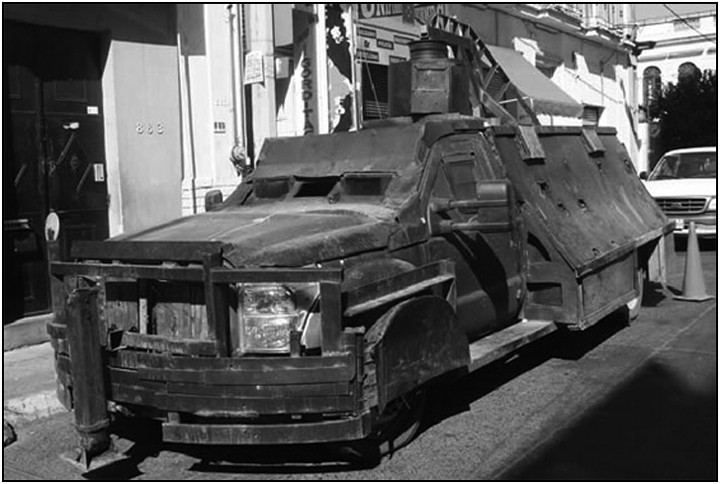
Heavy Metal: When Irregulars Go Armored

Saturday, November 2nd, 2013

[by Mark Safranski, a.k.a. “zen“]

If the symbol of the 20th century insurgent was the AK-47 and a red banner, his 21st century counterpart may someday be recognized by the suicide belt and the “homemade tank”. Irregular fighters have always used light arms, civilian passenger vehicles and armor captured (or donated by) from conventional armies, but the ability to produce serviceable fighting armored cars is a new wrinkle. They could not stand up to an American or Russian tank company, of course, but they are not meant to do so.

Most prevalent and evolved in Mexico’s narco-insurgency where cartels use these “monsters” converted from SUVs and various types of light and heavy trucks to battle one another and as “troop carriers” but these DIY armored vehicles have also appeared in the recent Libyan and ongoing Syrian civil wars. Where heavy anti-tank weapons, air power and real tanks are scarce, these narco-tanks are useful additions to irregular combat power and convey an intimidating image to lightly armed police and the public.

Dr. Robert Bunker and Byron Ramirez, with the support of Small Wars Journal, Borderland Beat.com and the Foreign Military Studies Office at Fort Leavenworth, have a new scholarly compilation on the subject of irregular use of DIY armor in Mexico:

Narco Armor : Improvised Armored Fighting Vehicles in Mexico

….The wave of violence that has left thousands dead began in early 2005, when former Mexican
president Vicente Fox sent government troops to Tamaulipas to fight the cartels. For the past
seven years the government has ordered its military to fight the cartels directly, which, in turn,
has led drug cartels to improvise and develop their own methods of warfare to combat both
government troops and other competing cartels.

The extreme rivalry among various Mexican drug cartels for regional control of the drug trade
market has yielded an arms race. The following collection of articles and images addresses a
segment of the military technology utilized by violent non-state actors during this period: “narco armor” or, more accurately, improvised armored fighting vehicles (IAFV).

….Mexican cartel use of IAFVs and armored sport utility vehicles (ASUV) may yield some
important lessons for military counter-criminal insurgency efforts. Still, many unanswered
questions exist concerning the fielding of narco armor in Mexico. Reports of these vehicles
being fielded span roughly from mid-2010 to the beginning of 2012, with a spike in activity 5
surrounding them taking place around mid-2011. These vehicles had predominantly been utilized

in the Mexican state of Tamaulipas in engagements between the Zetas and Gulf cartels and in a
few other locales (see Map Locations). While it has been said that the Mexican government has
seized well over one hundred of these vehicles, only about two dozen photographic examples
exist per our research (see Picture Gallery).

….Given the apparent cessation of the fielding of narco armor since early 2012, quite possibly these vehicles have reached an evolutionary dead end, with more emphasis once again placed by the cartels on fielding more stealth-masked armored vehicles, such as armored SUVs, that better blend in with civilian cars and trucks so as to eluded identification and targeting by Mexican federal forces. Still, given the ever changing conflict waging in Mexico among the cartels and against the Mexican government, future resumption of IAFV employment will always remain a potential. 

Read the rest here.

During the Russian civil war (1917-1922), armored trains complete with heavy machine guns and artillery were used by both Bolshevik and White armies across the vast expanse of the Eurasian steppe and the armored train subsequently made spotty appearances in civil wars in China and Spain before fading away. This less likely to happen with homemade armor which is smaller and infinitely more mobile and can be created in a sufficiently large garage with time, elbow grease and a supply of scrap metal.

New Article up at Pragati: Lethal Ideas & Insurgent Memories – Review of The Violent Image

Friday, October 25th, 2013

[by Mark Safranski, a.k.a. “zen“]


The Violent Image by Neville Bolt 

I have a new book review up at Pragati this morning:

Lethal ideas and insurgent memory 

….One expert who does acknowledge a paradigmatic shift and posits a powerful explanatory model for the behavior of what he terms “the new revolutionaries” is Dr Neville Bolt of the War Studies Department of King’s College, London and author of The Violent Image: Insurgent Propaganda and the New Revolutionaries. Taking a constructivist view of irregular military conflict as the means by which insurgents weave an enduring political narrative of mythic power and shape historical memory, Bolt eschews some cherished strategic tenets of realists and Clausewitzians. The ecology of social media, powered by decentralised, instant communication platforms and the breakdown of formerly autarkic or regulated polities under the corrosive effects of capitalist market expansion, have been, in Bolt’s view, strategic game changers “creating room to maneuver” in a new “cognitive battlespace” for “complex insurgencies”.  Violent “Propaganda of the Deed”, once the nihilistic signature of 19th century Anarchist-terrorist groups like the People’s Will, has reemerged in the 21stcentury’s continuous media attention environment as a critical tool for insurgents to compress time and space through “…a dramatic crisis that must be provoked”.

As a book The Violent Image sits at the very verge of war and politics where ideas become weapons and serve as a catalyst for turning grievance into physical aggression and violence. Running two hundred and sixty-nine heavily footnoted pages and an extensive bibliography that demonstrates Bolt’s impressive depth of research. While Bolt at times slips into academic style, for the most part his prose is clear, forceful and therefore useful and accessible to the practitioner or policy maker. Particularly for the latter, are Bolt’s investigations into violent action by modern terrorists as a metaphor impacting time (thus, decision cycles) across a multiplicity of audiences.  This capacity for harvesting strategic effect from terrorist events was something lacking in the 19th and early 20thcentury followers of Bakunin and Lenin (in his dalliances with terrorism); or in Bolt’s view, the anarchists “failed to evoke a coherent understanding in the population” or a “sustained message”.

Read the rest here.


Ruminating…..

Tuesday, October 22nd, 2013

[by Mark Safranski, a.k.a. “zen“]

Busy writing a book review for Pragati Magazine that should be published on Friday. In lieu of a post, I wanted to make a few completely disconnected observations.

First, Charles Cameron in his recent post on Pattern Recognition had a link to an interesting paper, “Outline of a Psychology of War”, that I did not want readers to miss.

Secondly, there is a bitterly apoplectic piece on The Tea Party and National Security by conservative defense intellectual Dov Zakheim that should stir some debate.

In a move that meshes the paranoid control-freakishness of some senior military leaders, penny-wise and pound-foolish military budget cutting, a political desire to outsource futurism to crony capitalists like Goldman Sachs, and the zealous intolerance of the administration’s “Chicago wing” for dissenting opinions or even informed advice – creeping apparatchiks in the Obama administration have their knives out for Andrew Marshall and the Office of Net Assessment.

This is the Joint Chiefs  intellectual equivalent of the longstanding USAF desire to kill the A-10. Seldom am I in complete agreement with The Lexington Institute but on this issue they are correct.

Readers can sound off on these or any issues they wish in the comments…….


Pattern recognition: backlash

Sunday, October 20th, 2013

[ by Charles Cameron — on human obstinacy, a change of heart, and what seems to me a major piece from Res Militaris ]
.

There’s a pattern of backlash that occurs when you present people with facts that don’t fit their preconceptions — they don’t switch, they double up. Here’s the opening of io9‘s report, The Backfire Effect shows why you can’t use facts to win an argument:

“Never let the facts get in the way of a good story” isn’t just a maxim for shady politicians and journalists. It’s also the way people often live their lives. One study indicates that there may even be a “backfire effect,” which happens when you show people facts that contradict their opinions.

Then there’s a study — Brendan and Jason Reifler, When Corrections Fail: The persistence of political misperceptions. I won’t go into the details, it’s the pattern it finds that’s of interest to me, but I will note that the title is a tip of the hat to Leon Festinger‘s When Prophecy Fails, a classic study in the same pattern of denial as it applied to a group whose belief in an end time prophecy was not shattered when the day arrived and the world went on as usual…

Here’s how the pattern works:

Participants in the experiments were more likely to experience the Backfire Effect when they sensed that the contradictory information had come from a source that was hostile to their political views. But under a lot of conditions, the mere existence of contradictory facts made people more sure of themselves — or made them claim to be more sure.

Everyone has experienced the frustration of bringing up pertinent facts, in the middle of an argument, and having those facts disregarded. Perhaps the big mistake was not arguing, but bringing up facts in the first place.

Okay? That’s a veeery interesting pattern to think about any time you’re considering ways to persuade people to change their minds during, for instance, a CVE campaign.

I’d like to dig into it a great deal more, of course.

**

Maajid Nawaz, a former recruiter for Hizb ut-Tahrir who renounced his membership and is now Chairman of the counter-extremist Quilliam Foundation, seems to have persuaded Tommy Robinson, until recently a leader of the English Defence League, to renounce the EDL and join Qulliam — a move whose results and second-order effects have yet to be seen. Both men, however, offer us examples of people who have in fact changed their minds on matters of profound belief, religious and political, and the odd uncomfortable fact may have played some role in those changes.

The role of anomalies (cf. “outliers”) in Kuhn‘s The Structure of Scientific Revolutions comes to mind.

And if showing people the error of their ways (a very loose equivalent of telling them unwelcome facts, I’ll admit) doesn’t work, here’s another anomaly that I ran across only yesterday, that “proves the rule” by, well, partially disproving it.

Dutch ex-politician Arnoud van Doorn, previously a senior member of Geert Wilders‘ fiercely anti-Islamic party, has changed his mind — or his heart was changed for him, within him, depending on your perspective. He has made the Shahada and is henceforth Muslim himself. In this photo, van Doorn is performing the Hajj, the pilgrimage to circumambulate the Kaaba in Mecca:

Do I detect a hint of enantiodromia here?

**

In closing, I would like to offer this link to an article in Res Militaris by Jean Baechler, titled Outlines of a psychology of war. It’s a weighty piece, as befits its grand sweep, and I believe it throws some light on the obstinacies of the mind to which this post is addressed.

I tried excerpting it, but it appeared to me that each sentence in every paragraph in turn begged to be highlighted, approved, tweaked, questioned, or disagreed with, and I wound up feeling you should read it for yourselves. I’ll be very interested to see if it captures the attention of the ZP readership, and leads to a more extended discussion…

Two Manea COIN Interviews at SWJ

Thursday, October 10th, 2013

[by Mark Safranski AKA “zen”]

Octavian Manea has two excellent interviews up at SWJ; for those interested in COIN theory and history, these are must-reads:

Learning From Today’s Crisis of Counterinsurgency

SWJ: What is the relevance of post-9/11 counterinsurgency campaigns for future Western expeditionary operations? What are the challenges you expect to see repeated in future campaigns? Is the past a prologue to the future?

Robert Egnell: In a simplified version, General David Petraeus already answered this question: “the counterinsurgency era is not over [because] the insurgency era is not over.” So long as the operating environment looks as it does today, so long as the character of conflict looks as it does today, the lessons at the tactical level of the last ten years remain highly relevant. Even if we can debate the concept of counterinsurgency and its application today and tomorrow, the lessons of operating in urban environments, foreign languages and foreign cultures will be relevant also in the future. Expeditionary powers cannot escape these challenges. It is not going to get easier: how to engage with a civilian population, how to establish and maintain civil order, how to collect and process human intelligence, how to operate in a foreign environment, how to provide basic services. These are challenges that are here to stay with us as we move forward.

David Ucko: Beyond these common operational challenges, one of the most pressing lessons from the cases discussed in the book is the need for greater strategic thinking. This sounds like a cliché these days, and becomes a catchall explanation with little substance. But despite great talk about the need for strategy, I don’t think the term or the art is widely understood. Looking at what happened in the last ten to fifteen years – whether we call it counterinsurgency, war, contingency operations, it doesn’t really matter – the ability to craft and implement a viable strategy is absolute, for any power involved in any kind of expeditionary operations. This is the relevance of the post-9/11 expeditionary operations and our book seems to place counterinsurgency within this strategic context. There are great lessons from these campaigns and we would be absolutely foolish to dismiss them as aberrations just because we don’t like the word “counterinsurgency.”

and

Gangs, Slums, Megacities and the Utility of Population-Centric COIN

SWJ: Are these trends here to stay with us? Are we heading towards a world that provides more opportunity for these dark networks to proliferate, to incubate? On one side, we see concentrated urbanization in coastal, hyper-connected areas that will need to accommodate more and more waves of rural immigrants. Presumably this will put pressure on an already overstretched city infrastructure. On the other side, we see what Moises Naim is talking in his latest book the decline/decay of power, the decoupling of power from size, the decoupling of the capacity to use power effectively from the control of a large Weberian bureaucracy.

VF-B: They will definitely stay and perhaps will intensify, partially for the reason that urbanization is taking place in a way and magnitude with which many governments struggle to cope. Much of Mexico City, a megacity of 20 millions people, for example, is really disconnected from the central government and the central business areas. Another example is Karachi: yes, the blood bath that we see there is partially instigated by state actors, but it is also a phenomenon of a very tenuous and limited control of the state in many areas of the city. I am intrigued by the Moises Naím’s suggestion of the decoupling of the effective exercising of power from the Weberian bureaucracy. I would say that the Weberian construct of power has never been as widespread as we imagine. Many areas in the world, Africa being the prime example, have had a different notion of the state, one much closer to the medieval conceptualization where the purpose of the state and the purpose of power competition for controlling the state apparatus is to make money for oneself as opposed to the public service state whose main raison d’etre is to deliver public goods to citizens in exchange for legitimacy and sustainability. In the end the social contract emerged because the self-interested elites understood that they need to offer something to the population. The notion that the state is weakening and collapsing might not be really appropriate for many parts of the world where the state has always been defined as a mafia bazaar. You take over the state so you can issue exceptions from law enforcement to your friends, so that you and your friends can make money.

In other parts of the world, the state might have also not been quite conceptualized in terms of social contract and Weber like notions.  For example, in parts of Latin America, the state lies somewhere in between the European/Western model and some of the Asian or African states. In Latin America, the state is often captured by and serves a very narrow elite. Many countries in Latin America are still highly exclusionary. Even in places like Colombia with all of its progress over the past decade, there is still a fundamental unequal society. Yes, the middle class is increasingly able to participate in state making, along with the political and economic elites, and being able to demand accountability. But still vast segments of population are really not experiencing the state in any positive manner or not experiencing the state at all. Much of Central America faces massive challenges: tax collection might be as low as 10%, and the political and economic power is enormously concentrated in the hands of narrow  elites.

All that said, the future, if troubling trends are not mitigated now, might bring some fundamental challenges. Imagine if in the long term, there is substantial global warming, major sea level rise, and large parts of Bangladesh, for example, are submerged. This will generate huge waves of immigrants, but also radically empower the non-state actors who are able to provide some sort of protection and public goods to the population.

Read the rest here.


Switch to our mobile site