zenpundit.com » twitter

Archive for the ‘twitter’ Category

NSA: interesting convo, but where to start?

Saturday, August 3rd, 2013

[ by Charles Cameron — I’ll keep this one short and painless, since long would be painful ]
.


Click for video.

**

Problem: the Snowden / NSA business is of interest to me as a human being, but way outside my competence.

Solution: To get NSA wrong, trust @ggreenwald. To get it right, filter GG through @joshuafoust, @20committee, @marcambinder and his book Deep State: Inside the Government Secrecy Industry — then the conversation gets interesting!

Of short stories and a dark sacrament

Monday, July 8th, 2013

[ by Charles Cameron — a powerful tale of “de-radicalization” as metanoia ]
.

Munir

.

Munir, by his own account, was drifting under the influence of various radical Muslim clerics, Abu Hamza al-Masri among them. One’s never too sure about the exactness of journo quotes, but here’s one media report to be going on with:

“Look who I ended up with,” he said.
“We had a fantastic relationship. It was a match made in heaven – his anger, my lack of self-esteem.
“He wanted me to die on the battlefield.”

It was, mashallah, not to be — Munir had a change of mind and heart, and now works to offer potentially susceptible British youth alternatives to the “al-Qaeda narrative”.

Here is his story in two brief tweets:

Sources:

  • Tweet 1: I once held a spoon
  • Tweet 2: That same spoon gouged
  • **

    That little double event — the holding of a spoon, the revelation of its invisible history — I am calling a dark sacrament. I draw the word “sacrament” my own theological background, but also from Joseba Zulaika‘s analysis of Basque terrorism in his fine book Basque Violence: Metaphor and Sacrament, wherein he quotes GB Ladner:

    The sacrament is altogether a very different kind of symbol: it not only signifies, but also effects what it symbolizes.

    I call this passing of the spoon a dark sacrament in two interwoven but opposite senses. The one who gave Munir the spoon intended it as a gesture making and marking a symbolic connection between Munir himself and its history, a gift of intensification in the dark religion of terror which calls on Islam for its justification.

    And yet it was also sacramental in another sense entirely from the one intended: it reached deep enough into that darkness to turn Munir himself towards the light — Islam rediscovered as the struggle of the soul to reorient from ignorance towards the Niche for Lights mentioned in the Verse of Light in the Qur’an, 24.35:

    God is the Light of the heavens and the earth; the likeness of His Light is as a niche wherein is a lamp (the lamp in a glass, the glass as it were a glittering star) kindled from a Blessed Tree, an olive that is neither of the East nor of the West whose oil wellnigh would shine, even if no fire touched it; Light upon Light; (God guides to His Light whom He will.) (And God strikes similitudes for men, and God has knowledge of everything.)

    Note those two last sentences: God strikes similitudes for men, so that each moment may be a signpost if we do but see it. And God guides to His Light whom He will.

    **

    Professional writers naturally have an affinity for all kinds of form, from the epic epic via the novel, novella, short story, sestina and sonnet to the haiku, and Twitter has unsurprisngly engaged their imaginations. Thus the New Yorker Fiction account, @NYerFiction, has been running a short story in tweets by Jennifer Eagan, while Teju Cole, more to my taste, has posted Seven short stories about drones in a tweet apiece.

    But those are prize-winning professional writers, which as far as I know Munir makes no claim to be: he is simply offering us his personal story, unvarnished — yet his effort effortlessly matches theirs. Here is a signal to myself and to the rest of us who try to understand radicalization, CVE and de-radicalization: that true epiphanies — sacramental signs, sacred moments — unleash a power into the system that no amount of calculation could predict.

    Taylor Swift, Sara Mingardo, JS Bach and a quiet WTF

    Thursday, June 27th, 2013

    [ by Charles Cameron — some very beautiful music accompanied by unexpected visuals ]
    .

    I am in full agreement with this tweet today from our co-blogger here on Zenpundit, Scott Shipman:

    Cantata 63, Christen ätzet diesen Tag, is indeed among the five or so works of Bach to which I find myself constantly turning, though not to this particular movement or performance. It is the work that John Eliot Gardiner performed so movingly, and that wonderfully caught for us on DVD — I’ve spoken of it before.

    Today, though, Scott’s post brings us a mystery I’ve been pondering, and preparing to post about, for a few weeks now. It involves a series of videos, as you can see, and videos take time to watch, I know. I can only say that the music of Cantata 63 itself is wonderful, and the mystery really quite a puzzle. I hope you will find both worth your while.

    **

    Without further comment, then, here is Taylor Swift performing Love Story:

    That seems simple enough.

    Here, though, is the same footage used to present Cantata 63, directed by Karl Richter:

    And here is what I take to be the same exact recording, presented with different visuals:

    Remarkable.

    To my mind, those three videos taken together raise all sorts of interesting questions about the sacred and the profane, eros and agape, aesthetics, mixology, you name it…

    **

    Here is Sara Mingardo singing the recitative O Selger Tag from the same Cantata — in the superlative rendering which I mentioned above — and only recently rediscovered on YouTube, and can thus bring you:

    I have listened to a number of versions of this aria — and to my ear, mind, and heart, Mingardo brings a devotion to this “mere” recitative which far outdistances the others.

    **

    Now for the second part of my puzzle:

    The second of those videos, with the glamorous Ms Swift’s imagery accompanying Herr Bach’s cantata, was posted by one “voiceofshariah” whose 117 videos include more Bach with Taylor Swift imagery:

    — quite a glorious Bach organ piece with which I was not already familiar — but also, under the name “afghanistansomalia”, this version of the B Minor Mass, which I discussed here earlier in a post titled Osama and the flute of the devil:

    — which you’ll note is posted after bin Laden‘s death, and — as if to confuse matters even further — this video, again with OBL visuals, of Maurice Jarre‘s soundtrack for the David Lean / Peter O’Toole film, Lawrence of Arabia!

    Whoa! Osama bin Laden and Lawrence of Arabia?

    What one is to make of all this, I can only guess. I desperately want to get back to the simple appreciation of beauty, however, and will do so, I hope, in an upcoming yet related post.

    A feast of form in my twitter-stream today

    Sunday, June 2nd, 2013

    [ by Charles Cameron — forms & patterns, pattern recognition & creative leaps, creative leaps & connecting dots, connecting dots & node-and-edge mapping — node-and-edge mapping, link charts and Sembl-HipBone games ]
    .
    .

    There’s no “actionable intelligence” in that tweet, but it recognizes a pattern, it makes a fine creative leap. And given the chance, that’s something bright minds do naturally, and enjoy doing, and is away more important than we think.

    Yestedrday I was watching Manhunt pretty closely for an upcoming Zenpundit review, and noticed that some of the most significant quotes in the film were absent from CNN’s transcript. One gap I noticed had to do with the descriptions of the analytic process, and in particular some of the things Cindy Storer said. I’ll quote this one, which goes to the heart of the matter, but there’s plenty more left for me to chew over with you later. Here she goes:

    Even in the analytical community there’s a relatively smaller percentage of people who are really good at making sense of information that doesn’t appear to be connected. So that’s what we call pattern analysis, trying to figure out what things look like. And those people, you really need those people to work on an issue like terrorism, counternarcotic, international arms trafficking, because you’ve got bits and pieces of scattered information from all over the place, and you have to try to make some sense of it. … That takes this talent, which is also a skill, and people would refer to it as magic — not the analysts doing it, but other people who didn’t have that talent referred to it as magic.

    That’s a pretty exact description of what the Sembl game will eventually teach people, once it comes out of the museum prototype and onto the web — but let’s back it up with a quick quote from Wittgenstein:

    A surveyable representation produces precisely that kind of understanding which consists in ‘seeing connections’ [Zusammenhänge sehen]. Hence the importance of finding and inventing connecting links. Hence the importance of finding and inventing intermediate links.

    That’s from Philosophical Investigations, 122, and it’s a higher altitude / more abstract view — but it’s also the very heart of network thinking, seeing processes not just in terms of isolated nodes but of the connections between them.

    **

    Seeing connections — connecting the dots — happens in lines and leaps. That is to say, it can happen according to the usual linear way of thinking, the dogged 99% of perspiration that people talk about — or according to the far less common lateral move or creative leap, which moves by analogy, which is to say by pattern recognition, by the perception of similarities of form.

    That’s the 1% we call inspiration. That’s the magic.

    **

    So a whole lot of patterning was going on in my twitter-stream today, and I thought I’d show you.

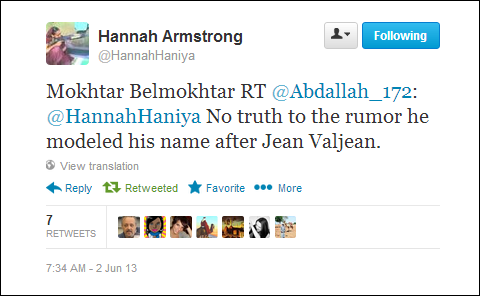
    First, there was the parallel between the names Mokhtar Belmokhtar and Jean Valjean (above). If you’re hunting either fellow, the parallelism isn’t going to yield a useful clue — but the mode of recognition is what matters, and the reason its such a rare mode is precisely because it’s playful. It plays with forms — in this case, the forms of the two names — without regard for practicality.

    And yet this playful spirit is what brought us Weil‘s conjecture and Pierre Deligne‘s Abel Prize, and the Taniyama-Shimura conjecture and Wiles‘ proof of Fermat’s Last Theorem.

    Serious playfulness is key… to serious, magical breakthroughs. In any and all domains.

    *

    With that in mind, here are the rest of the patterns I recognized in todays feed.

    Let’s start with self-reference, which can hardly get more succinct than the hackers hacked:

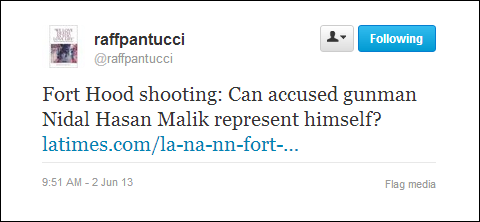
    There’s also a self-referential paradox at work in the question of a defendant appearing in his own defense — something that gives judges pause, because they see how tightly the serpent is chasing its own tail. Defendant defends self, From Raff Pantucci:
    The saddest self-reference of the morning’s tweets was this one, which could be encapsulated as storm-chaser chased by storm:
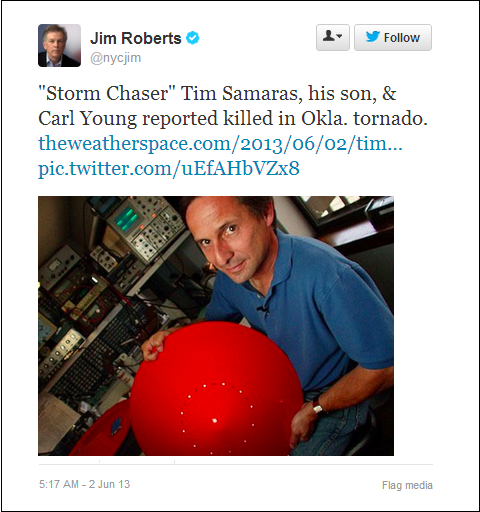
    Even tragedy can take self-referential form.

    **

    But lets move on to Turkey, which provided a rich dividend:

    There was this problem:
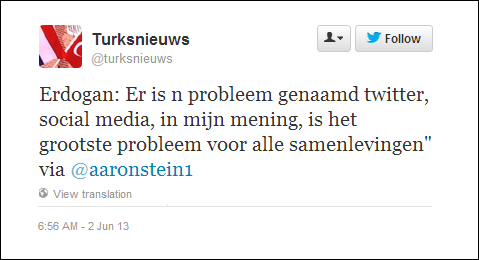
    Turkish I couldn’t read, Dutch I can more or less make out — but for an English tweet making the same point let’s go to Zeynep Tufekci, who has expertise in both matters Turkish and matters Internet, and tweets about Erdogan disapproving of tweeting:

    Tufekci again, this time catching an even neater self-reference which doesn’t quite pan out — because, as she says, PM Erdogan is not the same as @RT_Erdogan:
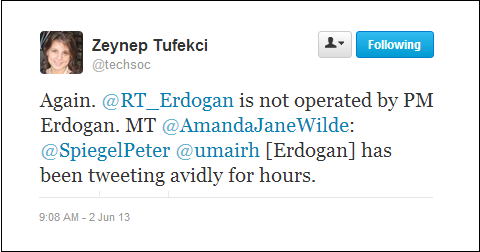
    **

    While we’re on Turkey, this tweet about Tienanmen, Tahrir and Taksim Squares gave us another example of a bright mind catching a hint of pattern…
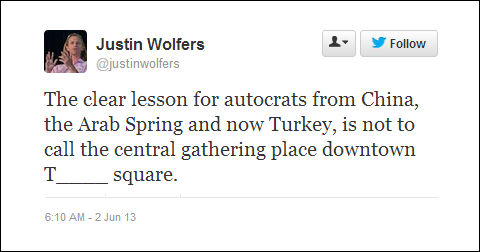
    And what a neat rejoinder!
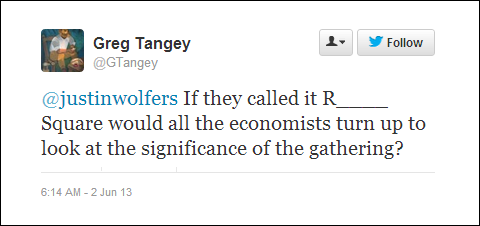
    All of the above is quite useless, entirely playful — and of deep interest if creativity and insight matter

    **

    Finally, I’d like to go someplace quiet and bathe in peace. This tweet, featuring a poem by a Korean zen master, does the trick nicely:
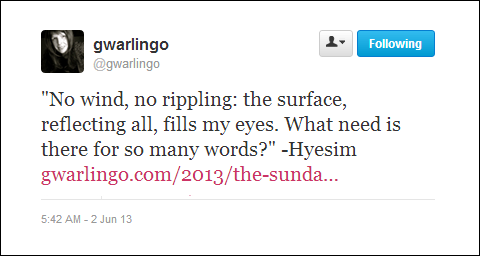
    AN appreciative bow to Gwarlingo for that one…

    Of Alice, Angels and Apsaras

    Wednesday, May 15th, 2013

    [ by Charles Cameron — squeezed between the space of astronomers and the paradise of the believers, is there yet room for the dancing play of poetry, music and imagination? ]
    .

    My first question for you today would be — do you believe in Alice?

    And further to that, do you believe in the Red Queen?

    **

    Two things collided to cause me to write this post today. First, Emptywheel opened her blog post on Putin’s outing of an American spy today with a quote from Lewis Carroll:

    ‘I declare it’s marked out just like a large chessboard!’ Alice said at last. ‘There ought to be some men moving about somewhere–and so there are!’ she added in a tone of delight, and her heart began to beat quick with excitement as she went on. ‘It’s a great huge game of chess that’s being played–all over the world -– if this is the world at all, you know. Oh, what fun it is!’

    I can’t really ignore Lewis Carroll when he crops up in my morning feed like that: he’s a Christ Church man and a poet, as I am, and it would be rude of me to ignore him. And besides, what he’s on about here is the world-as-game concept, which is never far from my mind — hence my inclusion of that question about the Red Queen.

    **

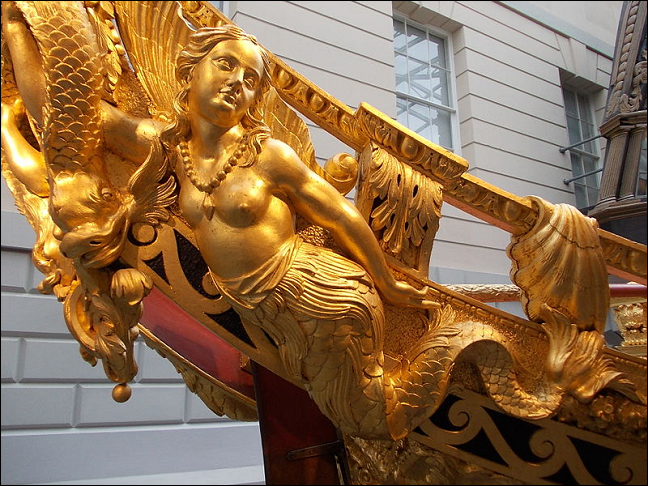
    And second, mermaids.


    .

    It gets more interesting, you see. Because what collided with that first question was a conversation @khanserai aka Humera Khan was having with @mujaahid4life aka Abdallah via Twitter, in which the Harry Potter books were discussed and the topic of unimaginative clerical fatwas on games and works of fiction came up. At which point, Abdallah pointed us all to this now-archived fatwa regarding the permissibility of eating mermaid flesh:

    Ruling on eating mermaids

    A mermaid is a creature that lives in water and looks like a human. As to whether it really exists or it is a mythical being, that is subject to further discussion.

    It says in a footnote in al-Mawsoo’ah al-Fiqhiyyah (5/129): From the modern academic resources that are available to us, it may be understood that the mermaid, which is called Sirène in French, is a mythical creature that is described in fairy tales as having an upper body like a woman and a lower half like a fish.

    See the French Larousse encyclopédique on the word Sirène.

    The encyclopaedia goes on to say: The widespread notion in ancient times was that the wonders and animals of the sea were more and greater than the wonders of dry land, and that there was no kind of animal in the sea that did not have a counterpart on land. This was confirmed by Prof. Muhammad Fareed Wajdi in his encyclopaedia, quoting from modern academic sources. See: Daa’irah Ma’aarif al-Qarn al-‘Ishreen: Bahr – Hayawiyan. End quote.

    Al-Dumayri said in Hayaat al-Haywaan al-Kubra: Mermaid: it resembles a human but it has a tail. Al-Qazweeni said: Someone brought one of them in our time. End quote.

    Many of the fuqaha’ mentioned mermaids and differed on the ruling concerning them. Some of them said that they are permissible (to eat) because of the general meaning of the evidence which says that whatever is in the sea is permissible. This is the view of the Shaafa’is and Hanbalis, and is the view of most of the Maalikis and of Ibn Hazm and others. And some of them regarded it as haraam because it is not a kind of fish. This is the view of the Hanafis and of al-Layth ibn Sa’d.

    Ibn Hazm (may Allaah have mercy on him) said in al-Muhalla (6/50): As for that which lives in the water and cannot live anywhere else, it is all halaal no matter what state it is in, whether it is caught alive and then dies, or it dies in the water and then floats or does not float, whether it was killed by a sea creature or a land animal. It is all halaal to eat, whether it is the pig of the sea (i.e., a dolphin), a mermaid, or a dog of the sea (i.e., shark) and so on. It is halaal to eat, whether it was killed by an idol-worshipper, a Muslim, a kitaabi (Jew or Christian) or it was not killed by anyone.
    What’s outside the box?

    And it goes on… ending, mercifully:

    And Allaah knows best.

    Sometimes I think those might be my favorite words evvah!

    **

    Are mermaids real enough for religious scholarship to address them?

    Is Alice?

    John Daido Loori Roshi, late zen master and abbot of the Mountains and Rivers Order’s Mt Tremper abbey, once gave a teisho using a passage from Alice as his koan:

    Many Zen koans contain references to myths and folktales of ancient India, China, and Japan. Since Westerners generally are not familiar with these stories, koan study without extensive background information is often a frustrating and exasperating process.

    In this dharma discourse, Abbot John Daido Loori fashions a koan, complete with pointer and capping verse, from a classic of children’s literature, Lewis Carroll’s Alice in Wonderland. The koan revolves around Alice’s encounter with a caterpillar who explains the magical properties of a special two-sided mushroom that to Alice’s eyes appears perfectly round. Alice’s struggles with this dilemma make for a stimulating story that mirrors the conflicts and dualities we face in our everyday life.

    You can read it here.

    **

    All of which brings me to the question of the place of deep imagination in a sometimes shallow world.

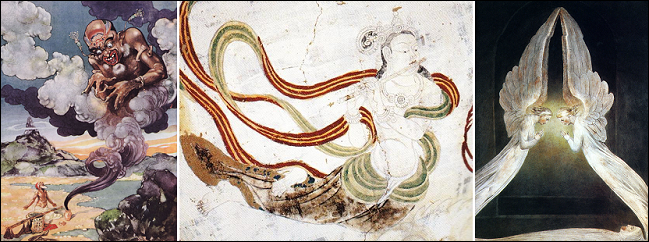
    Alice, do you believe in her? Mermaids and Macbeth mean something to sailors and theater-folk, respetively. Angels? If angels, then the djinn, too? Christian scripture speaks for the existence of one, the Qur’an of both — is one more probable, more real, perhaps, than the other?

    And what of the gandharvas and apsaras — middle panel — the celestial musicians and airy dancers who move to their music? Is there any poet who can claim never to have sensed them?

    **

    And thus we come to Robert Graves and the muse as he depicts her, in his book The White Goddess, and in many poems such as this:

    In Dedication
    .

    Your broad, high brow is whiter than a leper’s,
    Your eyes are flax-flower blue, blood-red your lips,
    Your hair curls honey-colored to white hips.

    All saints revile you, and all sober men
    Ruled by the God Apollo’s golden mean;
    Yet for me rises even in November
    (Rawest of months) so cruelly new a vision,
    Cerridwen, of your beatific love
    I forget violence and long betrayal,
    Careless of where the next bright bolt might fall.

    **

    But here the waters are getting deeper…


    Switch to our mobile site