Twinned tweets: al Shabaab
Sunday, August 19th, 2012[ by Charles Cameron — zeal ]
.

Zeal.
[ by Charles Cameron — zeal ]
.
Zeal.
[ by Charles Cameron — headlines, McVeigh, mea culpa, Breivik, media, guessing games and blame, puns, great tweet ]
.

.
That’s yesterday’s Charlotte Observer‘s headline and opening paras for an article they reposted from Slate, which had more cautiously titled it What’s on a Ku Klux Klan Membership Application?
We’ll come back to that headline later.
**
Okay, seriously.
Educated guesses can prove wrong in retrospect. Educated guesses can lay considerable blame. Educated guesses can have pernicious side effects.
When a bomb ripped through the Federal building in Oklahoma City, many people’s first reaction — including my own — was that it was probably the work of Al-Qaida “Muslim terrorists”.
The media initially broadcast the “Islamist” theory of the bombing quite extensively, and one of the results, according to Penny Bender Fuchs in an American Journalism Review piece titled Jumping to Conclusions in Oklahoma City? was:
A Muslim woman who suffered a miscarriage in her Oklahoma City home said she was afraid to seek medical attention because a crowd of people was throwing stones at her house.
Two more clips from that article:
Within hours of the bombing, most network news reports featured comments from experts on Middle Eastern terrorism who said the blast was similar to the World Trade Center explosion two years earlier. Newspapers relied on many of those same experts and stressed the possibility of a Middle East connection.
The Wall Street Journal, for example, called it a “Beirut-style car bombing” in the first sentence of its story. The New York Post quoted Israeli terrorism experts in its opening paragraph, saying the explosion “mimicked three recent attacks on targets abroad.”
“We were, as usual, following the lead of public officials, assuming that public officials are telling us the truth,” says John R. MacArthur, publisher of Harper’s magazine and author of a book on coverage of the Persian Gulf War. He believes the media overemphasized the possible Middle Eastern link and ignored domestic suspects because initially the police were not giving that angle much thought.
“Reporters can’t think without a cop telling them what to think,” MacArthur says. “If you are going to speculate wildly, why not say this is the anniversary of the Waco siege? Why isn’t that as plausible as bearded Arabs fleeing the scene?”
Most news organizations did mention other possible culprits. They noted the bombing took place on the second anniversary of the government raid on the Branch Davidians in Waco, Texas, suggesting that homegrown terrorists might be responsible. But that angle was buried in most stories.
And:
Jim Lobe, bureau chief for Inter Press Service, says tying the bombing solely to the Middle East “was in a sense a comforting story for Americans.”
Inter Press, a small wire service for papers in the Third World and development agencies in Europe and Canada, was perhaps the first news outlet to raise the possibility that domestic paramilitary fanatics carried out the bombing.
“Of course the Middle East has to be considered,” Lobe says. “But when you considered the weight of all the evidence, it takes you a different direction.”
Lobe, who is familar with militia groups, says many news organizations failed to notice a big clue: traffic on the Internet detailing bomb recipes and talking about the need to avenge the government’s attack on the Branch Davidians. He says the bombing coverage offers “a major lesson for the profession.”
Will that lesson be heeded? MacArthur doesn’t think so. The media are doing a poor job covering Timothy McVeigh and the militia groups around the country, he says. “They are going to turn them into oddball crazies, caricaturing McVeigh as a trailer park terrorist, which is no better than the caricature of the Arabs.”
**
Something similar happened in the immediate aftermath of the Oslo bombing, as this account from the media watch-dog group FAIR details:
On news of the first round of attacks–the bombs in Oslo–CNN’s Tom Lister (7/22/11) didn’t know who did it, but knew they were Muslims: “It could be a whole range of groups. But the point is that Al-Qaeda is not so much an organization now. It’s more a spirit for these people. It’s a mobilizing factor.” And he speculated confidently about their motives:
You’ve only got to look at the target–prime minister’s office, the headquarters of the major newspaper group next door. Why would that be relevant? Because the Norwegian newspapers republished the cartoons of Prophet Mohammad that caused such offense in the Muslim world…. That is an issue that still rankles amongst Islamist militants the world over.
CNN terrorism analyst Paul Cruickshank (7/22/11) took to the airwaves to declare that “Norway has been in Al-Qaeda’s crosshairs for quite some time.” He added that the bombing “bears all the hallmarks of the Al-Qaeda terrorist organization at the moment,” before adding, almost as an afterthought, that “we don’t know at this point who was responsible.”
On Fox News Channel’s O’Reilly Factor (7/22/11), guest host Laura Ingraham declared, “Deadly terror attacks in Norway, in what appears to be the work, once again, of Muslim extremists.” Even after Norwegian authorities arrested Breivik, former Bush administration U.N. ambassador John Bolton was in disbelief. “There is a kind of political correctness that comes up when these tragic events occur,” he explained on Fox’s On the Record (7/22/11). “This kind of behavior is very un-Norwegian. The speculation that it is part of right-wing extremism, I think that has less of a foundation at this point than the concern that there’s a broader political threat here.”
**
Peter Bergen, who wrote the book more than once on Bin Laden and his demise, recently discusses the topic, Right-wing extremist terrorism as deadly a threat as al Qaeda? for CNN — some key findings for perspective:
The word “terrorism” in the United States usually brings to mind plots linked in some way to al Qaeda, while the danger posed to the public by white supremacists, anti-abortion extremists and other right-wing militants is often overlooked.
Militants linked to al Qaeda or inspired by jihadist ideology have carried out four terrorist attacks in the United States since September 11, which have resulted in 17 deaths. Thirteen of them were in a shooting incident at Fort Hood, Texas, in November 2009.
By contrast, right-wing extremists have committed at least eight lethal terrorist attacks in the United States that have resulted in the deaths of nine people since 9/11, according to data compiled by the New America Foundation.
And if, after investigation, Sunday’s attack on the Sikh temple in Wisconsin is included in this count, the death toll from right-wing terrorism in the U.S. over the past decade rises to 15.
The shooting suspect, Wade Michael Page, posed with a Nazi flag on his Facebook page and has played a prominent role in “white power” music groups. The FBI is investigating the case as a “domestic terrorist-type incident.”
Here’s a link to the SPLC’s updated roster: Terror From the Right: Plots, Conspiracies and Racist Rampages Since Oklahoma City.
And there are no doubt other threats, some from potential left wing sources — and some from other half-crazed wingless entities who roam among us on two legs.
**
I said we’d come back to that Charlotte Observer headline later. Here we are:
.
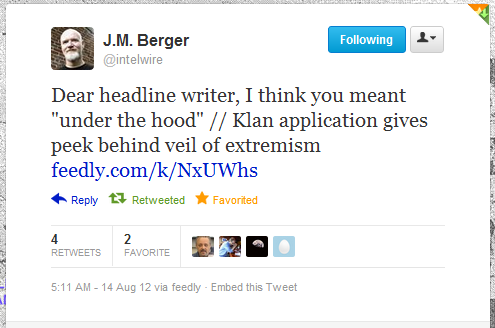
That tweet from friend JM Berger — think about it, “veil” suggests “Muslim”, doesn’t it? — and “hood” means “KKK”? — that’s really quite a double-barreled pun — and, given the context, it makes so much more sense!
JM gets my Tweet of the Month award.
[ by Charles Cameron — slaughters of Sikhs and Christians and questions of nomenclature: second addendum to my post responding to Scott Atran ]
.
Scott Atran recently argued that it is imperative that we understand religions, and in my post Landmines in Paradise Garden I agreed, while differing with Atran on what kinds of people are best suited to the task.
Here I would like to offer a second addendum to that post of mine, this time inviting ZP’s readers to compare and contrast the two quotes above, and likewise the two tweets below:

using them as, in effect, verbal Rorschach blots — allowing each of us individually to see something of our own ways of comparing and contrasting the two situations, their respective contexts and the ways in which we feel they have been treated by the media — and the two ways of “accurately” describing the tragic event in Oak Creek, Wisconsin.
We can see religion — we can see politics — we can see our own — we can see the other — the possible views and manners of relating to these events are many and varied, but the untimely deaths remain.
It is imperative for us to begin to get a better understanding of religion, in all its shadows and its lights. A little discussion might help.
**
Sources:
Shooting at the Wisconsin Gurudwara
Shooting at the Nigerian Church
For a chilling account of the Nigerian shooting, see this Christian Science Monitor piece (h/t Daveed Gartenstein-Ross)
[ by Charles Cameron — the Second Coming in Mahdist eschatology, Abu Musab al-Suri: a first addendum to my post responding to Scott Atran ]
.
I quietly asked “who among us can comprehend religion?” in the header to my most recent post responding to Atran on FP, and here and in the post that follows this one, I want to stir some thoughts on the topic.
**
First, here’s a snippet of today’s twitterfeed that caught my attention:
Bright folks, each one of them — and Vatyma is right, Lebovich nails it tecommending Filiu‘s book.
**
Okay, larger than life with my in-house advantage, here’s my response:
**
And here’s Jean-Pierre Filiu, talking specifically about Abu Musab al-Suri‘s attention to the Second Coming — understood as an accompaniment to the coming of the Mahdi and defeat of the Antichrist / Dajjal — in his Apocalypse in Islam, p. 191:
Abu Musab al-Suri endorses all the accepted traditions concerning Jesus and the Antichrist, notably among them the homicidal hadith about the stones and trees that denounce the Jews hiding behind them. But he innovates in supplementing it with a related saying, according to which the concealed presence of “impure Christians” will also be betrayed in the same fashion.
BTW, that’s the gharqad tree hadith, on which see (a) the Charter of Hamas, article 7, and (b) Anne Marie Oliver & Paul Steinberg, The Road to Martyr’s Square, pp 19-24.
Here’s Filiu again, a little later on the same page, still expounding Abu Musab:
The Antichrist, harassed by two angels who denounce his lies, will attempt to follow [the Muslims into Jerusalem], but at this juncture Jesus will return from heaven and strike him down.
**
Abu Musab dedicates the last hundred pages of his 1,600-page Call for Global Islamic Resistance to his eschatological views — and as Filiu notes, and as I have quoted before:
There is nothing in the least theoretical about this exercise in apocalyptic exegesis. It is meant instead as a guide for action. …
So there you have it: in the view of the man Brynjar Lia calls the Architect of Global Jihad, popular Sunni eschatology — including the return of Jesus — has detailed implications for prophetically informed strategic jihadist planning.
Religion: why it is indeed imperative, as Scott Atran suggests, for us to understand it.
[ by Charles Cameron — importance of the ratio form (“this is to that as thus is to so”) as a bridge between domains and silos, creative leaps, the glass bead game, and finally, Chittick’s joke about camels, sex and translations from the Arabic ]
.
.
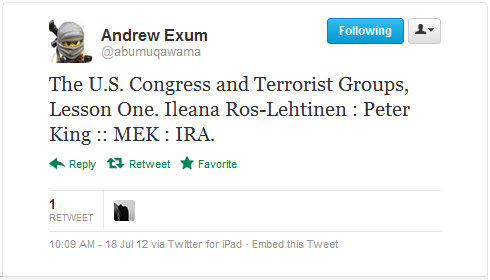
I retweeted this tweet of Andrew Exum‘s to my friend Paul Pilkington because I know he’s working on a project to find out what “this is to that” is to some other “this is to that” — across a wide swathe of human culture.
Note particularly that Exum is using this formal device to illuminate, to give insight, in an area of importance to analysts, strategic thinkers and decision makers.
I’m also retweeting Exum to Paul because I believe Paul’s simple experiment, based as it is on his reading of Hermann Hesse‘s Glass Bead Game, has the capacity to build an architecture of thought (a) crossing all disciplines and (b) spanning the trivial with the profound.
I’m doing something similar with Cath Styles in our Sembl games project — but this time I want to concentrate on Paul’s approach, and since there are four moving parts in an a is to be as c is to d configuration, I’m calling this post Numbers by the numbers: four — number three will just have to wait a while.
**
To get a sense of what Paul is up to, we can go to his Twitter Project page, which describes the fourth in a series of books he’s writing — and also follow him on Twitter, where he posts as Just Knecht.
Two of Paul’s recent tweets express his sense of the task pretty incisively:
The whole of language is the holding up of one unlike thing to compare, contrast and connect with another
Curating is a matter juxtaposition of work against work, artist against artist, place against place – A.Searle on Documenta 13, The Guardian
On his Twitter Project Page, he tells us:
Each tweet is an individual Glass Bead Game move, which is a comparison (metaphor, simile or analogy) across different areas, and may be either a statement or a question.
In question form, these are not unlike analogy questions from SAT tests with an additional dimension of general knowledge, cultural invention and intellectual playfulness. The basic challenge is to work out the relationship between two terms in one context, and apply it in another. Sometimes a tweet will extend an analogy further, which would be the beginning of forming a larger game from an individual move.
Some of the most interesting moves do not have right or wrong answers. Some have canonical or original answers, but they’re not necessarily right. In fact, very often I will post something I’ve picked up from elsewhere which I would love to see improved on, challenged, or at least better explained by others.
He then poses some of the sorts of questions that intrigue him:
Who is the J.H.Prynne of contemporary dance? Like Prynne in contemporary poetry they need to have been ‘out there’ right at the edge of theory and practice for some time, and also deeply steeped in tradition at the same time. Merce Cunningham? Suggestions welcome … And Heston Blumethal or Ferran Adrià might be the Prynne of cookery. But what about the Prynne of contemporary warfare?
What is the equivalent of sonata form in architecture? Goethe and Hegel both said ‘architecture is frozen music’ but neither really explained what they meant. If it is, then is there an architectural equivalent in Western architecture of the key structural form in Western art music? Suggestions welcome …
So, Zenpundit readers — who is the JH Prynne of contemporary warfare?
**
Not so long ago, in Numbers by the numbers: one, I posted a series of self-referential tweets that I’d collected over the last month or two — here I’d like to present some of Paul’s recent tweets:
Let’s start with one that’s a foreign policy insight, arguably as significant to day as it was when Vance first said it:
16 Jul @justknecht
“The Strait of Hormuz is the jugular vein of the West” (Cyrus Vance)
If these tweets can be timeless, they can also be timely:
4 Jul @justknecht
The Higgs boson is the quantum of the Higgs field, just as the photon is the quantum of the electromagnetic field
As they accumulate over time, they can build a conceptual “mesh” that engages an entire field — in this case, recent classical music — while linking it to a variety of other areas:
16 Jul @justknecht
“Boulez’ Derive 2 sounds like birthday cakes ought to” – Philip Clark, Gramophone22 Jun @justknecht
Wagner was a beautiful sunset that was mistaken for a dawn – Claude Debussy, quoted by Geoffrey Norris in Gramophone30 May @justknecht
Fauré’s Theme and Variations (no. 9) is like an evening star falling slowly from the sky – Bryce Morrison cites Alfred Cortot in Gramophone11 May @justknecht
Kraftwerk is the Warhol of pop music – The New Yorker
There’s profundity here:
9 Jun @justknecht
“Space is to place as eternity is to time.” – Joseph Joubert
This could be, as Paul says, “the beginning of forming a larger game from an individual move” — that quote in itself could plausibly be the keystone of an architecture bridging science with religion…
There are historical parallels to consider:
31 May @justknecht
Robert Burton : Oxford :: Jeremy Prynne :: Cambridge
Catty remarks by Nobel laureates:
21 May @justknecht
“Thinking is to humans as swimming is to cats” (Nobel laureate Daniel Kahneman)
Near-tautologies:
21 May @justknecht
Macon Telegraph: Recipes are to food as blueprints are to buildings.
And, ooh, exotic forms of slander!
18 May @justknecht
“[Your daughter] has lovers as numerous as the striking of tablas on Palm Sunday” – Arabic satire by Abu Nawas, 756 – 813 AD
Once again, it’s form that generates insight, not content. Get used to form, play around with it, and content will leap out at you from the page, from the screen.
**
I’m no Arabist myself, but ah! that last quote reminds me irresistibly of the difficulties faced by translators from the Arabic, as recounted by William Chittick in The Self-disclosure of God: Principles of Ibn Al-‘Arabi’s Cosmology (SUNY Press, 1998, pp. xxxv-xxvi.)
An old joke among orientalists tells us that every Arabic word has four meanings: It means what it means, then it means the opposite of what it means, then it has something to do with sex, and finally it designates something to do with a camel …. The rational mind tends to push the meaning of a word away from experience to ‘what it means’ but the imaginal mind finds the self-disclosure of the Real in the sex and the camel … it is in the world’s concrete realities that God is found, not in its abstractions.
I’d been looking for an excuse to post that quote on Zenpundit — now I’ve found it!

Zenpundit is a blog dedicated to exploring the intersections of foreign policy, history, military theory, national security,strategic thinking, futurism, cognition and a number of other esoteric pursuits.
Customized Web Site & Blog Design