zenpundit.com » elections

Archive for the ‘elections’ Category

Politics while in uniform: the No, Sir, and Yes of it

Saturday, March 19th, 2016

[ by Charles Cameron — trying out a new look for DoubleQuotes ]
.

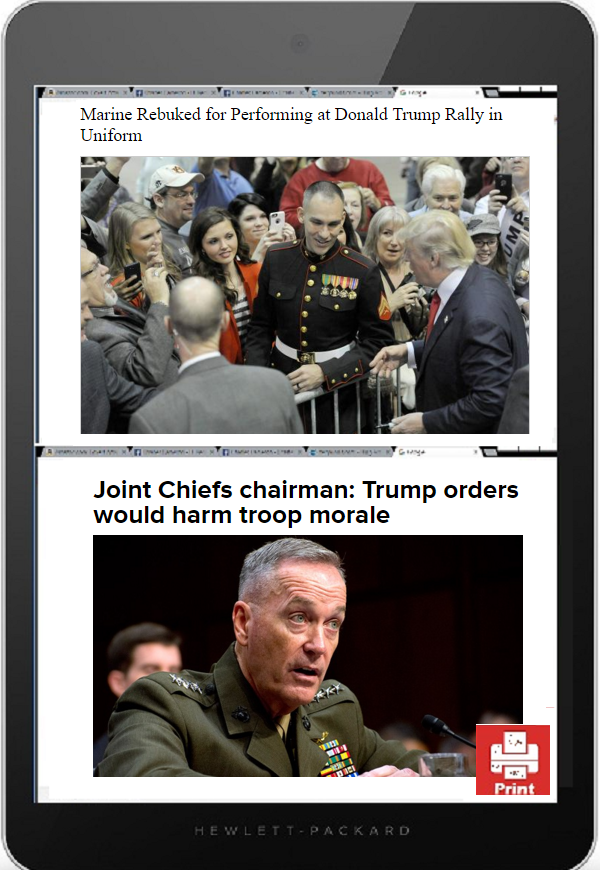
I’m aware that testifying under oath when questioned on a specific topic by Congress is different from promoting a presidential candidate at a campaign rally — but even so, the contrast strikes me as interesting:

tablet trump & politics in uniform

As for the question of orders to torture which Joint Chiefs of Staff Chairman Gen. Joseph Dunford was addressing, I personally am with him. My point here, however, is not to play politics, but to raise the issue of “justice” — in this case, “fair play” might be a better phrase — “not only being done, but being seen to be done”..

**

Sources:

  • Military.com, Marine Rebuked for Performing at Donald Trump Rally in Uniform
  • Thehill.com, Joint Chiefs chairman: Trump orders would harm troop morale
  • Nemesis is teh “unanticipated consequence” of hubris

    Wednesday, March 16th, 2016

    [ by Charles Cameron — a veritable rule of thumb ]
    ,

    Swiss Army Knife

    **

    Let me steer clear of both foreign policy and presidential candidates, and simply quote Cheryl Rofer from her recent twitter fusillade re Neil deGrasse Tyson:

    **

    Humility has as many applications as a Swiss Army Knife.

    Islamic State — hanging by a chad?

    Tuesday, March 15th, 2016

    [ by Charles Cameron — light-hearted, almost science-fictional “butterfly-hurricane” question in geopolitics, with an Elkus follow-up ]
    .
    chad bolton
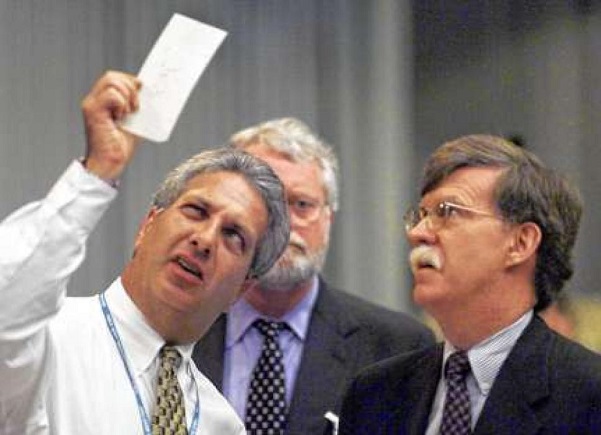
    A scene from the 2000 Florida recount: Palm Beach County’s canvassing board chairman eyes a questionable ballot as Republican attorney John Bolton looks on. Image: Greg Lovett/AP

    **

    Is the Islamic State an “unanticipated consequence” of Bush v Gore?

    Donald Trump, as quoted in Vox’s America’s unlearned lesson: the forgotten truth about why we invaded Iraq:

    You do whatever you want. You call it whatever you want. I want to tell you. They lied. They said there were weapons of mass destruction, there were none. And they knew there were none. There were no weapons of mass destruction.

    Without getting too far into the weeds, my question is this:

    Is it fair to say that the Islamic State (aka ISIS, ISIL) was born in 2006 in response to the American invasion and occupation of Iraq, which in turn was initiated by President George W Bush, who became Commander in Chief in 2000 in a disputed election only resolved by the Supreme Court’s ruling in Bush v. Gore, 531 U.S. 98 (2000)? And if so, looking back at the branching possibilities and eventualities that led to the creation of IS, might I plausibly suggest the Islamic State owes its very existence to a “hanging chad”?

    If the Florida electoral votes hadn’t been disputed on account of flaws in the mechanical method by which they were registered, in other words, might there have been no invasion of Iraq, and hence no IS as such?

    I know: this is hugely simplistic, both in terms of the election and of the drives behind Zarqawi and company — but I’m looking for an illustration of a very small digfference in “initial conditions” giving rise to a notable difference in a “later state” of a related aspect of the world system, Lorenz’s butterfly effect.

    I understand that “dimpled chads” were also part of the “initial conditions” in question, but “hanging by a chad” works better as a phrase than “dimpled by a chad” — although “hanging by a dimple” has a certain charm.

    Srsly, though — to what extent is our current timeline, in which IS may reasonably be viewed as a notable threat, causally connected to the resolution of a mechanical flaw in voting machine design?

    **

    And more seriously:

    I very much appreciated Adam Elkus‘ post, Trump: The Explanation of No Explanation, and the great quote from Charles Kurzman on the Iranian Revolution from which Adam kicks off:

    All of [the Iran] analyses are wrong, even if events unfold the way they predict. After all, if you make enough predictions, some are bound to look accurate. They are wrong because the outcome of this week’s events is simply unpredictable. Unpredictable means that no matter how well-informed you may be, it is impossible to know what will happen next. Moments of turmoil make a mockery of accumulated knowledge. Routine behavior, on the other hand, can be predicted. It is likely to occur tomorrow the way it occurred yesterday, with adjustments for shifts over time. But breaks from routine are a different beast altogether. The more that people feel that normal rules of behavior no longer hold, the more they search around for new rules, surveying their neighbors, collecting rumors, checking their text messages in a frantic attempt to figure out what everyone else is planning to do. Very few people are willing to be the only ones out in the street when the security forces start to advance. If people expect millions of their compatriots to demonstrate, many will want to help make history…. Such moments of mass confusion are unsettling and rare. They usually fade back into routine. Occasionally, however, they create their own new routines, even new regimes, as they did in 1978-1979. In later retelling of these episodes, especially by experts, confusion is often downplayed, as though the outcomes might have been known in advance. But that is not how Iranians are experiencing current events. Their experience, and their response to their experience, will determine the outcome.

    Contrapuntal video, fugal braiding

    Friday, March 11th, 2016

    [ by Charles Cameron — from Trumpery to Altman’s Nashville ]
    .


    Tufte’s illustration of the Kathasaritsagara or Ocean of the Streams of Story

    **

    Wired had a piece titled Never Mind Trump. The Internet Wants to Watch What’s Behind Him a couple of days ago, and it contained a sentence that caught my attention:

    Like a Bach fugue, the counterpoint rivaled, and then overtook, the original melody.

    **

    I’m always interested in non-musical forms of counterpoint, whether we’re talking Glenn Gould‘s radio dramas, Claude Levi-Strauss‘s structure for his Mytholoogiques, Tufte‘s Rushdie‘s Kathasaritsagara, or the various attempts to make Hermann Hesse‘s Glass Bead Game playable. Hesse himself invokes both fugue and counterpoint in the passage in which he describes actual moves in his game about as clearly as anywhere:

    A Game, for example, might start from a given astronomical configuration, or from the actual theme of a Bach fugue, or from a sentence out of Leibniz or the Upanishads, and from this theme, depending on the intentions and talents of the player, it could either further explore and elaborate the initial motif or else enrich its expressiveness by allusions to kindred concepts. Beginners learned how to establish parallels, by means of the Game’s symbols, between a piece of classical music and the formula for some law of nature. Experts and Masters of the Game freely wove the initial theme into unlimited combinations. For a long time one school of players favored the technique of stating ide by side, developing in counterpoint, and finally harmoniously ombining two hostile themes or ideas, such as law and freedom, individual and community. In such a Game the goal was to develop both themes or theses with complete equality and impartiality, to
    evolve out of thesis and antithesis the purest possible synthesis.

    **

    I was accordingly interested to read this paragraph, ending as it does with the sentence I quoted above:

    The Christie videos were just the latest installment in what might be the defining video format of this election. Call it marginal media, in which background activity overwhelms the intended subject. Most candidates have found themselves inadvertently sidelined at some point. Hillary Clinton was overshadowed by the surreal stylings of “Sticker Kid,” who mugged, jerked, and danced throughout her stump speech. Another short video treated Bernie Sanders’ endorsement of marijuana decriminalization as a preamble to an audience member’s startled reaction. Another Trump rally was undercut when a member of the crowd behind the lectern began reading a copy of Claudia Rankine’s Citizen. The drama unfolded over the course of Trump’s speech, as the reader’s neighbors began to argue with her, then brought their neighbors into the fray. Soon, the tension made it impossible to pay attention to Trump at all. Like a Bach fugue, the counterpoint rivaled, and then overtook, the original melody.

    **

    We need, it seems to me, to get used to thinking contrapuntally — and accordingly it is instructive to see just how many of the great artists of recent times have employed some measure of contrapuntal thinking in their work. From the same Wired piece:

    The frames of Robert Altman’s Nashville are packed with overlapping dialogue and activity—it’s often hard to determine which storyline should dominate—granting his aspiring losers the same weight as the country-music superstars they idolize. Tom Stoppard applied the same lens to Hamlet when he made two lackeys — whose off-stage death was barely remarked upon in Shakespeare’s play — the heroes of his fan-fic spin-off, Rosencrantz and Guildenstern Are Dead.

    Okay, I’m off to see Nashville if I can find it..

    Echolalia?

    Monday, March 7th, 2016

    [ by Charles Cameron — Jefferson and Adams reverberating still ]
    .

    For your current interest: words eschanged between two candidates for the Presidency of the United States some two centuries back, as presented in a neat DoubleQuote today by John Robb:

    I can’t improve on John’s presentation of thesse two quotes — but I might perhaps point out that they were similarly relevant to poiitical discourse in 2010, when ReasonTV posted the following video on YouTube:

    **

    As a conoisseur of coincidence, I appreciate the fact that Jefferson and Adams died within hours of each other — fifty years to the day after the signing of the Declaration of Independence. As Jorge Luis Borges observed of the rival theologians Aurelian and John of Pannonia, “The end of this story can only be related in metaphors since it takes place in the kingdom of heaven, where there is no time.”


    Switch to our mobile site

