zenpundit.com » authors

Archive for the ‘authors’ Category

Book Review: The Authentic Swing by Steven Pressfield

Wednesday, September 25th, 2013

[by Mark Safranski a.k.a “zen”]


The Authentic Swing by Steven Pressfield 

Callie was kind enough to send me a review copy of Steven Pressfield’s new non-fiction book, The Authentic Swing. Much like the title implies, it is a book with an arc.

The Authentic Swing continues a theme Pressfield began with his excellent The War of Art, continued with Do the Work and Turning Pro of helping struggling writers, artists and others conquer their resistance and acquire the mature habits of mind to become creative, productive professionals. While the previous books were advice, The Authentic Swing is a demonstration. Pressfield breaks down for the reader the gestation and evolution of his first successful novel, The Legend of Bagger Vance and applies a granular eye to the creative process but does so without tipping his hand or writing a “cookbook”. Steve is employing all his gifts as a storyteller to lead and nudge the reader into understanding.

There are many parts in the book that I like, but the following is in my view the most important, despite being less colorful and more straightforward than others:

When Robert McKee was a young writer/director in New York, he got the chance to interview Paddy Chayefsky, the only person to have one two Academy Awards for original Screenplay (Marty and Network) Chayefsky shared this priceless nugget:

As soon as I figure out the theme of my play, I type it out in one line and scotch tape it to the front of my typewriter After that, nothing goes into the play that isn’t on-theme.

If  there is a single more powerful piece of wisdom for any writer, artist or entrepreneur, I don’t know what it is.

Theme.

Theme is everything.

Once we know the theme we know the climax, we know the protagonist, we know the antagonist, we know the supporting characters, we know the opening, we know the throughline.

I said before that I have a file in my computer titled NEW IDEAS. I have another THEME.  for each new project, I open a new file and title it THEME. I go back to this file over and over. I pile paragraph on paragraph, trying to answer the question, “What the hell is this book about?”

It’s hard.

Theme not only drives art, it drives a coherent life. It makes the disparate connected and gives actions unity. We see theme in great innovative companies, in the curriculum of our best university programs, at the core of great religions, in revolutionary political movements and a nation’s grand strategy. Charles Hill, drew on themes of classical literature to teach that very point about foreign policy. This advice is worth the price of the book alone.

The theme here is authenticity and allowing yourself to express it. Pressfield demonstrates this frequently by parable and metaphor, moving the reader toward the process of discovering authenticity without making the fact that it is a process confuse the reader with the expectation that it will be linear or easy, only natural. I don’t want to give away too much because it is fun to see how the vignettes unfold on build upon one another, obviously golf and the cultural context the sport provided for Bagger Vance is a large part of the book but that will not be a surprise. I will say that The Authentic Swing is a very elegant method of teaching.

Steve’s best non-fiction book since The War of Art.

Ronfeldt’s In-Depth Review of America 3.0

Monday, September 23rd, 2013


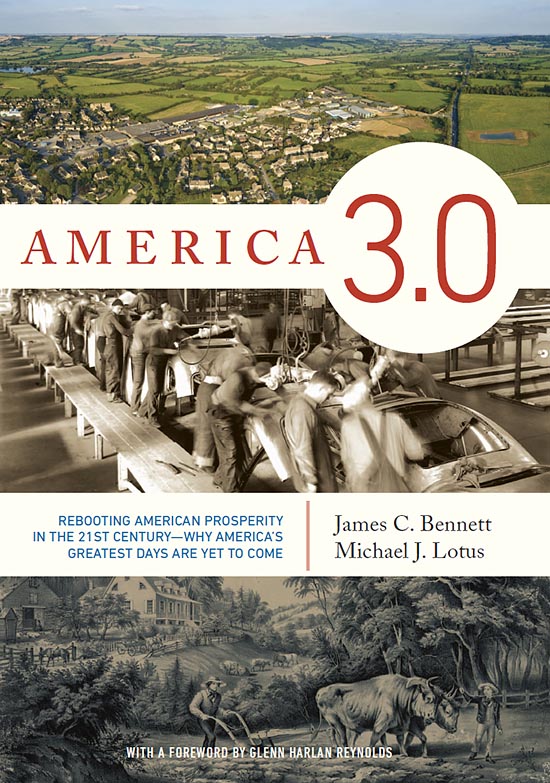
 David Ronfeldt, RAND strategist and theorist has done a deep two-part  review of America 3.0 over at his Visions from Two Theories blog. Ronfeldt has been spending the last few years developing his TIMN analytic framework (Tribes, Institutions [hierarchical], Markets and Networks) which you can get a taste from here  and here or a full reading with this RAND paper.

David regards the familial structure thesis put forward by James Bennett and Michael Lotus in America 3.0 as “captivating”  and “compelling” for  “illuminating the importance of the nuclear family for America’s evolution in ways that, in my view, help validate and reinforce TIMN”. Both reviews are detailed and should be read in their entirety, but I will have some excerpts below:

America 3.0 illuminates significance of nuclear families — in line with TIMN (Part 1 of 2) 

….Bennett and Lotus show at length (Chapter 2, pp. 29-45) that the nuclear family explains a lot about our distinctive culture and society:

“It has caused Americans to have a uniquely strong concept of each person as an individual self, with an identity that is not bound by family or tribal or social ties. … Our distinctive type [of] American nuclear family has made us what we are.” (p. 29)And “what we are” as a result is individualistic, liberty-loving, nonegalitarian (without being inegalitarian), competitive, enterprising, mobile, and voluntaristic. In addition, Americans tend to have middle-class values, an instrumental view of government, and a preference for suburban lifestyles. 

As the authors carefully note, these are generally positive traits, but they have both bright and dark sides, noticeable for example in the ways they make America a “high-risk, high-return culture” (p. 38) — much to the bane of some individuals. The traits also interact in interesting ways, such that Americans tend to be loners as individuals and families, but also joiners “who form an incomprehensibly dense network of voluntary associations” — much to the benefit of civil society (p. 39). 

In sum, the American-style nuclear family is the major cause of “American exceptionalism” — the basis of our freedom and prosperity, our “amazing powers of assimilation” (p. 53), and our unique institutions:

“It was the deepest basis for the development of freedom and prosperity in England, and then in America. Further, the underlying Anglo-American family type was the foundation for all of the institutions, laws, and cultural practices that gave rise to our freedom and prosperity over the centuries.” (p. 52)The authors go on to show this for America 1.0 and 2.0 in detail. They also reiterate that Americans have long taken the nuclear family for granted. Yet, very different marriage and family practices are the norm in most societies around the world. And the difference is profoundly significant for the kinds of cultural, social, economic, and political evolution that ensue. Indeed, the pull of the nuclear model in the American context is so strong that it has a liberating effect on immigrants who come from societies that are organized around extended families and clans (p. 55) — an important point, since America is a land of immigrants from all over, not just from Anglo-Saxon nuclear-family cultures.

….As for foreign policy, the authors commend “an emerging phenomenon we call “Network Commonwealth,” which is an alignment of nations … who share common ties that may include language, culture and common legal systems.” (p. 260) Above all, they’d like to see the “Anglosphere” take shape. And as the world coalesces into various “global networks of affinity” engaged in shifting coalitions (p. 265), America 3.0 would cease emphasizing democracy-promotion abroad, and “reorient its national strategy to a primary emphasis on maintaining the freedom of the global commons of air, sea, and space.” (p. 263) [UPDATE: For more about the Network Commonwealth and Anglosphere concepts, see Bennett’s 2007 paper here.]

Read the whole thing here.

America 3.0 illuminates significance of nuclear families — in line with TIMN (Part 2 of 2)  

….Overlaps with TIMN themes and propositions

Part 1 discussed America 3.0’s key overlap with TIMN: the prevalence and significance of the nuclear family in the American case. This leads to questions about family matters elsewhere. Furthermore, it should be pointed out that there is more to TIMN’s tribal form than the nature of the family. I also spotted several additional thematic overlaps between America 3.0 and TIMN, and I want to highlight those as well. Thus, in outline form, this post addresses:

  • Seeking a fuller understanding of family matters beyond the American case.
  • Gaining a fuller understanding of the tribal/T form.
  • Anticipating the rise of the network/+N form.
  • Recognizing that every form has bright and dark sides.
  • Recognizing the importance of separation among the forms/realms.
  • Recognizing that balance among them is important too.
  • Cautioning against the exportability of the American model.

After these points, the post ends by summarily noting that America 3.0 is more triformist than quadriformist in conception — but a worthy kind of triformist plus, well worth reading.

My discussion emphasizes the T and +N forms. Bennett and Lotus also have lots to say about +I and +M matters — government and business — and I’ll squeeze in a few remarks along the way. But this post mostly skips +I and +M matters. For I’m more interested in how America 3.0 focuses on T (quite sharply) and +N (too diffusely). 

By the way, America 3.0 contains lots of interesting observations that I do not discuss — e.g., that treating land as a commodity was a feature of nuclear-family society (p. 105), and so was creating trusts (p. 112). Readers are advised to harvest the book’s contents for themselves.

….Caution about the exportability of the American model: TIMN sharpens — at least it is supposed to sharpen — our understanding that how societies work depends on how they use four cardinal forms of organization. This simplification leaves room for great complexity, for it is open to great variation in how those forms may be applied in particular societies. Analysts, strategists, and policymakers should be careful about assuming that what works in one society can be made to work in another. 

….In retrospect it seems I pulled my punch there. I left out what might/should have come next: TIMN-based counsel to be wary about assuming that the American model, especially its liberal democracy, can be exported into dramatically different cultures. I recall thinking that at the time; but I was also trying to shape a study of just the tribal form, without getting into more sweeping matters. So I must have pulled that punch, and I can’t find anywhere else I used it. Even so, my view of TIMN is that it does indeed caution against presuming that the American model is exportable, or that foreign societies can be forced into becoming liberal democracies of their own design.

Meanwhile, America 3.0 clearly insists that Americans should be wary of trying to export the American model of democracy. Since so much about the American model depends on the nature of the nuclear family, policies that work well in the United States may not work well in other societies with different cultures — and vice-versa. Accordingly, the authors warn,

“American politicians are likely to be wrong when they tell us that we can successfully export democracy, or make other countries look and act more like the United States.” (p. 24)

“A foreign-policy based primarily on “democracy-promotion” and “nation-building” is one that will fail more times than not, … .” (p. 254)TIMN is not a framework about foreign policy. But as a framework about social evolution, it may have foreign-policy implications that overlap with those of America 3.0. In my nascent view (notably herehere, and here), the two winningest systems of the last half-century or so are liberal democracy and patrimonial corporatism. The former is prominent among the more-advanced societies, the latter among the less-developed (e.g., see here). As Bennett and Lotus point out, liberal democracy is most suitable where nuclear families hold sway. And as I’ve pointed out, patrimonial corporatism is more attractive in societies where clannish tribalism holds sway. 

Read the rest here.

This discussion about America 3.0 and TIMN seems particularly appropriate in light of the need to process, digest and distill the lessons of more than a decade of COIN and counter-terrorism warfare in Iraq, Afghanistan, Pakistan, Yemen and – increasingly- Africa. One of the more difficult aspects of COIN operations has been for American military and diplomatic to decipher the layered relationships and interplay of family honor, tribe, political institution, emerging market and networks in a nation shattered by dictatorship and war like Iraq or to import modern institutions and  a democratic political system in Afghanistan where they had never existed.

Many of these aspects were opaque and were understood only through hard-won experience (frequently lost with new unit rotation) or still remain elusive to Americans even after ten years of fighting among alien cultures which were also permeated by the sectarian nuances and conflicts of Islam. A religion to which relatively few Americans adhere or know sufficiently about, yet is a critical psychological driver for many of our adversaries as well as our allies.

Arguably, the eye-opening response of people to America 3.0 indicates we do not even understand ourselves, much less others

Book Review at Pragati: The Strategy Bridge by Colin Gray

Friday, July 5th, 2013

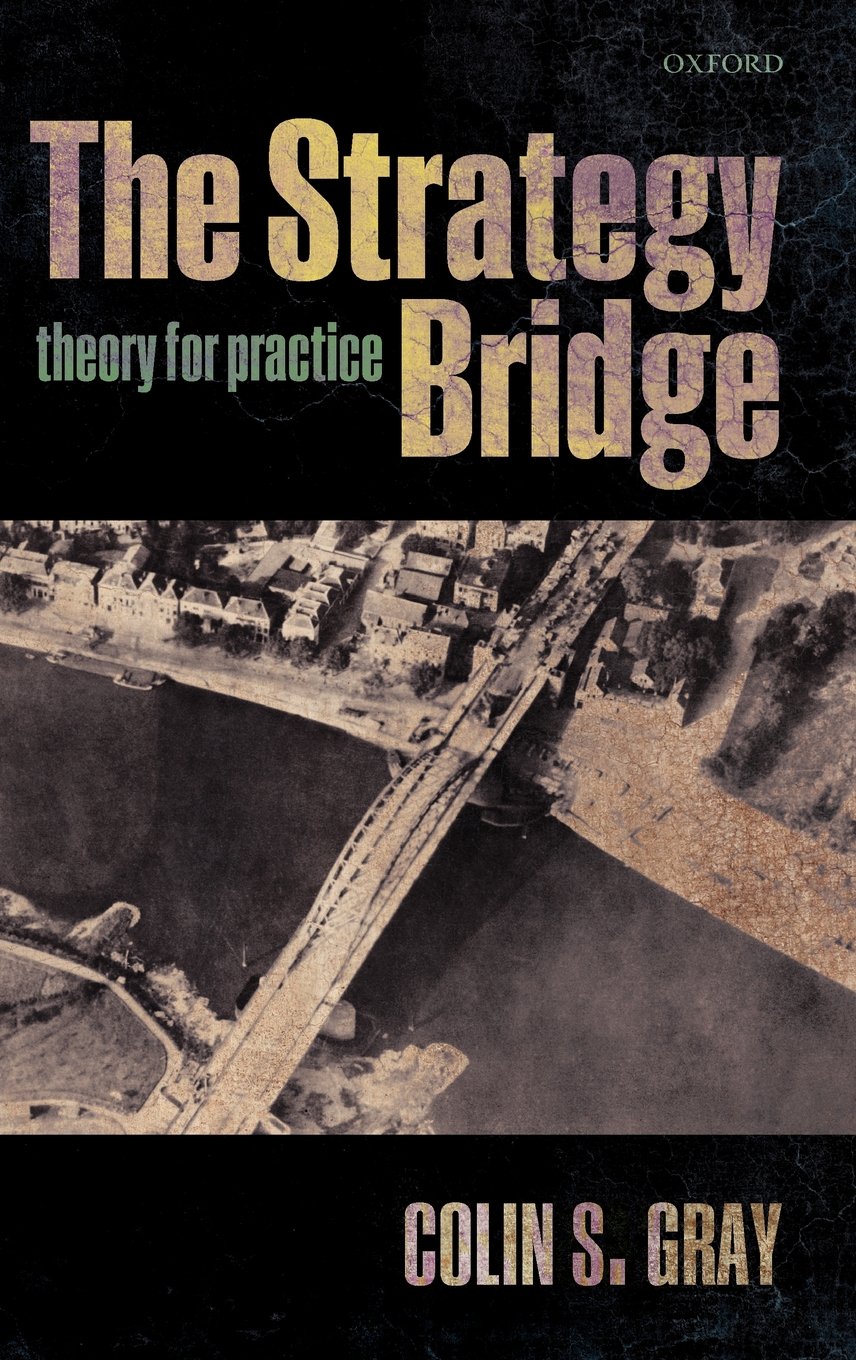
I have a new book review up at Pragati Magazine this morning, The Strategy Bridge:Theory for Practice by Colin S. Gray which is a must read book for any serious student of strategy.

Pragati, which is a national interest and policy magazine for India is starting to turn greater attention towards the subject of strategy and is also running another article in the same issue on strategy and the Maoist insurgency and recently on Indian grand strategy.

A Bridge over Troubled Waters

The title of The Strategy Bridge is also Gray’s operative metaphor, both for the purpose of strategy and the role of the strategist himself that represents the dialectical dynamic of war and strategy-making, the latter being a shared enterprise, save for some extreme historical outliers where strategy was vested in one man, like the regimes of Napoleon and Adolf Hitler. Strategy is the ‘bridge’ that must be built between policy determined by a national leadership and the operational and tactical behaviors of the military and other arms of national power. The strategist “mans the bridge”, orchestrating all of the elements within a master strategic concept and managing the iterative relationship.

Gray writes “The function of the military strategist, his unique raison d’etre, is to ensure that policy and the military instrument are purposefully connected… The strategist must understand the whole nature of a conflict, including war and warfare if antagonism has escalated thus far, because subject to political control, he has the duty of care over the entire competitive performance of the security community… The mission of the military strategist is to decide how the enemy is to be defeated. It is his task to invent a theory of military victory. That theory has to be expressed in and revealed in plans, which are contingent predictions of an extended kind, and must be commanded by generals to whom the strategist delegates some restricted command authority. Whether or not the strategist wishes or is able to function as a general also, must vary with historical circumstances”

….The Strategy Bridge is subtitled “Theory for Practice” because it is intended as a serious work of theory, a framework for understanding enduring principles of strategy so that a practitioner can thoughtfully apply them in making strategies for the specific context in which they find themselves to provide correct guidance for the operational planners and tacticians who will execute it. Consequently, Gray has not written an introductory text for a novice student but an insightful book for the strategic practitioner of journeyman experience – field grade officers, senior intelligence and foreign policy analysts, academic strategists, think tank researchers and national security advisers to senior government officials – who have a store of knowledge of their own. Hence the repeated invocation of “the bridge” metaphor by Gray; his primary audience are the people “doing strategy” and their success or failure “manning the bridge” will help determine the degree to which government purpose remains connected to action or whether the whole business will go off the rails into a quagmire, as it too often does. 

Read the rest here.

More Books and Bookshelf Musings

Sunday, June 30th, 2013


Mussolini’s Italy:Life under the Fascist Dictatorship by by R. J. B. Bosworth 

Seeing Like a State by James C. Scott

Been busy writing a book review and a long and serious post, so here is something more lighthearted and tangible in the meantime.

Having recently purchased the Bosworth bio of Mussolini, I went back and bought his history of Italian Fascism. While doing that, I came across Scott’s Seeing Like a State, which had either been highly recommended in a discussion over at Chicago Boyz blog or perhaps in an email by one of the Chicago Boyz themselves ( maybe Lex will help me out here).

However, a long discussion by my amigo Adam Elkus on Facebook about his emerging organizational system for his books coupled with an hour long search to try and find a book I needed to cite in the review I was writing have made me realize something: I no longer have any organization to my books.

Sure, there’s still a semblance of a core – a Soviet/Russian bookcase, an antique/antiquarian bookcase for collectible editions 80-130+ years old, three shelves of strategy and war, two and half on Nazi Germany, two on Richard Nixon, an “Ummah” shelf on Islam, al Qaida, Central Asia and the Mideast but after that it starts getting messy. Once methodically organized, diplomatic history and diplo memoirs are spread across two rooms, four bookcases and three packing boxes in the garage; the Vietnam War is on two shelves in two different bookcases plus a half dozen or books so shelved at work; ancient history and classical philosophy have metastasized to occupy parts of three shelves in two different rooms; American history, European history, Japan and China,  sociology, general science, politics, biographies, neuroscience, intelligence community, economics are everywhere and anywhere. Your guess is probably almost as good as mine.

And then there are book piles randomly stacked horizontally on top of shelved books and bookcases or stacked by my computer desk or on/under/next to my nightstand. I no longer recall what books I have loaned out or to whom vice given away as gifts.

Bibliomania….A Gentle Madness …..


Yet More Biographies…..

Monday, June 17th, 2013


Alexander The Great by Robin Lane Fox  

Colonel Roosevelt by Edmund Morris 

Shadow Warrior: William Egan Colby and the CIA  by Randall Woods 

The first, was one of the works cited by Paul Cartledge in his own biography of Alexander the Great. Fox is an eminent historian at Oxford, now emeritus and his biography was a an important work in the field.

The next two were gifts from my own students. Now that I have Colonel Roosevelt, I will have to read the prize-winning trilogy as I have copies of the first two volumes (somewhere). The impression Morris made with his Reagan biography, Dutch, was very strange, but this will probably redeem him.

Not very familiar with Woods, but William Colby was a fascinating, controversial and contradictory DCI whose intelligence career spanned the OSS and much of the Cold War, dying in retirement under mysterious circumstances.

Added to the pile…..


Switch to our mobile site