zenpundit.com » turkey

Archive for the ‘turkey’ Category

A feast of form in my twitter-stream today

Sunday, June 2nd, 2013

[ by Charles Cameron — forms & patterns, pattern recognition & creative leaps, creative leaps & connecting dots, connecting dots & node-and-edge mapping — node-and-edge mapping, link charts and Sembl-HipBone games ]
.

.

There’s no “actionable intelligence” in that tweet, but it recognizes a pattern, it makes a fine creative leap. And given the chance, that’s something bright minds do naturally, and enjoy doing, and is away more important than we think.

Yestedrday I was watching Manhunt pretty closely for an upcoming Zenpundit review, and noticed that some of the most significant quotes in the film were absent from CNN’s transcript. One gap I noticed had to do with the descriptions of the analytic process, and in particular some of the things Cindy Storer said. I’ll quote this one, which goes to the heart of the matter, but there’s plenty more left for me to chew over with you later. Here she goes:

Even in the analytical community there’s a relatively smaller percentage of people who are really good at making sense of information that doesn’t appear to be connected. So that’s what we call pattern analysis, trying to figure out what things look like. And those people, you really need those people to work on an issue like terrorism, counternarcotic, international arms trafficking, because you’ve got bits and pieces of scattered information from all over the place, and you have to try to make some sense of it. … That takes this talent, which is also a skill, and people would refer to it as magic — not the analysts doing it, but other people who didn’t have that talent referred to it as magic.

That’s a pretty exact description of what the Sembl game will eventually teach people, once it comes out of the museum prototype and onto the web — but let’s back it up with a quick quote from Wittgenstein:

A surveyable representation produces precisely that kind of understanding which consists in ‘seeing connections’ [Zusammenhänge sehen]. Hence the importance of finding and inventing connecting links. Hence the importance of finding and inventing intermediate links.

That’s from Philosophical Investigations, 122, and it’s a higher altitude / more abstract view — but it’s also the very heart of network thinking, seeing processes not just in terms of isolated nodes but of the connections between them.

**

Seeing connections — connecting the dots — happens in lines and leaps. That is to say, it can happen according to the usual linear way of thinking, the dogged 99% of perspiration that people talk about — or according to the far less common lateral move or creative leap, which moves by analogy, which is to say by pattern recognition, by the perception of similarities of form.

That’s the 1% we call inspiration. That’s the magic.

**

So a whole lot of patterning was going on in my twitter-stream today, and I thought I’d show you.

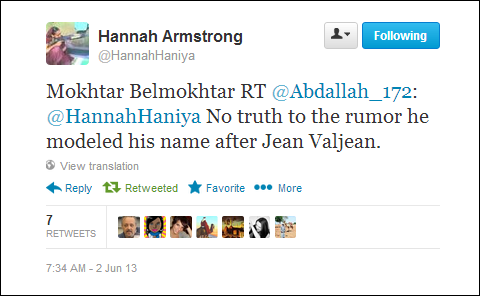
First, there was the parallel between the names Mokhtar Belmokhtar and Jean Valjean (above). If you’re hunting either fellow, the parallelism isn’t going to yield a useful clue — but the mode of recognition is what matters, and the reason its such a rare mode is precisely because it’s playful. It plays with forms — in this case, the forms of the two names — without regard for practicality.

And yet this playful spirit is what brought us Weil‘s conjecture and Pierre Deligne‘s Abel Prize, and the Taniyama-Shimura conjecture and Wiles‘ proof of Fermat’s Last Theorem.

Serious playfulness is key… to serious, magical breakthroughs. In any and all domains.

*

With that in mind, here are the rest of the patterns I recognized in todays feed.

Let’s start with self-reference, which can hardly get more succinct than the hackers hacked:

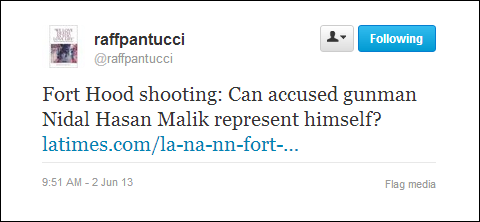
There’s also a self-referential paradox at work in the question of a defendant appearing in his own defense — something that gives judges pause, because they see how tightly the serpent is chasing its own tail. Defendant defends self, From Raff Pantucci:

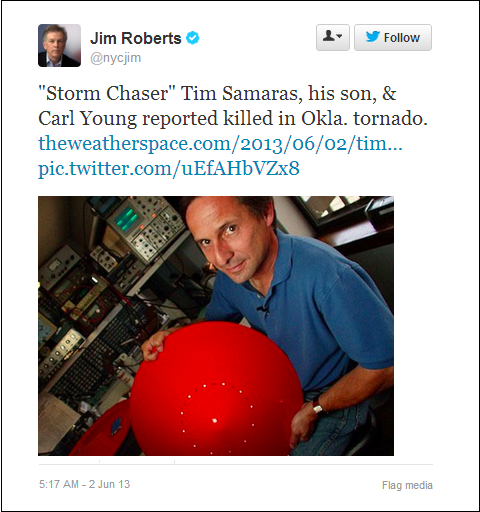
The saddest self-reference of the morning’s tweets was this one, which could be encapsulated as storm-chaser chased by storm:

Even tragedy can take self-referential form.

**

But lets move on to Turkey, which provided a rich dividend:

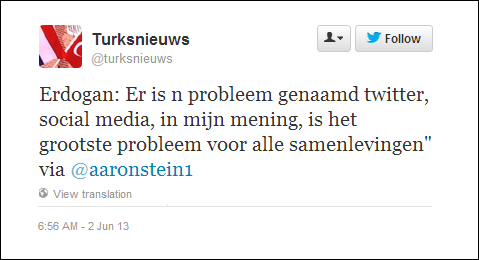
There was this problem:

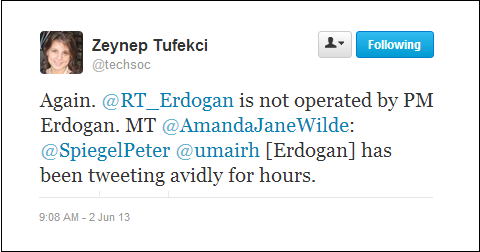
Turkish I couldn’t read, Dutch I can more or less make out — but for an English tweet making the same point let’s go to Zeynep Tufekci, who has expertise in both matters Turkish and matters Internet, and tweets about Erdogan disapproving of tweeting:

Tufekci again, this time catching an even neater self-reference which doesn’t quite pan out — because, as she says, PM Erdogan is not the same as @RT_Erdogan:

**

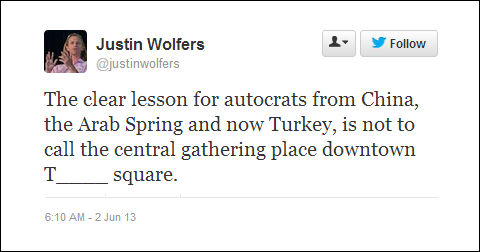
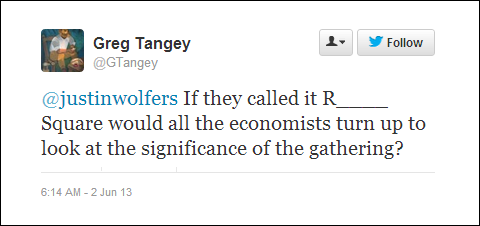
While we’re on Turkey, this tweet about Tienanmen, Tahrir and Taksim Squares gave us another example of a bright mind catching a hint of pattern…

And what a neat rejoinder!

All of the above is quite useless, entirely playful — and of deep interest if creativity and insight matter

**

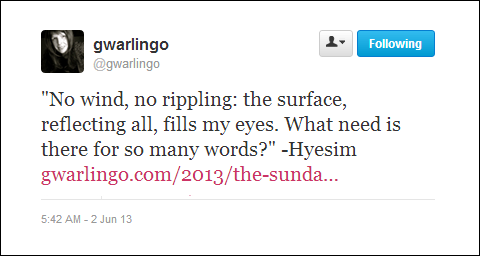
Finally, I’d like to go someplace quiet and bathe in peace. This tweet, featuring a poem by a Korean zen master, does the trick nicely:

AN appreciative bow to Gwarlingo for that one…

Furnish on Pew findings re: Islam

Thursday, May 2nd, 2013

[ Charles Cameron presenting guest-blogger Timothy Furnish ]
.

.

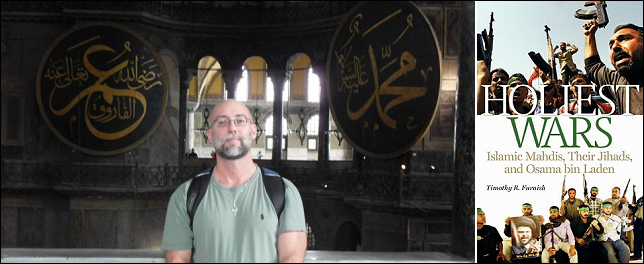
I’m delighted to welcome Dr Timothy Furnish as a guest-blogger here on Zenpundit. Dr Furnish has served as an Arabic linguist with the 101st Airborne and as an Army chaplain, holds a PhD in Islamic history from Ohio State, is the author of Holiest Wars: Islamic Mahdis, Their Jihads, and Osama bin Laden (2005), and blogs at MahdiWatch. His extended piece for the History News Network, The Ideology Behind the Boston Marathon Bombing, recently received “top billing” in Zen’s Recommended Reading of April 24th.

**

Does This Paint It Black, or Am I A Fool to Cry? Breaking Down the New Pew Study of Muslims
by Timothy R. Furnish, PhD
.

Pew has released another massive installment of data from its research, 2008-2012, into Muslim attitudes, entitled “The World’s Muslims: Religion, Politics and Society.” Over 38,000 Muslims in almost 40 countries were surveyed, thus constituting a survey both statistically sound and geographically expansive. Herewith is an analysis of that information and what seem to be its major ramifications.

The first section deals with shari`a, usually rendered simply as “Islamic law” but more accurately defined as “the rules of correct practice” which “cover every possible human contingency, social and individual, from birth to death” and based upon the Qur’an and hadiths (sayings and practices attributed to Muhammad) as interpreted by Islamic religious scholars (Marshal G.S. Hodgson, The Venture of Islam, Vol 1: The Classical Age of Islam, p. 74). Asked “should sharia [as Pew anglicizes it] be the law of the land,” 57% of Muslims across 38 countries answered “yes” — including, most problematically for the US: 99% of Afghans, 91% of Iraqis, 89% of Palestinians, 84% of Pakistanis and even 74% of Egyptians. Should sharia apply to non-Muslims as well as Muslims? Across 21 countries surveyed on this question, 40% answered affirmatively — with the highest positive response coming from Egypt (its 74% exceeding even Afghanistan’s 61%). And on the question whether sharia punishments — such as whippings and cutting off of thieves’ hands — should be enacted, the 20-country average was 52%, led by Pakistan (88%), Afghanistan (81%), the Palestinian Territories [PT] (76%) and Egypt (70-%). On the specific penalty of stoning for adultery, the 20-country average was 51% — with, again, Pakistan (89%), Afghanistan (85%), the PT (84%) and Egypt (71%) highest in approval. Finally, 38% of Muslims, across those same 20 nations, support the death penalty for those leaving Islam for another religion.

Huge majorities of Muslims across most of these surveyed nations say that “it’s good others can practice their faith” — but Pew’s imprecise terminology on this topic makes possible that this simply mean many Muslims are willing to grant non-Muslims the tolerated, but second-class, ancient status of the dhimmi. Majorities, too, in most countries say that “democracy is better than a powerful leader;” however, the latter was actually preferred by most surveyed in Russia, Bosnia-Hercegovina, Kyrgyzstan, Afghanistan and Pakistan, as well as by 42% of Iraqis, 40% of Palestinians and 36% of Egyptians. Most Afghans, Egyptians and Tunisians (and even 1/3 of Turks) believe that “Islamic political parties” are better than other ones, although 53% of Indonesians and 45% of Iraqis are also worried about “Muslim extremists.” (Curiously, 31% of Malaysians are, on the other hand, worried about “Christian extremists” — although evidence of such existing in that country is practically non-existent.) There is good news on the question of suicide bombing, however: across 20 countries, only 13.5% think it is ever justified — although the support is much higher in the PT (40%), Afghanistan (39%) and Egypt (29%).

In terms of morality, large majorities in most Muslim countries (especially outside Sub-Saharan Africa) think drinking alcohol is morally repugnant, notably in Malaysia (93%), Pakistan and Indonesia (both 91%). Most Muslims in most countries surveyed consider abortion wrong, as well as pre- and extra-marital sex and, almost needless to say, homosexuality. (Although one wishes Pew had asked about mu`tah, or “temporary marriage” — a practice originally Twelver Shi`i which has increasingly become used by Sunnis.) Yet, simultaneously — following Qur’anic rubrics — some 30% of Muslims in 21 countries support polygamy, including almost half of Palestinians, 46% of Iraqis and 41% of Egyptians. There is also significant support for honor killings in not just Afghanistan and Iraq but also Egypt and the PT. Over ¾ of Muslims across 23 countries says that “wives must always obey their husbands:” an average of 77%. And Pew notes that there is a statistically very significant correlation between sharia-support and believing women have few(er) rights.

Asked whether they believed they were “following Muhammad’s example,” 75% of Afghans and 55% of Iraqis answered affirmatively — although most Muslims were not nearly so confident. On the question “are Sunni-Shi`i tensions a problem,” 38% of Lebanese, 34% of Pakistanis, 23% of Iraqis and 20% of Afghans said “yes.”

It is no surprise that huge majorities of Muslims in most surveyed countries believe that Islam is the only path to salvation, nor that most also say “it’s a duty to convert others” to Islam. It is somewhat counterintuitive, however, that many Muslims say they “know little about Christianity” — even in places with large Christian minorities, such as Egypt. Muslims in Sub-Saharan Africa are the most likely to agree that “Islam and Christianity have a lot in common,” and so are 42% of Palestianians, as well as some 1/3 of Lebanese and Egyptians. But only 10% of Pakistanis agree. Asked whether they ever engaged in “interfaith meetings,” many Muslims in Sub-Saharan Africa said that they did (with Christians), and a majority of Thais said likewise (albeit with Buddhists). But only 8% of Palestinians, 5% of Iraqis, and 4% of Egyptians said they ever do so—despite substantial Christian populations in each of those areas.

Regarding the question “are religion and science in conflict,” most Muslims said “no” — with the exceptions of Lebanon, Bangladesh, Tunisia and Turkey where over 40% in each country (and, actually, a majority in Lebanon) said that they were at loggerheads. Most Muslims also say they have no problems with believing in Allah and evolution — the exceptions being the majority of Afghans and Indonesians. Regarding popular culture, clear majorities of Muslims in many countries say they like Western music, TV and movies—but, at the same time, similar majorities say that such things undermine morality (although Bollywood less so than Hollywood).

Observations:

1) The high degree of support for sharia is the red flag here. Contra media and adminstration (both Obama and Bush) assurances that most Muslims are “moderate,” empirical data now exists that clearly shows most Muslims, in point of fact, support not just sharia in general but its brutal punishments. Perhaps just as disturbing, almost four in ten Muslims are in favor of killing those who choose to follow another religion. And countries in which the US is heavily involved either diplomatically or militarily (or both) are the very ones where such sentiments run most high: Pakistan, Afghanistan, Egypt, the Palestinian Territories. So are the “extremists” these very Muslims who want to follow, literally, the Qur’an and hadiths? Messers Brennan, Holder and Obama have some explaining to do.

2) Afghanistan would appear to be a lost cause. Afghans are at the top of almost every list in support for not just sharia, suicide bombing, honor killing and — ironically (or perhaps not) — confidence that they are emulating Islam’s founder, as well as dislike for democracy. In light of this clear data, two points about Afghanistan become clear: tactically, ostensible American befuddlement as to the causes of “green on blue” attacks and the continuing popularity of the Taliban in Afghanistan appears as willful ignorance; strategically, the US decision to stay there after taking out the al-Qa`ida [AQ] staging, post-9/11, and attempt to modernize Afghanistan was a huge, neo-Wilsonian mistake. 2014 cannot come soon enough.

3) In some ways Islam in Southeastern Europe, and to a lesser extent in Central Asia, seems to be a more tolerant brand of the faith than the Middle Eastern variety. For example, the SE European and Central Asian Muslims are the least likely to support the death penalty for “apostasy,” and the most supportive of letting women decide for themselves whether to veil. And Muslims in Sub-Saharan Africa are the most likely to know about Christianity, and to interact with Christians. On the other hand, African Muslims are among the most enamored of sharia, and Central Asian ones fond of letting qadis (Islamic judges) decide family and property disputes. So there does not seem to be a direct link between Westernization and moderation; in fact, the influence of Sufism — Islamic mysticism — in the regard needs to be correlated and studied (beyond what Pew did on the topic in last year’s analysis).

4) One bit of prognostication based on this data: Malaysia may be the next breeding ground of Islamic terrorism. It’s home to some 17 million Muslims (61% of its 28 million people), who hold a congeries of unsettling views: 86% want sharia the law of the land; 67% favor the death penalty for apostasy; 66% like sharia-compliant corporal punishments; 60% support stoning for adultery; and 18% think suicide bombing is justified. PACOM, SOCOM and the intelligence agencies need to ramp up hiring of Malay linguists and analysts.

5) Finally, some words for those — like FNC’s Megyn Kelly and Julie Roginsky (on the former’s show “American Live,” 4/30/13) — who pose a sociopolitical and moral equivalence between Muslim support for sharia and Evangelical Protestant Christian support for wives’ obedience to husbands: that’s a bit too much sympathy for the devil. Yes, Evangelical Christian pastors hold some pretty conservative views of the family, as per a 2011 Pew study of them; for example, 55% of them do agree that “a wife must always obey her husband” (compared to 77% of Muslims). And, ironically, many such Evangelicals agree in large measure with Muslims on issues such as the immorality of alcohol, abortion and homosexuality. However, one searches in vain for any Evangelical (or other) Christian support for whippings, stonings, amputation of thieves’ limbs, polygamy or suicide bombing.

Islam is the world’s second-largest religion, numbering some 1.6 billion humans (behind only Christianity’s 2.2 billion). There is, thus, enormous diversity of opinion on many issues of doctrine and practice, and essentializing Islam as either “peaceful” or “violent” is fraught with peril. Nonetheless, this latest Pew study provides empirical evidence that many — far too many — Muslims cling to a literalist, supremacist and indeed brutal view of their religion. Insha’allah, this will change eventually — but time is not necessarily on our side.
Tamerlan Tsarnaev end times videos I: the Mahdist video, pt 2

Sunday, April 21st, 2013

[ by Charles Cameron — the Jewish Afghans — part 2 of a series on two end times videos that Tamerlan Tsarnaev “liked” ]
.

At this point, we are about a quarter of the way into the Mahdist video I was describing in the first part of this post, and you’d be well-advised to catch up to speed there if you want to follow along here… with the fascinating story of the Afghan children of Isaac.

At [03.16, 03.28 and 03.37] the story begins to unfold [transcripts below]:

The first of these reads:

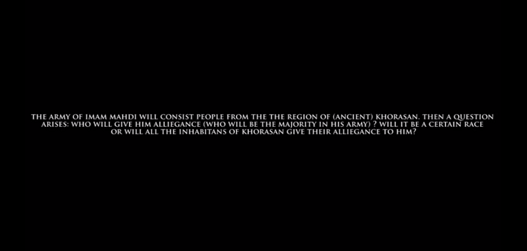
The army of Imam Mahdi will consist people fro the region of (ancient) Khorasan. Then a question arises: who will give hin alliegance (who will be the majority in his army)? Will it be a certain race or will all the inhabitans of Khorasan give their alliegance to him?

The second:

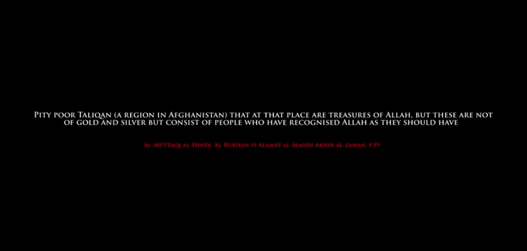
Pity poor Taliqan (a region in Afghanistan) that at that place are treasures of Allah, but these are not of gold and silver but consist of people who have recognized Allah as they should have

Al-Muttaqi al-Hindi, Al-Burhan fi Alamat al-Mahdi Akhir al-zaman, p.59

It is interesting to note that Harun Yahya quotes this same hadith under the heading “The Occupation of Afghanistan (1979)” and comments:

There is an indication that Afghanistan will be occupied during the Last Days. The Russian invasion of Afghanistan took place in 1979 (1400, according to the Islamic calendar).

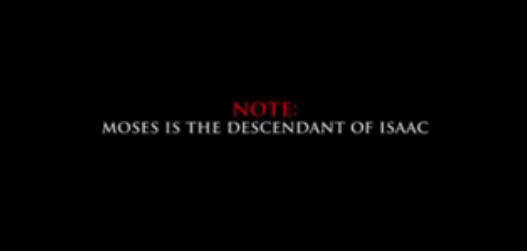
The third is headed “Note” in red, and reads:

The word Taliqan not just mentions the Taliqan region of today only but it describes the whole of the area since in older times sometimes a name of small region describes the whole of the region for example the King of whole Afghanistan and many parts of Central Asia i.e. MAHMUD OF GHAZNI was known as the KING OF ZABUL (Persian Poet Firdausi always called him as SHAH-E_ZABUL in his famous poem “Shahnama Ferdausi”). Zabul was a small province but the whole area was known as ZABUL at that time. SO the word TALIQAN means the whole of the area of Khorasan and not just TALIQAN itself.

I have tried to copy the spelling and syntax of the original, which to my ear might betray a touch of the subcontinent — but may of course have introduced errors of my own, or those of some damnable auto-correct function.

To continue. There’s something decidedly educational going on here in this video – the first, I do believe, that I’ve seen footnoted in quite this way.

The next four text slides read [04.00, 04.10, 04.15 and 04.30]:

We now know that the army of Mahdi will come out of Khorasan with their black banners and as to the question earlier (will it be a certain race or will all the inhabitants of Khorasan give their alliegance to him?

*

This answer is given to us when we read (the hadith in)
Saheeh Muslim Kitaab al-Fitan Hadith 2920

*

Abu Huraira (RA) reported that the Prophet (SAW) said, you have heard about the city of which is in the land and the other is in the sea (Constantinople). They said, Allah’s Messenger, yes. Thereupon he said, The last hour would not come unless seventy thousand persons from BANI ISHAQ would attack it.

Ishaq/Isaac: son of brahim/Abraham, father of Yaqub/Jacob

*

When they would land there, they will neither fight with weapons nor would shower arrows but would only say: “There is no god but Allah and Allah is the Greatest,” that one side of it would fall. Thaur (narrator) said: I think that he said: The part by the side of the ocean. Then they would say for the second time: “There is no god but Allah and Allah is the Greatest” that the second side would also fall, and they would say: “There is no god but Allah and Allah is the Greatest,” that the gates would be opened for them and they would enter therein and, they would be collecting spoils of war and distributing them amongst themselves that a noise would be heard and It would be said: Verily, Dajjal has come. And thus they would leave everything there and would turn to him.

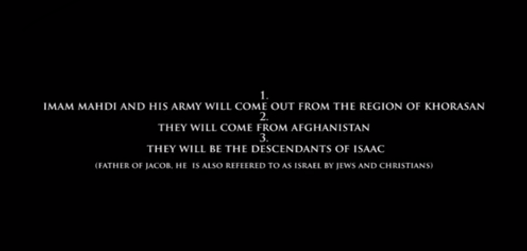
And at this point, with pedagogical precision, there’s a numbered summary of what we’ve learned thus far [05.01]:

Then an Afghan appears in video [05.06 forward] —

— while what sounds to me liker a cultured British voice translates:

When I was young, and had no beard, my grandfather’s uncle died at the age of a hundred and fifteen. He used to say that we are the children of Israel. I am of the Musahem, the People of Moses.

Got that?

**

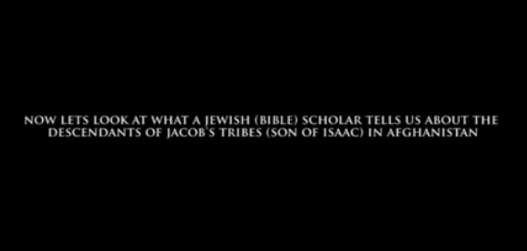
And then things take another interesting turn. Our next screen-grab offers an introduction:

What follows is the “Jewish (Bible) scholar” — on camera —

saying [05.32]:

We are in a country that is supposedly dominated by Muslims, but not Muslims just any Muslims, Muslim fundamentalism, And yet, we come face to face with people that say, “We are Musahem – We are from the people of Moses”. Reuben, Gad, Ephraim, Shimon – four more tribes. So we’ve actually located nine of the tribes. Or, let me put it differently: we think we located nine of the tribes. If we haven’t located nine of the tribes, then it’s a very strange coincidence going on, that you have all these people, with Biblical names, with Biblical practices, with an Israelite memory, exactly where they should be according to the Biblical map.

I’m glad the next slide says, again, “And Allah knows best”. But then it segues into the Mahdi’s physical appearance, and again there’s a Jewish strand…

And Allah knows best
Now, let’s look at a hadith which explains Imam Mahdi’s appareance

Here [06.44] follows a long paragrapoh, which I’ve transcribed for easier reading:

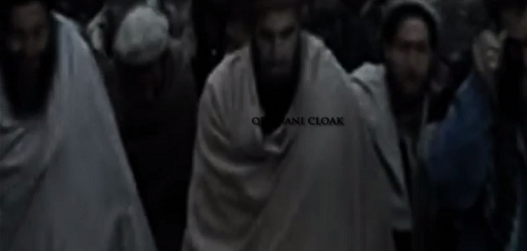
The appearance of Imam Mahdi (according to AHadith) is that he has deep wheatish complexion, light stature, medium height,beautiful broad comlexion, long straight nose, eyebrows round like bow, big natural black eyes, very white front two teeth and with a spacing between the teeth, a black mole mark on the right cheek, face glowing like a shining star, a mark on shoulder like that of Prophet Muhammad (SAW),complexion like the Arabs and body like the Childern of Israel, slight stutter in the tongue due to which he hits his right hand on left thigh sometimes because of annoyance, will appear at the agae of 40 ,while praying to Allah he will expand his hands for prayers like birds expanding their wings, will be wearing Qutwani cloaks (the clothes of the Children of Israel), will resemble in character to Prophet Muhammad (SAW) but in appearance he will be different from Prophet Muhammad (SAW)

And this section closes with an illustration — again, presumably from Afghanistan — of what is meant by a Qutwani cloak [07.26]:

**

I am going to take a break here, at the end of the section in which the people of Afghanistan, and indeed the Mahdi himself, are seen as having characteristics of the Children of Isaac.

In the third and, I hope final, section of this post, Jesus will make a stunning appearance, and attention will then turn back to Khorasan and the march of the black banners on Jerusalem… That final section of this post will, God willing, appear tomorrow.

In the meantime, I’ll also post Tamerlan Tsarnaev end times videos II: a Vinnie Paz video, which deals briefly with a second “end times” song that Tsarnaev “liked” — this one a whirl of contemporary conspiracy theories with Shaytan at the helm…

Tamerlan Tsarnaev end times videos I: the Mahdist video, pt 1

Saturday, April 20th, 2013

[ by Charles Cameron — possibility of Mahdist belief or sympathies on the part of one of the Boston bombers surfaces, with some details of the relevant video ]
.

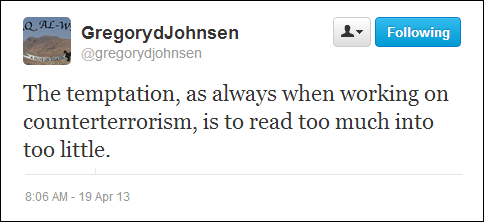
Source: https://twitter.com/gregorydjohnsen/status/325264215025782788

**

Having said that, here’s the explicitly Mahdist video that Tamerlan Tsarnaev liked on FaceBook — one of two “end times” videos as it happens, and worth viewing in context with the other.

The theme here of the black banners of Khorasan is one I have been writing about for years now, as the editors at NRO kindly noted yesterday.

**

I’m not alone in noticing this video [1, 2, 3], but I may have more interest in it than many others, because I believe Mahdism — and “end times” excitement in general — is a volatile conceptual additive and should be handled with considerable caution.

In particular, I would note that the “black banners of Khorasan” ahadith, cited in the video, have been widely used in AQ recruitment as reported by ex-FBI agent Ali Soufan and Syed Saleem Shahzad in their respective books [1, 2], although the ahadith are of probable Abbasid origin as suggested by David Cook [Contemporary Muslim Apocalyptic Literature, Chapter 8, Apocalyptic Predictions concerning Afghanistan and the Taliban, pp. 172 ff.] — and indeed, I’d recently asked the tweeting American mujahid Abu Mansoor Al-Amriki (Omar Hammami):

to which he’d responded:

[ I started to tweet occasional theological questions to Abu M after he instructed his followers to read Zenpundit, here and more emphatically here — I believe the post he was specifically referring to was this one ]

**

Okay.

This account of the Mahdist video would make a long post, and if you can watch the video and make out most of what it is saying in the title cards (intertitles) that form, along with the occasional voice over, the through-line of the movie, you won’t need most of the rest — I’m mostly going to offer transcriptions of those portions that aren’t too fuzzy for me to read.

Three things you might find worth noting, however, are:

  • the quotes from Imran Nazar Hosein, whom I’ve discussed before eg: 1, 2, 3, 4], starting in this section
  • the section on the supposedly Jewish origins of the Afghan people [which I discussed in some detail here], in part 2 of this post, and
  • the short clip from Mel Gibson‘s The Passion of the Christ which has been slipped into the video with dramatic effect, in part 3.
  • **

    For those of you who feel like following along — and there’s plenty of detail of interest — I’ve broken the thing into parts, and my account of the video begins here…

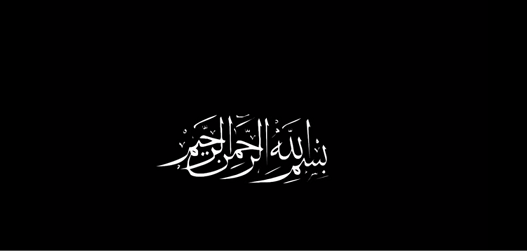
    After the Bismillah:

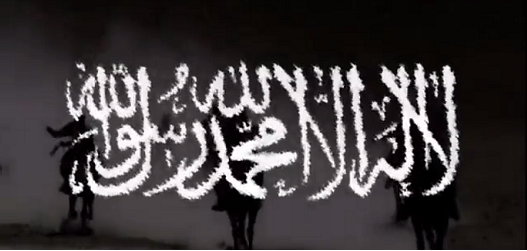
    … followed by a card proclaiming it to be the work of T.R.U.E.E. Productions [00.07], the video begins with the “black banner” itself [00.21], in this form:

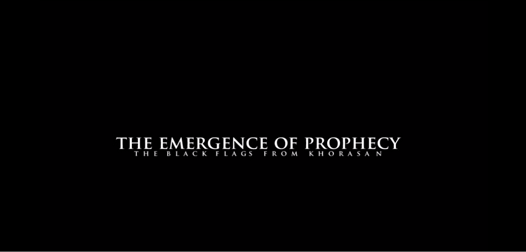
    This serves as the opening title of the video, which is presented on YouTube and a minute into the video with the title “The Emergence of Prophecy: The Black Flags From Khorasan“. The banner fades slightly to show present-day horsemen, presumably from Afghanistan:

    There are others — I’m thinking of Chris Anzalone and Aaron Zelin — who could tell you the origins of the various video clips and anasheed that are used throughout the video, but I’ll confine myself to the text cards and voice overs.

    Over the last of the horsemen, the voice of Imran Nazar Hosein speaks [00.46]:

    The prophet said, “When you see the black flags coming from the direction of Khorasan, go and join that army.” That army has already started its [march). They know it. And that’s why they demonize as a terrorist anyone, anyone who supports that army. They know it. And that’s why they demonize as a terrorist anyone, anyone who supports that army.

    That’s the end of the Intro, after which the title in English appears [01.16]:

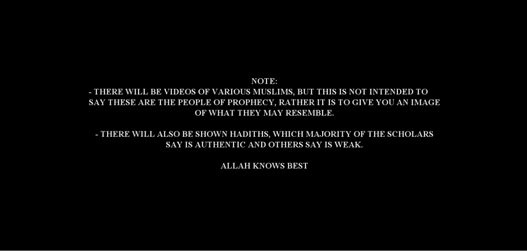
    For a bit of flash and excitement, there’s a count-down [01.23 – 01.32] — we’re approaching zero hour, I’m guessing — and the first major text card shows up [01.38]. It is the first of several “notes”:

    The caution exhibited here is interesting — someone doesn’t want to be caught out in an error by theologically more sophisticated viewers, hence the admission that some scholars view the black banners of Khorasan ahadith as weak… and the always welcome admission:

    Allah knows best.

    At [01.56] a hadith is introduced over black and white visuals of war by night:

    I’ve magnified this one a little for easier reading [02.09]:

    The citation in red is hard to make out, but I believe it references “Sunan Ibn Majah Hadith 971 Volume 3”.

    The statement, “their weapon will be the weapon of Emaan (Faith)” is of interest, compare in the New Testament Ephesians 6.13-17 —

    Wherefore take unto you the whole armour of God, that ye may be able to withstand in the evil day, and having done all, to stand. Stand therefore, having your loins girt about with truth, and having on the breastplate of righteousness; And your feet shod with the preparation of the gospel of peace; Above all, taking the shield of faith, wherewith ye shall be able to quench all the fiery darts of the wicked. And take the helmet of salvation, and the sword of the Spirit, which is the word of God.

    as is the reference to the conquest of Constantinople “without materialistic weapons”. But all that’s fodder for another post on another day.

    At [02.36] we get:

    The text in red here — compare with the use of white and red print against a black background in the screen-grab by JM Berger from an As-Sahab Media video at the top of this post — reads fairly clearly:

    Saheeh Muslim Book Hadith 2896, page 1904, volume 3

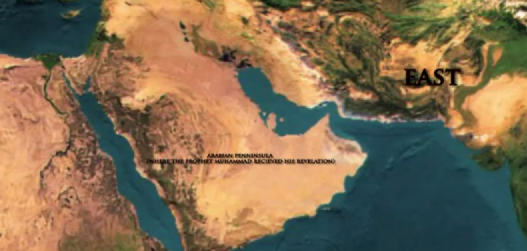
    There’s a brief flash of the world map, then this map with its central text in small print and the word EAST quite large by comparison [02.54]:

    That central text reads:

    Arabian Penninsula
    (Where the Prophet Muhammad received his Revelation)

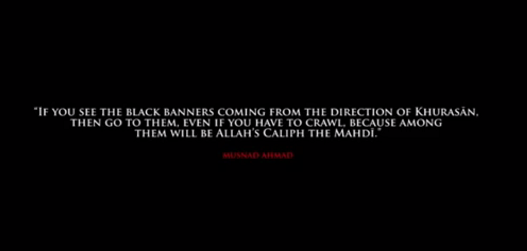
    Next coes another hadith [02.59]:

    Here the only reference is “Musnad Ahmad”.

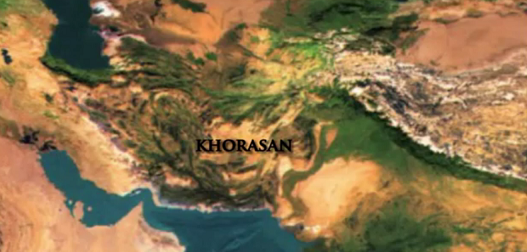
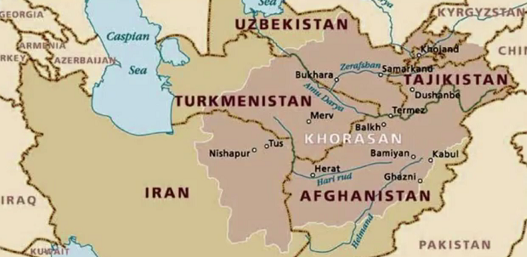
    Then two maps identifying Khorasan [03.04 and 03.07]:

    So that’s the set-up.

    Things get pretty intriguing around here, as a question is posed as to the race or races of those who will follow the black banners, and the comments on Afghanistan and the Lost Tribes of Israel begin…

    **

    I’ll take a break here, and continue in Part II.

    2013 Mahdism Update, I: duet or duel?

    Sunday, January 6th, 2013

    [ by Charles Cameron — comparative contemporary Turkish Mahdisms ]
    .

    Image from the Adnan Oktar / Harun Yahya site http://www.mahdinevershedsblood.com/

    .

    Here’s an intriguing paragraph today from Tim Furnish‘s MahdiWatch blog, as one prospective Mahdi candidate evaluates another:

    Another Mahdi-related figure (sometimes seen as a forerunner, other times as a successor) is al-Qahtani. Heretofore the most prominent such was Muhammad Abd Allah al-Qahtani (d. 1979), the putatative “mahdi” held up as inspiration for the abortive coup against the Saudis led by Juhayman al-Utaby in 1979. Now, however, another-and, thankfully, more pacific-Qahtani has been identified: he is Fethullah Gülen, the exiled-to-America neo-Sufi Turkish leader of a massive global charter school system This is according to a man whom some consider to be the Mahdi himself, Istanbul-based Adnan Oktar. (And in fact it’s not overly cynical to observe that since Oktar and Gülen are in many ways rivals for the mantle of the late Ottoman/early Turkish Mahdist thinker Said Nursi (d. 1960), the former’s relegation of the latter to a supporting role is quite astute in Mahdist circles.)

    Both Adnan Oktar / Harun Yahya and Fethullah Gülen are worth paying attention to as popular leaders who might well be treated as Mahdi by their devotees — much as the late Lubavitcher Rebbe Menachem Mendel Schneerson was considered the Messiah by some of his followers — though both of them seem to be of the opinion that the authentic Mahdi would not claim that title for himself.

    Both men, as I understand it, also make the claim that the Mahdi will be peaceable. I don’t want to promise a more detailed account of the Mahdi-related writings of either one of them at this time, because the research effort would exceed my grasp — but for a quick glimpse, see the Adnan Oktar page on the Mahdi illustrated above, or this page on the Mahdi from Gülen.

    **

    There’s more interesting stuff in the rest of Furnish’s piece, but that’s the paragraph that caught my attention and triggered this post.


    Switch to our mobile site