zenpundit.com » psychology

Archive for the ‘psychology’ Category

Playing a double game

Monday, November 19th, 2012

[ by Charles Cameron — a chess variant exploring the twinned human drives for competition and collaboration ]
.

I posted a neat piece of math the other day, showing how dogs might respond to conditions of combined fear and rage in terms of a catastrophe theory diagram, and Larry Dunbar pointed out in a comment that humans might respond differently in equivalent circumstances depending on whether they had a strategy going into the situation or not…


.

The idea that humans can have an override on such instinctive drives as fear and rage is obviously an important one, and Larry’s comment reminded me of a post I’ve been meaning to make about another “dualism” we humans are subject to…

**

Humans are not IBM machines: they have dual drives, responding to a greater or lesser extent at all times to competitive and collaborative motivations.

I was attempting to capture something of that essential dualism in the simplest possible game format when I devised my story-telling chess variant for Ruth Catlow‘s Rethinking Wargames blog:

My own chess variant, which would require two fairly accomplished story-tellers of roughly equal chess strength to play it, is one in which the game is played as in any chess game, following the usual rules, with the added proviso that at each move, the player should write a fictionalized account of the move, such that the combined narratives of the two players taken together in sequence of moves constitutes a story for publication.

The point is that each player then has two motives in making each move — a chess-winning-motive, and a storytelling-collaborative-motive — and the way they play will thus reflect something that parallels human motivation, with its characteristic mix of survival drive and quest for selfactualization / spirituality.

I’m neither a decent chess-player not a decent writer of fiction, but I believe I’m a first rate conceptual game designer, and that this game concept captures something essential about the human condition in simple form. I offer it as a thought-experiment with “live” game potential.

**

One last thought:

I suspect that this game is in effect a game for exploring the intersection of zero-sum with non-zero-sum games, so playing with the interactions of collaboration and competition should also offer us insight into the interactions of quality and quantity.

**

For more on Ruth Catlow’s work, see her book Artists Re: thinking Games.

Reading a partisan cartoon: the parable of a dog’s ears and teeth

Friday, November 16th, 2012

[ by Charles Cameron — on the difficulties that may be posed when “reading” graphics ]
.

**

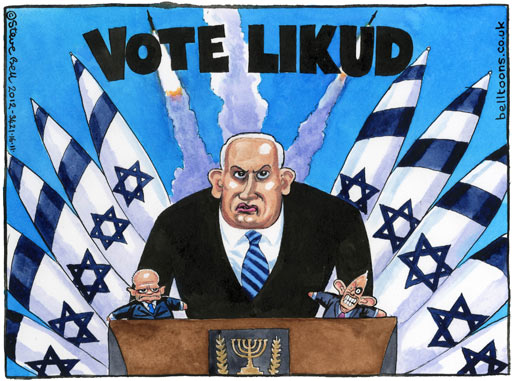
The question I want to ask in this post is: how much can you safely read into a political cartoon?

Here is the particular cartoon I have in mind:

It was published in The Guardian (UK) yesterday, and as you may be able to see, it portrays Israeli PM Benjamin Netanyahu as a puppet-master, with British politicians Tony Blair and William Hague as his puppets, and was published to illustrate the cartoonist’s view of British reaction to the Gaza situation.

How much can we read into it?

**

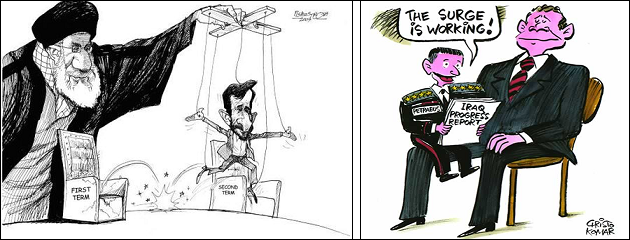
If you are used to seeing cartoons such as these —

showing Khamenei pulling Ahmadinejad‘s strings and Petraeus as a puppet of GW Bush, when you come across the Netanyahu cartoon in the Guardian, you may well view it as another in a long series of political cartoons suggesting that someone is running someone else’s show behind the scenes. It’s the old idea of the eminence grise, in other words, expressed in cartoon form.

**

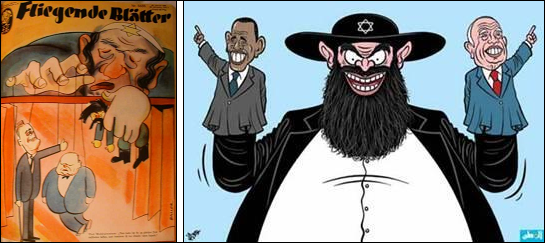
If, on the other hand, you’ve been exposed way too often to cartoons like these —

the one portraying Churchill, FDR and Stalin as Jewish puppets, taken from a 1942 issue of the Nazi paper, Fliegende Blätter, or the one depicting McCain and Obama as Israeli puppets, taken from a 2008 issue of the Saudi paper, Al-Watan… you may well see the same cartoon in a very different — and distinctly antisemitic — light.

**

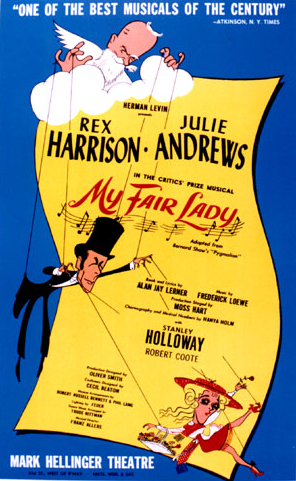
The last two graphics, at least, are extremely offensive, and I would like to offer another graphic here — one which also uses our “puppet master” theme — as a visual equivalent of offering a glass of water to cleanse the palate:

I’ll be addressing this My Fair Lady poster from a very different angle, in a later post in my “form is insight” series — this one on “dolls within dolls”, the “world stage which we have dotted with stages of our own devising” and “turtles all the way down”…

**

Having hopefully reduced the emotional freight which some of the cartoons above must surely have carried with them, I would now like to offer you some background which seems relevant to me. Characteristically, perhaps, it comes from a very different field of knowledge.

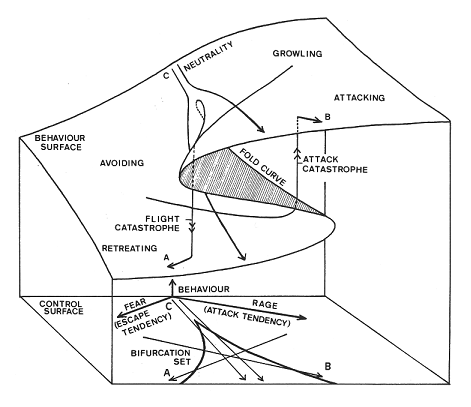
EC Zeeman‘s April 1976 article Catastrophe Theory in the Scientific American was my introduction to the mathematician Rene Thom’s remarkable body of work, an introduction which sailed mostly over my head — but one of Zeeman’s points, which he illustrated with the graphic below, made perfect sense to me.

The annotation to this illustration read in part:

If an angry dog is made more fearful, its mood follow* the trajectory ‘A’ on the control surface. The corresponding path on the behaviour surface moves to the left on the top sheet until it reaches the fold curve; the top sheet then vanishes, and the path must jump abruptly to the bottom sheet. Thus the dog abandons its attack and suddenly flees. Similarly, a frightened dog that is angered followes the trajectory ‘B’. The dog remains on the bottom sheet until that sheet disappears, then as it jumps to the top sheet it stops cowering and suddenly attacks.

My translation:

A dog that reaches the point where its ears are fully pinned back, indicating full-on fear, and its teeth are also fully bared, indicating full on rage, will behave differently depending on whether its fear level or its rage level was the first to be raised to “full”.

Just as a dog’s reaction to a full on mix of rage and fear may depend on which stimulus came first, so — I am suggesting — our own reaction to the cartoon in question — inherently antisemitic, or merely critical of a particular Israeli operation — may depend on our previous exposure to cartoons, politics, the Israeli-Palestinian conflict, or antisemitism.

**

We now have several levels of ease or difficulty in reading graphics. The Zeeman graphics are hard to read because they’re too small to be legible — but put them in the context of Zeeman’s article, and view them full size as originally published, and the only problem might be in following Zeeman’s text, itself a popularization and simplification of Rene Thom‘s work.

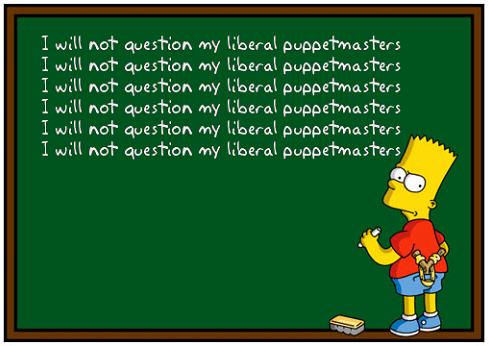
The Bart Simpson graphic is fairly straight forward, and regular viewers of the show would “read” it in line with hundreds of similar frames in which Bart writes repeated lines on a classroom chalkboard, from Season 1 episode 2’s “I will not waste chalk” to Season 23’s “There’s no proven link between raisins and boogers”.

And then there’s the disputed Netanyahu graphic… which can be “read” differently, depending on what previous “puppet master” associations the viewer beings to the task. Here, it seems to me, the task of interpretation can be viewed in one of two ways: (i) as an exploration of how it is likely to be read, which I’m suggesting will depend on previous association, and (ii) as an exploration of what “must have been” in the cartoonist’s heart.

**

Assessing the cartoon’s probable impact on segments of the public is one thing — knowing what the cartoonist intended, even though we tend to conflate the two, is quite another. Not for nothing does St Paul in I Corinthians 2.11 ask (in my own translation)

Who knows the qualities of a man but the spirit of that man within him?

The Pillar of Cloud and the Pillar of Fire

Thursday, November 15th, 2012

[ by Charles Cameron — IDF terminology and the Gaza conflict, explanations of Exodus, an IDF video, Megillah 10b and the koan “with God on our side” / “with God on all sides” ]
.

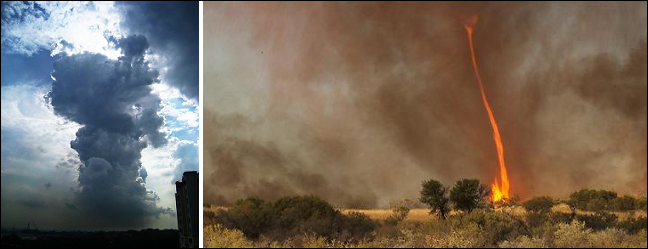
photo credits: Schristia, Cloud; Chris Tangey, Fire

.

I’m curious.

The IDF calls today’s Israeli operation in Gaza “Operation Pillar of Defense” in English, but as John Cook points out in Gawker, uses the term Hebrew term “Pillar of Cloud” in Hebrew.

There’s a great deal of interest here, apart from the difference between their use of non-Biblical terminology in English and Biblical terminology in Hebrew. One point that catches my ear, a poet being a poet, is that the phrase “Pillar of Cloud” is in fact only one half of a double reference…

Thus in Exodus 13.21-22 we read:

And the LORD went before them by day in a pillar of a cloud, to lead them the way; and by night in a pillar of fire, to give them light; to go by day and night: He took not away the pillar of the cloud by day, nor the pillar of fire by night, from before the people.

**

There are various ways of understanding the pillar of cloud and pillar of fire, but it’s pretty clear that there’s only one pillar —

And it came to pass, that in the morning watch the LORD looked unto the host of the Egyptians through the pillar of fire and of the cloud… [Exodus 14.24]

which is called a pillar of cloud by day and a pillar of fire by night, perhaps simply because we are speaking of theophany — the Divine Presence made visible — perhaps because smoke from a brazier is more visible in daylight and flames at night — perhaps because as Hans Goedicke, then chairman of the department of Near Eastern Studies at Johns Hopkins, suggested, the source of both fire and smoke was the eruption of Santorini around 1600 BCE.

The difference in worldviews behind those explanations alone is a matter of considerable interest.

**

Linguistically, however — and this is where the poet being a poet comes in — there are two pillars, and I have to wonder whether the name “Pillar of Fire” is being saved for a later and perhaps more impressive (“shock and awe”) operation, or — in line with the “by day and by night” distinction — refers to the covert side of the same op?

Not that anyone would be likely to give me that information, or that I’d have any use for it if they did.

But the Biblical phrasing is powerful, and “Pillar of Defense” doesn’t make a whole lot of sense — besides, cloud and fire go together in Hebrew in much the same way smoke and mirrors do in English.

Of the three choices, I’d have gone with “Pillar of Fire” myself.

**

An IDF spokesperson, in a response to Cook’s Gawker article, claimed:

I think that every example of Bible quotes you cited has defensive connotations, rather than “vengeful.”

One of those quotes is Exodus 14:24, which I quoted above but will now give in full, along with verse 25:

And it came to pass, that in the morning watch the LORD looked unto the host of the Egyptians through the pillar of fire and of the cloud, and troubled the host of the Egyptians, and took off their chariot wheels, that they drave them heavily: so that the Egyptians said, Let us flee from the face of Israel; for the LORD fighteth for them against the Egyptians.

I think calling that “defensive” is a bit one-sided, but on the other of the two hands in question, so is calling it “vengeful”.

The Israelites saw themselves in the larger context as escaping Egyptian oppression, the Egyptians obviously considered themselves under attack in the short term — just as surely as the people of Gaza must feel under attack by the oppressive Israelis today, while the Israelis clearly feel under attack by terroristic Hamas and its rockets. But hey, the IDF spokesman only offered his explanation that the Pillar of Cloud and Defense was “defensive” as “Just my two cents”…

FWIW, those two verses from Exodus sound just a little like Quran 33.26:

And He brought down those of the People of the Book who supported them from their fortresses and cast terror in their hearts; some you slew, some you made captive. And He bequeathed upon you their lands, their habitations, and their possessions, and a land you never trod. God is powerful over everything.

That’s an ayat that has always interested me, because of the use of the word “terror” found in a number of translations including this one, by AJ Arberry — others have “awe” or “panic”, but “terror” is interesting in the context of its contemporary usage.

**

Here’s the current strike counter strike in two tweets:

**

Okay, let’s get as close to visceral as modern technological warfare permits. After the recent truce was broken and numerous rockets fired into Israel, the IDF fired a missile that killed Hamas military leader Ahmed Jabari, and quickly put the video feed up on YouTube:

**

People are killing and getting killed. Should that be a matter for concern, or delight?

The narrative from which the IDF drew the name of their campaign in Gaza is taken from that of Israel’s escape from Egypt in Exodus, which also includes the parting of the waters and destruction of the Egyptian army:

And the angel of God, which went before the camp of Israel, removed and went behind them; and the pillar of the cloud went from before their face, and stood behind them: And it came between the camp of the Egyptians and the camp of Israel; and it was a cloud and darkness to them, but it gave light by night to these: so that the one came not near the other all the night. And Moses stretched out his hand over the sea; and the Lord caused the sea to go back by a strong east wind all that night, and made the sea dry land, and the waters were divided…. [Exodus 14.19-21]

And it came to pass, that in the morning watch the Lord looked unto the host of the Egyptians through the pillar of fire and of the cloud, and troubled the host of the Egyptians, And took off their chariot wheels, that they drave them heavily: so that the Egyptians said, Let us flee from the face of Israel; for the Lord fighteth for them against the Egyptians. And the Lord said unto Moses, Stretch out thine hand over the sea, that the waters may come again upon the Egyptians, upon their chariots, and upon their horsemen. And Moses stretched forth his hand over the sea, and the sea returned to his strength when the morning appeared; and the Egyptians fled against it; and the Lord overthrew the Egyptians in the midst of the sea. [Exodus 14.24-27]

Here again we see an instance of what I have called the two-fold logic of scriptures: In the Babylonian Talmud, Megillah 10b, R. Johanan tells us:

The ministering angels wanted to chant their hymns, but the Holy One, blessed be He, said, The work of my hands is being drowned in the sea, and shall you chant hymns?

to which R. Eleazar responds:

He himself does not rejoice, but he makes others rejoice.

**

To my mind, what we’re looking at here is a global koan: the immediate and eternal paradox of life and death.

But more on koans shortly.

Cross-grain thinking, 2: mapping the jihadist mind & AQ’s #3 spot

Sunday, November 11th, 2012

[ by Charles Cameron — the different types of “leaders” should give us an idea of the different mental operations in play in the individual minds of the led, as well as the “mind” of the organization — plus fun ]
.
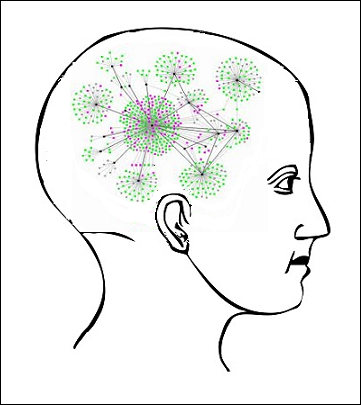
credit for mind map aspect of composite image to valdis krebs

.

Okay, I made my basic point here quite nicely in that little tag-line that gives you the brief overview of each of my posts right next to my name, so I’ll just repeat it here, very slightly amplified for focus:

The different types of “leaders” we identify in AQ should give us an idea of the different mental operations usually in play in the individual minds of jihadists, as well as within the “mind” of the organization itself.

I tried to show how cross-grain thinking in general, and thinking that includes both “subjective” and “objective” realities specifically, might play a considerable role in understanding some pressing contemporary issues in my recent post on Mozart — a figure so removed from those problems that some of you may have skipped it. Here’s my ending, with the Mozart details safely removed:

I think we should track that pattern, know as much as we can of that pattern, write the biography of the way in which some piece of music weaves between inspiration and thought, composer and instrument, mind and matter, performer and audience, studio and home digital music center…

Then, perhaps, we could begin to map other patterns – in some ways simpler and more urgent ones.

The sorts of “simpler and more urgent” patterns I was thinking of there include:

  • how discussions become deliberations and deliberations decisions
  • how scenarios are built and understood and sometimes poorly configured to our later detriment
  • how foreign policy plus feedback loops can create blowback and how to minimize it..
  • and specifically,

  • how the “jihadist” radicalization process moves from floating frustration and shame, via identification of a plausible “other” to rage against, to commitment, then via theology (!!) (for divine sanction of otherwise unpalatable acts) to the recognition of a binding moral obligation (fard ‘ayn in AQ terms) — and thence to camps for training in weaponry and the requirements and subtle limitations on Quranically sanctioned war…
  • **

    That last one has been an interest of mine, sitting in the back of my mind as an unanswered problem, quietly gathering data and forming insights for a while now, under a rubric along the lines of the question:

    Can we figure out a rough map of the workings of the “typical” mind of a potential jihadist as it radicalizes?

    It occurs to me that the leadership of an organization likely maps well to the organization’s functions, and those functions to the thought processes in which members are involved so a map of the aspects of leadership may well give us a rough draft of a mind-map for the individual member, including the passage from uninvolved observer to active participant: the process of radicalization.

    This may seem pretty obvious to some of you, but it’s a fresh idea for me, and to me it’s important because we already map communications networks and organizational flows, but the mind — the individual mind is one place we don’t seem to go.

    So I’m thinking in terms of sketching the mind of a “person” who is in some ways AQ as a whole, considered as if it were one sensate human-like being, filled with the usual variety of thoughts and emotions, ideals and pragmatisms, hopes and fears, hunches and hard data, clarities and confusions.. And I’m thinking of doing this by treating “leaders” as though they were distinct but coordinated processes in a single mind.

    We track and map people and their connections, we track and map groups and their connections, we track and map communications and their connections — are we tracking and mapping memes as such? ideas and their connections? minds?

    If we are already tracking ideas and minds — or if we aren’t doing that yet, but could — I’d be on the lookout for possible positive and negative feedback loops within the system, some that enhance the overall operation and could be disrupted, and some that fragment and damage it and could be amplified.

    So that, among other things, God willing, we could learn better ways to dampen some of the oscillations of hate…

    **

    I was looking at a comment in the recent ICSR report, Al-Qaeda at the Crossroads [h/t @azelin], and ran across this quote which struck me from an oblique angle:

    About ten core leaders have been subsequently killed, including Atiyah Abd al-Rahman, Abu Hafs al-Shahri, Samir Khan, Anwar al-Awlaki, and Abu Yahya al-Libi.

    Let’s take a look at these folk: Atiyah Abd al-Rahman was reported via Bill Roggio at Long War Journal as al Qaeda’s “operations chief” and a major planning a major attack on the US for the tenth anniverary of 9/11, as AQ’s “general manager” and bin Laden‘s “chief of staff”. Abu Hafs al-Shahri was another “operations chief”. Samir Khan was a publicist, the editor of the English-language magazine Inspire. Anwar al-Awlaki was a minor theologian with a talent for publicity and a decent understanding of his American audience…

    And as for Abu Yahya al-Libi, here’s an excerpt from an NYT piece about him:”I call him a man for all seasons for A.Q.,” said Jarret Brachman, a former analyst for the Central Intelligence Agency who is now research director of the Combating Terrorism Center at West Point. “He’s a warrior. He’s a poet. He’s a scholar. He’s a pundit. He’s a military commander. And he’s a very charismatic, young, brash rising star within A.Q., and I think he has become the heir apparent to Osama bin Laden in terms of taking over the entire global jihadist movement.”

    On that telling, al-Libi alone would be almost enough for my purposes — but let’s go with the whole list. The AQ mindset involves courage, poetry, scholarship, punditry and command and control. Specify that the scholarship needs to include theology (AQ at one point sent al-Libi to Mauretania for advanced Islamic studies) as well as strategy and guerrilla warfare (think Abu Mus’ab al-Suri, who was well-read in Taber’s The War of the Flea, Chairman Mao, Che Guevara, and Vo Nguyen Giap), and the significant influences on the jihadist mind begin to swim into focus.

    **

    See, I’m nudging my way to something fairly close to the Lincoln mention in Fred Kaplan‘s Slate piece about Petraeus the other day:

    Toward the end of the war, as the senior planning aide to Army Chief of Staff Gen. George Marshall, Lincoln realized that the Army needed to breed a new type of officer to help the nation meet its new global responsibilities in the postwar era. This new officer, he wrote to a colleague, should have “at least three heads—one political, one economic, and one military.” He took a demotion, from brigadier general to colonel, so he could return to West Point and create a curriculum “to improve the so-called Army mind” in just this way: a social science department, encouraging critical thinking, even occasionally dissent.

    How would we map these mental processes? How would we map the jihadist’s equivalent?

    **

    While I was fishing around for AQ leadership lists in search of an education, I ran across Robert Mackey‘s amusing piece on his NYT blog back in 2010, titled Eliminating Al Qaeda’s No. 3, Again, in which he mentioned as killed or captured claimants to the #3 spot Mustafa Abu al-Yazid, described as “a top financial chief for Al Qaeda” and quotes a colleague as saying “many of Mr. Yazid’s predecessors in Al Qaeda’s No. 3 slot” – from the Bush years alone, he lists Abu Zubaydah, Khalid Shaikh Mohammed, Abu Faraj al-Libbi, Hamza Rabia and Saif al-Adel.

    Okay, we should definitely add “financial chief” to my list above.

    The humorist and the artist in me often lead the more serious analyst in me to insights I’d not otherwise have access to, and since I’m worrying away at the notion that analysis needs to feature both “interior” (mind, heart) and “external” (world) realities, I keep the artistry and humor in my analyses, and hope that makes them more rather than less accessible — so let’s run with the AQ#3 nonsense for a bit.

    Mackey’s is a slightly tongue in cheek treatment of a reasonably serious topic. On Twitter the humor gets more incisive, with Andy Borowitz claiming 9,000 AQ#3s have been killed, and AQ#3 in person setting up a twitter account and tweeting merrily away for a while, see the two sample tweets in this SPECS graphic:
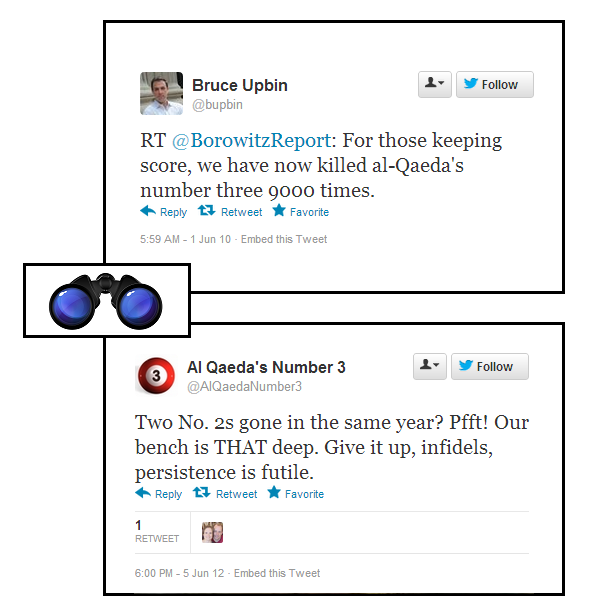
    My sources for those two tweets were Bupbin and AlQaedaNumber3.

    To be honest, I find the AQ#3 business both irritating — since it shows how little depth our popular understanding of who we’re dealing with really has — and amusing — because it’s so very ripe for satire…

    **

    I’ve been working at this post so long I’m mentally cross-eyed, so feel free to fill me in or chew me out…

    Numbers by the numbers: Twone?

    Saturday, November 10th, 2012

    [ by Charles Cameron — parallels and opposites, with a pinch of Shakespeare and a digression into philosophical theology ]
    .

    My friend Peter Feltham steered me towards an intriguing Telegraph piece about something called the Rolling Jubilee project. The accompanying image caught my eye —

    because it reminded me of another image I’d seen years ago, when I took a class in movie directing at UCLA extension.

    The upper image (above) illustrates the Telegraph piece, which depicts the Rolling Jubilee thus:

    The Rolling Jubilee project is seeking donations to help it buy-up distressed debts, including student loans and outstanding medical bills, and then wipe the slate clean by writing them off.

    The lower image is from Jean-Luc Godard‘s film, La Chinoise, which is apparently about a bunch of French Maoist radicals in the 1960s — the “wall” in the image is made of countless copies of Chairman Mao‘s Little Red Book.

    And bundles of twenty dollar bills are pretty much the intellectual opposite of stacks of Little Red Books, no?

    **

    So what? Where do we go from here? Is there anything actionable about those two images?

    Does the lower one mean the Rolling Jubilee project is Maoist? Or that capitalism has triumphed over Marxism in the 45 years since Godard’s film was produced? In China? Or in the world at large? Or (ironically?) that capitalism, like communism, is a failed system? That there’s a Hole in the Wall?

    Should we be thinking of Pyramus and Thisbe, the play within a play in Shakespeare‘s Midsummer Night’s Dream?

    This man, with lime and rough-cast, doth present
    Wall, that vile Wall which did these lovers sunder;
    And through Wall’s chink, poor souls, they are content
    To whisper.

    Is there idea that there’s a chink in Wall Street?

    **

    I’m asking all this because we can take all manner of conclusions from a juxtaposition — it naturally lends the mind to associative thinking, extrapolation, the derivation of one or more meanings. And I surely want to emphasize the “or more” here.

    But also because it brings up, with force, the issue of parallels and oppositions.

    We don’t say Oxford is the opposite of a Fouquieria columnaris cactus in the Huntington Gardens — they’re too disparate to be opposite. No, we think of Cambridge as the opposite of Oxford because they’re so similar, they’re almost the same — as I’ve said elsewhere on ZP, there’s even a single word for both: Oxbridge.

    Opposites are similars with difference, while parallels are differents with similarities — and is that one insight, or two?

    We talk about a “two-way street” — in city traffic terms, that’s just one street, but the traffic flows in two directions — and it’s probably best to keep ’em separate.

    **

    Zoom in, and you’ll see differences, zoom out, and you’ll see samenesses — is that true? true when applied to concepts, debates, arguments, elections, partisanship, wars? day and night? sun and moon? war and peace? life and death?

    Apples and oranges?

    I don’t think we’re terribly good at thinking about this sort of thing — and I also think binary thinking is both a primary and a frequently divisive factor in the human condition, so we’d best get better at it.

    Sun and moon are an interesting pair, because even though they are vastly different both in size and distance from our planet, they each subtend almost exactly the same angle on the eye — thus allowing for the brilliant halo effects of full eclipses of the sun.

    Alchemists see in that sameness a marriage of opposites or coincidentia oppositorum. But here’s my pair of questions for you:

  • is that similarity a matter of entirely random coincidence, or is it evidence of immaculate care and design?
  • and how different would the entire history of human belief be, if the moon and sun were not even close to the same as each other in (apparent) size?
  • For one thing, if the moon seemed smaller than the sun, we’d have no total solar eclipses — the impact of that alone would be interesting to consider.


    Switch to our mobile site