zenpundit.com » iraq

Archive for the ‘iraq’ Category

Mahdism in Iraq, redux

Thursday, August 30th, 2012

[ by Charles Cameron — news bulletin on Mahdist messianism, with a muddling mixing of metpahors ]
.

prominent ISCI leader Jalal al-din Ali al-Sagheer, via Rudaw


Dated yesterday, Hevidar Ahmed‘s piece on the Kurdish news site Rudaw, Shia Leader: The Awaited Imam Mahdi Will Fight the Kurds, confirms that Iraq’s Mahdist undercurrent has at least one well-placed adherent while also denying the specific applicability of one particular sermon — except in case of earthquake:

Jalal al-din Ali al-Sagheer, a prominent leader of the Islamic Supreme Council of Iraq (ISCI), denies saying that the awaited Imam al-Mahdi will fight the Kurds when he emerges.

Sagheer also sent a letter to the president of Iraq Jalal Talabani and Kurdistan Region President Massoud Barzani explaining his intentions behind a lecture he delivered on Aug. 10.

The lecture, delivered in Baghdad’s Buratha Mosque, was about recent political activities of Kurds in Iraq and Syria and the relation of these activities to the appearance of the awaited Shia imam.

Sagheer cited some texts about the subject and concluded that “these could be some of the signs of the appearance of the awaited imam, but in order for these expectations to come true, a strong earthquake needs to hit Syria and Turkish soldiers must land in Cizre region.”

A tip of the hat to Timothy Furnish, whose MahdiWatch blog has a longer and more detailed version of story. Among Dr. Furnish’s points:

Modern Iraqi Mahdism has, heretofore, been largely a phenemenon manifesting among outre groups there: Ahmad al-Hasan’s Ansar al-Mahdi, the late Abd al-Zahra al-Qar`awi’s Jund al-Sama’, or Mahmud al-Hasani al-Sarkhi’s Jaysh Husayn, as well as (albeit probably more politically and less seriously) Muqtada al-Sadr’s Jaysh al-Mahdi. Now, however, a mainstream Iraqi politician is espousing Mahdist views–and not just pious ones reflecting some far-off, future hope but beliefs working eschatology into the modern political scene in the Middle East.

Ali A Allawi said Iraqi Mahdism was flying “under the radar” of western analysts when he spoke at the Jamestown Foundation on October 9, 2007. The video of that meeting is no longer publicly available, and as far as I know, no transcription exists online.

Are we paying attention to Mahdism as a significant current in the Middle East yet? If not — and switching my metaphors in midstream — it’s probably “up periscope” time again.

Of a fault line, and of the Qibla

Tuesday, August 28th, 2012

[ by Charles Cameron — Sunni and Shia, Mecca and Qom, Saudi and Iran and the balances between them, with special attention to Mecca — and sideways comparisons with Las Vegas and Somoza’s Nicaragua ]
.

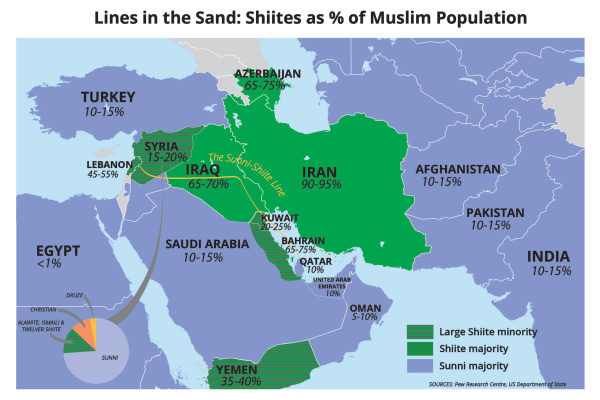
Consider this map:


.

It was ZenMeister who pointed me today, via Notes from Thermopylae, to Stephen Crittenden and his Global Mail piece, The Clash Within Civilisations: How The Sunni-Shiite Divide Cleaves The Middle East, from which the map above is taken. Crittenden writes:

There is a dangerous 2,000-kilometre fault line running through the Middle East between Beirut and Bahrain via Damascus and Baghdad, which marks the present line of demarcation between the two main branches of Islam, Sunni and Shiite.

The 1,300-year-old schism between Sunnis and Shiites was caused not by a theological dispute (those came later), but by rival clans in Muhammad’s tribe, the Quraysh, squabbling over the succession after his death in 632 AD.

Mostly the “Sunni-Shia Line” lies dormant, and ordinary Sunnis and Shiites live out their separate lives, side-by-side in relative harmony. In Lebanon and Iraq it has not been uncommon for Sunnis and Shiites to intermarry. But the Line is still always there, just below the surface, and it has recently re-emerged as the most significant factor reshaping geopolitical relationships in the Middle East, a region where religion and politics are always inextricably intertwined.

**

Suppose it, at least for now. And in that context, consider as a counterweight to all the talk about Iran, two fascinating pieces by the Pakistani novelist Maniza Naqvi.

Naqvi’s piece The Remit of Fear in 3 Quarks Daily today is worth reading — you may be interested in any one or more of her various critiques of the House of Saud:

I fear the perverse purchase of petrodollars from Saudi Arabia: the twin ideologies of Salafism and Islamophobia. …

[ … ]

I fear to imagine a county which produces no art, film, theater, song or dance. Yet such is the country created by the State of Saudi Arabia. I fear the reasons which cause 16 million citizens most of whom are not Saud in Saudi Arabia to remain silently compliant. The bulk of this population is under the age of 25 and disempowered and is ruled absolutely by old men who do not tolerate dissent or diversity of opinion. I fear the mindset that treats women as blots and clots to be erased or managed.

There’s plenty of food for thought there, not least about Pakistan:

I fear that the people unlearned and illiterate impressed by influence and the purchasing power of Saudi Arabia might be confused and unable to distinguish the House of Saud as being apart from the origin and the authors of Islam. I fear that this may be the case for Pakistan where matters are so far gone that if the father of the Nation, Mohammad Ali Jinnah were alive today he would not be able to go about freely for fear of being shot to death for being a Shi’a.

My own interest, as usual, draws me to the religious drivers at work and their impact:

I fear that after thirty years of petrodollar bonanzas and propaganda, Muslims are unable to delink Islam from the House of Saud. There are 5000 Saud and in comparison there are 1.2 billion Muslims all over the world. A majority of whom, for a myriad of reasons including illiteracy, poverty and sudden wealth are unable to resist or protest against the Saudi influence upon them. I fear that the populations of the world are unable to resist, protest and fight against the privatization of all that is their sacred to them: their lands where they grow their food, to the places where they congregate and live, to their own thoughts and even their bodies.

**

But you should read too her linked critique of the remaking of Mecca, The Architects of the War on Islam, from August 6th:

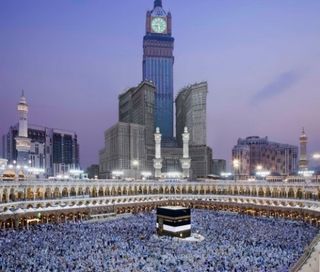
This is addressed to Muslims who think that Islam is under attack: They are right. Just take a look at the images of the House that Abraham built, the Ka’aba and see how progresses that ancient attack. Just look at the transformation of the environs of the Ka’aba and the Haram Shareef into a garish resort rivaling Las Vegas or Atlantic City.

Just look, at the transformation of the sacred environs of the Haram Shareef into a shopping mall and Disney world–to understand the war on Islam and who is responsible for waging it. Just look at this and see how Islam has been trafficked as though it were a bonded slave, dressed up in bells and baubles to be whipped and sold in the marketplace.

**

Note finally her remarks, in today’s piece, on fear and silence:

Much is at stake if people are not silent. Much is at stake if people remain silent.

[ … ]

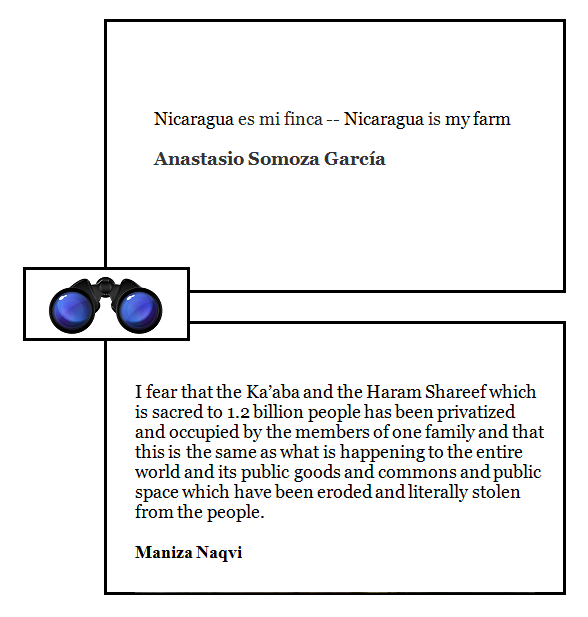
I fear that Haj and the Ka’aba, a central principal of Islam, sacred to 1.2 billion people have been privatized, by an estimated 5000 people belonging to one family. Why? How is the privatization of the Ka’aba different from the wholesale seizure and privatization of the commons and public lands and spaces all over the world? I fear that the Ka’aba and the Haram Shareef which is sacred to 1.2 billion people has been privatized and occupied by the members of one family and that this is the same as what is happening to the entire world and its public goods and commons and public space which have been eroded and literally stolen from the people.

And now you can see, too, why I am reminded of Somoza and his farm, Nicaragua:

With this profound difference: that the Ka’aba is the Qibla, the point of orientation to which all Muslim prayer turns, as others orient their prayers towards Jerusalem.

The Twilight War—a review

Monday, July 23rd, 2012

[by J. Scott Shipman]

The Twilight War, The Secret History of America’s Thirty-year Conflict with Iran, by David Crist

When President Obama made a heartfelt opening, a smug Iranian leadership viewed it as a ruse or the gesture of a weak leader. Iran spurned him. Obama fell back on sanctions and CENTCOM; Iran fell back into its comfortable bed of terrorism and warmongering. Soon it may no longer be twilight; the light is dimming, and night may well be approaching at long last. [emphasis added]

Thus concludes senior government historian David Crist’s The Twilight War, and be assured Crist’s language is not hyperbole. Crist masterfully details the tumult of U.S.-Iranian relations from the Carter administration to present day. Using recently released and unclassified archived data from principals directly involved in shaping and making American foreign policy, Crist provides the reader an up-front view of “how the sausage is made;” and, as with sausage, the view often isn’t pretty for either side. Crist’s access wasn’t limited to U.S. policy makers, as he conducted interviews with principles on the other side as well, for instance, he had secret meetings/interviews with pro-Iranian Lebanese officials in south Beirut. In all, Crist estimated he interviewed over “four hundred individuals in the United States and overseas.”

Crist begins his story with the Shah of Iran in the last days of his leadership, as popular sentiment was turning against both his regime, as well as his American enablers. He reveals the Carter administration’s fleeting notion of military intervention following the fall of the Shah, and includes details how the clerics reigned in professional Iranian military members, purging the “unreconstructed royalists.” From the start, the U.S. learned how difficult, if indeed impossible, relations were going to be with the new Iranian leadership. One State Department report summed up the situation:

It is clear that we are dealing with an outlook that differs fundamentally from our own, and a chaotic internal situation. Our character, our society are based on optimism—a long history of strength and success, the possibility of equality, the protection of institutions, enshrined in a constitution, the belief in our ability to control our own destiny. Iran, on the other hand has a long and painful history of foreign invasions, occupations, and domination. Their outlook is a function of this history and the solace most Iranians have found in Shi’a Islam. They place a premium on survival. They are manipulative, fatalistic, suspicious, and xenophobic.

While I am certain the writer of this report was not intending to be prophetic, as it turns out this paragraph captures the essence of our conflict. Each American president has thought himself equal to the challenge and each has thus far failed.

The Twilight War includes the birth of Hezbollah, accounts of the Marine barracks bombing in 1983 (from the men who were there), and the details of the Kuwaiti request for American protection of their tanker fleet from the Iranians. From this decision, the U.S. committed military force to protect Middle East oil—a difficult and at times, contentious decision. This decision resulted in continued sporadic confrontations between the U.S. and Iranian forces in the Persian Gulf.

Crist’s book is an illustration writ-large of a book previously reviewed here at Zenpundit.com; Derek Leebaert’s Magic and Mayhem, The Delusions of American Foreign Policy—as both “magic” and “mayhem” figure large in our on-going relationship with Iran. Most U.S. administrations when dealing with Iran came to rely on the “magic, ” and often divorced, or worse, ignored the realities.

At 572 pages, the fast paced narrative is a must read for anyone wanting insight into the origins and issues that remain in the ongoing U.S.-Iran conflict. The Twilight War is exhaustively sourced.  Crist says in the Notes his book was twenty-years in the making and it shows. Further, this book comes with excellent maps, so keeping up with the geography is made easier.

Tom Ricks said, “this is the foreign policy book of the year, perhaps many years,” and Ricks may be right. The Twilight War is an important and timely book on a vital topic, and comes with my strongest recommendation.

Postscript:

A copy of The Twilight War was provided to this reviewer by the publisher.

Book Review: The Snake Eaters by Owen West

Friday, June 8th, 2012

The Snake Eaters by Owen West 

Owen West, commodities trader, novelist and USMC Major in the Reserves has written a remarkable book in his war story of counterinsurgency in Khalidiya, a decaying rural town in the deadly Anbar province, heartland of Iraq’s Sunni insurgency. A success story for COIN, but also a very cautionary tale of the transformation of the Iraqi Brigade 3-1, from a dispirited, ill-equipped, poorly led unit distrusted and ignored by it’s American “partner” battalion and under siege by a hostile population into a self-confident, elite, combat force, “the Snake-Eaters”, feared by insurgents and respected by townspeople – and of their American advisors of Team Outcast who struggled to broker this transformation.

After reading The Snake-Eaters and reflecting, the book speaks to readers at different levels.

For the casual reader,  West has a narrative with no shortage of colorful characters – the inexperienced jundis, “Hater”, the grim Major Roberson, Colonel Troster, “Captain Bomb”, “Private Crazy”,  the treacherous police chief Shalal, the Superfriends, the beloved Doc Blakley, the indomitible Major Mohammed, Sheikh Abbas, the no-nonsense Huss, “Ogre” McCarthy, the Sadiqiya Sniper and some advisors who were “strange by any measure”.

The chronically undermanned, underesourced handful of  Team Outcast advisors in might resemble a Middle-eastern version of The Magnificent Seven, except that unlike Yul Brynner, Colonel Troster arrived in Khalidiya only to find Calvera and his bandits in control of the town, completely invisible and supported by a community that was implacably hostile:

….To protect a fellow Sunni was the duty of every Khalidiyan. Even if they didn’t love AQI, they were socially connected to and literally enriched by, the local insurgency. In the same way small Texas towns follow their football teams, everybody in Khalidiya knew an active resistance fighter and kept score. The Americans promised security but had brought a hurricane of damage. They passed through Khalidiya in their armored trucks like tourists on glass bottomed boats admiring exotic fish.

The Khalidiya sheikhs, a title loosely used in Anbar for any man with influence, implored the AQI fighters to remain cautious. If they paraded in their black balaclavas too prominently in town, mugging for pictures on al Jazeera, they would draw the attention of Marine headquarters in nearby Fallujah. It was best to inflict some casualties on each American unit that rotated through the area – enough to keep Americans on the defensive but not so many that the Marines would mass their forces and crush the city, as they had done to Fallujah in 2004.

The 3-1 of the New Iraqi Army in Khalidiya bore scant resemblance to a unit of the mighty, Soviet equipped, legions with which Saddam Hussein had daunted his neighbors, held off Iran for ten years of bloody combat or sacked and pillaged Kuwait. Or even the shadow version of Saddam’s Army, decimated by American arms  and hollowed out by a decade of UN sanctions after the Gulf War. West describes the Iraqi soldiers initially as a mendicant mob of ill-fed, untrained, Shia jundis without heavy arms, patrolling as seldom as possible, with beat-up Nissan junkers and a pray and spray shooting reaction to the frequent IED blasts that injured and killed them with regularity.

Like any underdog story, with much suffering and lessons learned counted in the lives of men, the American advisors bond with their Iraqi charges through a herculean effort at non-stop  patrolling of  Khalidiya’s bomb and sniper-ridden streets. Training Iraqis in aggressive tactics while learning Iraqi mores from them, the 3-1 evolves up into the Snake-Eaters, winning over the townspeople of Khalidiya and demoralizing, defeating and driving away the insurgents and gaining the respect of their American mentors. This is the level at which most readers will enjoy and be impressed with The Snake -Eaters.

A second level of reading will be for defense intellectuals, policy wonks, COIN and CT theorists, military historians and other academics. Despite West writing with tactful restraint, avoiding directly criticizing senior brass or national civilian leadership by name, The Snake-Eaters is, in it’s own way, an incredibly damning indictment by virtue of empirical observations of the conditions and restrictions under which Team Outcast labored, driving home the disconnect between leaders, indifferent bureaucrats or FOBbits and the men waging COIN on the ground.  Only in the last chapters, when West himself appears in the narrative, does the author permit himself something approaching real and embittered criticism of the Alice-in-Wonderland myopia that sometimes prevailed during the Iraq War:

“If he does this again, I will end his life! Dhafer threatened. “I will burn his house down!”

It was an empty threat. Every day in Iraq, troops encountered suspected insurgents who had previously been arrested. When I first joined the team, I had read Troster’s after-action report excoriating the “ridiculous evidentiary justice system” that “had no place in a wartime environment”. Most detainees were let go because their crimes could not be proved to the satisfaction of corrupt Iraqi judges, or to US military lawyers. We didn’t have prisoners of war in Iraq, only criminal suspects entitled to many of the same rights as in the States. Most detainees were set free within a few months. The advisors called it “catch and release”.

That’s an excellent of example of policy sabotaging strategy and undoing tactical success for transient to nonexistent political benefits for those in comfortable, clean offices far, far away from the crack of rifle fire and the cries of wounded men.

In his Epilogue, West is even more frank regarding counterinsurgency and respect for his efforts in Khalidiya and in the writing of this book require excerpting it here:

While writing this book over the past four years, I’ve tried to figure out how much influence an advisor team really has on it’s unit., and whether institutional expectations match those limitations. I have again read the field manuals taught in our Army and Marine schools where we train advisors. The manuals have an upbeat, culturally correct tone, suggesting that our soldiers and Marines will succeed as advisors based on their tact and sensitivity. The manuals need drastic revision: they are misleading a generation of advisors.

That the recent conference at Leavenworth on the COIN rewrite has been an insular affair may not bode well for the acceptance of critical, empirically-based, views of COIN being offered by Major West.

The final level of reading is one to which West alludes several times in the text, but one in which I cannot share, is that of the soldier or marine who was “outside the wire”. For those men, there is a poignancy in the stories of the figures portrayed in The Snake Eaters that goes beyond mere words, which West bluntly states comes with a sense of despair at the lack of comprehension in the civilian world. Perhaps these feelings of isolation are also shared by veterans of earlier wars, when they speak of Kasserine Pass, the Bulge,  Chosin or Khe Sanh; or perhaps not, as every war is horrible in it’s own way. But if we cannot understand these shades of grief and meaning that West indicates are harbored in our veterans, the rest of us can at least acknowledge them and respect it.

The Snake-Eaters is an important book that delivers a microcosm of the COIN war in Iraq, gritty and unromanticized, as experienced by jundis, marines, soldiers and Iraqis in sweltering and crumbling Khalidiya. It is a success story but it is where the phrase “winning ugly” comes to mind; dedication and valor, stubborness and cunning, pitted against dolorous bureaucracy and savage insurgency.

Strongly recommended.

High Ground

Monday, May 21st, 2012

Hat tip to Kanani Fong of Kitchen Dispatch

The award -winning film HIGH GROUND  is due for release in August 2012:

Since 2002, almost 50,000 U.S. soldiers have returned home from Iraq and Afghanistan with their lives radically altered by war. With the improvement of battlefield medical treatments, these soldiers return alive yet not whole, and face long painful paths to recovery.

Full integration back into their community and the civilian world is a treacherous road, fraught with obstacles and pitfalls. After initial rehabilitation, these veterans are often left to fend for themselves, and struggle with physical and mental roadblocks, depression, and alienation.

This issue affects every aspect of society, not just families and hometown communities, but our national character and our legacy. How these wounded soldiers transition is one of the most important repercussions of these wars and an adversity with which we will contend for generations.

igh Ground was a showcase expedition bringing together disabled war veterans with world recognized mountain climbers to demonstrate what could be achieved by climbing a Himalayan giant. A key outcome of the expedition was to produce a documentary film that would tell the inspiring stories of these heroes and spread a healing message to a national audience.

This film, featuring stunning cinematography and capturing powerful emotions, will touch the hearts of concerned citizens, military families, outdoor enthusiasts and most of all, soldiers who find themselves wondering how to face the days and months and years ahead. It is an honest and gripping portrayal of our American warriors, telling an action packed story that unfolds in unexpected ways as the team makes their way high into the mountains, through the villages of Nepal, over raging rivers and up terrifying steep terrain risking injury and death for a chance at the summit.

A second and equally important goal is to continue to impact those thousands of injured soldiers in the midst of their own daunting recoveries through the use of the film at veteran’s hospitals and military bases around the United States. In the fall of 2011, a multi-city nationwide tour will be launched to welcome our soldiers home, celebrate their spirit and sacrifice, and to encourage them to pursue their dreams.

Efforts are currently underway to assess the potential of additional expeditions and to create a long-term strategy as a non-profit organization. By getting involved and supporting this project you can participate directly in this vital process and connect your company to the message that our soldiers can indeed… return home to live again.


Switch to our mobile site