zenpundit.com » intelligence

Archive for the ‘intelligence’ Category

On the Limits of Human Intelligence

Monday, July 16th, 2012

IQ as a concept (and specifically “g“) and the psychometric instruments used to quantify them has provoked fierce political and scientific debate for decades. The political debate tends to be heatedly emotional and revolve around the inescapably inegalitarian societal implications of crafting policy (education, public health etc.) in light of a wide spectrum of IQ scores being unevenly distributed through the population. Scientific debate tends to be more focused on defining or identifying the parameters of intelligence, the relationship between physical brain structure, cognition and human consciousness,  heritability, neuroplasticity, the accuracy of psychometric instruments and more specialized topics beyond my ken.

What’s usually seldom disputed by scientists is that large differences in IQ are significant and that a very, very small number of individuals – the top 1% to .0001% of the Bell Curve, have unusually gifted and varied cognitive capacities.  It is technically more difficult to measure people who are such extreme outliers with accuracy as their intelligence might very well exceed the parameters of the test. Stephen Hawking’s IQ is frequently estimated in the media to be in the 160’s and Albert Einstein’s in the 150’s but those are speculative guesses. Most of the people touted as being “smarter than Einstein” with astronomical IQ scores, like Marylin vos Savant or Christopher Langan do not (for whatever reason) produce any tangible intellectual work comparable to that of Stephen Hawking, much less Albert Einstein. Maybe we really ought to use that cultural comparison with greater humility until there’s a better empirical basis for it 🙂

[If you are curious what the extremely smart do think about, browse the Noesis journals of The Mega Society]

It is being asserted that any evolutionary improvements to human intelligence are apt to come with (presumably undesired) tradeoffs or deficits. That we are “bumping up against” our “evolutionary limits”. I’m not qualified to evaluate that hypothesis, but it’s assumptions are not stable as advanced societies are already radically changing their cognitive environments as well as approaching the ability to directly manipulate our genetic legacy. Whether it is Kurzweil’ssingularity” or not matters less than these things change the “natural” probability of our evolutionary trajectory. A one in a billion random genetic mutation is no longer so if you can design it in a lab.

How much higher could we push cognition? Or could we expand the existing range by adding a new dimension of senses?

Why would a dictatorship not bound by ethical scruples not do this, even at considerable cost to the individual subjects of such experiments, in order to systematically harness the results of “a genetic arms race” for the benefit of the state? Though a growing body of supersmart people would eventually become difficult to control if your secret police were not intelligent enough to comprehend what they were doing .

The potential economic rewards of increasing human intelligence would inevitably outweigh any risk assessment or ethical constraints.

It Seems the Oligarchs Distrust their own Creepy-state

Tuesday, July 10th, 2012

I previously made note of the emergence of an authoritarian Creepy-state element in American government, enjoying bipartisan popularity with this era’s predominantly Boomer elite politicians, CEOs and academic activists. Largely because this growing surveillance state is directed at controlling the rest of us and eroding the democratic and legal accountability of a self-imagined superclass.

Here’s a new (but unsurprising) wrinkle. The political-bureaucratic folks quietly building this incipient machinery of coercion already distrust and fear the men and women who are employed to run it. Evidently, the Rise of the Praetorian Class theory has been widely read.

US spy agency accused of illegally collecting personal data

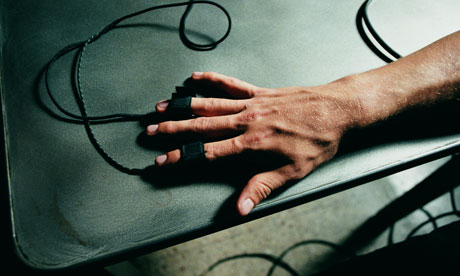
WASHINGTON — One of the nation’s most secretive intelligence agencies is pressuring its polygraphers to obtain intimate details of the private lives of thousands of job applicants and employees, pushing the ethical and legal boundaries of a program that’s designed instead to catch spies and terrorists.

The National Reconnaissance Office is so intent on extracting confessions of personal or illicit behavior that officials have admonished polygraphers who refused to go after them and rewarded those who did, sometimes with cash bonuses, a McClatchy Newspapers investigation found.

The disclosures include a wide range of behavior and private thoughts such as drug use, child abuse, suicide attempts, depression and sexual deviancy. The agency, which oversees the nation’s spy satellites, records the sessions that were required for security clearances and stores them in a database.

Even though it’s aggressively collecting the private disclosures, when people confess to serious crimes such as child molestation they’re not always arrested or prosecuted.

“You’ve got to wonder what the point of all of this is if we’re not even going after child molesters,” said Mark Phillips, a veteran polygrapher who resigned from the agency in late May after, he says, he was retaliated against for resisting abusive techniques. “This is bureaucracy run amok. These practices violate the rights of Americans, and it’s not even for a good reason.”

The agency refused to answer McClatchy’s questions about its practices. However, it’s acknowledged in internal documents that it’s not supposed to directly ask more personal questions but says it legally collects the information when people spontaneously confess, often at the beginning of the polygraph test.

Even though it is against the law as well as internal regulations, the NRO management have given themselves the green light in a self-investigation to keep doing it to their own employees and anybody going through a security clearance background investigation – a vast number of people, many of whom have or will someday have incredibly sensitive positions in the defense, intelligence and national security communities.

After a legal review of Phillips’ assertions, the agency’s assistant general counsel, Mark Land, concluded in April that it did nothing wrong. “My opinion, based on all of the facts, is that management’s action is legally supportable and corrective action is not required,” he wrote.

But McClatchy’s review of hundreds of documents – including internal policy documents, memos and agency emails – indicates that the National Reconnaissance Office is pushing ethical and possibly legal limits by:

-Establishing a system that tracks the number of personal confessions, which then are used in polygraphers’ annual performance reviews.

-Summoning employees and job applicants for multiple polygraph tests to ask about a wide array of personal behavior.

-Altering results of the tests in what some polygraphers say is an effort to justify more probing of employees’ and applicants’ private lives.

Read the rest here.
.
The charitable explanation is that all this is bureaucratic overreach motivated by tiny empire building and budget-padding in the age of  austerity, where cybersecurity is one of the few “growth” areas of discretionary spending for senior bureaucrats to pursue.
.
The cynical explanation is that these are blackmail files being compiled systematically and deliberately; to be used later to compel IC/DoD/DHS/DoJ employees to stick with an agency party line, intimidate and punish whistleblowers or use their official positions to engage in illegal misconduct to benefit politically influential VIPs. Like harassing American citizens or journalists critical of an agency or administration policy or special interests.
.
There’s few good reasons for the government to do this – and those few are all narrowly related to genuine and specific security concerns we have had to live with since WWII – but many bad ones.

Elkus and Zen at Pragati Magazine

Saturday, July 7th, 2012

My amigo Adam Elkus and I each have an article up at the newest issue of Pragati magazine:

Adam Elkus – Confront, Conceal, Leak 

David Sanger’s Confront and Conceal is best used as a Rosetta stone for deciphering DC discourse. Its true utility lies not in its uneven discussion of Barack Obama’s national security decisions, but in the way it reveals both mundane and alarming traits of American foreign policy debate. Sanger’s obsession with a supposed “split” between values and interests, mistaken belief that international security should be conducted according to the Golden Rule, and exposure of sensitive leaks all tell a story about the state of national security debate in 21st century Washington. Although the message is muddied and the narrator unreliable, Confront and Conceal is gripping reading.

Sanger’s self-designated task is to illuminate, through judicious research and both on and off the record interviews, the Obama administration’s struggle to operationalise its new vision of foreign policy. Sanger is at his best when exploring the way high-level officials engage in bureaucratic judo. His Obama is a canny political operator that compensates for relative inexperience with self-awareness and vigor. Even in the face of strategic surprise and bureaucratic infighting, Obama keeps a firm hand on the steering wheel. Sanger aggressively promotes a reading of Obama as driven operator rather than spectator, a portrayal that rings true when compared to other popular accounts of Obama’s foreign policy leadership style…. 

Mark Safranski –Drone invasions and cyber dystopias 

….Of the two, drones have the older history, going back almost a century to the Great War where experiments in auto-piloted planes were financed by the US Navy, but for much of the twentieth century, military applications for drones (or “remotely piloted vehicles”) were sharply limited. The technological capabilities of drones always lagged far behind the advances in manned aircraft and they were extremely vulnerable to modern anti-aircraft systems, or in some cases, small arms fire. While drones had some marginal utility for battlefield surveillance or as decoys, during the Cold War they were never the primary collection tools for sensitive intelligence that the U-2 Blackbird, listening posts and spy satellites were.

Several factors in the twenty-first century have pushed drones to the forefront as a weapon of choice for the Pentagon and the militaries of major powers. First, has been the relative decline of the probability of major interstate war since the collapse of the Soviet Union and the corresponding rise of irregular warfare in the form of insurgency by terrorists, guerrillas and rebellious tribes. Generally, these low-tech combatants reside in poor and remote areas and lack the capacity to detect or defend against drones except by concealment. Secondly, drones offer a tremendous economic advantage and battlefield return on investment (ROI) per enemy killed over advanced fighter aircraft.  A new F-22 costs $150 million to buy and $45,000 an hour just to fly with a pilot whose training costs the USAF $2.6 million; a reusable, propeller-driven Predator only costs slightly over $4 million. About the price of two and half Tomahawk cruise missiles….

The best war game is a library of windows

Tuesday, July 3rd, 2012

[ by Charles Cameron — Escher, Borges, simulating the future, wargames, A Pattern Language, Sembl ]
.

MC Escher, Relativity

.
Ridiculous phrase, a library of windows. Unless you think, as I do, of books as windows onto different worlds, in which case it makes a whole lot of sense, and a decent library has more windows onto more profoundly different worlds than any physical room — and here we are getting into the territory of Jorge Luis Borges (links to Library of Babel) and Maurits Escher (image above).

And let me just state for the record that Godel Escher Bach could just as well have been Escher Carroll Borges, and that a comparison between the logics of Escher and Borges is one of the desiderata of our times.

That’s a Sembl move.

**

Let’s expand the concept of window to include the sort of inter-worldview glimpse that Haaretz describes today here:

Last week, in a small beit midrash (study hall) named after Rabbi Meir Kahane in Jerusalem’s Shmuel Hanavi neighborhood, an emergency meeting was convened to discuss instigating freedom of religion and worship on the Temple Mount. It was a closed meeting attended by representatives of the Temple Institute, HaTenu’ah LeChinun HaMikdash (the Movement to Rebuild the Holy Temple) and the Temple Mount Faithful, as well as two representatives of Women for the Mikdash, and others. The activists met to try to understand how they could overcome the authorities, who they believe are plotting against them, and return to the Temple Mount. At this meeting, Haaretz was offered a rare behind-the-scenes glimpse of the most ardent activists in the battle to Judaize the Temple Mount.

**

Here’s the meat of the post, as yet uncooked. Back in 2005, but brought to my attention today by Rex Brynen at Paxsims, is this piece from Strategy Page:

After eight years of effort, and spending over $300 million, the U.S. Army has officially received its new wargame (WARSIM) for training battalion, brigade, division, and as big as you want to get, commanders, and their staffs. Now even the most elaborate commercial wargame would not get $300 million for development, and eight years to create the system. But wargames for professional soldiers have different requirements, and a troublesome Department of Defense bureaucracy to deal with. First, the requirements. Commercial wargames shield the player from all the boring stuff (support functions, especially logistics.) But professional wargames must deal with these support activities, because in a real war, these are the things commanders spend most of their time tending too. …

WARSIM covers a lot of complex activities that a commander must deal with to achieve battlefield success. Besides logistics, there’s intelligence. Trying to figure out what the enemy is up to is, next to logistics, the commanders most time consuming chore.

— which in turn was referenced by Michael Peck writing in a Kotaku piece today titled Why It’s So Hard to Make a Game Out of the 21st Century:

Let’s build a game. Let’s make it a strategy game. We will realistically simulate global politics in the 2030s. Perhaps a sort of Civ or Supreme Ruler 2020-type system.

Where shall we start? How about something easy, like choosing the nations in the game? It’s simple enough to consult an atlas. We’ll start with Britain…but wait! Scotland is on the brink of declaring independence from the United Kingdom. Should Britain be a single power, or should England and Scotland be depicted as a separate nation? What about Belgium splitting into Flemish and Walloon states? And these are old, established European nations. How will states like Syria and Nigeria look in two decades? It was only a bit over 20 years ago that the Soviet Union appeared to be a unshakeable superpower that controlled Eastern Europe and Central Asia.

**

Let’s cook that meat, let’s make a meal of it.

Peck’s piece goes into many other ways in which predictive gaming isn’t terribly productive.

But it left me asking the question, what would I do with a game-sized budget, if my aim was to push military and intelligence towards greater insight.

And my answer would be to embed information in walls. In corridors…

To build windows at sparse and irregular intervals into the internal corridors that connect any given office in the Pentagon or three-letter agency — or my local preference (hush, I know it’s the Glorious Fourth tomorrow) MI-5 and -6 — through which analysts and decision makers can glimpse snippets of information.

Which can then fall into the deep well of memory.

It is deep within that well of half-forgotten knowledge, ST Coleridge tells us, that the “hooks-and-eyes of memory” link one thought with another to build a creative third.

**

A wall, then. I would build a wall embedded with facts and fancies, maps and illustrations, graphs and stats, film clips and news clips, anecdotes and quotes — even, perhaps, tiny alcoves here and there with books free for the taking, music CDs, DVDs of movies, old, new, celebrated, strange…

And I would be constantly shifting and rearranging the “views” from my windows, so that what was seen yesterday would not be what would be seen tomorrow — yet with a powerful index of words, topics, themes, memes, image contents, names of actors, newscasters, authors and so forth, so that what was once seem and dimly recalled could be recaptured.

**

The concept here is pretty much the exact opposite of having a huge black poster proclaiming Creativity Matters!

Don’t get me wrong, creativity does matter (get that poster and others here), but it “works in mysterious ways its wonders to perform” — and the way to entice it is to see things out of the corner of the eye…

The windows I’m looking for, therefore, offer glimpses you wouldn’t necessarily notice if you were deep in thought or conversation, and conversely, wouldn’t see twice and grow so familiarized to that they’d become irrelevant by repetition. They’d be glimpsed in passing, their esthetic would be that of Christopher Alexander’s Zen View, pattern 134 in his brilliant work — the closest we have to a Western I ChingPattern Language:

The idea, then, is to seed the memory with half-conscious concepts, patterns, facts and images, carefully selected and randomly presented — so that those hooks and eyes have the maximum chance of connecting some scrap of curious information with a pressing problem.

Which is how creativity tends to work.

**

That way each corridor becomes a game-board — but it is in the analyst’s focused mind that the game is played and won.

What you’d get, in effect, would be community-wide, ongoing free-form gameplay in complete alignment with the web-based game we’re currently developing at Sembl. Games of this genre will also have powerful application in conflict resolution.

And peace.

The Psychology of Intelligence Analysis

Friday, June 22nd, 2012

Recently, commenter L.C. Rees brought to our attention  Psychology of Intelligence Analysis by Richards J.  Heuer, one of the rare sort of CIA officers who spent decades in both the Directorate of Operations and the Directorate of Intelligence.  I have been thumbing through Heuer’s work and if you have an interest in metacognition, analytical clarity, and cognitive biases, this book is for you.


Switch to our mobile site