zenpundit.com » propaganda

Archive for the ‘propaganda’ Category

Hysteria about Afghan schoolgirl hysteria

Sunday, April 28th, 2013

[ by Charles Cameron — Reuters publishes scary stuff, should have checked their facts with WHO epidemiologists first ]
.

Last time, it was the Jerusalem syndrome — this time it’s mass hysteria, not poison.

The Reuters article, Afghan girls’ school feared hit by poison gas by Folad Hamdard (upper frame, above) was posted on April 21, 2013, just one week ago.

Its key paragraphs in terms of etiology and blame are these:

As many as 74 schoolgirls in Afghanistan’s far north fell sick after smelling gas and were being examined for possible poisoning, local officials said on Sunday.

While instances of poisoning are sometimes later found to be false alarms, there have been numerous substantiated cases of mass poisonings of schoolgirls by elements of Afghanistan’s ultra-conservative society that are opposed to female education.

and:

Between May and June last year there were four poisoning attacks on a girls’ school in Takhar, prompting local officials to order principals to stay in school until late and staff to search the grounds for suspicious objects and to test the water for contaminants.

Takhar has been a hotbed of militancy and criminal activity since 2009, with groups such as the Taliban and the Islamic Movement of Uzbekistan active.

One wonders: Does Reuters employ fact checkers?

**

One wonders because…

An Editorial Note on the 2012 article Mass Psychogenic illness in Afghanistan (lower frame, above) in the WHO’s Weekly Epidemiological Monitor (Vol 5 # 22, 27 May) reads in part:

This is the fourth year where episodes of suspected mass poisoning of school girls is reported from Afghanistan. Like in the previous years the events are triggered off with one girl developing symptoms of headache, weakness, dizziness, nausea and fainting. Often these outbreaks were believed to be the work of political elements in the country who oppose girls education. Reports of stench smells preceding the appearance of symptoms have given credit to the theory of mass poisoning (chemical/bioterrorism). However, investigations into the causes of these outbreaks have yielded no such evidence so far. In the last four years over 1634 cases from 22 schools have been treated for Mass Psychogenic Illness (MPI) in Afghanistan. There are no related deaths reported.

Reuters is read by a whole lot more people than some WHO epidemiological weekly, eh?

**

Luckily, the NY Times at least posted a blog post by Matthieu Aikins writing from Kabul, The ‘Poisoned’ Girls of Afghanistan, by way of alerting us to the WHO report:

I’m willing to bet that there was no poison.

Over the past few years, thousands of girls have fallen victim to waves of alleged poisonings in Afghan schools. The government, media and education activists have blamed the Taliban, and the police in a number of provinces have produced the “guilty” parties, with some of them confessing on national television.

But last July when I investigated the subject for Newsweek, I discovered never-released reports showing that the United Nations, the World Health Organization and NATO’s International Security Assistance Force had investigated the incidents for years and had never found, despite extensive laboratory tests, any evidence of toxins or poisoning — a fact that may explain ISAF’s conspicuous silence on the issue.

I’m glad that’s been cleared up.

**

Here’s another DoubleQuote for you:
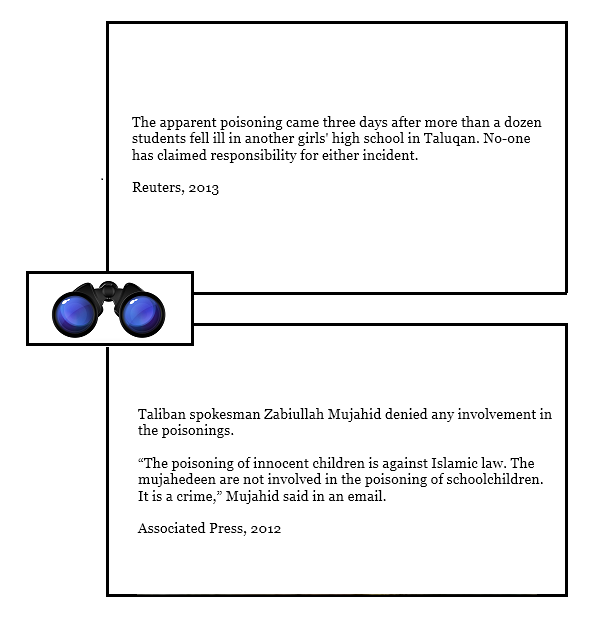
Of course, the Taliban spokesman was addressing a 2012 outbreak of the same hysteria story, and the “no claim of responsibility” report is from one of this year’s versions.

But why would anyone claim responsibility in any case, if the actual cause is mass hysteria rather than poisoning? There’s history to these things — they didn’t begin in Afghanistan:

The cases the Afghanistan incidents most resemble are the Tanganyika laughter epidemic of 1962, in which hundreds of people, mostly schoolgirls, were overcome by fits of mirthless, extended laughter, in what is now known as Tanzania, and the West Bank fainting epidemic of 1983.

The similarities between the heavily studied epidemic in the occupied West Bank and Afghanistan are particularly striking. Both places are in a state of conflict, where political violence is a fact of life, and both have powerful local rumor mills. The incidents follow a similar pattern: First a single report of a bad smell, then a small number of girls come down with symptoms, then it spreads. Local media fueled the rumors and the incidents spread in Afghanistan, just as they did in Israel and Palestine.

Albert Hefez, Israel’s lead psychiatric investigator of the incident, wrote in his 1985 study “The Role of the Press and the Medical Community in the epidemic of ‘Mysterious Gas Poisoning’ in the Jordan West Bank” that Israeli newspaper reports of “poisoning” at the start of the epidemic added fuel to the flames. A front page article in Haaretz on March 28, 1983 even claimed that Israeli military investigators had found traces of nerve gas and quoted “army sources” as saying they suspected Palestinian militants were poisoning their own people in order to blame Israel and provoke an uprising. Palestinian leaders followed up with accusations that Israel had poisoned them in an attempt to drive them from the West Bank.

And such things don’t only happen “abroad” — as detailed in that same NYT blog post I quoted above:

The phenomenon of groups of people falling ill for psychological, rather than physical, reasons is not unknown, nor is it limited to Afghanistan. Moreover, the typical victims are school-age girls. In late 2011, when a group of girls in Le Roy, New York, fell victim to a mysterious twitching illness, medical authorities eventually concluded it was psychogenic.

Hermit Kingdom of Darkness

Sunday, April 7th, 2013

North Korea’s shopworn game of bluster, threaten, bully, violate international norms and eventually be rewarded with concessions and bribes has stopped working, which is why there now is a crisis. With the suckers (ROK, USA and Japan) refusing to play three card monty and with even  Pyongyang’s confederate China wearying of the scam when they have their own fish to fry, Kim Jong Eunhas few options to save face except to double down on painting himself into a smaller and tighter corner. There are some who would like to play the game of appeasement for a temporary respite but both Seoul and Washington are taking a harder line on North Korean antics.

One gets the impression that -unofficially, mind you – Beijing would not mind “Fatty the Third” getting a comeuppance that could push him from power and lead to the ascension of a more mature, more reasonable, more seasoned and more Sinicized leader of the Kim dynasty.

Here is a round up of more intelligently thought out (or at least interesting) articles and posts about the Nut of the North and possible war with North Korea:

Colonel Dave Maxwell– north Korean Leadership Assessment and The Realist Prism: North Korea Gambles on Strategic Assumptions and U.S. would seek regime change in North Korea if attack occurs

Colonel Maxwell is an area specialist on the DPRK, these are the “must read” pieces

Robert Baer –Viewpoint: North Korea’s Gaddafi Nightmare 

Gordon Chang –Is Kim Jong Un’s Bluster Really a Prelude to Reform?

Thomas PM Barnett –The Tricky Thing about Kim Jon Eun 

Patrick Cronin – Tell me How this Starts

IHT –Detecting Shift, U.S. Makes Case to China on North Korea 

Let me try my hand at reading the tea leaves. I don’t know that much, relatively speaking, about the “sovietology” of analyzing North Korean nuances which I will leave for experts like Colonel Maxwell to concentrate on other angles. Some points i no particular order:

  • First, any hope of an internal coup against Eun is probably nonexistent. Not only for the the consistent ruthlessness and lavish bribery which the Kim Family regime has treated it’s military, but the fact that coups of this nature have a poor track record in Communist states, even weird ones like the DPRK. From the inception of Communist power in the USSR, Soviet leaders fretted about “Bonapartism” by counterrevolutionary generals on white horses from Kornilov to Tukhachevskii to Zhukov. That these plots were mostly imaginary did not matter and Communist rulers neutralized this threat by binding the military leadership into the Party leadership at a level subordinate to the Politburo and periodically shooting likely upstarts. The political space for successful military coups do not exist in Communist regimes even for the key insiders, just ask Lin Bao. The North Korean military does not have the will to do this except in conjunction with massive Chinese intervention. Perhaps not even then.
  • For all the talk of irrationality, North Korea has been been playing this game as a survival strategy for sixty years and only miscalculated once, with the original invasion of South Korea in 1950 – which only happened, after Kim Il-Sung received the blessing of Stalin and promise of massive support from Mao ZeDong – and it was an unmitigated disaster for North Korea and China. Pointedly, the North has not initiated a war since and their subsequent violent provocations, while infuriating, have been quixotic and weird rather than existential threats that would guarantee a crushing military response.
  • The “win” for the US and ROK here is in frustrating the regime’s grasp for status, however self-deluded, in extorting more material concessions by acting like the international community’s equivalent of a crazy, menacing, homeless person ranting on a street corner. We need to make this charade appear to be a diplomatic sure-fire loser this time in the eyes of Pyongyang’s elite with an endgame where the North emerges empty handed and Eun feels that pressing further risks a greater loss of face. We do this by making moves where the spillover costs of North Korean intransigence and public lunacy drift in China’s direction; a tightly constrained North Korea out of diplomatic and economic options is really Beijing’s problem.
  • The strategic equation for “victory” from the North’s perspective depends heavily upon the reaction of the US and ROK governments to get drawn into tiresome negotiations before the North ceases it’s behavior, something they ultimately cannot control. Washington and Seoul cold hold firm or even (conceivably) take a harder line. If frustrated in their quest for concessions, the regime could exercise several options a) shift gears to a different propaganda campaign to distract internal audience b) engage in an act of terrorism elsewhere in the world, such as against a ROK embassy c) engage in a military demonstration that while provocative, like ballistic missile test, is not a casus belli d) all of the above e) undertake a military strike under the mistaken impression the ROK will not retaliate.

Comments welcomed.

Fair and balanced, eh?

Monday, January 21st, 2013

[ by Charles Cameron — Guardian reporting on Gaza and Mali, weighed in the balance and found wanting? — with Fox News for company ]
.

.

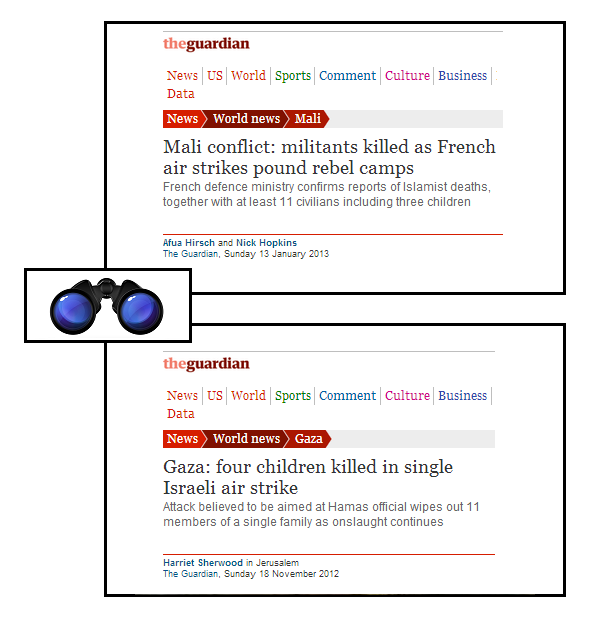
I frankly don’t for a moment buy that Fox News is fair and balanced, but then I don’t know if any news source is, so let me try to be a little even-handed here myself, and take a gander at a couple of recent Guardian headlines, using my SPECS format to display them:

I’m not the first one to juxtapose these two headers — there’s a site called CiF Watch that monitors the Guardian (specifically) for signs of “antisemitism, and the assault on Israel’s legitimacy” and it brought these two Guardian posts together with the comments:

The contrasts in language, tone and narrative focus between a report by Harriet Sherwood on Israel’s November conflict with Hamas and a recent Guardian report on the French war against Islamists in Mali represent an exquisite illustration of the paper’s egregious double standards. …

In Sherwood’s report, the deaths of Palestinian children represent the overwhelming narrative focus. The fact that the IDF was attempting to target Hamas terrorists is only mentioned in the strap line, and even then is qualified with the word “believed”.

In the report by Hirsch and Hopkins, on the other hand, we are informed via the headline that militants are killed, while the deaths of Mali children are only noted at the end of the strap line.

On the one hand, I appreciate this kind of close reading as an analytic technique, while on the other I can’t really expect editors to check previous possibly comparable events to make sure their treatment of breaking news is immune from this kind of criticism.

That’s a quandary, IMO — but not yet a quagmire.

**

Forget the question of whether Fox News is more or less biased than the Guardian — or should I call them Faux News and the Grauniad? — and just think again about our passions, about how they can blind us, and about how that blindness can manifest in emphases, in choice of words or images — in so many conscious and unconscious ways.

We need to deploy considerable mindfulness if we are to explore, read, filter, balance and comprehend the world around us — with anything like the nuance required for making wise (rather than lop-sided) choices…

**

Sources:

  • Mali conflict: militants killed as French air strikes pound rebel camps, Jan. 13, 3012
  • Gaza: four children killed in single Israeli air strike, Nov. 18, 2012
  • WYSIWYG

    Friday, January 18th, 2013

    [ by Charles Cameron — what you see is what you get: WYSIWYG — and possibly also TEOTWAWKI ]
    .

    See buildings, walls, handrails, reflections, rows of windows, and people he’s walking past vanish and reappear as a man dressed for mountain climbing sets out into a blizzard of snow, video snow and special effects…

    Hat-tip — Shlok Vaidya.

    **

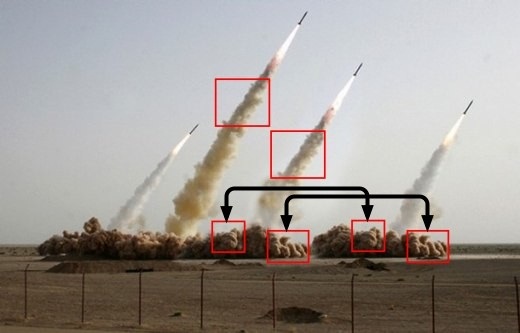
    We knew that Iran could photoshop extra rockets into a widely distributed news image –

    and that Russian dissidents could makeover Kirill as his friend Putin

    But the video above, with it’s vanishing and reappearing everythings? Simple — it’s a stunning portrayal of just what patience and skill can manage with video tampering using Photoshop CS5 or the like. Hence — this may also be the time to announce TEOTWAWKI. The end of the world as we know it. As we believe we know it.

    You only need one of those effects, remember, to fake out a geopolitical tipping point…

    Watcher, beware.

    **

    But then there’s my friend Howard Rheingold, who points out that our whole world is a constructed reality:

    We habitually think of the world we see as “out there,” but what we are seeing is really a mental model, a perceptual simulation that exists only in our brains. …

    Cognitive simulation — mental model-making — is what humans do best. We do it so well that we tend to become locked into our own models of the world by a seamless web of unconscious beliefs and subtly molded perceptions. And computers are model-making tools par excellence, although they are only beginning to approach the point where people might confuse simulations with reality.

    That’s a quote from his piece in Brenda Laurel‘s 1990 classic Art of Human-Computer Interface Design — and it seems to grow more prescient by the day!

    **

    Three topics, at least somewhat related, we can maybe talk about later:

  • Who it was that spread the word about the Innocence of Muslims trainer.
  • The disputed Muhammad al-Durrah incident at the Netzarim junction. And
  • Zero Dark Thirty.
  • Battling bus ads revisited

    Saturday, January 12th, 2013

    [ by Charles Cameron — today’s “shout it from the rooftops” is “advertise it on the bus” — the wars of sound-bite religion, plus special extra, the perils of dehumanization ]
    .


    .

    I am pretty sure that when Sojourners puts up an ad saying Love your Muslim neighbors” (above, right) it’s a religiously motivated act with political implications, but not quite so sure when Pamela Geller puts up an ad that’s certainly anti-Hamas and likely anti-Muslim (below), whether to consider it religiously or politically motivated: the two things aren’t always easily untangled.

    *

    But hey, at least in Portland according to this AP article, the Pamela Geller ads were posted in response to this one, which I’d tend to characterize as politically motivated, with a plausible religious undercurrent:

    **

    Of course, there are other maps.. including this one, from American Trial Attorneys in Defense of Israel:

    **

    Okay, I’ve been on about ads as a medium for religious dispute for a while now [1, 2], and frankly I don’t know why we need seminaries in Oxford, Qom or Dharamsala if all you need to know about a religion can be found on the side of a bus…

    But it does get confusing, eh?

    For instance, when Mona Eltahawy defaces one of Pamela Geller’s ads, is she erasing freedom of speech, or hate speech — or freedom of hate speech?

    **

    Look, here are a series of ads that CAIR has just put out, using the term “jihad” in a way that’s both a legitimate meaning of the term within Islam and compatible with western democratic ideals:

    **

    And here are Pamela Geller’s reworkings of the same series of ads, using the term “jihad” in a way that’s both a legitimate meaning of the term within Islam and entirely incompatible with western democratic ideals.

    The thing is, there’s an enormous spectrum of beliefs and nuances of belief within Islam, and even within Salafism…

    And buses and subway ads aren’t the go-to places to understand that spectrum.

    **

    But they’re worth watching to get a sense of how the public is being swayed.

    Ironic, isn’t it, that as the New York Times reports, Erika Menendez told the cops:

    I pushed a Muslim off the train tracks because I hate Hindus and Muslims ever since 2001 when they put down the twin towers.

    Hindu, Muslim, Sikh..

    **

    For what it’s worth, Sojourners could have posted an ad that said, Love your enemies rather than Love your neighbor — both are equally biblical:

    Ye have heard that it hath been said, Thou shalt love thy neighbour, and hate thine enemy. But I say unto you, Love your enemies, bless them that curse you, do good to them that hate you, and pray for them which despitefully use you, and persecute you.

    Matthew 5. 43-44

    But then, that’s a bit long for an advertisement, isn’t it?

    **

    Somewhere between Christ‘s command “Love your enemy” and Sun Tzu‘s “Know your enemy” we can surely find a place for “Honor your enemy” — and that, it turns out, may be of considerable importance. Describing the work of Lt. Col. Dave Grossman, Lin, Mehlman and Abney write in their Greenwall Foundation report, Enhanced Warfighters: Risk, Ethics, and Policy:

    Grossman has interviewed many US veterans of the Vietnam War. Not all of his subjects, however, were those with lingering psychological trauma. Grossman found that some of the men he interviewed had never truly achieved emotional distance from their former foes, and seemed to be the better for it. These men expressed admiration for Vietnamese culture. Some had even married Vietnamese women. They appeared to be leading happy and productive post-war lives. In contrast, those who persisted in viewing the Vietnamese as “less than animals” were unable to leave the war behind them.

    That, more generally, may be key to understanding why demonizing Islam and Muslims is such a bad idea. In Grossman’s own words:

    It can be easy to unleash this genie of racial and ethnic hatred in order to facilitate killing in time of war. It can be more difficult to keep the cork in the bottle and completely restrain it. Once it is out, and the war is over, the genie is not easily put back in the bottle. Such hatred lingers over the decades, even centuries, as can be seen today in Lebanon and what was once Yugoslavia.


    Switch to our mobile site