zenpundit.com » democracy

Archive for the ‘democracy’ Category

On the Mythic and the Historic

Thursday, February 3rd, 2011

My amigo Sean Meade ponders:

Notes: The Problem with Sparta

So here are some of the ideas and notes, for posterity.The Problem with Sparta (and Greece)

References
300 (original graphic novel by Frank Miller and better-known movie)
Gates of Fire, Steven Pressfield
The Peloponnesian War, Thucydides
A War Like No Other, Victor Davis Hanson
Sailing the Wine-Dark Sea, Thomas Cahill

The fiction glorifies Sparta while the non-fiction is more critical than laudatory. I was struck by how much the fictional Sparta, in three stories I really love, did not match the history I’d been studying.

Did Pressfield make his story more palatable to his readership by soft-pedaling Helot slavery, radical conservatism and aristocracy, oligarchy and homosexuality and pederasty?

We moderns are very critical of the real, historical Sparta. Insofar as it stands in for Greece in the fiction above, it’s an inaccurate portrayal. To say nothing of all the problems with our view of the Golden Age of Athens…

Ah, the tension between history and myth. 

Admiration for ancient Sparta was imprinted into Western culture because Sparta’s Athenian apologists, including Xenophon but above all Plato, left behind a deep intellectual legacy that includes a romantic idealization of Sparta that contrasts sharply with the criticisms leveled by Thucydides against Athens in The Peloponnesian War. The Melian Dialogue remains a searing indictment against Athens 2,500 years later but no equivalent vignette tells the tale of the Helots living under the reign of terror of the Spartan Krypteia. Plato’s Republic upholds oligarchic authoritarianism inspired by Sparta as utopia while Athenian democracy is remembered partly for the political murder of Socrates and the folly of the expedition to Syracuse. Somehow, ancient Athens lost the historical P.R. war to a rival whose xenophobic, cruel, anti-intellectual and at times, genuinely creepy polis struck other Greeks as alien and disturbing, no matter how much Sparta’s superb prowess at arms might be applauded. 

The fact that the vast majority of the ancient classic texts were lost, or as Dave Schuler likes to note, very selectively preserved and edited – at times, invented – by later peoples with agendas, may account for some of the discrepancy.

DQ Egypt: impact on Israel

Wednesday, February 2nd, 2011

[ by Charles Cameron [hoping Zen’s ISP will be back up shortly] — cross-posted from ChicagoBoyz ]

Someone posted an excerpt from an interview with Khaled Hamza, the webmaster of the Muslim Brotherhood, as a comment on an earlier post of mine on ChicagoBoyz, where I also blog, and I was interested enough to track the original interview down, and have presented the key points of the excerpt here in Quote #1.

I am pairing it, in Quote #2, with an excerpt from an interview the BBC recently conducted with Mortimer Zuckerman – because I find the two quotes taken together suggest something of the complexity of the breaking situation in the Middle East.

*

I’d like to float a trial balloon / try a though experiment, if I might. And since I’m more “tail” than “left” or “right wing”, I’ll be posting this in more than one place, and hope to get comments from all sides…

On the face of it, Zuckeman is applying what’s arguably a racist double-standard. He advocates democracy, “totally” and “without question” – but not for the Egyptians, or at least not today or tomorrow.

On the face of it, the Egyptian public seems distinctly unenthused by Mubarak’s regime and will, in a democratic election, presumably vote in a fair number of Muslim Brotherhood representatives – though it’s by no means clear that they would be in the majority, and their present ideology in any case is closer to the processes of electoral politics than those of violent jihad.

So there is reason for Israel to be concerned, and reason for those who support democracy to see some hope for democracy, in the ongoing events in Egypt.

Let me put it this way: Quote #1 illustrates why Zuckerman might make the remarks quoted in Quote #2, while Quote #2 illuminates why Hamza might make the remarks quoted in Quote #1.

*

And here’s the thought experiment — I’d like to come at this from a Maslovian angle.

Maslow’s Hierarchy of Needs

I’d like to suggest that “democracy” is an ideal, or to get away from that word with its somewhat ambiguous political connotations, an activity of the “the better angels of our nature” – and thus, from a Maslovian perspective, an aspect of a group or nation’s “self-actualization” level of interest, whereas “stability” would fall under “safety” or even “physiological”.

If that’s right, Zuckerman is at least arguably articulating a “stability first, eventual democracy would be ideal” position.

Does that “Maslovian” formulation throw any additional light on the situation?

*

The problem with the position I just described is nicely articulated by Mohammad Fadel at the very end of a Foreign Policy post, Can Black Swans lead to a sustainable Arab-Israeli peace? — and it’s only his conclusion I’m quoting here:

Tunisia and Egypt have demonstrated categorically that any peace which relies on the stability of police states is doomed from the outset.

If a butterfly flapping its wings in Brazil can in theory cause a tornado in Texas – heaven alone knows what someone blinking in Cairo or Jerusalem or Washington can do.

Myself, I pray for empathy, which seems a reasonable request, I hope for wisdom, which seems a great deal more chancy — and I long for peace.

In the current environment of hatred and mistrust, that seems entirely beyond the capacity of anyone’s present thinking to achieve.

Remarkable

Tuesday, January 11th, 2011

A popular and respected Democratic member of Congress is shot by a lunatic and her partisan colleagues honor her by proposing to restrict political speech, give themselves special privileges at airports and to give all members of Congress and, apparently, the Federal judiciary, the statutory status of the President if the United States.

“We’ve had some incidents where TSA authorities think that congresspeople should be treated like everybody else,” he [ Rep. Clyburn] said. “Well, the fact of the matter is, we are held to a higher standard in so many other areas, and I think we need to take a hard look at exactly how the TSA interact with members of Congress.”

The indignity of it all! A Congressman, treated as if he was under the same laws as his fellow citizens. An outrage. Maybe with that “harder look” Representative Clyburn can take a little time for how his fellow Americans are being treated by TSA as well.

Perhaps granting the Democratic House minority leadership and their children a few hereditary titles of nobility and some estates on Federal lands would cut to the chase for what these people are really after. At a minimum that would be as relevant a response to the shooting of Rep. Giffords as empowering the FCC to censor FOXnews and force Rush Limbaugh off of the airwaves – and it would do our constitutional order a whole lot less harm. I am perfectly content to refer to Rep. Clyburn as Viscout, Prince-bishop or Archduke if he in turn agreed to, say, read the Bill of Rights. Better late than never, I say.

Incidentally, making credible death threats against anyone is already a crime in most jurisdictions I am aware of, albeit one insufficiently prosecuted by DA’s. Threatening USG officials is a Federal offense.

At the turn of another year

Saturday, January 1st, 2011

[ by Charles Cameron ]

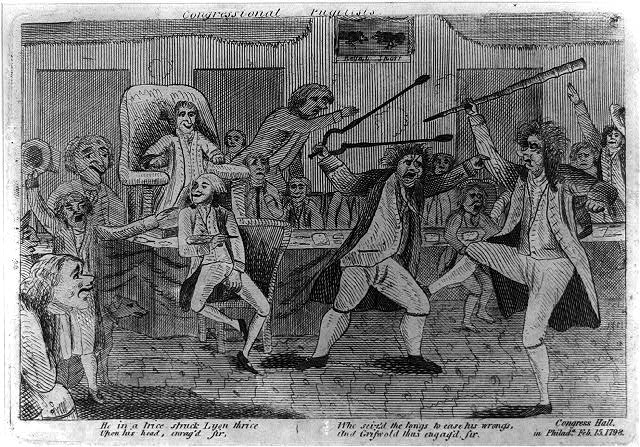
Lyon-Griswold brawl

Reps. Roger Griswold of Connecticut and Matthew Lyon of Vermont practice politics by means of hickory stick and tongs in Congress Hall, 1798

It’s always interesting to watch the way one thing morphs into another, and von Clausewitz’ formulation that war is “a mere continuation of politics by other means” is instructively illustrated in the gallery of a dozen photos on the CBS News site titled Best Parliamentary Brawls of 2010.

Ukraine, Indonesia, Italy, S Korea, Nigeria, Taiwan, Turkey… that’s a pretty fair slice of gepopolitics!

Happy New Year!

image above from the Prints and Photographs Division, Library of Congress.

We Need Pitchforks and Torches

Monday, October 18th, 2010

Top Billing! The Daily CallerTheDC OP-ED: One nation, under fraud

Tomorrow, a bank-not your bank, but any bank-could evict you from your home. Even if you didn’t know the bank was foreclosing. Even if your mortgage is paid off. Even if you never had a mortgage to begin with. Even if the bank doesn’t hold a single piece of paper that you signed. And major banks not only know this fact, but have spent millions of dollars to defend it in court. Why? The answer starts with a Jacksonville homeowner named Patrick Jeffs.

In 2007, Deutsche Bank sued Jeffs for his home, which is a necessary step in the process of foreclosing on a homeowner in the state of Florida. Curiously, despite the fact that he immediately hired a law firm to defend his property when he found out about the foreclosure, neither Jeffs nor his attorneys were at the trial. That’s because it had already happened. Deutsche won by default because Jeffs wasn’t able to travel backwards in time to attend, even though the trial featured a signed affidavit indicating that he had been served his court summons.

The only problem with the summons Jeffs supposedly received was that it had been conjured out of thin air.

In June of this year, a Florida court ruled that the document was fraudulent, as the person who was supposed to make sure Jeffs was served had mysteriously received a copy of the summons before the lawsuit had even been filed, and Jeffs never even saw the copy. The text of that ruling was posted on various financial news websites in September. The lawyers that Jeffs hired to defend his case say that fraud such as this is not uncommon. It’s a widespread problem, and it has cost countless families their homes.

“I think it’s safe to say that 95% of the foreclosure cases in Florida involve some form of fraud on the part of the bank,” David Goldman of Apple Law Firm, PLLC told The Daily Caller in a phone interview. “It’s probably closer to 99%. And the court system is helping them get away with it.”

Banksters should not only be going to prison for intentionally destroying the lives of people who are not only NOT in default on their mortgages, but have never transacted a mortgage with the institutions attempting to illegally seize their property, these guys should be made to face an angry mob composed of the people they have defrauded.

This is the Oligarchy in action. They intend to hollow this country out and move their loot offshore just like in Russia during the 1990’s

Hat tip to Ron Beasley at Newshoggers.com who also found this gem:

COUNTERPOINT ADDENDUM:

Blogfriend Fabius Maximus, who often blogs on economics, would like to offer a counterpoint and i have agreed to let him put up his perspective here and some excerpts:

  A briefing about the foreclosure fraud crisis: its origin and impacts.
 

….The real estate title system in the US is complex, with safeguards protecting debtor and creditor (for details see this by Barry Ritholz).  It’s also local (rules and data are not national).  This system worked well for generations, but collapsed during the housing boom.

  • Loan volume accelerated, overloading key parts of the system.  Appraisals were often corrupted, as loan originators routed business to compliant appraisers.
  • Massive securitization of mortgages ignored these constraints, and erected a pseudosystem on top of it that cheaply processed the high volume of both mortgage origination and securitization (e.g., the Mortgage Electronic Registration System – a faux version of security clearing corporations; see this explanation).  Securitization also broke the link between the originator and end owner, with many ill consequences.  Among other things, this put great pressures on the servicing firms to lower costs.
  • During the RE boom years recoveries on foreclosed mortgages were zero or positive, which meant a low rate of foreclosures (homes could be sold by the owner rather than default on the mortgage).  So the institutional apparatus for foreclosures atrophied.

The the default bust hit.  Massive flow, overwhelming the system – which was never configured for such an event.  Remember, experts believed home prices never decline for more than a calendar year.  The worst scenario considered by the most experts was flat prices for 3 years.

The servicers (sometimes the bank originating the mortgage, often not) reacted by cutting corners (seethis Reuters story).  Finding the original loan documents was too expensive, so they used lost document procedures designed for extraordinary circumstances (e.g., fire, flood, or misfiling – see this at Calculated Risk and here at Reuters).  Some servicers hired law firms set up as foreclosure mills (e.g., FL), processing incredible numbers of foreclosures.  It’s not clear how, but clearly proper procedures were not followed.

As a result there have been many claims that foreclosure notices were never served (an easy way to make serving a high-margin profit center).  Employees have admitted under oath in depositions to fraudulently signing thousands of notarized affidavits.

This took place in the 23 states with judicial foreclosures only with the cooperation of Judges.  A few Judges protested when shown that their banks and their agents were committing perjury.  But the process ran smoothly for the past few years.  Now the wheels are coming off.  This might be difficult for the financial sector to conceal or mitigate, despite their de facto control over the government’s regulatory machinery.

A situation report about two headine issues – and a more serious problem

….Despite the oft-hysterical analysis, there is as yet insufficient public information about the scale of the problem.  Quite likely even key players (e.g., banks, their law firms, government regulators) lack the necessary information.  Deliberately, as all prefered to “see no evil.”  But now that the problem has erupted into the daylight, this leaves them ill-prepared to respond.  Especially as any adequate response will reveal their incompetence and malfeasance in creating the situation.  (Here are Wells Fargo’s procedures regarding creditors’ complaints; nothing available for their procedures to debtors’ complains).

Political factors, not legal or economic, probably will control the evolution of this crisis.  Hence the likelihood of modest impact to the national economy.  More than the small impact expected by Wall Street; less than expected by the increasingly rabid doomsters.   Over a longer horizon, a year or more, the economy will affect the political dynamics.  For a good analysis of the current political situation see “Congress Taking Cautious Approach with Foreclosure Mess“, American Banker, 14 October 2010.  The Republicans, as usual, eagerly support the banks – despite any violations of the law, despite the interests of the American people.

The economic impact looks to be minimal and probably less than the political effects.  New home sales are unaffected by this crisis.  The title problems are solvable.  New home finance is unaffected, and in any case are now 90% government financed or guaranteed.  Interruptions in sales of existing homes will have severe effects for those affected, but little for the overall economy (despite the massive attention to the volume of existing home sales, they have minimal economic effect).

What could change this forecast? A second dip would radically change the situation, as more links in US and global economy “unexpectedly” break.   As would a long foreclosure moratorium, although this is unlikely under the current political regime.  It could happen as part of system change, of such magnitude that the moratorium would be one of the lesser results.


Switch to our mobile site