zenpundit.com » music

Archive for the ‘music’ Category

Cross-grain thinking, 1: Mozart and how music reaches us

Thursday, November 1st, 2012

[ by Charles Cameron — tracking a single pattern back and forth across the Cartesian divide between “inner” (subjective) and “outer” (objective) realities, and why ]
.

.

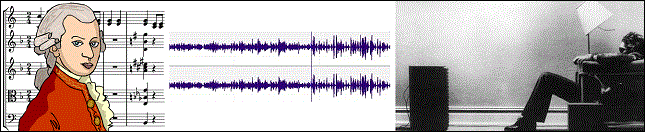
From God’s lips, figuratively speaking — via Mozart‘s mind and hand onto paper and out to musicians’ eyes and into their minds, then back out through their lips and hands and instruments and air — to your ears, and beyond? One pattern across a variety media.

We study Mozart’s biography. We study the “chunking” techniques a pianist typically uses to become proficient. My friend Wm. Benzon writes about how the brain’s oscillatory circuits can be internally synchronized through sonic activity and much more. We study how musical tastes correlate with education, or wealth, or class. What we don’t study nearly so intently, it seems to me, is the entire sequence by which a musical pattern makes its way from a composer’s initial thought to a listener’s delighted experience.

And what makes me want to talk about that is my sense that it requires thinking across the grain — across disciplines, across silos, across assumptions and languages and expectations.

It helps that I love Mozart. And I’m interested in the way patterns work. And perhaps most significantly, I believe that analytic mapping that doesn’t concern itself with both “inward” subjective experience, thought and emotions as well as “outer” realities, people, processes, and so forth will have us firing on only 50% of our cylinders at best. As I said in an earlier post on Anders Breivik:

A lot of our maps and models move between one quantity and another, and a lot of our thinking, correspondingly, has to do with materiel rather than morale — but nowhere is there a map or model of how quantity and quality affect each other, or how morale “force multiplies” materiel — even though “real life” moves seamlessly between (subjective, qualitative) mind and (objective, quantifiable) brain.

We have no map to walk us through the hard problem in consciousness — except our own insight.

And x-rays do not an insight make.

Let’s simply call this an early attempt to think about a stretch of the border between subjective and objective worlds, taking Mozart — a reasonably innocuous subject compared with Breivik — to start with.

**

There’s a phrase of music in Mozart’s head: it is a pattern – we shall see it later as a pattern in ink on paper, a pattern in keys depressed on a keyboard, on strings struck and vibrating, as a pattern in acoustic waves in air and a pattern of impacts on the ear drum, then of electrochemical activity in the brain, of “Mozart” in the mind – and perhaps in a tapping of the feet on the floor, and from thence, onwards…

Perhaps Mozart got it, this pattern, consciously or unconsciously, from the starling he wrote a poem to, and gave a burial to when it died [1, 2] … No doubt something of that pattern would have been in the starling’s brain as its throat muscles moved, and in the air that moved and he sang…

**

Something goes on with this pattern “inside” Mozart, and he composes, which is itself a hugely complex business involving various parts of his brain — and mind? Just brain, or brain and mind, or mind-brain? That’s the “hard question in consciousness” right there, and it applies as much to the starling, and the eventual listener, as it does to Mozart…

That “something” going on inside him has been variously described, in any case, and the historian William Stafford has written an enlightening piece comparing the myth of Mozart’s genius (Mozart himself used the term a couple of times in the classic sense of an intuitive guide, much as Socrates too would use the term) with the practicalities of musical skill and concentration.

**

Thus there is undoubtedly a romantic “Mozart the genius” slant to the account given by Mozart’s earliest biographer who, working with Mozart’s widow, described his process of composition in these terms:

Mozart wrote everything with a facility and rapidity, which perhaps at first sight could appear as carelessness or haste; and while writing he never came to the klavier. His imagination presented the whole work, when it came to him, clearly and vividly.

This idea is even more vividly expressed in the letter, purported to be Mozart’s own words but now widely considered a later effort by the publicist Friedrich Rochlitz and “attributed” to Mozart himself in the spirit of the times:

When I am, as it were, completely myself, entirely alone, and of good cheer — say, travelling in a carriage, or walking after a good meal, or during the night when I cannot sleep; it is on such occasions that my ideas flow best and most abundantly. Whence and how they come, I know not; nor can I force them. Those ideas that please me I retain in memory, and am accustomed, as I have been told, to hum them to myself. If I continue in this way, it soon occurs to me how I may turn this or that morsel to account, so as to make a good dish of it, that is to say, agreeably to the rules of counterpoint, to the peculiarities of the various instruments, etc.

All this fires my soul, and, provided I am not disturbed, my subject enlarges itself, becomes methodised and defined, and the whole, though it be long, stands almost complete and finished in my mind, so that I can survey it, like a fine picture or a beautiful statue, at a glance. Nor do I hear in my imagination the parts successively, but I hear them, as it were, all at once (gleich alles zusammen). What a delight this is I cannot tell! All this inventing, this producing, takes place in a pleasing lively dream. Still the actual hearing of the tout ensemble is after all the best. What has been thus produced I do not easily forget, and this is perhaps the best gift I have my Divine Maker to thank for.

When I proceed to write down my ideas, I take out of the bag of my memory, if I may use that phrase, what has been previously collected into it in the way I have mentioned. For this reason the committing to paper is done quickly enough, for everything is, as I said before, already finished; and it rarely differs on paper from what it was in my imagination…

**

In start contrast to this romantic picture, Stafford himself writes in his paper Mozart and Genius, and more briefly in his essay in the Cambridge Mozart Encyclopedia:

We must suspect a large element of myth-making in all of this, a construction of Mozart and his life in accordance with preconceived ideas.

and:

The real Mozart expressed pride in his craft, in the compositional skills he had learned from other musicians and taken to a high level. Much recent scholarship has emphasized the relationship of his creativity to his social milieu. In place of an unreflective genius who composed in a dream, it has given us, as in Konrad Kuster’s recent biography, a musician of the highest technical competence for whom composition presented a series of intellectual and aesthetic challenges that could only be surmounted with considerable effort.

**

I suspect that Stafford, too, is giving us his “construction of Mozart and his life in accordance with preconceived ideas”.

To my mind, it’s just that our own contemporary preconceptions have shifted the emphasis from the “inspiration” to the “perspiration” factor in understanding great works and the exceptional minds and mind-sets that produce them. In my view, both accounts have something to offer us – that what we retrospectively term “genius” happens when a prepared mind (meaning Stafford’s “compositional skills” and so forth) lets go of its controlling urgency, and a deeper, richer mind emerges — an emergence which takes places classically in reverie (Gaston Bachelard) or after some similar disengagement of the active will, from whence we get the phrase “let me sleep on it” in response to the posing of a tricky problem or dilemma

**

But the pattern.

No doubt there are a thousand ways in which Mozart differs from Beethoven, Beethoven from El Greco, El Greco from Einstein, Wittengenstein from Heraclitus, and Heraclitus from the Heraclitus who stepped into “the same river” a while ago…

What seems to be more stable is the pattern that Mozart wove, as it traveled from the throat of his starling through the intricacies of his own knowledge and practices, his friendships and tastes, his needs and longings and out onto paper, to a pianist or orchestra, and through instruments and voices into concert halls and magnetic wave forms and curious spirals engraved on discs, into sub-woofers and tweeters and full-range drivers..

And into our minds and hearts, our memories – our quiet hummings to ourselves on long autumn drives between motels.

**

I think we should track that pattern, know as much as we can of that pattern, write the biography of the way in which some piece of music weaves between inspiration and thought, composer and instrument, mind and matter, performer and audience, studio and home digital music center…

Then, perhaps, we could begin to map other patterns – in some ways simpler and more urgent ones.

Coming up shortly: Cross-grain thinking, 2: AQ’s #3 spot and mapping the jihadist mind. One thing you can be sure of: it will be different.

The war and peace paradox, take 2: of wolves and music

Tuesday, October 30th, 2012

[ by Charles Cameron — second take on the paradox, this time featuring wolves, poetry, lions, honey, and Bach ]
.

eye-catching headline & image from the New York Times, 2008

.

I’m always trying to see war and peace — violence and gentleness, if you like — in counterpoint rather than in opposition. The distinction is a subtle one, I know, but that’s the task. I tackled it from one angle a few days ago in this earlier post, and imagine I’ll return to it again from time to time.

**

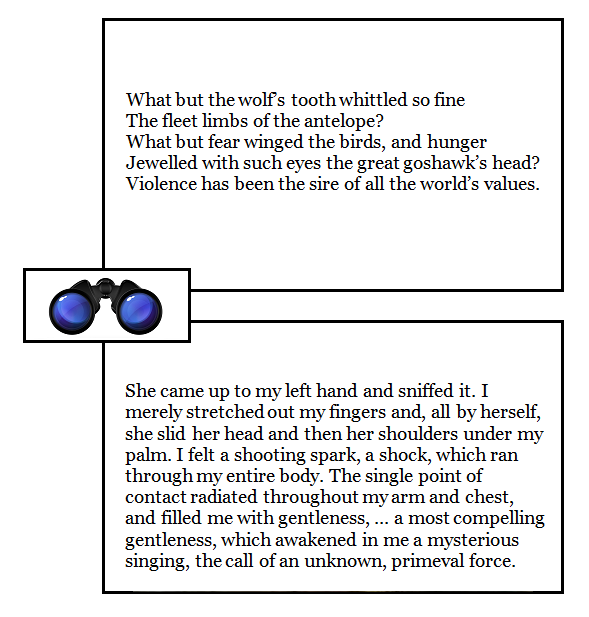
I was fascinated to run across two very different artists talking about wolves these last few days. Robinson Jeffers, in his great poem The Bloody Sire, sees the wolf’s violence (upper panel) as bringing speed and grace to the antelope:

while the extraordinary pianist Hélène Grimaud describes her first encounter with a wolf (lower panel) in terms of gentleness.

After that striking first encounter with a wolf, Grimaud went on to found the Wolf Conservation Center in upstate New York (see NYT article by clinking on image at top of this post).

**

There’s a longish and fairly erotically, religiously and violently charged story in chapter 14 of the book of Judges. Samson, so the story goes, took a liking to a woman of the Philistines, and despite his parent’s urgings went down to see her because, as he delicately put it, “she pleaseth me well.” Along the way he meet a young lion, and “rent him” — tore him apart with his bare hands — “as he would have rent a kid” — here meaning a young goat. Samson continued to like the look of the women of the Philistines, we are told, and on his next visit down to see her, “he turned aside to see the carcase of the lion: and, behold, there was a swarm of bees and honey in the carcase of the lion. And he took thereof in his hands, and went on eating, and came to his father and mother, and he gave them, and they did eat…”

Samson, it seems, was a gambling man, and he soon proposed a bet and a riddle to his bride’s companions — for somewhere around that time they had married, a fact that the story teller omits to tell us in so many words — giving them seven days to solve it:

Out of the eater came forth meat, and out of the strong came forth sweetness.

The companions, of course, could not solve the riddle, since they had not seen the lion, nor its carcase with its swarm of bees and honey… but they pleaded with his new wife so piteously that she pleaded with her new husband so piteously that he revealed the secret to her, and on the seventh day her Philistine companions won the bet and answered Samson’s riddle:

What is sweeter than honey? And what is stronger than a lion?

To which poor Samson replied:

If ye had not plowed with my heifer, ye had not found out my riddle.

The marriage didn’t last — and, we are told, “his anger was kindled…”

**

I certainly heard this story intoned in chapel at one school or another, but recognized neither the eroticism nor the violence nor the significance of the religious enmity between monotheistic Jew and pagan Philistine…

But my mother did make us pancakes on rare and wonderful occasions, and on them I lavished farm butter and Tate and Lyle‘s glorious Golden Syrup, with its image of Samson’s lion and the honey bees:

and the Tate and Lyle motto: Out of the strong came forth sweetness.

It’s that sweetness — that image of the lion and those bees more than the Biblical story itself — that I remember…

**

I am grateful to Steve Engel for bringing Robinson Jeffers’ poem to my attention this last week, and to J Scott Shipman of this blog for introducing me to Hélène Grimaud’s playing of the Bach Chaconne on YouTube:

Out of the strong came forth sweetness indeed.

Form is insight: a musical experiment

Monday, October 22nd, 2012

[ by Charles Cameron — here’s a musical experiment from the book / project i seem to be writing, which offers a grand slam intro to contemplative and artistic approaches to creative thinking, and hence a fresh angle on intelligence ]
.

It looks very much as though I’ve been beginning to write parts of let’s call it “a book” for a while here on Zenpundit. I laid out the overall topic and approach as I see it in my previous post, but here I would like to launch into it mid-stream, with a musical experiment to explore the mind’s capabilities. I’ll explain why, later.

**


.

**

Okay, here’s the experiment.

I invite you to listen to a short piece by JS Bach on YouTube. This will take roughly three and a half minutes of your time, the piece of music itself is one of the glories of the classical tradition, I’ve chosen the video because of the terrific graphics that accompany and illuminate the music, there will be some rock and ragtime to follow for those whose tastes go those ways — and I must ask you to pay very special attention while watching and listening to the video.

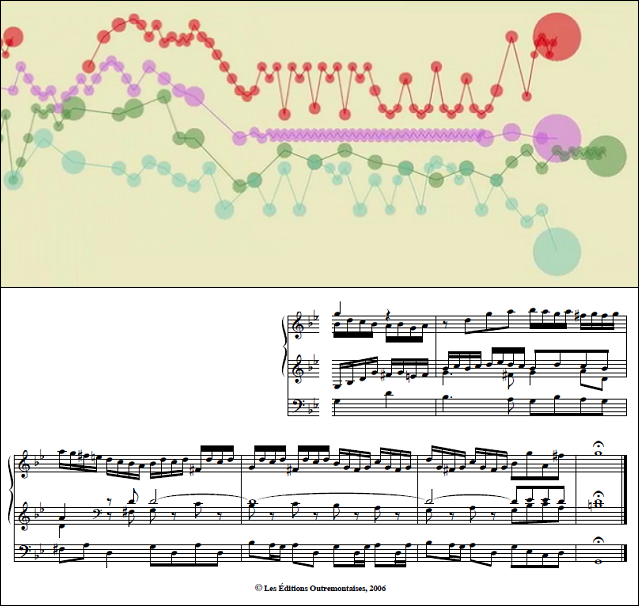
Before you do that, however, I’d like you to take a look at the image at the top of this post, which shows you the ending of the piece both as the video graphics present it, and in the musical notation or “score” an organist would read. The graphics are terrific because they allow the untrained eye to follow the threads of the different melodies or “voices” as Bach braids them together. The work is his “Little Fugue” in G minor, which you can find indexed in his collected works as “BWV 578”.

Here’s how I’d like you to pay attention during the piece:

As you listen to the performance on video, I’d like you to follow the colored lines of the melodies as they move along in the video graphic, and listen carefully to hear how many of the lines of sound you can actually follow distinctly in your mind. At the beginning there’s only one “voice” – only one line of melody – so your task is easy. If you are used to listening to music of one sort or another, you’ll almost certainly be able to track, more or less, some kind of thumping bass line and some kind of melody rising above it – two voices.

Can you manage three? four or more?

If you’re a musician you may still find the graphics — and the exercise – illuminating, but you might prefer to make the same experiment with a version of the piece played by Robert Köbler on a Silbemann organ, accompanied on video by the score..

Here’s the video — see how many voices you can hear and track:

**

How did you do? How many voices could you follow at one time?

And why am I bothering to as you to do this, and then talking so much about it? After all, you may already know everything I’m saying and more, or you may simply not care that much about such things.

Here’s why: the project is about creativity and intelligence.

It’s about how to apply forms of creativity that are generally found in the arts and humanities — and in the world’s contemplative traditions — to the questions that arise for every bright human as we face the exhilarating challenging and terrifyingly complex world around us.

It’s about understanding complexity, in the way the Intelligence Community needs to understand complexity, and business leadership, and our scientists and technicians, and the congregants at our synagogues, churches, mosques and temples, and, well, all the bright people everywhere — disillusioned, or fresh and rarin’ to go.

**

Complex problems often require some sort of recognition and resolution of several or many distinct and sometimes conflicting voices, points of view, concerns or vectors.. which may shift in intensity and direction as the situation evolves.

In musical terminology, any music that includes two or more distinct melodic lines or “voices” playing together simultaneously is polyphonic — from the Greek for “many voices”. Counterpoint — from the Latin for a point that counters another point — is the artful way in which composers can “work” two or more melodic lines together, so they clash at times, resolve, and harmonize.

The fugue — the particular contrapuntal form Bach uses in the piece you just heard — imposes even tighter constraints on the composer, and can elicit even greater creative inspiration as a result — as many of Bach’s, Mozart‘s, Beethoven‘s and others’ greatest works testify..

**

I imagine you can see that the many voices of polyphony — voices in counterpoint, that at times clash and are in need of resolution and harmony — have their equivalents in the complex multi-stakeholder problems, clashing points of view and need for constructive resolutions that creative artists, intelligence analysts, strategy, policy and decision makers, and anyone who wants to keep aware of the shifting currents of our strange and complicated times all need to take into account.

So polyphonic, and specifically contrapuntal, thinking, can be extended way beyond the realm of music — as Hermann Hesse suggested in his greatest novel, Glenn Gould tried to demonstrate in his “contrapuntal radio” pieces, and Edward Said understood when he characterized the Israeli-Palestinian issue in these words:

When you think about it, when you think about Jew and Palestinian not separately, but as part of a symphony, there is something magnificently imposing about it. A very rich, also very tragic, also in many ways desperate history of extremes — opposites in the Hegelian sense — that is yet to receive its due. So what you are faced with is a kind of sublime grandeur of a series of tragedies, of losses, of sacrifices, of pain that would take the brain of a Bach to figure out.

The “book” may turn out to be a DVD, or a workshop, at this point who knows? Whatever format it winds up it takes, it will teach contrapuntal thinking — using examples drawn from world culture and contemporary geopolitics — as a radical alternative methodology, complementary to but very different from our current analytic methods. It will be a text in the cross-disciplinary, associative, lateral or horizontal equivalent of the kind of disciplinary, siloed, linear or vertical thinking that our increasingly specialized culture has trained us in —

and which we need to supplement, if we are to have the mental flexibility to see and make the creative leaps our times require of us.

For more on this, see also my Feb 2011 post (at least I’m reasonably consistent over time) A HipBone approach to analysis VI: from Cairo to Bach.

**

God only knows how many voices there are in Bob Dylan‘s song Sad Eyed Lady of the Lowlands, or Eric Clapton‘s Have you ever loved a woman from the 2004 Crossroads Guitar Festival – the principle’s the same, but we don’t (yet) have the graphics to allow your eye to follow what the musicians are doing — and there are solos, and sidemen.

Each musician has at least one voice, its melodies and its silences, to present – and sometimes several, as we saw with the Bach organ piece. And together the individual musicians add up to an ensemble, each with an awareness of the others’ voices and a concentration on their own.

And for an insight into the varieties of organ mastery, compare Billy Preston‘s amazing solo starting at 9’33” on the Clapton piece, Al Kooper‘s organ work on Dylan’s Sad Eyed Lady, and Ton Koopman‘s rendering of the same Little Fugue BWV 578 we started with – where at times you can watch Koopman’s fingers on the keys or feet on the pedals, for yet another way of visualizing the intricate interweavings of this glorious music.

**

Glenn Gould had an amazing mind: for your enjoyment, here’s a version of his own fugue, aptly entitled So You Want To Write a Fugue? — with a similar graphical display to help you follow along with the interweaving lines of melody…

It’s serious, and it’s hilarious too! Or maybe you’d prefer Scott Joplin? Either way, enjoy:

Glenn Gould:

Scott Joplin, Euphonic Sounds, a Syncopated Novelty:

Form is Insight: the project

Monday, October 22nd, 2012

[ by Charles Cameron — about the (not yet titled) book (or post-book project) i seem to be writing, which offers a grand slam intro to an array of box-free contemplative and artistic approaches to creative thinking, and hence opens fresh angles on intelligence ]
.

One thing I can promise: whatever this project turns out to be, it won’t be predictable.

credit for this incredible image: Roger Dean

.

This project won’t take you over familiar territory, congratulating you on holding the same opinions as the author and adding in enough choice details to keep you interested. I’m not aiming to teach you the same thing you already know, only better, more interestingly, more precisely, or in greater detail. I’m aiming to question you, challenge you, and give you a whole new range of optics through which to view the world.

**

So, here we go.

I think I am finally at the point where the book (or whatever it is) I’ve been gathering inside me all these years is ready to be written. Some of it has already emerged in earlier posts here on Zenpundit — you don’t known and couldn’t count how many thanks, Mark — and this is certainly where I’ve been developing the style of integrated visuals and verbals that gives the project its flavor — so I’d also like to use my posts here to discuss the thing with you as I go along.

The project is about intelligence in the widest sense, including heart and mind, and with particular focus on creativity. I’m addressing this from two standpoints that mesh together well, and I’m addressing it to two audiences that I believe also mesh together well.

The standpoints are (i) meditation and (ii) the arts, and the audiences are (i) the “intelligence community” and (ii) bright people in general.

I believe that meditation cultivates a spacious mind-set in which we can hold multiple concerns in mind at the same time – the opposing needs of different people, stakeholders, sections of society, the environment, etc – thus seeing things from multiple angles and in balancing & thus balanced ways. And I think the arts serve as the primary means for expressing these balances with all their nuances and shadings, and that techniques from within the arts such as polyphony, chiaroscuro, formal constraint and pattern can teach us to shape multi-faceted insights like these into rich and complex understandings – complex patterns that respond to complex situations. I’ll go into all this in detail as we move along, with examples.

I also believe that this kind of creatively patterned insight — embodying artistic methodology in the context of complex problems with a “fresh” and open mind – will be of interest beyond the intelligence agencies and policy-makers, to business people, artists, and also — importantly — the bright general public, which I take to be a far larger subset of the population than we commonly think, and always eager for reading that doesn’t talk down to them but appreciates their own intelligence and good will.

For now let me just say that I’m very excited, because this seems (at last) to be a project that ties together my game-work with Sembl, the think-tank side of me which has been monitoring religious violence, jihad and terror and working towards nuance, understanding and peace these last dozen years — and my sense of creativity as a writer and poet.

Ripeness is all: I suspect the time for this venture has arrived.

**

Here’s the single page overview I’ve written, with a working title:

Intelligence is Zen: understanding our complex world with koans in mind

Just a few days ago, the Director of National Intelligence, James Clapper, referenced Pirsig‘s book, Zen and the Art of Motorcycle Maintenance, as key to the Intelligence Community’s work in understanding and adapting to the many, varied, intersecting problems we face in the world today. As I noted, Clapper was focused a bit more on the biker wisdom than the Zen to be found in Pirsig’s book, but he does raise a question I’ve been addressing for some years now:

What does the contemplative mind have to offer in terms of understanding a complex world?

To my mind, the creativity which is all the buzz of the business world, aimed at solving what are called “wicked problems” — problems that feature multiple stakeholders with multiple aims and objectives, aims and objectives which themselves shift over time so the problems are “never the same river twice” – requires a major mental and emotional shift. Reverie and meditation free us up to make the shift: the shift itself is poorly understood.

Our present, mostly linear way of thinking favors either/or side-taking, dubious cause-and-effect expectations which fail to take complex feedback loops into account, followed all too often by a rush to judgment. We need a whole new – old, even ancient – way of thinking.

Our problems are complex because they overlap, they ripple through one another. In Buddhist terms, they are “interdependently arising.” Not surprisingly, the way of thinking that is required to gain a deeper insight into “interdependently arising” problems can be found in explicit form in such contemplative traditions as Madhyamika & Zen, Taoism, Sufism, and their Abrahamic contemplative analogs. At the heart of these systems is fresh thinking – thought refreshed by quiet.

Furthermore, the shaping of insights in an open field of thought is something the world’s artistic traditions have long dealt with, and there are schools of insight not just available but recorded in exquisite detail in the world’s traditions of poetry, music, painting, theater, film… in patterns that are found in nature, in culture, and in the very turbulence we now must learn to flow with.

The project therefore takes a meditation-influenced approach to intelligence, both in the sense in which Clapper would use the word, relating to the intelligence analysis which develops and influences our decision-makers’ understanding of what’s needed, and in the more general sense of those capable folk with bright minds, keen insights, sharp instincts, warm hearts.

I’ll propose a series of ways of looking differently – with application for anyone, whether artist, intel analyst, businessman, policy-maker, or lover – that cut to the essence of creativity: lateral, analogical, holistic thinking, witnessing pattern beneath the surface of things. My examples will be mainly drawn from terrorism, which I have been monitoring for a dozen years: my style is that of a poet and an eccentric Englishman.

My subtext, my subliminal message, will be contemplation and artistry as profound common sense.

Let not thy left hand know what thy right hand doeth

Tuesday, October 2nd, 2012

[ by Charles Cameron — this post is about comparisons — what you make of them, and what they make of you, death calculus, and Handel ]
.


.

Scraped from my morning read, these two quotes — a tweeted headline from Breitbart and a gobbit of the Jerusalem Post — neatly illustrate a paradox I’ve been wrestling with, the way more profound souls wrestle with angels [link is to Rilke].

It’s the paradox of comparison.

**

On the one hand, I can barely imagine what it would be like to build — with, say, enough funds for a latter-day Manhattan Project — a Department whose job it was to monitor all activities and ensure even-handedness in the allocation of resources.

So that not ever would a Presidential aide on vacation receive a security detail until each and every ambassador had an equivalent force of marines around them at any given moment, in embassy or out.

I mean, what about consuls, or CIA heads of station — are they ambassadorial enough? Members of the cabinet on vacation? Members of the National Security Council? How far do we need to go with our even-handedness? Is Benghazi different from London? Londonistan?

How would one possibly assure oneself that no “hand” of government, left, right, center, upper, lower, or oblique to all of the above, ever arranged things in a way that compared foolishly with the way some other “hand” of government had arranged something more or less similar?

**

Let’s go to what my friend Bryan Alexander calls the death calculus. Since we’re interested in terrorism here, I’ll pull quotes from a couple of pieces that you can read in full if this topic interests you. Two paras from TomDispatch:

In 2008, 14,180 Americans were murdered, according to the FBI. In that year, there were 34,017 fatal vehicle crashes in the U.S. and, so the U.S. Fire Administration tells us, 3,320 deaths by fire. More than 11,000 Americans died of the swine flu between April and mid-December 2009, according to the Centers for Disease Control and Prevention; on average, a staggering 443,600 Americans die yearly of illnesses related to tobacco use, reports the American Cancer Society;5,000 Americans die annually from food-borne diseases; an estimated 1,760children died from abuse or neglect in 2007; and the next year, 560 Americans died of weather-related conditions, according to the National Weather Service, including 126 from tornadoes, 67 from rip tides, 58 from flash floods, 27 from lightning, 27 from avalanches, and 1 from a dust devil.

and:

The now-infamous Northwest Airlines Flight 253, carrying Umar Farouk Abdulmutallab and his bomb-laden underwear toward Detroit on Christmas Day 2009, had 290 passengers and crew, all of whom survived. Had the inept Abdulmutallab actually succeeded, the death toll would not have equaled the 324 traffic fatalities in Nevada in 2008; while the destruction of four Flight 253s from terrorism would not have equaled New York State’s 2008 traffic death toll of1,231, 341 of whom, or 51 more than those on Flight 253, were classified as “alcohol-impaired fatalities.”

Two paras from a Salon piece [copied here sans links and emphases]:

“The number of people worldwide who are killed by Muslim-type terrorists, Al Qaeda wannabes, is maybe a few hundred outside of war zones. It’s basically the same number of people who die drowning in the bathtub each year,” said John Mueller, an Ohio State University professor who has written extensively about the balance between threat and expenditures in fighting terrorism.

Last year, McClatchy characterized this threat in similar terms: “undoubtedly more American citizens died overseas from traffic accidents or intestinal illnesses than from terrorism.” The March, 2011, Harper’s Index expressed the point this way: “Number of American civilians who died worldwide in terrorist attacks last year: 8 — Minimum number who died after being struck by lightning: 29.” That’s the threat in the name of which a vast domestic Security State is constructed, wars and other attacks are and continue to be launched, and trillions of dollars are transferred to the private security and defense contracting industry at exactly the time that Americans — even as they face massive wealth inequality — are told that they must sacrifice basic economic security because of budgetary constraints.

**

My points?

On the one hand, that the world is far too complex to avoid disparities that can draw mockery down on the heads of those one might wish to mock.

And on the other, that comparisons also have an invaluable role to play in giving us a sense of the relative peaks and valleys of the terrain we live in — and may be literally or metaphorically mountaintop removal / valley fill coal mining in preparation for our children’s children…

**

Here’s a “DoubleQuote” for you:

Or for the musically inclined:

Now there’s a fascinating comparison (between the mining and the music) that doesn’t tell you much. Or does it?

**

Onwards to the issue of that sacred plateau in Jerusalem, featured as my second “reading for the day” at the top of this post.

It appears that you can be arrested for carrying a concealed knife on the Noble Sanctuary — or tallit or tefillin on Temple Mount — same place, different perspective.

That’s the sort of comparison that makes me catch my breath with wonder.

As the Famous Thinkers School might ask, giving you a pencil and a blank sheet of paper: can you draw this conclusion?

**

The full text of Matthew 6.3 reads in the KJV:

But when thou doest alms, let not thy left hand know what thy right hand doeth:

Marangolo P and associates uses a significant variant of that verse in the title of a learned paper: Let not thy left hand know what thy right hand knoweth. The case of a patient with an infarct involving the callosal pathways.

Brain malfunctions (and brain surgeries) can provide windows of considerable interest on our human condition, as the writings of Oliver Sacks so eloquently demonstrate.


Switch to our mobile site