zenpundit.com » strategist

Archive for the ‘strategist’ Category

USNI Press to Rerelease J.C. Wylie’s Classic

Tuesday, October 29th, 2013

[by J. Scott Shipman]

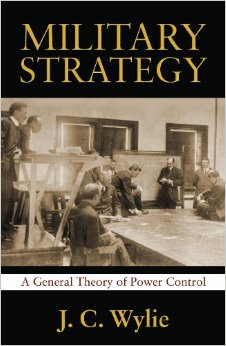
Military Strategy, A General Theory of Power Control, J. C. Wylie

Mark your calendar; March 15, 2014, the USNI Press will rerelease J.C. Wylie‘s classic Military Strategy. A couple years ago I reviewed here.

If you have not read Wylie, I strongly recommend adding his little book to your list.

And a big “Thank You!” to the USNI Press!

POSTSCRIPT: A representative of the USNI notified me that an eBook will be forthcoming, too. 

Charles Hill on Freedman’s Strategy: A History

Thursday, October 3rd, 2013

[by Mark Safranski, a.k.a. “zen“]


Charles Hill pens a favorable but also fairly critical review of Sir Lawrence Freedman’s tome-like, Strategy: A History.

The snares of strategizing

.…Sir Lawrence Freedman’s 750-page magnum opus, Strategy: A History, is encyclopedic, although not alphabetical, a pleasure to dip into here and there to get a carefully considered summary briefing on the strategy of the Hebrew Bible, the 1815 Congress of Vienna, Jane Addams, Black Power, or the strange array of social science attempts to redefine human behavior as a contribution to strategy. Everybody talks about strategy, but no one seems to know what it is. But now there are no excuses; it’s all here, at least in chronological array. As with my childhood set of Compton’s, I read it straight through for its several-thousand-years’-long narrative arc; it only remains to try to make sense of the whole thing as one big idea.

Freedman begins by admitting that there is no agreed-upon definition of strategy. When one encounters the word applied to battle plans, political campaigns, and business deals, “not to mention means of coping with the stresses of everyday life,” the concept may begin to seem meaningless. But not so for Sir Lawrence, a most distinguished professor of war studies at King’s College, London, who unapologetically focuses his modern section on American approaches because “the United States has been not only the most powerful but also the most intellectually innovative country in recent times.”

The “origins” of strategy run from David and Goliath to Machiavelli to Milton’s Paradise Lost, a vast stretch of time covered, for this big book, in a relatively short space, as though the author is hurrying to get to strategy in our modern age. All the old warhorses are here. Thucydides is analyzed as the start of “real” strategy and the distortions of language as a cause of Athens’ fall is featured. Plato’s Republic is taken seriously as a “strategic coup” by which philosophy defeats strategy. (I am one of those who read Plato’s Socrates as ironic, playing along with an overnight concoction of a perfect polity—which turns out horribly—as the most effective way of showing us what not to do when thinking strategically.) Sun Tzu is properly portrayed not so much as a strategist as a master of stratagems, a subset of the art in full: To do the opposite of what is expected is not enough to qualify as strategy. Overall, the centuries of “Origins” analyzed here could be characterized as “a series of footnotes to Homer,” a running debate between advocates of force (Achilles) and those who prefer guile (Odysseus). The Trojan Horse was guile personified; it worked, but thereafter could be scorned as a despicable trick unworthy of heroes. The strategic approach of Milton’s Satan to his own demonic team, as well as toward Adam and Eve, was all seductive guile and still seems to be working….

The book comes across as being rather unwieldy in size, scope and definition of strategy, though informative. I disagree with Hill’s interpretation of Sun Tzu as well as Plato ( Socrates was an ironist, Plato? Well, he wandered quite far from his master’s teachings in the fullness of time). Nevertheless, worth a read.

Echevarria and the Irrational in Strategy

Tuesday, September 17th, 2013

Adam Elkus alerted me to an insightful op-ed by Dr. Antulio Echevarria of SSI:

Op-Ed: Is Strategy Really A Lost Art?

…. Instead, we need to rediscover the value of strategizing relative to the outcome, the product, an individual strategy. The hard truth is that policy does not always need strategy to get what it wants. We have used military force plenty of times in our history without the guiding logic of strategy, and—though critics do not like to admit it—we have made it work often enough for it to be taken seriously. Sometimes what policy wants most is not to be tied to something inflexible, particularly something as inflexible as our strategic process. It is the proverbial machine that goes of itself, and it takes, or almost does, the preparation for and direction of war out of policy’s hands. The question modern-day Clausewitzians really have to answer is whether war has its own logic after all, a logic provided by the dictates, the processes, and the dynamics of making strategy.

      In all the online debates and blog sites concerning strategy, one theme is constant: we call strategy an art, but approach it as a science. We praise creative thinking, but assess our strategies with formulae: strategy = ends + ways + means (the ends we want to achieve + the ways or concepts + the availablemeans). This formula is as recognizable to modern strategists as Einstein’s equation E=mcis to physicists. Each defines its respective field. Like all good math, good strategies consist of balanced equations. As our variables change, we merely rebalance our strategy: scale down the ends, increase the means, or introduce new ways. Like any good equation, our strategy remains valid so long as we keep one half equal to the other. This is a far cry from when military strategy meant the “art of the general” and, by extension, grand strategy meant the “art of the head of state.”

.    If the art of strategy is truly lost, perhaps it is because—despite our rhetoric to the contrary—we really wanted it to be a science all along.

Several comments….
.
First, Echevarria is correct that it is certainly possible to win ugly, win lucky, win through the other side imploding for internal reasons that have nothing to do with us or to win by unimaginatively, but steadily bludgeoning a much weaker opponent to death while employing a bad strategy or no strategy at all. Finland’s Marshal Mannerheim, for example, repeatedly humiliated Stalin’s immensely larger but poorly led Red Army in the Winter War but the end was never in doubt if Stalin chose to press the issue.  An effective strategy and a Red Army officer corps that were more than lackeys and thoroughly terrorized purge survivors would have markedly improved the USSR’s abysmal military performance, but it would not have changed the longitudinal equation that Stalin had thousands of tanks and planes and potentially millions of soldiers and the Finns did not. The asymmetry between the Soviet Union and Finland was too great; Mannerheim played a weak hand with great skill against an enemy leader whose basic foreign policy outlook was opportunistic yet risk averse ( as Stalin understood the situation at least. He was also a great miscalculator).
.
When  however that Echevarria writes “Sometimes what policy wants most is not to be tied to something inflexible” he is certainly correct, but the real crux is that it is politicians who want and policy that bends to their desires. Flexibility can be a virtue when a situation is new, has not yet risen to open hostilities or a hedge is required against many dangers. Raised to systemic practice, “flexibility” -meaning a conscious avoidance of the “strategic process – really means that we have embraced an astrategic culture and accepted not just greater political behavior, but elevated the minutia of domestic politics and cynical careerism to displace strategy as the primary calculus for making decisions of war with unsurprisingly poor results.
.
Lastly, I see merit in Echevarria’s criticism of the tendency to view strategy in algebraic or scientific terms. He’s right that this is an arid reification of strategy from which all chance, passion, genius, stratagems, deception, novelty and coup d’oeil have evaporated. Sometimes, the Czarina dies, the unsinkable ship sinks,  the “rules” get broken and certain victory turns into utter defeat because leaders, with the intuitive mind that Einstein called ” a sacred gift”, seize the moment and do what should have been by rational calculation, impossible. We fail to look for such qualities in ourselves or allow room for their expression and worse, fail to discern them in the enemy.
.
Strategy is rational, but people doing strategy and the circumstances in which strategy is done often are not.
Octavian Manea interviews T.X. Hammes

Saturday, September 7th, 2013

[by Mark Safranski, a.k.a. “zen“]

Octavian Manea and SWJ are on something of a roll lately. Colonel T.X. Hammes (ret.) PhD is the respected author of the excellent The Sling and the Stone. If you have never read it, you should.

The Fallacies of Big Expeditionary Counterinsurgency: Interview with T.X. Hammes

SWJ: How different is Mao’s people’s war compared with what you call 4GW (Fourth Generation Warfare)? Is 4GW an updated, evolved form of people’s wars? In the end, isn’t 4GW focused on people and minds, on influencing people and minds?

TX: Mao is a little bit different because (in China) it was a domestic insurgency and focused on wearing down the nationalists and changing the minds of the warlords who supported them. In the case of 4GW, the focus is overseas. People you can’t reach with force, you must reach with the message. 4GW is an evolved form of insurgency. It is also important to note that Maoism is a type of insurgency that essentially fits a hierarchical society, not a tribal one. It always ends with a conventional campaign to destroy the government’s army as the final step in overthrowing the government. You can’t run a Maoist insurgency in the mountains of Afghanistan, the society won’t tolerate that kind of structure.  Nor can you do it in Iraq. 4GW covers both because its objective is not the military defeat.  4GW does not focus on the destruction of the enemy’s armed forces, but on changing the minds of the enemy’s political decision makers. 4GW directly attacks the will of enemy decision makers.  Once the outside power has been ejected, the conflict can continue until resolution. 

SWJ: Tell us about the center of gravity in a 4GW.

TX: The center of gravity in a 4GW is the will of the policymakers of the other side. 4GW war uses all available networks – political, economic, social and military – to convince the enemy’s political decision makers that their strategic goals are either unachievable or too costly for the perceived benefit. 4GW is not necessarily targeted at the people.  If the war is small enough, it can run on for years like El Salvador.  In that case, the US commitment was small enough there was no major political cost to US decision makers to continue supporting the El Salvadorian government.

When you look at the counterinsurgent side, I am more and more convinced that as a foreign power you can only do indirect counterinsurgency. You can advise and assist.  But keep it small – the host nation has to make it work. We, the United States, have done this successfully a number of times. Admittedly, we have not created the perfect nations that the nation-builders want, but that wasn’t the goal. The goal was to achieve US strategic goals. And we achieved our strategic goals in the Philippines, El Salvador, Columbia and Thailand. In a 4GW, the insurgent is not trying to win over the people as a whole. But the counterinsurgent must do so. In a tribal society, you can do what Kilcullen refers to as wholesale COIN – if you persuade the tribal chief everybody flips. In a more democratic society, you have to convince the people. It is more of a retail operation. It is critical to understand the society you are in and tailor your counterinsurgency and insurgency accordingly. 

I would add, in the 4GW theme of reasoning with the “moral level of war”, that a foreign power supporting a host nation government with FID that faces an insurgency, can probably get away with “punitive raiding”  of the non-state actors from time to time, particularly in rapid response to some heinous action committed by rebels. A heavy in-country footprint though will change the political calculus for the population – it is too easy to look lie occupiers and stringpullers. Foreign troops are rarely welcome guests for long.

Read the rest here.

Octavian Manea Interviews General David Petraeus

Monday, September 2nd, 2013

[by Mark Safranski a.k.a. “zen“]

Octavian Manea has had an excellent series of COIN  interviews at SWJ and this is one of the more important ones:

Reflections on the “Counterinsurgency Decade”: Small Wars Journal Interview with General David H. Petraeus

SWJ: In his recent op-ed published in the New York Times, “The Pipe Dream of Easy War”, General H.R. McMaster warned against the fantasy of “a new era of war”, and especially about the dangers in the blind faith in the transformative effects that technology promises to have on war. He argued that over the past counterinsurgency (COIN) decade we relearned a few lessons that we really should keep in mind as we head into the future: “American forces must cope with the political and human dynamics of war in complex, uncertain environments”. His warning reminds me of an article you wrote in 1986 with General John Galvin about “uncomfortable wars”. You warned to take into consideration “the societal dimension of warfare”. To what extent do you see that prophecy still holding true post Iraq and post Afghanistan?

General Petraeus: I think the essence of the article back in 1986 with General Galvin was frankly the importance of the human terrain in each particular situation, and the importance of understanding the terrain, having a very nuanced, detailed feel for the context of each situation, not just nationally, but sub-nationally and literally all the way down to each valley and each village. That kind of knowledge was achieved in Iraq and helped us enormously during the Surge. We had a greater understanding there, earlier than we did in Afghanistan, just because we had so many more forces on the ground, 165,000 American military alone at the height of the surge. In Afghanistan at the height of our deployment, we had 100,000 US troopers and about 50,000 coalitional forces, and we maintained that level for a relatively brief period of time. As I noted on a number of occasions, we never really got the inputs close to right in Afghanistan until late 2010.

So, noting the importance of human terrain, I believe, is a fundamental aspect of crafting a counterinsurgency campaign. In fact, it was the biggest of the big ideas when we launched the Surge in Iraq, and we knew that since the human terrain was the decisive terrain, we would had to secure it as our principal focus – and to do so by living with the people, locating forward operating bases/joint security stations in the neighborhoods and villages, and specifically right on the sectarian fault-lines across which the heaviest fighting was ongoing in the capital. We ultimately established 77 additional locations just in the Baghdad area of operations alone, and many dozens more elsewhere throughout the country. There were other big ideas to be sure:  e.g., that you can’t kill or capture your way out of an industrial strength insurgency, such as we faced, therefore you need to reconcile with as many of the insurgents as was possible, seeking to maximize the number of the reconcilables; correspondingly, we also needed to intensify our campaign of targeted operations against the irreconcilables. But I think, fundamentally, it comes back to this issue, that it is all about people, counterinsurgency operations are wars in, among, and, in essence, for the people. And the first task of any counterinsurgency campaign has to be to secure those people.

Read the rest here.


Switch to our mobile site

