zenpundit.com » christianity

Archive for the ‘christianity’ Category

Southern Baptists and Presidents, an open question

Monday, July 29th, 2019

[ by Charles Cameron — all views & comments welcome ]
.

**

Readings:

  • Time, Evangelicals Are Supporting Trump Out of Fear, Not Faith
  • SBC, Resolution On Moral Character Of Public Officials
  • **

    I’m leaving this DoubleQuote as an open question> I have my own preferences, of course, but in the spirit of free discourse, comments are welcome from believers and non-believers, saints and sinners, Trumpeteers, Clintonians, and a-politicals alike..

    Two Ourobouroi — and some somewhat gruesome books..

    Friday, July 19th, 2019

    [ by Charles Cameron — this is one of those posts for those who take a quasi-perverse delight in the strangely, beautifully morbid — bibliophiles ahoy! ]
    .

    Here’s another Ouroboros, this one from Microsoft’s eBook Apocalypse shows the dark side of DRM:

    Amazon, overcome by a fit of irony in 2009, memorably vanished copies of George Orwell’s 1984 from Kindles.

    That was a decade ago, and happily some human at some point in the process had the good sense to intervene. Still, it really is a moment worth contemplating.

    **

    And here for your consideration is a second ouroboros in which a painting is made on the material depicted in it..

    It’s gruesome-beautiful, which is why I’ve placed it second — but it’s vidual immediacy speaks viscerally to us, once we know the material on which the imaged was placed..

    The ouroboros is not so strong in this case, since the flayed skin on wh9ich the representation is made is of vellum, ie the skin of a lamb or young anim=mal, flayed (removed from the animal’s flesh) after the death of the animal — while the depiction of St Bartholomew shows him being flahed in flie.

    **

    The image in question is part of a quadripartite miniature, which I’ll display here by posting two images from the Morgan collection immediately above one another — in its proper context, it seems less gruesome, perhaps?

    I’m not saying, mark you, that human fklesh isn’t on occasion used in the binding of books. Wikipedia has an entry under the title Anthropodermic bibliopegy, which if you untangle it from the Greek means “binding with human skin” — and offers for our view and judgment the following example from the Welcome collection of medical rarities:

    That’s S. Pinaeus, De integritatis et corruptionis virginum. And while we’re on the subject of virgines (girls), there’s also this label:

    translation:

    This book has been bound with the skin of a woman”

    — which is found in another book, this one in the Smithsonian collection.

    The Hayden-Furnish Matter

    Wednesday, July 17th, 2019

    [ by Charles Cameron — opening a discussion of two tweets and the place of New Testament theology in political praxis ]
    .

    Gen Michael Hayden:

    Dr Timothy Furnish:

    **

    It seems to me that Tim Furnish‘s response to Gen Hayden opens up one of the few truly central questions of our times — maybe in fact The Key Question for holders of western culture and values.

    I take it that this question is in fact a koan — strictly unanswerable, yet livable, lively.

    Zen koans are the equivalent of case law. In what follows, I shall offer some precedents that may be of use as we consider the case that Tim Furnish sets before us.

    **

    First, I would like to offer two notions from New Testament studies which may be of help here.

    The Kerygma:

    Following the scholar CH Dodd, Wikipedia defines the kerygma thus:

    • The Age of Fulfillment has dawned, the “latter days” foretold by the prophets.
    • This has taken place through the birth, life, ministry, death and resurrection of Jesus Christ.
    • By virtue of the resurrection, Jesus has been exalted at the right hand of God as Messianic head of the new Israel.
    • The Holy Spirit in the church is the sign of Christ’s present power and glory.
    • The Messianic Age will reach its consummation in the return of Christ.
    • An appeal is made for repentance with the offer of forgiveness, the Holy Spirit, and salvation.

    if that’s the Foreign, what’s the Domestic Policy?

    The Acts of Corporal Mercy:

    I was an hungred, and ye gave me meat: I was thirsty, and ye gave me drink: I was a stranger, and ye took me in: Naked, and ye clothed me: I was sick, and ye visited me: I was in prison, and ye came unto me. .. Verily I say unto you, Inasmuch as ye have done it unto one of the least of these my brethren, ye have done it unto me.

    Gospel of Matthew 25 vv. 35-36, 40.

    **

    Michael Lotus gave me an exemplary comment with permission to quote it the other day:

    As to binaries, lawyers, judges and legislators do not get to spend unlimited time dealing with the ultimately unique nature of each person, each event, each controversy. They have to determine when government power will be applied to compel behavior, to extract money, to seize and bind and carry away persons against their will, to imprison, to put to to death. They have over millennia determined that clear, simple rules are the best way to use this blunt and often brutal, but essential, instrument. Then they have to apply rules to actual cases. Clarity, certainty, and the ability to plan accurately based on known rules, is critical. And inevitably there will be, or seem to be, unfairness in the application, and hard cases, and heart-breaking cases. Attempts to deal with many nuances lead to a thicket of confused rules, lack of guidance for action, and even more arbitrary application of the same unavoidable application of government power. Large and complex human groups cannot be governed otherwise than by general rules of general application. Some balance between hard-and-fast rules tempered by some degree of judicial discretion is where most reasonably fair systems end up, and that is what we have. But the basic fact of binary division is inevatable in the law. Do we hang this man or not? Is this or is this not the type of property subject to this set of rules? Is this man entitled to a deduction on his tax or not? Etc., etc. The law is at best a very crude approximation of the ideal of justice which we can imagine even in human terms if we lived in a a less defective world than the real one. And of course our poor, merely human law, even at its best. falls bitterly, laughably short of that perfect justice that God alone can comprehend and impose. It is one of the many tragedies of the human condition, deriving ultimately from original sin.

    Much food for thought there..

    **

    I’m a Brit, and a guest here in these United States. Here, accordingly, are some materials of British origin:

    Think of the British coronation service, a Eucharist with anointing, and these words proffered to the King or Queen by the presiding Archbishop:

    Receive the Rod of equity and mercy.
    Be so merciful
    that you be not too remiss,
    so execute justice
    that you forget not mercy.
    Punish the wicked,
    protect and cherish the just,
    and lead your people
    in the way wherein they should go.

    **

    Sir Thomas More, in Robert Bolt‘s play, A Man for All Seasons:

    Oh? And when the last law was down, and the Devil turned round on you–where would you hide, Roper, the laws all being flat? This country’s planted thick with laws from coast to coast–man’s laws, not God’s–and if you cut them down–and you’re just the man to do it–d’you really think you could stand upright in the winds that would blow then? Yes. I’d give the Devil benefit of law, for my own safety’s sake.

    According to a Harvard Crimson article:

    Sir Howard Beale, the Australian ambassador to this country, took the late Mr. Justice Frankfurter to see Bolt’s play in New York in 1962. Beale recounts that the Justice could scarcely contain his excitement during the scene just set out, and as it ended Frankfurter whispered in the dark. “That’s the point, that’s it, that’s it!”

    **

    I saw a reference to More, who was Lord High Chancellor under Henry VIII, as Keeper of the King’s Conscience, which drove me to this definition:

    Keeper of the King’s Conscience”

    The early chancellors were priests, and out of their supposed moral control of the King’s mind grew the idea of an equity court in contradistinction to the law courts. A bill in chancery is a petition through the Lord Chancellor to the King’s conscience for remedy in matters for which the King’s common law courts afford no redress. The Keeper of the King’s Conscience is therefore now the officer who presides in the Court of Chancery; see Chancellor and Lord Keeper.

    **

    Barnett Rubin, today, for another up-to-the-moment view:

    Politics is not a mechanism for transforming goals into reality, for the Taliban or anyone else. It is a process of conflict and cooperation dependent on resources, relationships, and chance in which no one controls the outcome.

    **

    St Francis would, I think, like to see the Beatitudes, and proceeding from them the corporal works of mercy, deployed in all functions of the individual and community / state; the Jesuits would, by and large and in contrast, it seems to me, appreciate pragmatism — tempered by mercy, yes, as and when pragmatism permits.

    Think on these things..

    Your thoughts?

    Mind-blowing golden images from Louis de Laval’s Book of Hours

    Sunday, June 30th, 2019

    [ by Charles Cameron — whatever you may think of religion, the artwork in these images is stunning ]
    .

    There’s this phrase in the Apostles Creed, the shortest and most basic of the three creeds which mainstream Christians accept: the communion of saints. The hymn known as the Te Deum is more explicit, while describing basically the same companionship:

    The glorious company of the Apostles : praise thee.
    The goodly fellowship of the Prophets : praise thee.
    The noble army of Martyrs : praise thee.
    The holy Church throughout all the world : doth acknowledge thee;

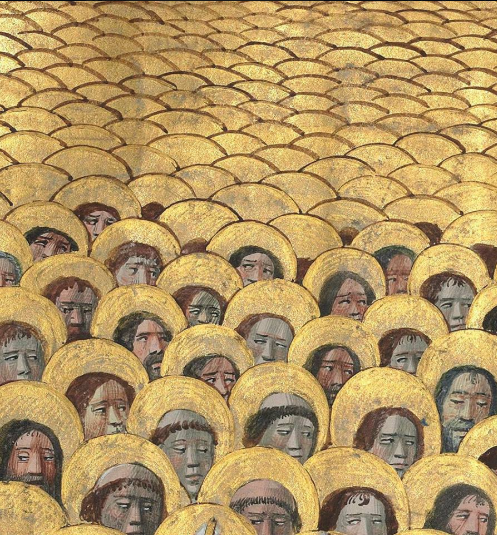
    But this image of that company, from Louis de Laval‘s illuminated Book of Hours, ca 1480, is the first I’ve seen that suggests the membership of this communion is innumerable —

    — wave on wave, saint upon saint, halo on halo into the distance — until they constitute a veritable sea of gold.

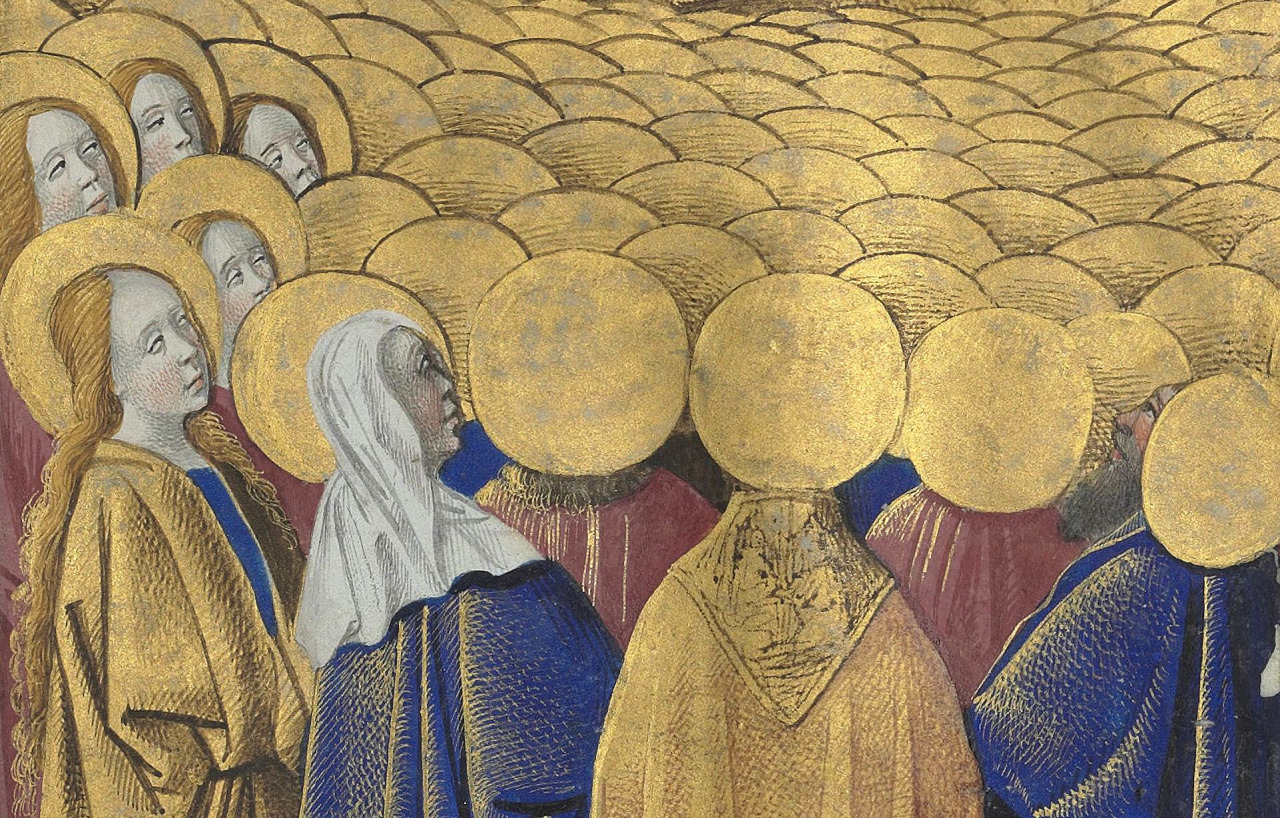
    Nor that the company includes many females, also innumerable–

    — some of whom must have caused a ferment in their own day, or at least in the creative imagination of a court artist, likely Jean Colombe, in the 1480s..

    Nor had I seen until now that there were vacancies for saints as yet unknown, perhaps unborn, their halos vacant —

    — unless perchance these are saints so deeply meditative that they have lost all face, as the Zennists might say, save the original face alone..

    Glorious.

    A Methodist Happiness Healthcare Ouroboros

    Saturday, June 29th, 2019

    [ by Charles Cameron — on finding that the word hospital just might be related to the word hospitable ]
    .

    Note that the name of the medical group is Methodist Le Bonheur Healthcare

    **

    The twenty-first century thinks in terms of optics; Christianity thinks in terms of the imitation of Christ. And it would seem from this ProPublica report that Methodist Le Bonheur Healthcare isn’t doing terribly well on either count:

    The thing is, there’s an ouroboric (snake-bites-tail-ish) quality to the situation. The same hospital group that is under-paying and under-insuring its workers is then over-suing them for their medical costs.

    It wouldn’t be terribly good, from either a Christian or an optical perspective, if they were suing people who were too poor to pay, but who were employed by others. That would be simple thoughtless meanness, though, and since they’d not be responsible for the financial situation of their creditors, John Wesley, the Anglican pastor who founded Methodism as a revivalist movement in the English church, might shrug in his grave, knowing how things tend to be down or up here on earth, but not actually spin.

    But Methodist Le Bonheur are the ones under-paying and under-insuring their own workers: they appear to control both ends of a vicious circle, and that’s why the headline above caught my eye.

    See the vicious circle? That’s the snake biting its tail — that’s ouroboros.

    **

    Hmm.

    The appearance is terrible — as, in these cases at least, is the fidelity to Christ’s teachings as reported in Matthew 25: 35-40 —

    I was an hungred, and ye gave me meat: I was thirsty, and ye gave me drink: I was a stranger, and ye took me in: Naked, and ye clothed me: I was sick, and ye visited me: I was in prison, and ye came unto me .. Verily I say unto you, Inasmuch as ye have done it unto one of the least of these my brethren, ye have done it unto me.

    It’s pure speculation, of course, but my guess is that there’s a layer or three of bureaucracy atop the medical staff, inhospitable to hospital-ity. And that’s the ouroboric vicious serpent in its essence: being inhospitable to hospitality

    **

    Le Bonheur is French for happiness, welfare, by the way.

    Here’s aother way of phrasing the problem: those whose focus is on quantity all too often blind themselves to quality.

    I fully expect Methodists do a great many (quantity) of good works (quality). What ProPublica reports here would not appear to be among them.


    Switch to our mobile site