The Said Symphony: move 12
Thursday, July 21st, 2011[ by Charles Cameron – extended analytic game on Israeli-Palestinian conflict — continuing ]
.
I am titling my next move “Moral Equivalence?” with the question mark as the crux of the title, and I am posting it separately since it (a) raises a central question with regards to the entire project and (b) plunges us directly into the twin narratives of Palestinian and Israeli… in parallel, in counterpoint… perhaps in…
Move 12: Moral Equivalence?
Move Content:
In President Obama‘s address at Cairo University on June 4, 2009, the President presents the two narratives, Israeli and Palestinian, side by side:
America’s strong bonds with Israel are well known. This bond is unbreakable. It is based upon cultural and historical ties, and the recognition that the aspiration for a Jewish homeland is rooted in a tragic history that cannot be denied.
Around the world, the Jewish people were persecuted for centuries, and anti-Semitism in Europe culminated in an unprecedented Holocaust. Tomorrow, I will visit Buchenwald, which was part of a network of camps where Jews were enslaved, tortured, shot and gassed to death by the Third Reich. Six million Jews were killed — more than the entire Jewish population of Israel today. Denying that fact is baseless, it is ignorant, and it is hateful. Threatening Israel with destruction — or repeating vile stereotypes about Jews — is deeply wrong, and only serves to evoke in the minds of Israelis this most painful of memories while preventing the peace that the people of this region deserve.
On the other hand, it is also undeniable that the Palestinian people — Muslims and Christians — have suffered in pursuit of a homeland. For more than 60 years they’ve endured the pain of dislocation. Many wait in refugee camps in the West Bank, Gaza, and neighboring lands for a life of peace and security that they have never been able to lead. They endure the daily humiliations — large and small — that come with occupation. So let there be no doubt: The situation for the Palestinian people is intolerable. And America will not turn our backs on the legitimate Palestinian aspiration for dignity, opportunity, and a state of their own.
For decades then, there has been a stalemate: two peoples with legitimate aspirations, each with a painful history that makes compromise elusive. It’s easy to point fingers — for Palestinians to point to the displacement brought about by Israel’s founding, and for Israelis to point to the constant hostility and attacks throughout its history from within its borders as well as beyond. But if we see this conflict only from one side or the other, then we will be blind to the truth: The only resolution is for the aspirations of both sides to be met through two states, where Israelis and Palestinians each live in peace and security.
Insult #3 in Nile Gardiner‘s piece, “Barack Obama’s top ten insults against Israel,” from the Telegraph blog of April, 2010, consists of the comment:
In his Cairo speech to the Muslim world, President Obama condemned Holocaust denial in the Middle East, but compared the murder of six million Jews during World War Two to the “occupation” of the Palestinian territories, in a disturbing example of moral equivalence:
followed directly by the third paragraph above from Obama’s speech.
The question raised by this move is that of “moral equivalence”. Specifically, I am raising the question of whether Obama’s four paragraphs do indeed contain “a disturbing example of moral equivalence”. More generally, I am asking whether juxtaposition — which is one of the central features of analogical thought, and thus of this game – implies equivalence.
Link claimed:
To Bob Dylan, “One too many mornings” and the lines “You’re right from your side / I’m right from mine” – juxtaposing them like that, is there a moral equivalence implied?
Dylan’s overview doesn’t sound too optimistic about the possibility of any kind of reconciliation of the opposites: “We’re both just one too many mornings / An’ a thousand miles behind…”
Accordingly, this may be an appropriate point at which to note that Edward Said thought the conflict between Israelis and Palestinians was asymmetrical and irreconcilable.
In the interview from which I borrowed Said’s notion of a “symphonic” reading of the conflict, the question and answer immediately following that paragraph reads thus:
Q: Is this a symmetrical conflict between two peoples who have equal rights over the land they share?
A: There is no symmetry in this conflict. One would have to say that. I deeply believe that. There is a guilty side and there are victims. The Palestinians are the victims. I don’t want to say that everything that happened to the Palestinians is the direct result of Israel. But the original distortion in the lives of the Palestinians was introduced by Zionist intervention, which to us – in our narrative – begins with the Balfour Declaration and events thereafter that led to the replacement of one people by another. And it is continuing to this day. This is why Israel is not a state like any other. It is not like France, because there is continuing injustice. The laws of the State of Israel perpetuate injustice.
This is a dialectical conflict. But there is no possible synthesis. In this case, I don’t think it’s possible to ride out the dialectical contradictions. There is no way I know to reconcile the messianic-driven and Holocaust-driven impulse of the Zionists with the Palestinian impulse to stay on the land. These are fundamentally different impulses. This is why I think the essence of the conflict is its irreconcilability.
Comment:
Are the two narratives symmetrical? Is there a moral equivalence between them?
The great early Russian film director Sergei Eisenstein wrote that “the juxtaposition of two shots by splicing them together resembles not so much the simple sum of one shot plus another — as it does a creation.”
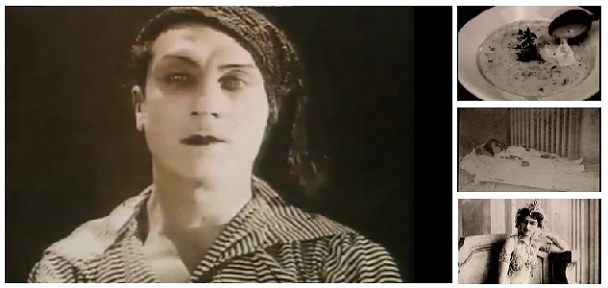
His colleague Vsevolod Pudovkin goes further:
Kuleshov and I made an interesting experiment. We took from some film or other several close-ups of the well-known Russian actor Mosjukhin. We chose closeups which were static, and which did not express any feeling at all-quiet close-ups. We joined these close-ups, which were all similar, with other bits of film in three different combinations. In the first combination the close-up of Mosjukhin was immediately followed by a shot of a plate of soup standing on a table. It was obvious and certain that Mosjukhin was looking at this soup. In the second combination the face of Mosjukhin was joined to shots showing a coffin in which lay a dead woman. In the third the close-up was followed by a shot of a little girl playing with a funny toy bear. When we showed the three combinations to an audience which had not been let into the secret the result was terrific. The public raved about the acting of the artist. They pointed out the heavy pensiveness of his mood over the forgotten soup, were touched and moved by the deep sorrow with which he looked on the dead woman, and admired the light, happy smile with which he surveyed the girl at play. But we knew that in all three cases the face was exactly the same.
What I am getting at here is, first and foremost, that juxtaposition is a rhetorical and aesthetic device, and that how to “read” a given juxtaposition is not necessarily obvious.
In a subsequent move, I shall discuss the specific philosophical problem involved in weighing one body of suffering against another…