zenpundit.com » barnett

Archive for the ‘barnett’ Category

Two Articles

Friday, July 10th, 2009

Both good but entirely unrelated.

Tom Barnett belts on out of the park at Esquire magazine:

What the Hell Is Really Going Down in Honduras?

….The primary charge was treason relating to Zelaya’s stubborn effort to mobilize popular support, through a non-binding poll, for a constitutional assembly. But the underlying suspicion was that the lame-duck and deeply unpopular (as in, sub-30-percent approval ratings) president was plotting to extend his personal rule with the strong encouragement of his new “oil daddy,” Venezuelan strongman Hugo Chavez, whose well-established blueprint has worked with political protégés elsewhere (e.g., Bolivia’s Evo Morales, Ecuador’s Rafael Correa).

Essentially, this Chavez scenario was a Pandora’s box that Honduras’s political elite refused to open. Why? Because after too many decades of nasty military dictatorship, Honduras, while still quite poor, had managed seven straight civilian transitions thanks to its 1982 constitution. So the Honduran legislature, which had previously ordered Zelaya’s arrest (but not his deportation), promptly voted him out of office and – following the constitution – selected its ranking member, Speaker Roberto Micheletti, as the interim president. Two key points to remember here: Martial law was never instituted, and the national elections, slated for November, are still a go. In effect, Zelaya’s removal from power was an impeachment without trial – a classic rush job that denied him his day in court even as he had already lost his battle with the country’s supreme court and displayed overt contempt for its rulings on his proposed poll.

From the Honduran military’s point of view, their actions broke no law, and since the military never assumed power, calling these events a “military coup” is completely misleading. From America’s point of view, it seems clear enough that Chavez-style politics has its limits, so overreactions are to be avoided. But from a national-security perspective, when your own Drug Enforcement Agency is telling you (as a Bush official did a year ago) that Chavez has become a “major facilitator” of the flow of Colombian cocaine to America, and when there are credible reports that Honduras, under Zelaya, has joined that network as a trans-shipment waypoint, there definitely needs to be some limits to your diplomatic efforts to reinstate this suddenly revered “pillar of democracy.”

I am in full agreement with Tom here about Mel Zelaya, who is the Rod Blagojevich of Latin America as well as a supplicating client of Hugo Chavez. The Obama administration, with the thrust coming from the State Department, has been too supportive of Zelaya’s outrageous behavior in an effort to avoid giving the Latin American left room to blame America for Zelaya’s removal. Now that moment has passed, it is time to distance the US from Zelaya and let him twist in the wind as OAS encouraged negotiations with the legitimate interim government in Honduras drag out for weeks or months

Chris Albon at War & Health has an excellent book review of Before My Helpless Sight (The History of Medicine in Context) by Leo van Bergen:

Leo van Bergen’s book, Before My Helpless Sight, is a history of suffering in World War I, a description the author readily admits: “At the roots of the book lies the question of what can happen to a soldier between the moment he steps onto a train or ship bound for the theatre of battle an the point at which he is evacuated wounded, or whether dead or alive, buried in the ground” (pg. 1). Needless to say, the book is not a light read.

….Van Bergen cannot be criticized on methodology. The book is impressively well researched (and cited), including qualitative and quantitative sources in numerous languages. Apart from the organization of the book itself, you see very little of the author in the pages. Readers are bounced from anecdotal accounts to descriptive statistics with little commentary or fanfare. This is not necessarily a negative, the sources speak for themselves. Their sheer, horrifying weight is ample to progress the book forward.

….However, in the light of the book’s contribution these issues are quickly forgotten. Before My Helpless Sight is a powerful counter to the innumerable discourses on WWI tactics and strategy. Van Bergen pulls back the curtains of glorious offensives and magnanimous generals, revealing the grim, muddy reality of life on the Western Front. It is a story of pus, rats, hunger, dirt, disease and madness. You do not know World War I before reading this book.

More and more, as passing time gives historians greater perspective, the Great War appears as a civilizational turning point for the West on the broad spectrum of human activity. WWI produced, really for the first time, a significant number of horrifyingly disfigured and maimed survivors, who would have perished from their wounds in, say, the Civil War or the Napleonic Wars. John Keegan writes, in his The First World War how postwar European governments resorted to segregating these most unfortunate of war invalids away from the eye of their publics and being at a loss how to deal with those soldiers  mentally shattered by “shell shock”, what we now recognize as PTSD.

Modern war as an industrial, mass-synchronized, 2GW meat grinder was so awful that the West turned to all kinds of stratagems to avoid a repeat of the Western Front – from political pacifism, isolationism and maginot lines to political revolution, blitzkrieg  tactics and technological innovations like the tank or airplane. None of them were a complete answer to the horrors born in 1914.

Barnett, the Bomb and Obama

Friday, May 15th, 2009

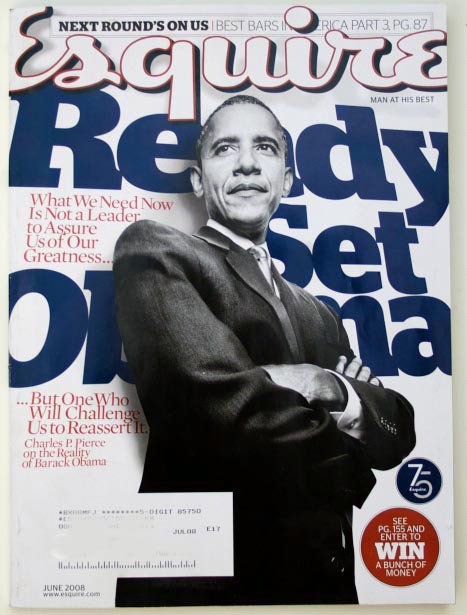
In line with the vigorous discussion in the comment section of the previous post, Tom Barnett weighs in on Obama’s nuclear utopianism in Esquire Magazine:

3. An America with fewer nukes breeds a new class of military powers.

By reducing “barriers to entry” to the marketplace called great-power war, I believe we would actually encourage the proliferation of nuclear weaponry. If Obama and his successors were to withdraw America’s virtually global nuclear umbrella, numerous middle powers would become highly incentivized to fill that security gap.

Of course, the dream would be to include all such states in a global rejection of nuclear weaponry, but that’s not likely if the system’s clear Leviathan (the United States) demotes itself to the status of a de-nuclearized great power. That scenario (Obama’s scenario) instantly elevates a slew of suddenly “near-peer” military powers in a manner that smaller states will likely find strategically unpalatable. As in, they could be blown into oblivion — strategic or literal — at any moment.


4. A new class of military powers breeds a new round of local wars.

The fallout from the collapse of our nuclear umbrella would be as frightening as it would be immediate: the resumption of great-power rivalries and proxy wars in regions once again subject to profound spheres of influence. That would further complicate the strategic landscape and undo so much of the Obama administration’s diplomatic success between now and then.

Read the rest here.

I think that Tom belted it out of the park here. Good policy seldom emerges from bad premises.

Blogfriends on the Make

Thursday, April 16th, 2009

Galrahn of Information Dissemination was interviewed by James Joyner and Dave Schuler at OTB Radio. The interview is approximately an hour. 

OTB Radio – Tonight at 7 Eastern 

As usual, Dave Schuler will co-host.  We’ll be joined tonight by Raymond Pritchett, who blogs under the pseudonym Galrahn at Information Dissemination and the United States Naval Institute Blog.  We’ll talk about the Somali pirates, the state of the U.S. Navy, and the Tea Party Protests.


Tom Barnett has a muscular op-ed piece up in Esquire Magazine that is making some waves:

Inside the War Against Robert Gates

….When it came to selling that paradigm shift, Gates didn’t need to convince the military itself – the ascendant Army and Marine corps have suffered enough casualties to have learned it the hard way. And quite honestly, Gates needn’t worry about the defense industry’s willingness to follow the money, because Lockheed Martin and L-3 have been snatching up enough blue-chip companies to prove they can spot the Pentagon’s future funding spigots.

Turns out you can find Gates’s biggest antagonists in the halls of Congress, where the battle cry of “Jobs, jobs, jobs!” echoes the military’s growing embrace of funding for the manpower that’ll keep this counter-insurgency movement as successful as it’s become. So even amidst all this fighting and dying – neither of which is likely to slow down any time soon – the American military’s newest struggle seems to come down to one question: whose economic stabilization package matters more?

Read the rest here.

Barnett in the House!

Thursday, March 26th, 2009

Dr. Barnett made an important appearance today to testify before the House Armed Services Committee on the future of the U.S. Navy and the global strategic environment it faces:

Tom’s testimony today

I appear before the subcommittee today to provide my professional analysis of the current global security environment and future conflict trends, concentrating on how accurately–in my opinion–America’s naval services address both in their strategic vision and force-structure planning.  As has been the case throughout my two decades of working for, and with, the Department of Navy, current procurement plans portend a “train wreck” between desired fleet size and likely future budget levels dedicated to shipbuilding.  I am neither surprised nor dismayed by this current mismatch, for it reflects the inherent tension between the Department’s continuing desire to maintain some suitable portion of its legacy force and its more recent impulse toward adapting itself to the far more prosaic tasks of integrating globalization’s “frontier areas”–as I like to call them–as part of our nation’s decades-long effort to play bodyguard to the global economy’s advance, as well as defeat its enemies in the “long war against violent extremism” following 9/11.  Right now, this tension is mirrored throughout the Defense Department as a whole:  between what Secretary Gates has defined as the “next-war-itis” crowd (primarily Air Force and Navy) and those left with the ever-growing burdens of the long war–namely, the Army and Marines. 

….As someone who helped write the Department of Navy’s white paper, …From the Sea, in the early 1990s and has spent the last decade arguing that America’s grand strategy should center on fostering globalization’s advance, I greatly welcome the Department’s 2007 Maritime Strategic Concept that stated: 

    United State seapower will be globally postured to secure our homeland and citizens from direct attack and to advance our interests around the world.  As our security and prosperity are inextricably linked with those of others, U.S. maritime forces will be deployed to protect and sustain the peaceful global system comprised of interdependent networks of trade, finance, information, law, people and governance. 

Rather than merely focusing on whatever line-up of rogue powers constitutes today’s most pressing security threats, the Department’s strategic concept locates it operational center of gravity amidst the most pervasive and persistently revolutionary dynamics associated with globalization’s advance around the planet, for it is primarily in those frontier-like regions currently experiencing heightened levels of integration with the global economy (increasingly as the result of Asian economic activity, not Western) that we locate virtually all of the mass violence and instability in the system.   

Moreover, this strategic bias toward globalization’s Gap regions (e.g., a continuous posturing of “credible combat power” in the Western Pacific and the Arabian Gulf/Indian Ocean) and SysAdmin-style operations there makes eminent sense in a time horizon likely to witness the disappearance of the three major-war scenarios that currently justify our nation’s continued funding of our Leviathan force–namely, China-Taiwan, Iran, and North Korea.  First, the Taiwan scenario increasingly bleeds plausibility as that island state seeks a peace treaty with the mainland and proceeds in its course of economic integration with China.  Second, as Iran moves ever closer to achieving an A-to-Z nuclear weapon capability, America finds itself effectively deterred from major war with that regime (even as Israel will likely make a show–largely futile–of delaying this achievement through conventional strikes sometime in the next 12 months).  Meanwhile, the six-party talks on North Korea have effectively demystified any potential great-power war scenarios stemming from that regime’s eventual collapse, as America now focuses largely on the question of “loose nukes” and China fears only that Pyongyang’s political demise might reflect badly on continued “communist” rule in Beijing–hardly the makings of World War III. 

Read the rest here.
 

Tom has probably made the heads of many senior admirals explode today. Though, it must be said, this is unlikely to be the first time that has happened and everything Dr. Barnett said this morning was perfectly consistent with what he’s been saying and writing for years, as he made clear in his statement. It’s more where he was saying it and to whom. Coming down so hard in Congressional testimony in favor of expanding the Navy’s capacity at littoral operations at the expense of capital ship building and submarines is waving a red flag at the “Big War” crowd while executing a taunting, end-zone dance.

Ok, I exaggerated that last part, but from the text, Tom gave a very strong signal to the Committee as to where the Navy should be headed in coming years.

UPDATE!!:

Evidently, Tom also caused the heads of committee members to explode as well. Galrahn was there at the hearing and had this anecdote:

My favorite moment was during Thomas Barnett’s opening statement, which I thought was really good. Dr. Barnett said something along the lines of “I want allies with million man armies and I want them to be ready to kill people,” which is strategically exactly right.

Well, what the audio and video won’t show is the reaction by Maine Congresswoman Chellie Pingree (D), who looked to me like she was about to either feint or have a heart attack when Barnett said that. It was a priceless moment of facial expressions as she struggled to cope with the idea he was expressing. Honestly, I’m still laughing writing about it here. It was only afterward I was reminded that she is co-sponsor in the creation of a new government organization.

The Department of Peace.

Good. The whole concept of a Department of Peace amounts to institutionalizing antiwar activists on the Federal payroll to try and obstruct foreign policy and erode national security for the benefit of unfriendly and undemocratic foreign states. If Bashir Assad and Hugo Chavez want foreign agents to lobby Congress, they can hire K Street lawyers like everyone else; we don’t need to have U.S. taxpayers footing the bill to promote far Left political causes.

Tom also weighed in on his blog on the experience:

Questions from members are extremely specific to their pet causes. I considered that exchange largely to be a showy waste of time.

Only sparks: I raise issue of Navy needing to accept more tactical risk if they want to influence events ashore more, referencing LCS. I get a small lecture about “sons and daughters” from Taylor. I refrain from mentioning my family members now in Iraq, considering that a counter-grandstanding move better avoided.

Instead, I counter with logic of Army-Marine COIN: you accept more risk when you get closer in–plain and simple. The Navy has already perfected its force structure in terms of largely rendering itself casualty-free and irrelevant to the long war, so it’s just a question of “whose sons and daughters” bear the brunt.

Taylor thanks me for a response he clearly had no expectation of triggering.

Then Thompson, who panders a grace bordering on the sublime (decrying costs in aggregate but praising individual systems and platforms), gets pissed when I downplay the intell capture argument offered by Seawolf sub proponents (Oh, to need $2.2B stealthy platforms to spy off Syria’s coast! His example, not mine). He laments that it’s too bad that the American public can’t truly know how value such collection is! This is the classic insider put down: If only you knew the secrets I know! Then you’d not dare to question my porkish logic!

Heh.

Book review: With Great Powers comes Great Responsibilities….

Wednesday, March 11th, 2009

Great Powers: America and the World After Bush by Thomas P.M. Barnett

Great Powers: America and the World After Bush is a book whose influence will be deep and long. It is also a book that will be loved and reviled. Loved because in it, Barnett connects history with strategy and foreign policy and does so with unvarnished, supremely confident, optimism regarding a future of an americanized Globalization and a globalized America. It will also be bitterly reviled for exactly same reason.

In essence, Great Powers is an intellectual-political rorschach test.

This will not be a traditional book review. By way of disclaimer, I was one of the people who read the earliest draft version of Great Powers as Tom Barnett was writing it ( at times Tom was writing faster than any of us could keep up reading it!) and offered comments and advice. I have seen various iterations of different parts of Great Powers as it was shaped by Dr. Barnett, Mark Warren and Neil Nyren and discussed the book during this time with others in Tom’s circle who were also readers. As a result I cannot possibly be considered an objective or impartial reviewer but what I am, however, is a well informed one.

What I will offer instead of a traditional review is my thoughts on why Great Powers should be read whether you admire Thomas Barnett’s philosophy or not.

First, Great Powers represents the first attempt to critically distill the meaning and the context of the historical mark of the George W. Bush presidency in a way that is not beholden to the needs of domestic partisans, Right or Left. As a result, some of these people will go absolutely ape in Chapter One and will be riding their hobby horse to the uptopian horizon of choice and never really read anything else in the book except through heavily rose colored glasses.  For everyone else, Barnett’s handling of Bush-Cheney is a needed step back from presentism and into analysis of causes and effects, risks and opportunities, which make up the global legacy of President Bush.

Secondly, Barnett is enunciating a theory of historical evolution heavily influenced by economic determinism but not only economic determinism. Very few reviewers have picked up on this element ( John Robb was a notable exception) but Tom has revived and synthesized the “Frontier Thesis” of Frederick Jackson Turner into postmodern, 21st century,  transnational terms. “The frontier” is not just an economic margin but a verge for deep but decisive conflicts of personal identity and cultural renewal. Frontiers are dynamic and psychological, not fixed entities and the momentum is usually running toward civilizational expansion or collapse. We can find the frontier at home in “feral” neighborhoods mere miles from our houses or thousands of miles distant in far off Pushtunistan and the Fergana valley. There is no maginot line we can build, no place to “bring the boys home” to when the frontier exists as much in cyberspace as on the ground.

Thirdly, Barnett articultes the strategic macro-choices (“Realignment”) that we face in the first decades of the 21st century based on the framework that our past choices have created. This last part of the book is where he generates enormous amounts of friction with more traditional policy wonk experts by de-compartmentalizing their pet issues into the agonizingly interrelated gordian knot that they represent in reality while re-buffing the idea that they add up to a collection of worst-case scenarios fusing into a mega-apocalypse. The integrated perspective pushed by Barnett also denies the likelihood of securing neat little zero-sum policy “wins” just for America (or Russia, or China or the EU). Tom gets bashed for simplifying in his briefs but briefs are not books and the problem his critics have is not his simplicity but the complexity that Barnett chooses to put on the table for debate.

That approach makes a lot of people whose education and experience is in selling or consuming the inch-wide, mile-long, tunnel -vision perspectives very uncomfortable. It is a repudiation not of their policies but of their whole mode of thinking about policy.

That brings me to why I think Great Powers should be read. An old mentor of mine used to warn his grad students of books that made them feel good by confirming their prejudices and dulling their thinking with smug superiority. Good books cause you to scrawl furiously in the margin. Despite the fact that I am in sync with many of Tom Barnett’s strategic ideas, there are parts of Great Powers that caused me to grit my teeth (case in point, his entertaining the faddish, Left-Fem polemicist, Susan Faludi as a serious thinker) or take a second look at my previously held opinions. This is what good books do and great books are the ones that do so for many people and thereby become potential game-changers.

Great Powers is one of those books.


Switch to our mobile site