zenpundit.com » history

Archive for the ‘history’ Category

Sixty Years after Stalin

Wednesday, March 6th, 2013

Sixty years ago one of the greatest monsters in history, a mass-murderer of tens of millions many times over, the yellow-eyed, “Kremlin mountaineer”  breathed his last.

We live, deaf to the land beneath us,
Ten steps away no one hears our speeches,
All we hear is the Kremlin mountaineer,
The murderer and peasant-slayer.
His fingers are fat as grubs
And the words, final as lead weights, fall from his lips,
His cockroach whiskers leer
And his boot tops gleam.
Around him a rabble of thin-necked leaders –
fawning half-men for him to play with.
They whinny, purr or whine
As he prates and points a finger,
One by one forging his laws, to be flung
Like horseshoes at the head, to the eye or the groin.
And every killing is a treat
For the broad-chested Ossete.
– Osip Mandelstam

So great was the terror he had inflicted that many of his victims, dazed and bloodied by decades of fear, savage oppression and war, openly wept. The greatest fear of the late dictator’s closest henchmen and accomplices, who had more than likely escaped the conveyor belt of torture, gulag and execution only by their master’s death, was that the people would think that they had murdered their dear vozhd and would storm the Kremlin and tear them to pieces.

The former Georgian seminarian and bank robber Joseph Djugashvilli Stalin did more to shape Russia than any man in history except Peter the Great and Genghis Khan. Ivan the Terrible, the tsar whom Stalin much admired and imitated in killing off his own “boyars”, could not hold a candle to his Bolshevik successor in either cruelty or statesmanship. Stalin entered power as Lenin’s chief clerk in a failed state wracked by civil war and ended it as master of the Communist world, possessor of the atomic bomb and the implacable victor of Berlin.

Stalin sent thirty million of his countrymen to their deaths at the hands of buffoons, sexual sadists and deranged dwarfs, yet was a sensitive and gifted poet of no mean talent who could discuss Clausewitz, the intricacies of Marxist theory or the classics when he chose. Stalin was an avid writer of marginalia in books, making comments one scholar termed “insightful” as well brutal.

An artist of the vendetta, Stalin personally lingered over lengthy death lists, making annotations, sparing one here and drawing out the torment of others there. Some estimates are that he signed some thirty thousand such death lists of prominent Soviet and pre-Revolutionary figures, often consigning their families to arrest, torture and exile. Endless ordinary Soviets accused of “wrecking” or “trotskyite counter-revolutionary activity” or “espionage” went to the Gulag or the grave by quota. Not merely in the terrible year of 1937, but throughout Stalin’s long, grim reign; and after the war, it was the turn of the Eastern Europeans, especially suspected “cosmopolitan” Communists, like Ana Pauker and Rudolf Slansky and the usual litany of “class enemies” and “fascists”.

Stalin’s archenemy in both fact and fevered imagination, Leon Trotsky, received an icepick in his brain from Stalin’s messenger, Ramon Mercader. Then for good measure, Stalin killed Trotsky’s son.

The only man Stalin seemed to fear, was Hitler, near whom he had once briefly lived in 1913 in Vienna when Stalin was a young Bolshevik revolutionary and the future Fuhrer was a struggling “artist” living in a bum’s hostel. They both frequented the Schoenbrunn park and likely, the same cheap coffee hoses and cafes. Stalin’s efforts to appease Hitler the Warlord and mad visionary proved no more successful than had Neville Chamberlain’s; the USSR survived Operation Barbarossa in part because the tyrannical Stalin could force the Russian people to spill an ocean of blood in 1941 the way Tsar Nicholas II could not in 1914.

Twenty million, perhaps more, of the Red Army died on the road to Berlin and victory over Nazism, giving Stalin, who had curried favor with Hitler and allied himself with the Third Reich, mastery over half of Europe. His sycophants called him “Generalissimo” and tried to deify him on his 70th birthday and please him, assuring themselves of safety. It was no use; Stalin ostracized them or arrested their wives or toyed with them cruelly at late night drinking sessions as Stalin’s suspicious mind turned again toward the blackness as it had in the Thirties, when his closest collaborators became dead men talking, disappearing and then reappearing suddenly, gaunt and haunted, to grovel for death at show trials.

Roy Medvedev, Soviet era dissident and Marxist historian wrote of Stalin, “Let history judge“. The judgement it must be said, is in with Russia’s tragic post-Soviet decline. A degradation so severe that even the tough and crafty siloviki ,Vladimir Putin, has been unable to reverse it.

The wounds inflicted by Stalin run too deep.

The Heirs of Stalin

Mute was the marble. Mutely glimmered the glass.
Mute stood the sentries, bronzed by the breeze.
Thin wisps of smoke curled over the coffin.
And breath seeped through the chinks
as they bore him out the mausoleum doors.
Slowly the coffin floated, grazing the fized bayonets.
He also was mute- his embalmed fists, 
just pretending to be dead, he watched from inside.
He wished to fix each pallbearer in his memory: 
young recruits from Ryazan and Kursk, 
so that later he might collect enough strength for a sortie, 
rise from the grave, and reach these unreflecting youths.
He was scheming. Had merely dozed off.
And I, appealing to our government, petition them
to double, and treble, the sentries guarding this slab, 
and stop Stalin from ever rising again
and, with Stalin, the past.
I refer not to the past, so holy and glorious, 
of Turksib, and Magnitka, and the flag raised over Berlin.
By the past, in this case, I mean the neglect
of the people’s good, false charges, the jailing of innocent men.
We sowed our crops honestly.
Honestly we smelted metal, 
and honestly we marched, joining the ranks.
But he feared us. Believing in the great goal, 
he judged all means justified to that great end.
He was far-sighted. Adept in the art of political warfare, 
he left many heirs behind on this globe.
I fancy there’s a telephone in that coffin: 
Stalin instructs Enver Hoxha.
From that coffin where else does the cable go! 
No, Stalin has not given up. He thinks he can cheat death.
We carried him from the mausoleum.
But how remove Stalin’s heirs from Stalin! 
Some of his heirs tend roses in retirement, 
thinking in secret their enforced leisure will not last.
Others, from platforms, even heap abuse on Stalin
but, at night, yearn for the good old days.
No wonder Stalin’s heirs seem to suffer
these days from heart trouble. They, the former henchmen, 
hate this era of emptied prison camps
and auditoriums full of people listening to poets.
The Party discourages me from being smug.
‘Why care? ‘ some say, but I can’t remain inactive.
While Stalin’s heirs walk this earth, 
Stalin, I fancy, still lurks in the mausoleum.

 -Yevgeny Yevtushenko

Discovering a New Circle of Hell

Monday, March 4th, 2013

There is an understandable buzz when a historical event as well known and deeply investigated as  the Holocaust has suddenly been found to have been underestimated by an order of magnitude.

From The New York Times:

The Holocaust Just Got More Shocking 

….As early as 1933, at the start of Hitler’s reign, the Third Reich established about 110 camps specifically designed to imprison some 10,000 political opponents and others, the researchers found. As Germany invaded and began occupying European neighbors, the use of camps and ghettos was expanded to confine and sometimes kill not only Jews but also homosexuals, Gypsies, Poles, Russians and many other ethnic groups in Eastern Europe. The camps and ghettos varied enormously in their mission, organization and size, depending on the Nazis’ needs, the researchers have found.

The biggest site identified is the infamous Warsaw Ghetto, which held about 500,000 people at its height. But as few as a dozen prisoners worked at one of the smallest camps, the München-Schwabing site in Germany. Small groups of prisoners were sent there from the Dachau concentration camp under armed guard. They were reportedly whipped and ordered to do manual labor at the home of a fervent Nazi patron known as “Sister Pia,” cleaning her house, tending her garden and even building children’s toys for her.

When the research began in 2000, Dr. Megargee said he expected to find perhaps 7,000 Nazi camps and ghettos, based on postwar estimates. But the numbers kept climbing — first to 11,500, then 20,000, then 30,000, and now 42,500.

The numbers astound: 30,000 slave labor camps; 1,150 Jewish ghettos; 980 concentration camps; 1,000 prisoner-of-war camps; 500 brothels filled with sex slaves; and thousands of other camps used for euthanizing the elderly and infirm, performing forced abortions, “Germanizing” prisoners or transporting victims to killing centers.

In Berlin alone, researchers have documented some 3,000 camps and so-called Jew houses, while Hamburg held 1,300 sites.

….The lead editors on the project, Geoffrey Megargee and Martin Dean, estimate that 15 million to 20 million people died or were imprisoned in the sites that they have identified as part of a multivolume encyclopedia

Read the rest here.

Perhaps some of you will recall the controversy in the late 1990’s surrounding the release of Hitler’s Willing Executioners by Daniel Goldhagen where Goldhagen argued that Nazi genocide was only possible with the widespread complicity and often enthusiastic participation of “ordinary Germans” who were not themselves Gestapo agents or Nazi fanatics.  One of the primary charges against Goldhagen by academic historians was his generalizing indictment of a generation of Germans for Nazi policy that was, for all intents and purposes, officially a state secret.  After all, the closest thing to a “public” discussion in the Third Reich of the Final Solution was a terrifying speech by SS-Reichsfuhrer Heinrich Himmler at the Posen Conference to an assembly of Gauleiters  and Reichsleiters who constituted the aristocracy of the Nazi Party.

The sheer geographic density and social ubiquity of the Nazi machinery of repression and genocide documented by researchers severely undermines the critics of Goldhagen. While it is well documented that most Germans, unless they were political opponent or social misfits, did not personally feel the heavy hand of the Gestapo in the way Soviet citizens experienced the NKVD, Germans during the war years irrefutably lived cheek by jowl with the miserably wretched slaves of the Reich.

Some of the shock produced by this investigation is due to an artificial “parsing of genocide” by historians into distinct categories of death-dealing instead of looking at Nazi democide as a whole cloth or continuum.

In the immediate aftermath of the war, there was little interest beyond the Nuremberg  Tribunal in delving into the depths of Nazi crimes. Reconstruction of Europe and “getting on with life” or the exigencies of the Cold War and the ominous threat of the Soviets took far greater precedence. Even among Holocaust survivors themselves, there was initially an effort to “move on” from the unimaginable, or to make a anguished pretense of so doing, as expressed in the critically acclaimed Rod Steiger film, The Pawnbroker. When historians began more serious examinations of Nazi crimes in the 1960’s and 1970’s, there was a tendency to separate the Holocaust from related or similar atrocities due in part to the overriding ideological emphasis the most extreme Nazis placed upon the total and absolute elimination of all Jews – every last one – at all costs,. Even over and above winning the war.

However, that genocidal crusade by the SS against the Jews also facilitated the deaths of millions of others – including the Gypsies (marked for nearly complete extermination), the “useless eaters“, some 700,000 Serbs to please the Ustase puppet regime, political opponents who disappeared into the Night and Fog, and a vast democide of Slavic peoples to feed the Third Reich’s inexhaustible need for slave labor. Albert Speer wrote that Himmler coldly planned a further massive reduction of the Russian and Ukranian populations west of the Urals to build a post-war Nazi racial empire in vanquished Russia.

The scale of murder by totalitarian governments in the 20th century approaches the mythic, a phenomena for which the Holocaust has become a totem.

On Socrates and His Legacy, Part I.

Thursday, February 14th, 2013

Recently, I finished two books on the iconic ancient Athenian philosopher Socrates, both of which pointed me to a third. The books were of a very different character and quality, yet together raised an important dichotomy about a man who lived 2400 years ago, whose intellectual legacy contributed to the shaping of Western civilization. The Stoics and Cynics looked back to Socrates as their forerunner; Socrates’ greatest student Plato became the most influential philosopher of the written word of all time, rivaled only by his own protege, Aristotle. So definitive was the influence of Socrates and his inexhaustible store of questions that all the Greek philosophers who came before him are reckoned “the pre-Socratics“. Yet he was put to death by the Democracy that had proudly boasted of being the “the school of Hellas“.

Who then, was the historical Socrates?

Socrates shares, to a lesser degree, the enigmatic quality of Buddha, Jesus and his own near contemporary, Confucius; we know more about Socrates than we do the others, but as with the others, it is all secondhand. Having written nothing himself, we must rely on the apologia of his disciples, the barbs of his critics, some statuary relics and the commentary of philosophers and historians from later in antiquity who had access to sources now lost to tell us of Socrates.

Here are the books:


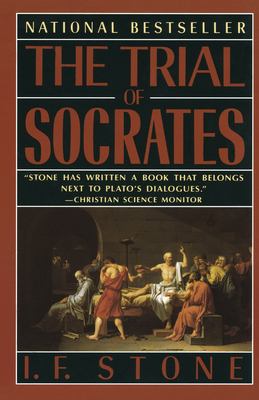
The Trial of Socrates by I.F. Stone

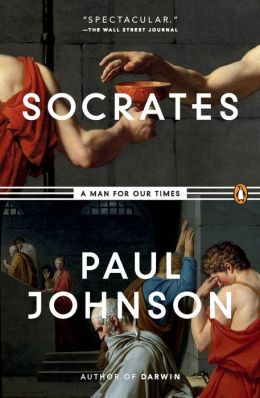
Socrates: A Man for Our Times by Paul Johnson  

Both authors were splendid prose writers, otherwise they are a study in contrasts. The late I.F. Stone was a famous radical, an antifascist, an investigative, “muckraking” journalist of the mid twentieth century and, for a time,  a Soviet agent during the “Red decade” of the Thirties. Stone, who was noted for his diligence with using government documents as a reporter, unearthing scoops everyone else had missed, became, in his retirement, a scholar of antiquity who read deeply in the classics in the original ancient Greek.

Paul Johnson began his career as a prolific writer and popular historian on the British Left with The New Statesman and over time shifted rightward to become a leading Anglo-Catholic conservative public intellectual, an adviser to Margaret Thatcher and an author of 40 books. Johnson is most known for his best-sellers that tackled panoramic and encompassing subjects – The Birth of the Modern, Intellectuals and The History of the Jews, often written from a highly idiosyncratic, as well as a conservative, perspective.

Of the two books, Stone’s  The Trial of Socrates is by far the most substantive. Stone relies heavily, though not exclusively, upon primary sources in the original Greek to build his argument, which is that Socrates was executed because of his militant, arch-reactionary, “antipolitical” opposition to self-government, especially in the form of the Democracy; and further, that Socrates’ actions at his trial were perversely designed to inflame the jury which might easily have acquitted him.  Socrates:A Man for our Times by Johnson is based on English translations of primary sources and secondary sources, is lighter in tone and much closer to being an essay. Johnson is evaluating the importance of Socrates in a broad, civilizational, context while Stone trying to tell what really happened while simultaneously judging Socrates culpability.

One point on which both authors have agreement is the mendacity and artistry with which Plato has made this task more difficult. I.F. Stone generally sees a “sneering” antidemocratic political continuity between Socrates and all of his disciples Plato, Xenophon, Charmides, Critias, Antisthenes and Alcibiades but even Stone cannot stomach Plato’s casual misuse (or abuse) of Socrates in his later dialogues to vent petty gripes and snobbish airs. Writing of an insulting passage in The Republic:

….Plato put this into the mouth of Socrates many years after the latter’s death. There is no evidence that the historical Socrates ever spoke so unkindly or pretentiously. Otherwise Socrates could not have had the lifelong affection of his oldest disciple, the “low-born” Antisthenes; his mother was a Thracian, hence he was twitted for not being of pure Attic blood (Diogenes Laertes, 6.1). Several scholars believe this was Plato’s slur against his fourth century rival – and Socrates’ old friend – Isocrates.[255]

Paul Johnson goes much further; attributing much that scholars regard as negative in Socrates’ reputation to the machinations of Plato using his late master as “a ventriloquist’s dummy”, a caricature Johnson calls “PlatSoc” to add authority to his own views and theories in which Socrates never believed or more likely, never even had heard:

….As an intellectual he [Plato] began to formulate his own ideas. As an academic he quickly merged them into a system. As a teacher he used Socrates to spread and perpetuate it. In his earlier writings Plato presented Socrates as a living breathing, thinking person, a real man. but as Plato’s ideas took shape, demanding propagation, poor Socrates whose actual death Plato had so lamented, was killed a second time, so that he became a mere wooden man, a ventriloquist’s doll, to voice not his own philosophy but Plato’s.

….So the act of transforming a living, historical thinker into a mindless, speaking doll – the murder and quasi-diabolical possession of a famous brain – became in Plato’s eyes a positive virtue. That is the only charitable way of describing one of the most unscrupulous acts in intellectual history. Thus Plato, with no doubt the best of intentions, created like Frankenstein, an artificial monster-philosopher [11]

There are other sources of information regarding Socrates than Plato, of course.  Xenophon, also wrote an apologia; Aristophanes and other comic poets satirized Socrates in their plays, the philosopher being a “public figure” in Athens as much as was Pericles or Cleon (Socrates apparently could take a joke much better than the litigious and bloodthirsty demagogue Cleon); Aristotle had informed speculations regarding Socrates based on his long (and one suspects trying) tutelage under Plato and there are Roman writers such as Cicero who had access to sources now lost, but Plato remains the most prolific.

This is important, because the central thesis in The Trial of Socrates is that Socrates is not merely an “antidemocratic” gadfly in Athens, but an arch-reactionary teacher of “antipolitical” doctrines. That is to say that Stone argued that Socrates and his followers rejected the concept of the self-governing “polis” itself, oligarchy as much as democracy, that men were a “herd” fit only for a shepherd, an absolute Homeric ruler defined by Socrates as “the One who Knows”. Stone argues, with accuracy, that Socrates disciples, despite differences in personality and philosophy, shared a common disdain for democratic politics and furthermore, that Socrates teaching repeatedly led to cohorts of aristocratic, pro-Spartan,”Socratified youth” who twice supported the overthrow of the Democracy. In short that Socrates was tried because his activities, his “examinations”, were ultimately politically subversive to the state in a time of danger and instigated civil strife.

This means, to judge Stone’s argument requires that we discern Socrates from Plato that in turn requires some expertise on Plato. This need to sift Platonic dialogues explains why both Johnson and Stone, despite Stone’s ability to work with the primary texts in the original Greek, turned to the scholarship of Gregory Vlastos for guidance. Vlastos was a seminal figure in the field of Platonist philosophy whose work is described by other scholars as “transformative” and having “a vast influence” who best parsed Socrates from his artfully prolix disciple. Because of Stone and Johnson, I have picked up what is regarded by many as “the best book on Socrates” – Socrates: Ironist and Moral Philosopher by Gregory Vlastos.

Vlastos, in this final book, ultimately came closer to Johnson’s position in the sense that some of what  moderns find disagreeable in Socrates and what Stone criticizes in particular – the harsh antidemocratic edge – is more a product of Plato’s literary handiwork than the philosophy of the historical Socrates. Vlastos writes:

I have been speaking of a “Socrates” in Plato. There are two of them. In different segments of Plato’s corpus two philosophers bear that name. The individual remains the same. But in different sets of dialogues he pursues philosophies so different that they could not have been depicted as cohabitating in the same brain throughout unless it had been the brain of a schizophrenic

The early Socrates of the Elenctic Dialogues is the most genuine in the view of Vlastos.

End Part I.

The White Paper and its Critics

Monday, February 11th, 2013

Someone for reasons unknown last week leaked the classified Department of JusticeWhite Paper” on targeting with drone attacks the numerically tiny number of US citizens overseas who have joined al Qaida or affiliated groups. The leak set off an outburst of public debate, much of it ill-informed by people who did not bother to read the white paper and some of it intentionally misleading by those who had and, frankly, know better.

Generally, I’m a harsh critic of the Holder DOJ, but their white paper, though not without some minor flaws of reasoning and one point of policy, is – unlike some of the critics – solidly in compliance with the laws of war, broader questions of international law and the major SCOTUS decisions on war powers. It was a political error to classify this document in the first place rather than properly share it with the relevant Congressional committees conducting oversight

Here it is and I encourage you to read it for yourself:

Lawfulness of Lethal Operation Directed Against a US Citizen Who is a Senior Operational Leader of al-Qa’ida

Much of this white paper debate has been over a legitimate policy dispute (“Is it a good idea if we use drones to kill AQ terrorists, including American ones?”) intentionally being mischaracterized by opponents of the policy (or the war) as a legal or constitutional question. It is not. The law is fairly settled as is the question if the conflict with AQ rises to a state of armed conflict, which SCOTUS dealt with as recently as Hamdi and for which there are ample precedents from previous wars and prior SCOTUS decisions to build upon. At best, framed as a legal dispute, the opponents of the drone policy would have a very long uphill climb with the Supreme Court. So why do it?

The reason, as I discern it, is substituting a legalistic argument and judicial process (“FISA court to decide drone killings”) to conceal what is really a debate over American war policy   and the President’s war powers in order to accrue domestic political advantage or at least avoid paying the costs of advocating a potentially unpopular position. Otherwise, opponents have to argue on the merits that the US should not as a matter of policy kill al Qaida terrorists sheltered by Pakistan or beyond the reach of government control in Yemen. Or that we are not “really” at war or that Federal judges are better suited for picking bombing targets than Air Force and CIA analysts and that “due process” should apply to enemy combatants on the battlefield. Many of these arguments are valid ones to raise and debate but are unlikely to be persuasive to the public or Congress; if they were, they would have prevailed in 2010 (drones) or 2001 (“are we at war?).

A straightforward legal analysis begins and stops with ascertaining whether or not we are in a state of armed conflict with al Qaida. The white paper used a “kitchen sink” approach to try and cover all legal bases, perhaps to create a basis for a later freewheeling peacetime use of armed drones – which incidentally, I am not in favor of – but it is not required here and actually distracts from the strongest legal argument – the administration is lawfully fighting an enemy in an armed conflict declared by Congress.
.
If we are in an armed conflict under international law with al Qaida – and the evidence appears here in fact, legislative action, context, historical and legal precedent to be overwhelming – renders most of the other justifications cited in the white paper for the policy regarding due process as well as nearly all of the criticisms of it moot, at least in terms of legality. Wartime enemy combatants are in a qualitatively different legal status vis-a-vis the United States government acting as a belligerent than are non-combatants or are civilians in peacetime (even civilians who commit criminal acts). No American citizen has a right to pick up arms and join an enemy army or armed group during a war, period. Or a subsequent right to be treated as anything but a combatant if they do. Combatant status is not determined by nationality under international law but by behavior and adherence to a belligerent party’s military forces and their physical disposition ( hors d’ combat, in the act of surrender etc.).
.
American citizens fought in enemy armies, notably the Wehrmacht and Waffen-SS, against the United States in WWII and a handful defected to the enemy in the Korean and Vietnam Wars. While some of these men were tried for treason after these wars ended, others were treated as enemy POWs or simply allowed to come home at a later date, but none were accorded judicial due process *during* the conflict as potential targets of an American military attack. Only after capture, as with the saboteurs in the Ex Parte Quirin case, did judicial review and due process come in to play.. We see a similar phenomena with the Civil War where, even under the Lincolnian theory that the Confederacy merely represented “Combinations too powerful to be suppressed” (i.e. a private insurrectionist conspiracy and not the states themselves as corporate, legal, sovereign entities in rebellion), we do not see SCOTUS insisting on normal, civilian, judicial due process in Ex Parte Milligan except where “civil courts are in operation” (i.e. away from the battlefield). This was to prevent the application of martial law in civilian areas in the North, not to stop martial law in theater or occupational zones.
.
Had this issue of due process for active enemy combatants been raised during WWII or even Vietnam, it would have been likely (and properly) regarded by US officials as ludicrous; if true, the logic would imply that enemy units could immunize themselves from attack (or substantially delay them)  by recruiting American citizens into their ranks. It would also beg the question why the US could lawfully bomb enemy targets and risk killing American POWs via collateral damage, but not directly target enemy fighters who happened to be American citizens. It would further beg the question why it would be lawful to indirectly target an American citizen in a group of enemy fighters with, say, artillery or gravity bombs from 52,000 feet but be an unlawful violation of due process to aim at him directly with a drone missile or a sniper rifle. Is a Marine rifleman who happens upon Adam Gadahn in Afghanistan and kills him therefore an “assassin” (to use Glenn Greenwald’s description of targeted killings) to be charged with murder?
.
Even as a matter of “due process” (!) – never mind fighting a war – how could this legal argument possibly make any sense? What precedent under military law or international law from prior conflicts supports it?
.
How would inserting judicial review – even SCOTUS – over operational planning and target selection as a step in the President’s exercise of his Constitutional authority as Commander-in-Chief likely to affect the Separation of Powers? This is not a trivial question – in military terms it is analogous to the judiciary usurping the position of the Rules Committee in the House of Representatives over legislative matters. How would this innovation impact our ability to fight our next war or wars?
.
Much like the white paper’s lengthy, but entirely irrelevant discourse into the nature of threat “imminence” and “breadth”, this argument is sheer invention if a state of armed conflict with al Qaida exists. Most criticisms and not a few of the white paper’s own legal justifications consist of novel restraints alien to the historical practice of states prosecuting an armed conflict that we would be extremely unwise to adopt and sanctify as precedents for waging future wars.
.
Let us take one of the more intellectually serious and responsible expert critics as an example, Steve Vladeck of American University. Not everything he has to say in his lengthy post is wrong and I even agree with some of his points, but things like this strike me as specious, or at least a very weak reed upon which to rest an argument that alters the constitutional balance:
.

….First, many of us who argue for at least some judicial review in this context specifically don’t argue for ex ante review for the precise reasons the white paper suggests. Instead, we argue for ex postreview–in the form of damages actions after the fact, in which liability would only attach if the government both (1) exceeded its authority; and (2) did so in a way that violated clearly established law. Whatever else might be said about such damages suits, they simply don’t raise the interference concerns articulated in the white paper, and so one would have expected some distinct explanation for why that kind of judicial review shouldn’t be available in this context. All the white paper offers, though, is its more general allusion to the political question doctrine. Which brings me to…

.

Second, and in any event, the suggestion that lawsuits arising out of targeted killing operations against U.S. citizens raise a nonjusticiable political question is almost laughable–and is the one part of this white paper that really does hearken back to the good ole’ days of the Bush Administration (I’m less sold on any analogy based upon the rest of the paper). Even before last Term’s Zivotofsky decision, in which the Supreme Court went out of its way to remind everyone (especially the D.C. Circuit) of just how limited the political question doctrine really should be, it should’ve followed that uses of military force against U.S. citizens neither “turn on standards that defy the judicial application,” nor “involve the exercise of a discretion demonstrably committed to the executive or legislature.” Indeed, in the context of the Guantánamo habeas litigation, courts routinely inquire into the very questions that might well arise in such a damages suit, e.g., whether there is sufficient evidence to support the government’s conclusion that the target is/was a senior operational leader of al Qaeda or one of its affiliates…

My first criticism would be that Vladeck’s premise that the question of a targeting decision of an American citizen who is a senior leader of al Qaida during a state of armed conflict who is active outside the territory of the United States is a matter for adjudication by US courts is incorrect. He is essentially arguing that the political question doctrine does not cover the exercise of the Constitutionally specified war-making powers of the executive and legislative branches during a war. I am highly skeptical this is an argument any Supreme Court would entertain lightly, much less the Roberts Court.
.
My second criticism is more practical – that Vladeck in seeking judicial review of the decision process by which an American citizen is determined to be senior or not senior leader in al Qaida leadership is a distinction without a difference from a court having a priori judicial review of the larger military operation in wartime but with the added detriment of exposing the intelligence process, to discovery. Targeting decisions involve assessment of intel about the target from a variety of perspectives – confidence, effect, probability of success/costs and the “fusion” of (usually) USAF and IC in a targeteering shop. Why  judicial scrutiny should apply only to drone strikes targeting a specific US citizen among other al Qaida operatives in wartime vice simply bombing an al Qaida safe house in which a US citizen might be employs a legal reasoning that is obscure to me. If a US citizen being a potential casualty is the critical constitutional variable here, then not also judicial review of a bayonet charge?
.
The proposal for judicial review of potential attacks during an armed conflict (not peacetime) is rife with a host of counterproductive second and third order constitutional and military effects. It represents a sweeping change in our political order by a technical legal fiat. It would also be an exceedingly dumb way to run a war. It might test our powers of imagination, but somehow, we faced down Hitler and the Imperial Japanese without Federal judges running our strategic bombing campaigns.
.
This preference for legalistic arguments is partly a product of over representation of lawyers among the American political elite. Highly competent attorneys are very skilled at framing arguments on behalf of clients so that they begin litigation not only from a favorable explicitly stated position but, where possible, with several layers of one-sided implicit premises built in that you accept uncritically only at your peril. When a lawyer comes into a public policy debate saying that a political question is a legal question, he is making a political argument to remove a political dispute in a democratic polity to the courts where the matter will be decided under very different procedures and will remain as a legal question thereafter.
.
Sometimes, this is the constitutionally correct thing to do; more often, it is simply an expedient thing to do that diminishes democratic accountability while rendering policy and process needlessly more complex and adversarial than even open public debate. It is also a self-aggrandizing feedback loop for lawyers as a class – when all political questions are legal questions, then should we not all defer to their superior expertise and training? It is the road to technocracy and the rule of law becoming “rule by lawyers”.
.
Does that mean the critics have no point whatsoever regarding the use of drones in “targeted killings”? No. The idea that targeting American citizens is bad *policy* because it might, for example, be poorly employed against innocent people by mistake or, in slippery slope fashion, lead to a normalization and extension of the practice of targeted killing outside of an officially recognized armed conflict is a completely valid *political* argument. It is even, in my view, a very wise caution. It just does not hold water as a legal argument on behalf American citizens who go overseas and pick up arms and wage war against the US by joining al Qaida.
.
More importantly, there are better, simpler remedies to a “slippery slope” with drone attacks that can be employed legislatively and through vigorous oversight that can be enacted that will strengthen rather than undermine and confuse our constitutional system of governance. First, the Obama administration, for it’s part, should allay critics fears by removing “targeted killings” from the arbitrary hands of unnamed “senior officials” (code for the President? The National Security Adviser? A random White House lawyer?) and either return to a more traditional Pentagon target assessment procedure or use the NSC process with a PDD/NSDD and a properly and timely “finding” being presented to Congress.
.
Secondly, the proper body to review the judgement of the administration in tactics, operations, and strategy is not the judicial branch, but the legislative, which has done so in prior conflicts and holds the power of the purse to control the extent of campaigns and the raising of armies. The Joint Committee on the Conduct of the War was the oversight mechanism the Congress employed during the Civil War to review and influence the actions of the Lincoln administration. I would argue that the US Congress is more than sufficient to do the same task today with a far less existential conflict, if it chose to do so. Congress could, if it wished, forbid these operations or cease funding them. Quite pointedly, they have done neither.
.
If Congress does not engage in rigorous oversight, it does not follow that a Federal Court is the appropriate constitutional substitute for Congress abdicating it’s wartime responsibilities. Targeted killings of enemy combatants during a declared armed conflict is a question of war policy, not due process, and is the purview of the political branches, not the judiciary
.
Thirdly, the “slippery slope” danger is genuine and should be interdicted with legislation prohibiting or severely restricting the use of armed drones at home or forbidding their use against civilians resident in the territory of the United States entirely. A definition from Congress of under which circumstances that terrorism is a matter for law enforcement or military action is something that is likewise years overdue.
.
Congress should be taking up it’s weighty responsibilities in war policy and not punting them to the executive or the judiciary, so that the actions of the US government in a matter of extreme gravity like a war are constitutionally clothed in democratic consent.
“Sin, Death, and Hell have set their Marks on Him”

Tuesday, February 5th, 2013

King Richard III 

The bones of Richard III, Shakespeare’s greatest villain and the last King of England to be killed in battle have been discovered and identified by DNA testing:

….There were cheers when Richard Buckley, lead archaeologist on the hunt for the king’s body, finally announced that the university team was convinced “beyond reasonable doubt” that it had found the last Plantagenet king, bent by scoliosis of the spine, and twisted further to fit into a hastily dug hole in Grey Friars church, which was slightly too small to hold his body.

But by then it was clear the evidence was overwhelming, as the scientists who carried out the DNA tests, those who created the computer-imaging technology to peer on to and into the bones in raking detail, the genealogists who found a distant descendant with matching DNA, and the academics who scoured contemporary texts for accounts of the king’s death and burial, outlined their findings.

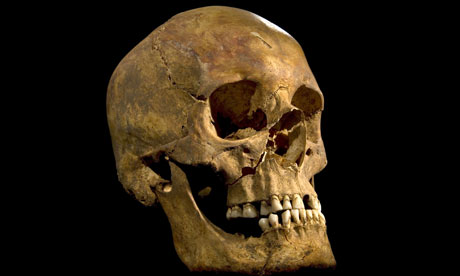
….Richard died at Bosworth on 22 August 1485, the last English king to fall in battle, and the researchers revealed how for the first time. There was an audible intake of breath as a slide came up showing the base of his skull sliced off by one terrible blow, believed to be from a halberd, a fearsome medieval battle weapon with a razor-sharp iron axe blade weighing about two kilos, mounted on a wooden pole, which was swung at Richard at very close range. The blade probably penetrated several centimetres into his brain and, said the human bones expert Jo Appleby, he would have been unconscious at once and dead almost as soon.

The skull of Richard III

Injuries to the skeleton appear to confirm contemporary accounts that the king died in battle. Photograph: AFP/Getty Images

The injury appears to confirm contemporary accounts that he died in close combat in the thick of the battle and unhorsed – as in the great despairing cry Shakespeare gives him: “A horse! A horse! My kingdom for a horse!” 

Richard III, usurper and probable regicide of his nephew the boy King, was the last truly medieval King of England. Had Richard lived to rule, his reign would have been characterized by the same bloody uprisings and civil strife that marked the War of the Roses. England was fortunate in his successor who had bested him in battle, Henry Tudor who became King Henry VII was an energetic and far seeing monarch who restored a war-wracked and bankrupt England to peace and fiscal health and set the foundations of the modern United Kingdom and the future world-spanning British Empire. It was Henry who started the Royal Navy and curtailed the ability of the nobility to wage war as they pleased with large private armies, by taxing them for each man at arms, thus ending bastard feudalism ; recalcitrant rebels were executed and justices of the peace established in every shire to enforce the law of the realm rather than the corrupt whims of manorial courts.

Richard III has his devoted fans as well his detractors. Except for his impatient ruthlessness, Richard probably was little worse, morally speaking, than his fellow medieval monarchs in an age when brutality and the rule of the strong was the norm.  However, unlike the brilliant Henry, Richard would have done little to improve the situation and might have made life in England more savagely violent.


Switch to our mobile site