zenpundit.com » history

Archive for the ‘history’ Category

A Library vs. a Collection

Thursday, June 30th, 2011

Recall the “antilibrary ” discussion some years back, prompted by Nassim Nicholas Taleb?

The other day, I was having a conversation in the comments section regarding ancient Chinese philosophers with my learned friend Lexington Green, when I had cause to quote Nassim Nicholas Taleb, from his most recent book The Black Swan: The Impact of the Highly Improbable:

The writer Umberto Eco belongs to that small class of scholars who are encyclopedic, insightful, and nondull. he is the owner of a large personal library ( containing thirty thousand books), and separates vistors into two categories: those who react with ‘Wow! Signore professore dottore Eco, what a library you have! How many of these books have you read?’ and others – a very small minority- who get the point that a private library is not an ego boosting appendage but a research tool. Read books are far less valuable than unread ones. The library should contain as much of what you do not know as your financial means, mortgage rates, and the currently tight real estate market allow you to put there. You wil accumulate more knowledge and more books as you grow older, and the growig number of unread books on the shelves will look at you menacingly. Indeed, the more you know, the larger the rows of unread books. Let us call the collection of unread books an antilibrary.

A passage that immediately made me feel better about having resigned myself to falling further and further behind in reading the books that I keep purchasing ( I’m now also periodically finding myself going to IKEA to buy shelf extensions. I’ve resigned myself to that too).

Taleb was advocating building a library – an organized assemblage of books on a wide range of topics, of which the unread portion was your antilibrary. Libraries, private or public, are wonderful things, functioning in an earlier time as the poor man’s university. Andrew Carnegie endowed public libraries for that purpose and in past ages, wealthy patrons opened the doors of their private libraries to their favored scholars, like King George III did for Samuel Johnson.

My library is sizable but disorderly and eclectic. There are books on Turkic kingdoms and network theory, art history and classical economics, political memoirs and diplomatic papers, the “great books” and sci fi. And of course a great deal of books on strategy and history. My friends Lexington Green and Dave Schuler have far larger personal libraries and Lex’s, I can say firsthand, seems to be much better organized than mine ( though, admittedly, that would not be hard).

Recently, one of my uncles, an academic, decided he wanted to make me the eventual recipient of a major portion of his library, along with the funds to transport and shelve the books. This generous offer came with a proviso – that his collection is to be kept intact and passeed on only to someone else who would agree to keep it so. And it is really a collection and not a library. Naturally, I agreed

The difference between a library and a collection is puposeful focus and quality. My uncle decided on the advice of one of his mentors to really become a collector and decided to target the Hanoverian period of British history and only read and collect books that related directly in some way to the book previously read. He also specifically wanted to acquire rare editions and copies with the marginalia of important people from the period for purchase. My uncle also made a habit of going to the best rare and used bookstores (when he visits Illinois, Bookman’s Alley is his faviorite) wherever he happened to be. The uncle has been doing this for at least thirty+ years and has read his way forward to the early 20th century and in recent years, developed an extensive sub-collection dedicated to T.E. Lawrence.

Interestingly enough, none of this has anything remotely to do with his area of academic expertise (he has two doctorates; in a hard science and another in a medical specialty) but he’s made himself into more of an expert on the historiography of this period of British history than are most professional historians.The reason is a tunnel-like focus, which is the primary distinguishing characteristic between a building a general library and building a collection. There’s a comprehensiveness to a collection that becomes an end in itself.

books.jpg

All van Creveld, All the Time

Tuesday, June 28th, 2011

Darth Creveld explains the strategic dark side to SWJ

Michael Few pinged me regarding an interview Martin van Creveld gave to SWJ with the always interesting interlocuter, Octavian Manea:

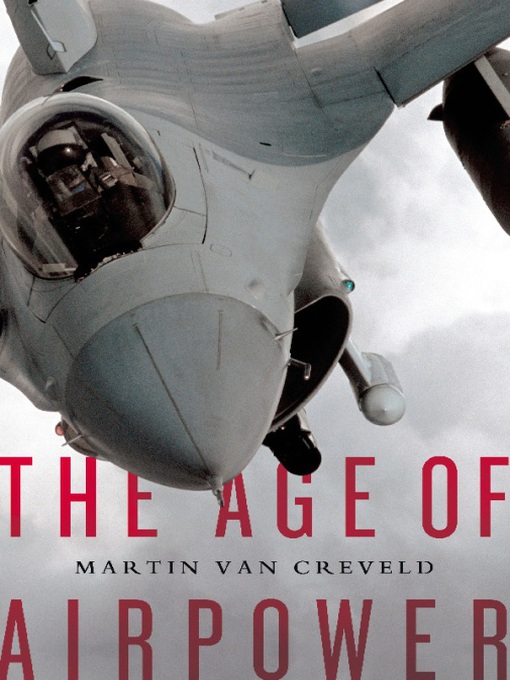
The Age of Airpower

Q: It is stated that Operations Rolling Thunder in Vietnam was the wrong way of using airpower in order to break the will of an opponent. Why? And which is the right way?

MvC: As Jesus once said, by their fruit will thou know them. Given the vast cost of Rolling Thunder, and the meager results it yielded, there can be no question that it was a foolish waste of resources. It was only made possible by the fact that it was carried out by the richest nation in history at the very peak of its economic power and psychological hubris.

The real question is, had the “gradual approach” been replaced by a short, sharp, all-out attack, would it have worked any better? To my mind the answer is almost certainly negative. Look at “Shock and Awe” as carried out both in Afghanistan and in Iraq. Both of these offensives employed weapons infinitely more sophisticated, and in many ways much more powerful, than the ones the Americans used in Vietnam almost forty years earlier (though some aircraft, notably the venerable B-52s, may well have taken part in both campaigns). Both depended their success, if indeed one can talk of success, on the presence of troops of the ground. Vietnam, though, was primarily a guerrilla war. Expanding ground operations into North Vietnam, as some in Washington DC demanded, would merely have made things even more difficult for the Americans.

Postscript: 

Adam has his take on the Infinity article.

Martin van Creveld on The Lebanon War

Monday, June 27th, 2011


Eminent and controversial military historian, Martin van Creveld, analyzes the 2006 Israeli-Hezbollah War in the latest issue of Infinity Journal. Some Excerpts:

The Second Lebanon War: A Re-assessment

….Though the decision to retaliate in force was inevitable, it also meant that the Israel Defense Force (IDF) was taken by surprise and did not have time to prepare properly. Of the entire vast order of battle, only five regular brigades were immediately available. Moreover, these brigades had spent years doing little but carrying out counter-insurgency operations in the Occupied Territories. As a result, they had almost forgotten how to fight a real enemy; he who fights the weak will end up by becoming weak. Some of the burden fell on the Israeli Navy which shelled Lebanon’s coast, imposed a blockade, and cut the country off from the world. In doing so, one of its modern ships was hit by an Iranian-built surface to sea missile, suffering damage and taking some casualties. Since this was the first time in thirty-nine years anything of the kind had happened, it was a considerable propaganda victory for Hezbollah. At the same time it proved how much the crew had underestimated the enemy, since they (perhaps acting on their superiors’ orders) had not even switched on the vessel’s electronic defenses.

….”Stark raving mad” (majnun, in Arabic) was, in fact, the way many people in Lebanon and the rest of the Arab world reacted to the Israeli attack. As the statements of several of Hezbollah’s top leaders indicated, they too were surprised by the strength of the Israeli reaction. None of the organization’s original objectives were achieved. Its fighters remain in prison; the Israeli “occupation” of Shaba Farm continues; and Jerusalem, which it set itself as its ultimate objective to liberate, remains as firmly in Israeli hands as it has been during the last forty-four years. What the war did do was to show that, in case of war, neither Syria nor Iran would necessarily come to Lebanon’s rescue. The country’s infrastructure was left in ruins. Thirty thousand dwellings were destroyed or damaged, and dozens of bridges, underpasses, and gas stations demolished. Hundred of thousands of people were forced to flee, and as many as 2,000 killed.

Free registration required to read the article.

This piece is heavily IDF-centric in the analysis, perhaps reflecting van Creveld’s established authority on command and logistics and his recent work on air power, but I was surprised by the lack of space devoted to Hezbollah’s operations, given the author’s deep influence on 4GW theory and the study of postmodern irregular and asymmetric warfare. That may reflect, in part, the thrust of Infinity as a publication or the need for brevity but there’s an almost Clausewitzian subtext in the conclusion.

The Said Symphony: Meditation / moves 10 and 11

Sunday, June 26th, 2011

[ by Charles Cameron – extended analytic game on Israeli-Palestinian conflict — continuing ]

Meditation part 1 / Move 10

.

What to say? There are two sides to the game, darkness and light, and the light encompasses the darkness, and the darkness threatens the light.

I promised a meditation on the state of the game, and it comes in the form of two moves: Move 10: Piano Lesson, by Haim Watzman, addresses the light, and my sense that the game is as much a gift to me as a gift from me to you, while Move 11: Auschwitz and Theodor Adorno raises the darkest question of all, whether art can still function in situations as terrible as those where humans hate to the fullest extent of their powers.
____________________________________________________________________________________________

Move 10: Piano Lesson, by Haim Watzman
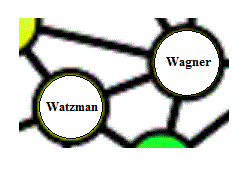
move-010.gif

Move content:

The content of this move is Haim Watzman‘s story Piano Lesson which comes from his Necessary Stories series, on the South Jerusalem blog he shares with my friend and colleague Gershom Gorenberg. It concerns young Felix Mendelssohn, the grandson of the rabbinic scholar Moses Mendelssohn, composer – and the man who revived Bach‘s St Matthew Passion after it had lapsed into obscurity for a century or so.

Links claimed:

With Wagner, in complete refutation of the latter’s opinions about Judaism and musicianship – Watzman’s story opens with the words:

I am impressed. You play like a Jew, Felix. What I mean by that is that you have Johann Sebastian Bach in your heart as well as in your fingertips…

contains this more detailed assertion:

This piece you have played so beautifully for me this morning, the Partita No. 5 in G Major, can only be played properly, in our falscherleuchtung age, this time of false enlightenment, by a person of Jewish sensibility. Please do not interrupt me. At your age you are to listen to your elders first. After you listen you may disagree, you may do whatever you want. But first you must listen.

Sebastian Bach was a devout Lutheran, true, but he wrote Jewish music. I do not say this simply to embellish the repute of my ancestral people. The nation Israel needs no trills. I say this after long years of study and performance of Bach’s music, during which I have come to know this remarkable man. Better, I hazard to say, than his own sons did.

What is Jewish about the music? To see that, you have to know music. Which, of course you know. You also have to know what Judaism is. Which, thanks to my niece, you do not. This is scandalous. The grandson of the great Moses Mendelssohn knows nothing of his own people’s special relationship with God.

and closes with:

Remind me to show you the “St. Matthew Passion.” It is such wonderfully Jewish music!

Comment:

I read this story a day or two after completing moves 8 (Wagner) and 9 (Golgotha) and posting the game thus far to Zenpundit, and was astonished and delighted to find that a mind and heart in Jerusalem – friend of a friend – was touching on the same territory: the relationship of music, especially that of Bach, and Judaism.

But not only does Watzman deftly refute Wagner’s position on Judaism and music as presented in move 8, he also specifically discusses the contrapuntal aspect in both music and religious understanding, and the power of dissonance at times to work towards resolution.

This he accomplishes through a discussion of the two “laws” of Judaism, and the complexities of their musical relationship with one another:

I kept working on the piece and the morning prior to the performance I had my epiphany. Here, let me play it for you.

So where is the stress? Yes, here. And here too. At the end of the melodic line. And at the end of the harmonic progression. Which do not coincide.

You see, the underlying harmonics here are the Torah, the Written Law. And the melody playing above it is the Oral Law. The melody would be hollow, meaningless without the underlying harmony, and the underlying harmony would be incomplete and useless without the melody above it.

The simple-minded might think that the two laws should coincide. What good is a God if his message is not clear?

Yet it is the lack of clarity, the occasional dissonance, the unsynchronized phrases that move us forward, that propel us toward the final resolution. And that final tonic itself sends us off into new melodic and harmonic firmaments, from which we again return to our G major chord. One idea begins before the previous idea has been completed. As when you interrupt your Great Aunt Sara.

There is thus an uncanny melodic line here, running from Said through Bach, Gould, Wagner, to Watzman.

said-watzman.gif

Whatever I am doing here – and it feels at times quite lonely, I am not sure how many people will find this game an easy work to follow – in reading Watzman’s tale of Felix Mendelssohn I felt again my kinship with what has been termed the “invisible cloud of witnesses”…

Indeed, my sense of the gracious synchronicity involved in my stumbling across this particular story of Watzman’s at this particular time can only deepen as Watzman concludes his story – and I my move – with this rendition of the Bach Partita No. 5 in G major BWV 829, played by one Glenn Gould

____________________________________________________________________________________________

Meditation part 2 / Move 11

If the first part of this meditation relates to the game <as a whole, and to the fabric of grace of which, it seems, the universe as a whole is woven, this second part addresses the sense — as bitterly merciless to those who suffer it as grace is merciful to those who receive it — that the fabric of grace is itself picked at and torn by humans, in danger at any point (and perhaps in this moment more than most) of unravelling.

In my personal perspective, I should no more ignore the threat than ignore the grace — for love extends itself in compassion to the one, even as it extends in gratitude to the other.

____________________________________________________________________________________________

Move 11: Auschwitz and Theodor Adorno
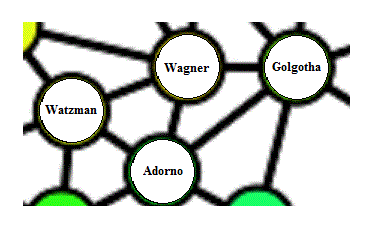
move-011.gif

Move content:
Theodor Adorno famously said: “To write a poem after Auschwitz is barbaric.”

*

Think of this move as a sort of metaphysical black hole, an anti-game.

To expand on this idea a little: Adorno was a musical advisor to Thomas Mann while Mann was writing his novel Doctor Faustus — a copy of which he inscribed to his friend Hermann Hesse with the words “To Hermann Hesse, this glass bead game with black beads, from his friend Thomas Mann, Pacific Palisades, January 15, 1948” – featuring a composer named Adrian Leverkuhn, whose intention in his final work was to retract — cancel, annul — Beethoven‘s Ninth Symphony, and in particular its Ode to Joy with his own oratorio, The Lamentation of Doctor Faustus.

 “I find,” he said, “that it is not to be.”
“What, Adrian, is not to be?”
“The good and the noble, what we call the human, although it is good, and noble. What human beings have fought for and stormed citadels, what the ecstatics exultantly announced — that is not to be. It will be taken back. I will take it back.”
“I don’t quite understand, dear man. What will you take back?”
“The Ninth Symphony,” he replied.

Herbert Marcuse — another modernist philosopher of the left — is quite clear on the power of this Faustian attempt, which he approves as liberating us from “illusion” and indeed “making us see the things which we do not see or are not allowed to see, speak and hear a language which we do not hear and do not speak and are not allowed to hear and to speak”:

The present situation of art is, in my view, perhaps most clearly expressed in Thomas Mann’s demand that one must revoke the Ninth Symphony. One must revoke the Ninth Symphony not only because it is wrong and false (we cannot and should not sing an ode to joy, not even as promise), but also because it is there and is true in its own right. It stands in our universe as the justification of that ‘illusion’ which is no longer justifiable.

Links claimed:

To Wagner, because the mythology of blood and race which he promulgated so stirred one Adolf Hitler that the latter carried out the Shoah, in face of which Adorno finds poetry – hence Orpheus and the muses — speechless.

To Golgotha, because Christ is banished and beaten from the city, Jerusalem, whose name is The Abode of Peace — because there is no more despairing cry than his cry at Golgotha: “My God, My God, why hast Thou forsaken Me?” — because the Descent of Mercy in human form is then brutally executed as a common criminal – because the very veil that protects the holy of holies in the JerusalemTemple is then torn asunder, as his body is broken – because all this marks the darkest moment in the Christian narrative – and because such desolation, felt by the Marys gathered at the foot of the cross, is nowhere so closely mapped in the history of the arts as by the silence of poetry and the arts before atrocity.

And to Watzman, because despite the Shoah — the Golgotha of my civilization and Hesse’s and Bach’s — and despite Adorno, there is poetry in his voice — an Israeli voice, speaking after Auschwitz, in an Israeli State, in Jerusalem.

Comment:

As I was setting out the ground-rules for this game, my friend Lexington Green made what I’d like to call “the essential objection”. He wrote:

Pals send their teenagers to be suicide bombers. That is beyond dissonant. There is no symphony where one group of musicians is committed to a relentless campaign of murder and terror. Said was using this as one more way of playing make-believe, and claiming moral equivalence. In other words, it was a sophisticated move in an elaborate scheme to help disarm his opponents so his fellow Palestinians could kill them.

There is another point of view, which sees the Israelis enforcing a mutant form of apartheid with attendant horrors on an occupied population – indeed, I have Israeli friends who hold some version of this view — but Lex’s point is crucial:

There is no symphony where one group of musicians is committed to a relentless campaign of murder and terror.

This cuts to the heart of the work, as it cuts to the heart of our world. It is, in essence, the issue of theodicy, and which Lex’s permission I am addressing it in this meditation, within the work itself …

My linking of the cry of Golgotha –“My God, My God, why hast Thou forsaken Me?” – with the cry of Adorno – “To write a poem after Auschwitz is barbaric” – is my presentation of the most godforsaken of despair of which we are humanly capable, and I present it within that opposite extremity of human possibility represented by Bach’s motto which I invoked earlier, Soli Deo Gloria.

It is precisely in the context of free will that both possibilities arise, and theodicy becomes an issue. Here, then, is the relationship of darkness to light as described by St John in the Prologue to his gospel:

the light shines in the dark, darkness does not blot it out.

I can say no fairer than that.

____________________________________________________________________________________________

Conclusion:

Oliver Sacks in Musicophilia tells the story of a Manhattan psychiatrist who lived immediately opposite the Twin Towers, and whose otherwise rich interior musical life went blank for months after he witnessed the 9-11 attacks:

My internal life was dominated by a dense and silent pall, as if an entire mode of existence were in an airless vacuum. Music, even the usual internal listening of especially beloved works, had been muted…

“Music”, the psychiatrist said, “finally returned as a part of life for and in me” after an absence of several months. The first music to return was Bach‘s Goldberg Variations.

Again, I must admit it was by no skill of mine but some grace of god or muse that I stumbled on Sacks’ book today, while searching my cramped and overflowing shelves for something else entirely.

There are, it seems true, periods of silence in the arts, while we absorb horrors of our human doing.

There is also a return from those horrors to the arts — even Marcuse admits this — and as forgiveness, mercy and compassion alike claim, to that great possibility, “a happy issue out of all our afflictions”.

Or so the mystics tell the realists — and time grinds all to dust.

[ next ]

In Search of Civilization, a review

Saturday, June 18th, 2011

 [by J. Scott Shipman]

civilization.jpg

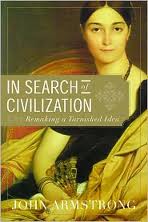
In Search of Civilization, by John Armstrong 

In Search of Civilization is a refreshing and erudite examination of civilization, how it developed in the past, negative present day connotations, and why it remains importance and relevant today. What follows is a detailed overview of Part One, and with any luck, the teaser will be enough to convince you to read this important book. For me, this is a truncated review. Normally, I would provide a 1200-1500 hundred word overview, but like Zen, I’ve been busy and wanted to share what I had with you. This books makes a nice foil for John Gray’s Black Mass, which I read recently but probably will not review.

Also, some books have wonderful finds in the bibliography. Back in the early 80’s I chased footnotes for about two years—and have no memory of what the original book was, but I went from one reference to another. Going forward, I’ll provide the titles from the bibliography that piqued my interest, which may also provide the you a little more insight on the works that influenced the author. Please let me know if this is or is not useful to you.

Part One Civilization as Belonging

Armstrong’s quest to define civilization began as he was reading a bedtime story to his son, and he advances that “with the possible exception of God, civilization is the grandest, most ambitious idea that humanity has devised.” From that introduction, Armstrong makes a compelling case for civilization.  He notes that it is difficult to get one’s mind around the concept since “civilization” touches everything. As a result, he offers that our ideas about “civilization tend to be rather messy and muddled.”

Armstrong goes on to frame civilization as “a way of living,” a level of political and economic development, “the sophisticated pursuit of pleasure,” and finally, “a high level of intellectual and artistic excellence.” Separately each of these, what I’ll call working definitions, made sense. But Armstrong rightly attempts to define, frame, contextualize civilization, not from historical perspective, but rather the philosophical in a way that is relevant to our times.

The actual word “civilization” is, according to Armstrong, not “fashionable” in our globalized world, particularly among those one would expect to be the “defenders.” He offers that civilization carries a “moral implication” whereby one society is somehow better than another, “fully human” or “superior.” And nations often advance the idea that they are better, more civilized, etc. Those defenders (in the arts and humanities) mentioned above have become “wary and negative” with respect to civilization. I’ll call this standard-less ambivalence based primarily on fear. Fear of “what,” you may ask. Fear of offending. Harvey Mansfield in City Journal made an excellent point with respect to political correctness:

“When there is no basis for what we agree to, it becomes mandatory that we agree. The very fragility of change as a principle makes us hold on to it with insistence and tenacity. Having nothing to conform to, we conform to conformism—hence political correctness. Political correctness makes a moral principle of opposing, and excluding, those of us who believe in principles that don’t change.”

Principles are a big part of civilization.A brief review of Samuel P. Huntington’s classic The Clash of Civilizations follows. Armstrong reminds of Huntington’s words: “In coping with an identity crisis, what counts for people are blood and belief, faith and family.” Armstrong recounts Huntington’s view of civilization a sense of “loyalty” and “shared identity.” Armstrong calls this an “organic conception of civilization;” witness the identity politics of the in the aftermath of 9/11 where it seemed the US, for once, stood as one. The phenomena can be found around the world, regardless race, religion, or ethnicity.  If there is a community of people, chances are there will be shared identities, but is this “sharing” civilization?

One of the strongest parts of the book is the emphasis he places on the “quality of relationships.” With the aforementioned “sharing” and “loyalty” Armstrong rightly asks about the quality of individual relationships and the impact on civilization. He compares the loyalty of religious believers to their faith to their loyalty to their civilization. Armstrong believes, and I agree, we share much more in common than one might, on first glance imagine. He says, “The rich achievements of any civilization are not in violent conflict, and in fact are on the same side in a clash between cultivated intelligence and barbarism. The irony is that such barbarism too often goes under the name of loyalty to a civilization.” Armstrong believes that a “true civilization is constituted by high-quality relationships to ideas, objects, and people.” In high quality relationships there is love and Armstrong sees civilization as “the life-support system for high-quality relationships.” Civilization sustains love; I like the implications.

The cultivation of high quality relationships tends to bring out the best in people.  He goes on to discuss the paradox of freedom—as we in the West live in cultural democracies. He asserts that vulgarity is “triumphant” because of our democratic ideals; the majority rules. Freedom comes with great responsibilities, greater responsibilities than living in a coercive state. At the level of the individual we make choices, satisfy appetites. “The civilizing mission is to make what is genuinely good more readily available and to awaken an appetite for it.”

Part Two Civilization as Material Progress, Part Three: Civilization as the Art of Living, Part Four: Civilization as Spiritual Prosperity 

References you may find of interest:

F.R. Leavis, The Great Tradition

C.P. Snow, a lecture “The Two Cultures and the Scientific Revolution

Matthew Arnold, Culture and Anarchy  A free online copy here.

 Kenneth Clark’s BBC television series Civilization

Bernard Berenson, The Florentine Painters of the Renaissance (1896)

T.S. Elliot, an essay called “Tradition and the Individual Talent


Switch to our mobile site