zenpundit.com » history

Archive for the ‘history’ Category

Book Review: The Grand Strategy of the Byzantine Empire by Luttwak

Monday, February 14th, 2011
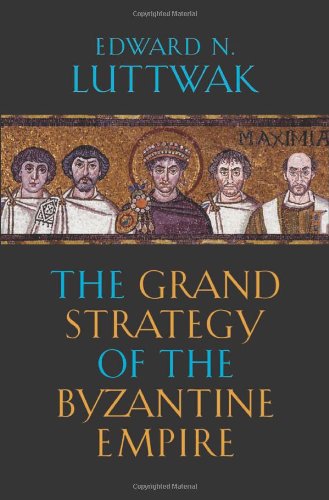
The Grand Strategy of the Byzantine Empire by Edward Luttwak

A quarter century in the making, eminent and controversial strategist Dr. Edward Luttwak has produced a tour de force work of scholarship that illuminates the little known (to laymen)  military and diplomatic vision of the Byzantine Empire while making a case for adopting some of Byzantium’s strategic posture to adapt to the challenges of today. A book intended to provoke as much as inform the reader, Luttwak’s epilogue, “Conclusion:Grand Strategy and the Byzantine ‘Operational Code”, which synthesizes the best elements of leading schools of strategic thought, is so good that it merits a separate printing of it’s own.

Luttwak’s central idea is that the Hellenic and holy Orthodox Byzantines, who forever saw themselves as “the Romans”, abandoned the grand strategic posture of the Roman Empire whose mighty legions were optimized to smash heavy infantry into the enemy, seeking not just a decisive victory, but the total destruction of the enemy. Facing a sophisticated peer rival in Persia and the endless steppes that vomited up unending waves of invading Huns, Avars, Pechnegs, Slavs, Bulghars, Bulgars, Turks and Mongols, eventually menaced by an ideologically motivated Islamic enemy, the Byzantines sought to conserve their strength by avoiding decisive battle.

As the position of the Empire meant that one destroyed enemy might be replaced by a worse successor, the Byzantines crafted a grand strategy that maximized stratregic alternatives to wars of attrition that the small, highly trained, well-armed, tactically versatile and irreplaceably expensive Byzantine army could ill afford. Diplomacy, espionage, bribery, assassination, recruitment of foreign proxies, strategic raiding, naval supremacy, manuver warfare and cunning strategems were all employed in preference to engaging in decisive battle. Today’s enemy might be tomorrow’s ally was a foremost consideration for the Byzantines, who took great care to lay down hard-won military wisdom in handbooks and manuals like The Strategikon or  De Re Strategica.

Strengths and Weaknesses:

Where you sit in reading The Grand Strategy of the Byzantine Empire is likely to determine where you stand on it. 

Luttwak has written a very interesting book about a historical subfield in which he himself is not an expert but has infused it with distillations of professional insight regarding strategy and warfare that no Byzantinist scholar and only very few military historians could have brought to bear. And importantly, never have tried to do so. Luttwak’s commentary on each of the surviving Byzantine military manuals, some only recently translated, for example, while repetitive for a lay reader is an important service for students of war and military strategy.

The empire lasted an exceedingly long period of time, as the Byzantines themselves reckoned it, from the 8th century BC to 1453 when the last Emperor Constantine died heroically fighting the final onslaught of the Ottoman Turks a mere 39 years before Christopher Columbus discovered the New World.  Luttwak is not a historian and makes no attempt to approach the subject as a historian would – something that might require multiple volumes or a very superficial treatment – and makes selections from Byzantine history to illustrate thematic points regarding strategy or, as with the digressions on the composite recurve bow and training of mounted archers, the complex relationship between technology, economics, military tactics and strategy.  To the reader interested in strategy and military history, Luttwak’s approach is efficient and sensible; for those interested in a comprehensive understanding of the Byzantines it makes for a highly idiosyncratic reading.

Nor does Luttwak make any pretense of bowing to rhetorical academic conventions. He does not soften his language anywhere, referring for example to the later wars between the Empire and Arab potentates as “jihad” and “crusade” and draws clear connections between the wars of Byzantium and the wars today with al Qaida, the Taliban and Iraq or the continuity between old  Persia and Ahmadinejad’s Iran. Luttwak freely injects modern terminology into archaic subjects and generally writes as he pleases, meandering whenever details of a topic interest him. His endnotes though, are a rich source of further commentary and observations and the bibliography runs for an additional seventeen pages.

Strongly recommended.

Ronald Reagan Roundtable: “full of jovial doom” by Charles Cameron

Friday, February 11th, 2011

[ by Charles Cameron ]

Yesterday I made my post on the ChicagoBoyz roundtable about President Reagan’s enthusiasm for prophecies of the end times:

Knowing of my interest in matters apocalyptic, you wouldn’t expect me to pass up President Reagan‘s connection with Ezekiel and the Revelation of John of Patmos on an occasion such as this, would you?
.
Seriously:
.
I’m not entirely comfortable with the idea of people who believe in prophecy having their fingers on the triggers of nuclear weapons. Ronald Reagan was one such, and didn’t press the trigger — a fact for which I am profoundly grateful. Perhaps it was his “jovial” approach to “doom” that made the difference.
.
The story is actually quite fascinating…

and (quoting the Nuclear Age Peace Foundation, a group which advocates for nuclear disarmament):

According to his wife, Nancy, “Ronnie had many hopes for the future, and none were more important to America and to mankind than the effort to create a world free of nuclear weapons.”
.
President Reagan was a nuclear abolitionist…

Since that time, Lex has strongly critiqued my post, I’ve responded, and y’all are cordially invited to chime in…
.
*
.
But I didn’t want to clog that more serious business with what one might term “apocalyptic trivia” – even though such things can be interesting in their own right as samples of humor, conspiracy etc – so I’ll follow that up today with one of my DoubleQuotes here on ZP.

NSDD-32 as Ronald Reagan’s Grand Strategy

Wednesday, February 9th, 2011


[Cross-posted to the Ronald Reagan Roundtable at Chicago Boyz]

Big Peace blogger Sun Tzu has dug into the historical archives to post NSDD-32, the cornerstone document for coordinating the Reagan administration’s foreign, defense and intelligence policies ( Hat tip to Col. Dave).

“NSDD” stands for “National Security Decision Directive”. In essence, the document is an executive order issued through the National Security Council to executive branch agencies represented or under the supervision of the NSC. A NSDD (or “PDD” in Democratic administrations) carries the force of law and is often highly classified, frequently being used for presidential “findings” for approving covert operations, as well as to set national security policy.

NSDD-32: Ronald Reagan’s Secret Grand Strategy

CLASSIFIED:  TOP SECRETTHE WHITE HOUSE
WASHINGTON

May 20, 1982

National Security Decision
Directive Number 32

U.S. NATIONAL SECURITY STRATEGY

I have carefully reviewed the NSSD 1-82 study in its component parts, considered the final recommendations of the National Security Council, and direct that the study serve as guidance for U.S. National Security Strategy.

Our national security requires development and integration of a set of strategies, including diplomatic, informational economic/political, and military components.  NSSD 1-82 begins that process. Part I of the study provides basic U.S. national objectives, both global and regional, and shall serve as the starting point for all components of our national security strategy.

The national security policy of the United States shall be guided by the following global objectives:

  • To deter military attack by the USSR and its allies against the U.S., its allies, and other important countries across the spectrum of conflict; and to defeat such attack should deterrence fail.
  • To strengthen the influence of the U.S. throughout the world by strengthening existing alliances, by improving relations with other nations, by forming and supporting coalitions of states friendly to U.S. interests, and by a full range of diplomatic, political, economic, and information efforts.
  • To contain and reverse the expansion of Soviet control and military presence throughout the world, and to increase the costs of Soviet support and the use of proxy, terrorist, and subversive forces.
  • To neutralize the efforts of the USSR to increase its influence through its use of diplomacy, arms transfers, economic pressure, political action, propaganda, and disinformation.
  • To foster, if possible in concert with our allies, restraint in Soviet military spending, discourage Soviet adventurism, and weaken the Soviet alliance system by forcing the USSR to bear the brunt of its economic shortcomings, and to encourage long-term liberalizing and nationalist tendencies within the Soviet Union and allied countries.
  • To limit Soviet military capabilities by strengthening the U.S. military, by pursuing equitable and verifiable arms control agreements, and by preventing the flow of militarily significant technologies and resources to the Soviet Union.
  • To ensure the U.S. access to foreign markets, and to ensure the U.S. and its allies and friends access to foreign energy and mineral resources.
  • To ensure U.S. access to space and the oceans.
  • To discourage further proliferation of nuclear weapons.
  • To encourage and strongly support aid, trade, and investment programs that promote economic development and the growth of humane social and political orders in the Third World.
  • To promote a well-functioning international economic system with minimal distortions to trade and investment and broadly agreed and respected rules for managing and resolving differences.

In addition to the foregoing, U.S. national security policy will be guided by the operational objectives in specific regions as identified in Parts I and III of the study.

Read the rest here.

Normally, for important NSDD, there will be several preliminary meetings of principals (the statutory members of the NSC) or their key deputies, before the text of the NSDD is prepared by the NSC adviser or executive director (sort of the chief of staff of the NSC) and the White House Counsel before it is formally approved by the NSC and signed by the President. This however, is not set in stone. Presidents are free to determine the NSC procedures of their administrations or ignore them if it suits their purpose. It is hard to imagine Richard Nixon fully briefing his SECSTATE William Rogers on anything of importance, much less doing it through Kissinger’s NSC, or JFK permitting any kind of bureaucratic structure to constrain his prerogatives.

NSDD-32 was prepared under the auspices of Reagan’s second NSC Adviser, “Judge” William P. Clark, who succeeded the hapless William V. Allen. Clark was the most conservative of Reagan’s many NSC Advisers and, as a California political crony of the president, the only Washington outsider. As a result, Clark was in tune with DCI William Casey and UN Ambassador Jeanne Kirkpatrick, hostile toward the views of State Department Soviet experts and far more interventionist than the top officials at Cap Weinberger’s OSD (Office of the Secretary of Defense). Clark had previously served at State as Deputy Secretary under Al Haig, an experience that did not leave him with a good impression of the loyalty of senior State Department officials to the administration’s foreign policy goals.

The activist “we win, they lose” strategy laid out NSDD-32 reflects Clark’s alignment with William Casey and it is very hard to credit Reagan’s national security strategy looking like NSDD-32 if it had been concocted by Colin Powell, Frank Carlucci and George Schultz, making Clarks brief tenure of critical historical importance. Powell, Carlucci and Schultz are all fine public servants but were disinclined by temperment and institutional loyalty to have articulated a strategy that “went on offense”; though, in fairness to Schultz, as SECSTATE he made very effective diplomatic use of Reagan Doctrine programs that State consistently opposed ( Contra aid, covert aid to the Afghan Mujahedin, UNITA and RENAMO) to extract concessions from the Soviets at the bargaining table.

Rumsfeld’s Rules

Tuesday, February 8th, 2011


At Best Defense, Thomas Ricks indicates that “the Rumsfeld Files” might be the new “wikileaks”, in terms of interesting data points:

Playing Rummy Bingo

Speaking of the Rumsfeld files, he has put up all sorts of stuff up there on his website. Just start typing in names and see what pops up. Put in “Chalabi” and see that he was still taking advice from Ahmed Chalabi about Iraq as late as November 2005: “Chalabi was in and he, along with everyone else who has been in during the last two months, says we ought to reduce our presence in the cities — that it is causing a problem. Is George [Casey] sensitive to that?”

Have to think that Secretary Rumsfeld selected more than one document bombshell in that mass of papers with care.

Speaking as someone trained in diplomatic history back in the day when FRUS was years behind on the usual 30 year de-classification standard, the speed with which confidential and secret information enters the public domain, by hook or crook, is amazing. As more and more docs are being overclassified by government bureaucrats, the faster the secrets are stolen, leaked or released.

Probably a correlation there.

Ronald Reagan Roundtable Begins Sunday at Chicago Boyz

Saturday, February 5th, 2011

As previously announced, to commemorate the 100th birthday of President Ronald Wilson Reagan, there will be a Roundtable hosted at Chicago Boyz blog starting February 6th featuring the stable of Chicago Boyz contributors and an august panel of invited guest-posters from a range of philosophical perspectives and disciplinary backgrounds.

On Saturday night, I will put up the introductory post, highlighting our guest posters and making some remarks appropriate for the occasion, after which, participants are free to post as often or at whatever length they deem sufficient until February 16th, at which point the roundtable will come to a close.  I will be linking to all posts here at ZP and I encourage my readers to visit Chicago Boyz and comment there directly.

Sunday, is of course, aside from Reagan’s 100th birthday, the Superbowl. I think President Reagan would have liked that coincidence, given his most famous movie role, to have his centennial be associated with America’s hallowed day of football. It also allows me to say that with this Roundtable, regardless of the participants’ take or clash of views, we will accomplish one thing:

” WIN ONE FOR THE GIPPER!”


Switch to our mobile site

