zenpundit.com » france

Archive for the ‘france’ Category

Paris, the Prophet and his veiled face

Sunday, January 11th, 2015

[ by Charles Cameron — the role of iconography vs idolatry within Islam and Christianity ]
.

Karim Sadjadpour of the Carnegie Endowment for International Peace tweeted an image of Muhammad today:

This image, according to Wikipedia, is not merely Persian but specifically Shiite, “reflecting the new, Safavid convention of depicting Muhammad veiled”. It is also non-satirical.

As such, it is neither offensive in the sense of insulting the person of the Prophet, nor does it in fact show the features of his face, nor is it the product of the Sunni “mainstream” branch of Islam.

**

In considering the revulsion that many Muslims feel at the images of their Prophet in Charlie Hebdo, it may be helpful to understand the respect in which the Prophet is held within their faith.

The Qur’an says of the Prophet:

And We have not sent you but as a mercy to the worlds.

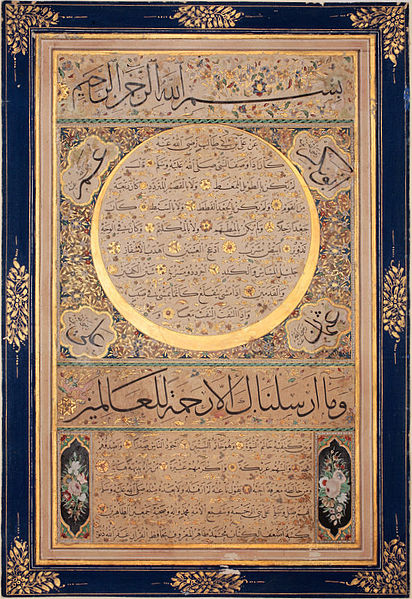
Muhammad is sent “as a mercy”, and thus whatever representation of the Prophet, his words and deeds serves to carry human thought towards the divine participates in that divine mercy, whereas whatever representation scorns that mercy or merely distracts us from it is to be avoided.

The normative manner in which the Prophet is represented within Islam, then, is abstract and calligraphic, with the artist showing devotion and respect for the Prophet through the care with which the work itself is endowed with beauty:
412px-Hilye-i_serif_7

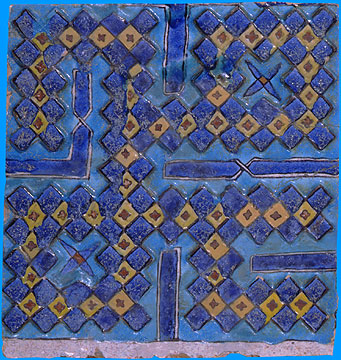
Simpler, and in its own way no less beautiful, is this calligraphic representation of the Prophet’s name in tile from Samarkand:
Muhammad_calligraphy_tile

**

Icon or idol?

One facet of the controversy over Charlie Hebdo has to do, then, with a deep issue in representation, which crops up elsewhere in the jihadists’ relish in destroying “idols” — the Bamiyan Buddhas, yes, but also the tombs of Muslim prophets and saints; there has even been discussion within Saudi circles of the destruction on the Prophet’s tomb and relocation of his remains to an anonymous grave.

Within Christianity, there have been those who encouraged the painting of icons, believing that they carry the minds and hearts of believers deep into the mysteries of faith — and those who would tear them down, holding them to be “graven images” (via Judaism, Exodus 20.4) that give mind and heart a resting place far short of those same mysteries: iconodules and iconoclasts.

Wars have been fought in Christendom too over such questions [in both East and West].

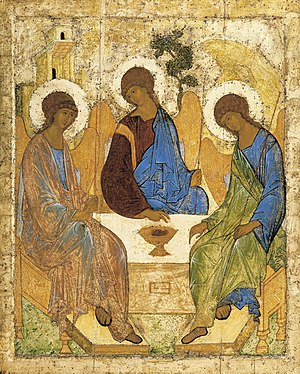
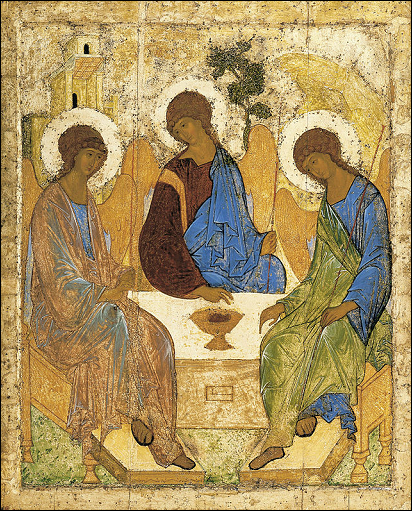
The great Russian iconographer Andrei Rublev‘s most celebrated icon is often referred to as The Trinity — though literally (or should I say, figuratively) speaking, it portrays the three angels who visited Abraham at the Oak of Mamre (Genesis 18. 1-15):
Rublev Trinity icon

It is significant for our context that Rublev has not in fact attempted to portray the Trinity, a mystery deemed beyond human comprehension — the Athanasian Creed, speaking of the Three Persons in one God says explicitly “there are not three incomprehensibles .. but one incomprehensible” — but these three angels, considered as “types” or foreshadowings of the Trinity, which can therefore both veil and represent it.


Paris, AQ and IS

Friday, January 9th, 2015

[ by Charles Cameron — just noting the apparent blurring of a significant distinction, although it’s still early to draw conclusions ]
.

Raffaello Pantucci tweets:

French TV interviewed Cherif Kouachi who states clearly I was directed by AQAP and funded by Awlaki. Same French TV channel spoke to Coulibaly who they say told them he was linked to ISIS. And Coulibaly claims that the brothers and himself were coordinated.

Here’s the video (in French) that Pantucci linked to:

Paris, a DoubleQuote in cartoon form

Friday, January 9th, 2015

[ by Charles Cameron — in partial reply to Jeff Sharlet ]
.

I’m not a great lover of cartoons as a form, to be honest, all too often there’s exaggeration for malicious effect in the genre, which isn’t my way of doing things — but this DoubleQuote in cartoon form struck me as apposite for the insight it brings — that our media are under siege by those who would bully them into silence, not in two isolated ways, but in two ways that together constitute a sort of wave-front.

One “leading indicator” — one unconnected “dot” — leads nowhere. Two indicators — two dots — give us a possible connection, a pattern to be alert for.

Or in this case, against.

Paris, in a DoubleTweet with Nigeria

Friday, January 9th, 2015

[ by Charles Cameron — what’s the value of a human life in tweets, in column inches, in my attention span? ]
.

I really don’t have much to say — I’ve lived a year in Paris, have never been to Nigeria, am human.

**

I was in Managua shortly after the 1972 earthquake there, driving past block after block of city rubble with yellow flags indicating the locations of bodies buried too deep to be recovered. My Pentax served to dilute and capture my emotions then, as my DoubleTweet and other formalisms do now with these mind-numbing horrors piled on horrors.

Paris: reminders

Thursday, January 8th, 2015

[ by Charles Cameron — personally, i’d rather grieve than hate ]
.

You can’t dull one mass of senseless pain with another, they don’t cancel out, nor are they additive — but FWIW:

**

The last serious European Christian violence in response to perceived blasphemy that I recall was the rioting surrounding the release of Scorsese’s The Last Temptation of Christ in 1988. I would have been 45 or thereabouts, and was friends with Scorsese‘s friend, the late film-maker Michael Henry Wilson, who was involved with the publicity for the film, and I remember the tension in the air as I obtained my tickets for an LA pre-screening.

In an earlier post, Of films, riots and hatred III: Scorsese and Verhoeven, I quoted The Encyclopedia of Religion and Film:

Overseas, at the September 28 opening in Paris, demonstrators who had gathered for a prayer vigil threw tear gas canisters at the theater’s entrance. Catholic clergy led rock-throwing and fire-bombing assaults on theaters in many French municipalities. A thousand rioters in Athens trashed the Opera cinema, ripping apart the screen and destroying the projection equipment.

and Wikipedia:

On October 22, 1988, a French Christian fundamentalist group launched Molotov cocktails inside the Parisian Saint Michel movie theater while it was showing the film. This attack injured thirteen people, four of whom were severely burned. The Saint Michel theater was heavily damaged, and reopened 3 years later after restoration. Following the attack, a representative of the film’s distributor, United International Pictures, said, “The opponents of the film have largely won. They have massacred the film’s success, and they have scared the public.” Jack Lang, France’s Minister of Culture, went to the St.-Michel theater after the fire, and said, “Freedom of speech is threatened, and we must not be intimidated by such acts.”

In the case of Last Temptation there was a potential for fatal violence, but no death. Today’s massacre at Charlie Hebdo was less spontaneous, more concentrated, carefully planned and executed, and deadly.


Switch to our mobile site