zenpundit.com » france

Archive for the ‘france’ Category

Twitter mixology

Friday, August 23rd, 2013

[ by Charles Cameron — bemused by all you young people ]
.

Kim Kierkegaardashian is exactly the right amount of Kardashian for me to allow into my life. It’s a twitterstream consisting entirely of combination authentic Kardashian soundbites and Kierkegaard quotes, and it’s usually hilarious.

JM Berger‘s tweet, by contrast, sets out one version of an aesthetic principle which seems to underlie much of today’s culture: mixing pop-reference in with serious culture, for serio-popular effect.

Bashar al-Assad‘s supporters do this, aligning their man with Buffy the Vampire Slayer. Salafi jihadists likewise, borrowing footage from the Lord of the Rings. Dan Drezner does it — using zombies to discuss international politics — and wins an Association of American Publishers honorable mention for the 2011 PROSE Award in Government & Politics. Kim Kierkegaardashian does nothing else…

**

Has this sort of hi-lo-brow mixing always happened?

L’homme armé was a French pop song from the 14th or 15th century, its melody used as the basis for Masses by composers from Dufay and Okeghem to Palestrina — and thence to Peter Maxwell Davies in our own times:

The man, the man, the armed man,
The armed man
The armed man should be feared, should be feared.
Everywhere it has been proclaimed
That each man shall arm himself
With a coat of iron mail.

It must be noted that some believe the “armed man” in question is the Archangel Michael. His fight, unlike Kierkegaardashian’s, is neither with God nor man, but directly with the Devil.

**

DoubleQuotes Sources:

  • Kim Kierkegaardashian
  • JM Berger
  • D-DAY, June 6, 1944

    Thursday, June 6th, 2013

    “Soldiers, Sailors and Airmen of the Allied Expeditionary Force! You are about to embark upon a great crusade, toward which we have striven these many months. The eyes of the world are upon you. The hopes and prayers of liberty loving people everywhere march with you. In company with our brave Allies and brothers in arms on other fronts, you will bring about the destruction of the German war machine, the elimination of Nazi tyranny over the oppressed peoples of Europe, and security for ourselves in a free world.

    Your task will not be an easy one. Your enemy is well trained, well equipped and battle hardened, he will fight savagely.

    But this is the year 1944! Much has happened since the Nazi triumphs of 1940-41. The United Nations have inflicted upon the Germans great defeats, in open battle, man to man. Our air offensive has seriously reduced their strength in the air and their capacity to wage war on the ground. Our home fronts have given us an overwhelming superiority in weapons and munitions of war, and placed at our disposal great reserves of trained fighting men. The tide has turned! The free men of the world are marching together to victory!

    I have full confidence in your courage, devotion to duty and skill in battle. We will accept nothing less than full victory!

    Good Luck! And let us all beseech the blessings of Almighty God upon this great and noble undertaking.

    — Gen. Dwight D. Eisenhower “

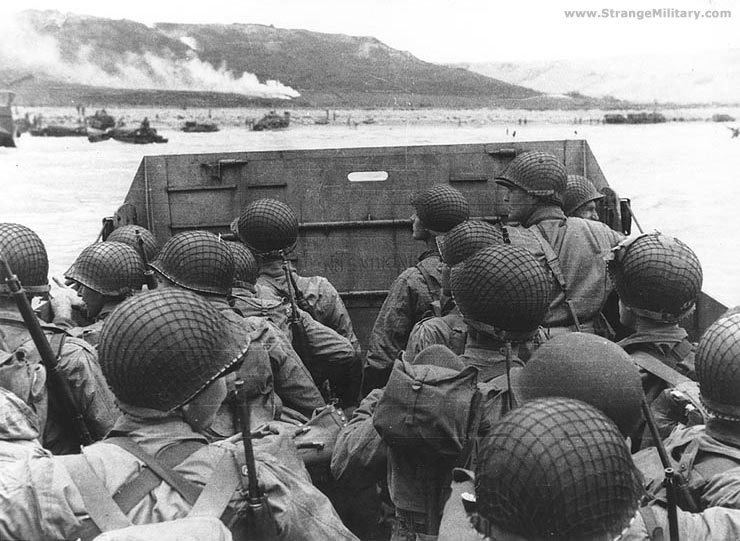
    Sixty-nine years ago over 9,000 American men, some hardly older than boys, laid down their lives on the beaches of Normandy in the greatest military operation in the history of the world. The white crosses stand row upon row in Colleville-sur-Mer,  in silent testimony of their supreme sacrifice.

    Others who scrambled ashore on bloody Omaha Beach, or who climbed the rocky cliffs of Pointe du Hoc or who parachuted behind enemy lines with the 82nd and 101st Airborne lived to fight their away across France and across the Rhine into the heartland of Germany to break the power of the Third Reich forever. Others who survived the terrible ordeal of D-Day and fought on were not so lucky and did not come home.

    The median age of WWII veterans now stands at 92. The “Greatest Generation” is receding into history in increasing numbers with each passing year but their deeds are destined to become legend.

    ….The men of Normandy had faith that what they were doing was right, faith that they fought for all humanity, faith that a just God would grant them mercy on this beachhead, or on the next. It was the deep knowledge – and pray God we have not lost it – that there is a profound moral difference between the use of force for liberation and the use of force for conquest. You were here to liberate, not to conquer, and so you and those others did not doubt your cause. And you were right not to doubt.

    You all knew that some things are worth dying for. One’s country is worth dying for, and democracy is worth dying for, because it’s the most deeply honorable form of government ever devised by man. All of you loved liberty. All of you were willing to fight tyranny, and you knew the people of your countries were behind you.

    The Americans who fought here that morning knew word of the invasion was spreading through the darkness back home. They fought – or felt in their hearts, though they couldn’t know in fact, that in Georgia they were filling the churches at 4:00 am. In Kansas they were kneeling on their porches and praying. And in Philadelphia they were ringing the Liberty Bell.

    Something else helped the men of D-day; their rock-hard belief that Providence would have a great hand in the events that would unfold here; that God was an ally in this great cause. And so, the night before the invasion, when Colonel Wolverton asked his parachute troops to kneel with him in prayer, he told them: “Do not bow your heads, but look up so you can see God and ask His blessing in what we’re about to do.” Also, that night, General Matthew Ridgway on his cot, listening in the darkness for the promise God made to Joshua: “I will not fail thee nor forsake thee.”

    …..Here, in this place where the West held together, let us make a vow to our dead. Let us show them by our actions that we understand what they died for. Let our actions say to them the words for which Matthew Ridgway listened: “I will not fail thee nor forsake thee.”

    Strengthened by their courage and heartened by their value [valor] and borne by their memory, let us continue to stand for the ideals for which they lived and died.

    Thank you very much, and God bless you all. ”

    – Ronald Wilson Reagan, President of the United States, June 6, 1984

    The possible unexpected consequences of intervention

    Thursday, January 24th, 2013

    [ by Charles Cameron — wondering whether it can ever be possible to expect the unexpected, and if so, what exactly that might mean? Libya & Mali ]
    .


    .

    Alex Thurston at Sahel Blog: Covering Politics and Religion in the Sahel and the Horn of Africa posted Libya and Mali, Part I today. The topic is one I am not qualified to comment on, although I’m trying to learn from those (such as AT) who are — but this sentence caught my eye and got me writing:

    A failure to soberly consider the possible unexpected consequences of intervention and transition has helped chaos to develop in post-Qadhafi Libya.

    I wonder if that’s a koan?

    **

    Is it ever possible to “soberly consider the possible unexpected consequences” of anything? Consider Donald Rumsfeld‘s remark:

    There are known knowns. These are things we know that we know. There are known unknowns. That is to say, there are things that we know we don’t know. But there are also unknown unknowns. There are things we don’t know we don’t know.

    Throw in the missing fourth category, supplied by somebody for Wikipedia:

    Moreover, one may criticize Rumsfeld statement for omitting the most dangerous type of unknown: the “unknown known”. That is, as Mark Twain famously expressed it, “It ain’t what you don’t know that gets you into trouble. It’s what you think you know that just ain’t so”. Indeed, Rumsfeld was really discussing an “unknown known” which provided faulty justification for the war — members of the Bush administration claimed that the Iraqi government possessed weapons of mass destruction (see Rationale_for_the_Iraq_War), but it just wasn’t so.

    **

    Now allow for what you might call informed guess-work, what CS Peirce called abduction — I’m just now introducing my elder son to Eco & Sebeok‘s magnificent book, The Sign of Three: Dupin, Holmes, Peirce — and “non-predictive” attempts to lay out a spread of possible outcomes by means of scenario-planning, as Tom Barnett wrote in his Year 2000 International Security Dimension Project Final Report:

    By “decision scenario approach,” we mean using credible scenarios to create awareness among relevant decision-makers regarding the sort of strategic issues and choices they are likely to face if the more stressing pathways envisioned come to pass.

    and:

    Again, none of our material here is meant to be predictive in the sense of providing a step-by-step “cookbook” approach to Y2K and Millennial Date Change crisis management. Our fundamental goal in collecting and synthesizing this analysis is to avoid any situation where US military decision makers and/or operational commanders would find themselves in seemingly uncharted territory and declare, “I had no idea . . ..”

    We (myself at times included) seem to be busily employed making non-predictive predictions.

    **

    Black swansNassim Nicholas Taleb may have been the one who most recently crept up behind us and clapped loudly to alert us to the unexpected, but Stéphane Mallarmé was there first in 1897 with the great graphical poem Un coup de dés jamais n’abolira le hasard, featured in the lower image of the pair at the top of this post.

    My own “zen telegram” version, for those who neither know the poem nor read French:

    A ROLL OF THE DICE

    NEVER

    not even when tossed sub specie aeternitatis from the depth of a shipwreck

    WILL NEVER EVER ABOLISH

    CHANCE

    — now there’s a koan for our times — and always.

    **

    Listen to the poets…

    Hear the voice of the Bard!
    Who Present, Past, & Future, sees;
    Whose ears have heard
    The Holy Word
    That walk’d among the ancient trees…

    **

    Sources and links:

  • Un Coup de Dés Jamais N’Abolira Le Hasard from Wikipedia
  • le début de la typographie moderne by Étienne Mineur with page images
  • Un coup de dés, French original and English translation, by AS Kline
  • See that voice of the Bard, William Blake
  • Bouleversé by forgiveness

    Tuesday, January 8th, 2013

    [ by Charles Cameron — not just “thinking outside the box” — how about upending the whole thing and seeing what shakes out? ]
    .

    FWIW, this isn't the world, nor is it upside down -- it's just a rather different map, eh?

    .

    A celebrated stanza by the Indian poet-saint Kabir — beloved of both Hindus and Muslims — asks:

    Is there any guru in the world wise enough
    to understand the upside-down Veda?

    There’s a style of poetry used by Kabir and others to describe experience of the divine called “ulatbamsi” or the “upside down language” — and Linda Hess, Kabir’s great translator, writes of it as a language “of paradoxes and enigmas” — not too dissimilar, perhaps, to the koans or meditation paradoxes often encountered in zen training.

    **

    Boom! The French have the word “bouleversé” to cover the way we feel when suddenly our whole world seems turned upside down.

    Maybe it’s a modern idea? Bob Dylan, I’m delighted to say, no longer belongs to Robert Zimmerman except for purposes of copyright — his songs have entered the cultural bloodstream. Here’s his version:

    The battle outside ragin’
    Will soon shake your windows
    And rattle your walls
    For the times they are a-changin’

    The world often seems upside down, our values are often quite the reverse of what they might be if we had the kind of clarity that is implied in Samuel Johnson‘s celebrated quote:

    Depend upon it, sir, when a man knows he is to be hanged in a fortnight, it concentrates his mind wonderfully.

    And then there are those great ones for whom our world is manifestly unjust, manifestly topsy-turvy — or “through the looking-glass”, if you prefer.

    I mean, what else can being “in the world, but not of it” be all about, if it’s not about a major shift in perspective?

    **

    I’m writing about this at such length because I just read one of those paragraphs that turns my own world upside down. It came in the middle of a long piece on “restorative justice” and it focuses on the power of forgiveness.

    This particular paragraph describes how an Indian-American woman, Sujatha Baliga, came to see the unexpected power of forgiveness, and for her it occurred in a Buddhist context — but the power itself is beyond the boundaries of specific religions:

    Baliga had been in therapy in New York, but while in India she had what she calls “a total breakdown.” She remembers thinking, Oh, my God, I’ve got to fix myself before I start law school. She decided to take a train to Dharamsala, the Himalayan city that is home to a large Tibetan exile community. There she heard Tibetans recount “horrific stories of losing their loved ones as they were trying to escape the invading Chinese Army,” she told me. “Women getting raped, children made to kill their parents — unbelievably awful stuff. And I would ask them, ‘How are you even standing, let alone smiling?’ And everybody would say, ‘Forgiveness.’ And they’re like, ‘What are you so angry about?’ And I told them, and they’d say, ‘That’s actually pretty crazy.’ ”

    **

    I like the dark blue “sky” and the “clouds” at the top of the map I began this post with — but then, I’m a mostly vertical human who seldom stands on his head, so it looks “natural” to me. But that’s simply a matter of my point of view.

    I imagine maps like that one must please our friends “down under”.

    **

    A hat-tip to Hadar Aviram, whose California Corrections blog first pointed me to the article about Sujatha Baliga.

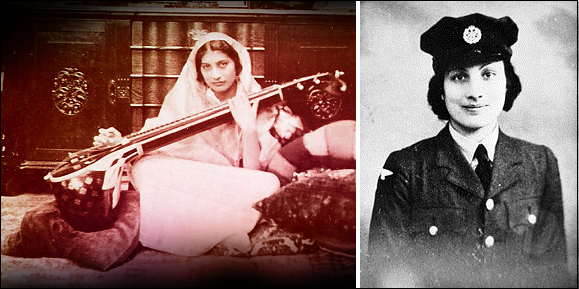
    Noor Inayat Khan, GC

    Saturday, November 10th, 2012

    [ by Charles Cameron — east, west, music, espionage, pacifism, war, the Resistance, the Nazis, Dachau, and exceptional gallantry ]
    .

    A Muslim woman — born in Moscow of princely Indian paternal descent, her mother an American from Albuquerque, her father a great North Indian classical musician and Sufi master of pacifist leanings…
    .


    .

    Noor Inayat Khan was a student of Western classical music in pre-War Paris under the great Nadia Boulanger, escaped the oncoming Nazis and made it across the channel to England, where she told a British officer during a recruitment interview that she would indeed support Indian independence from Britain after the war — but that defeating Hitler took precedence and she would gladly fight for the British…

    She thus became the first female radio operator sent by the British Special Operations Executive into Nazi-occupied France, where she worked courageously as a vital link between the French Resistance and Churchill‘s London until she was finally betrayed, imprisoned, and finally executed by firing squad in Dachau.

    After the war, the British awarded her the highest civilian award for bravery, the George Cross, and France the Croix de Guerre.

    **

    Yesterday’s Guardian reports:

    On Thursday afternoon, in a corner of Bloomsbury, Princess Anne unveiled Britain’s first memorial to an Asian woman. The bust is of Noor Inayat Khan, a woman who was a pioneer in so many things: an Indian princess who was also a gifted harpist; a Sufi who wrote Buddhist fables for children; an anti-imperialist who spied for the British empire – and the first female radio operator sent into Nazi-occupied France.

    Her Twenty Jataka Tales is available here.
    Shrabani Basu‘s biography of Noor Inayat Khan is here.

    I raise a virtual toast to Noor Inayat Khan.

    **

    h/t David Foster at Chicago Boyz.


    Switch to our mobile site