zenpundit.com » france

Archive for the ‘france’ Category

Pity America the Un-Philosophical

Tuesday, March 29th, 2011


I attempted to leave a short amusing response at Foreign Policy.com but was thwarted by their comment system, so I am writing a pedantic post here instead.

Joshua Keating, bursting with admiration for Bernard-Henri Levy, laments the lack of enlightenment of American politicians compared to their much cooler French counterparts:

Libyan intervention: Brought to you by Bernard-Henri Levy?

….I was going to write some kind of quip along the lines of, “Can you imagine President Obama taking phone calls from [American philosopher] in the oval office while he debates whether to send U.S. troops to war,” but I can’t even think of a name for whom that joke would make sense. 

France and Germany have a tradition of publicly engaged philosophers that’s pretty much alien to the United States. The idea of an American BHL or even Jurgen Habermas seems pretty laughable. Economists like Paul Krugman are the go-to public intellectuals here while philosophy has become an increasingly specialized and technical discipline, even within academia. What effect the prominence of philosophers in public life has on a country’s political culture and policies is a pretty promising subject for further research.

Heh. 

Philosophers have never had much of an impact on American public life and the politics of their times except…. maybe…. for William James, Reinhold Neibhur, John Dewey, Leo Strauss, Walter Lippmann, Ayn Rand, Herbert Croly, Sydney Hook, Allan Bloom, James Burnham, John Rawls and Thomas Kuhn. That’s just off of the top of my head. If you want to include economists as philosophers who influenced contemporary American political life – and, frankly, we often should – add Adam Smith, Karl Marx, John Maynard Keynes, Friedrich von Hayek, Ludwig von Mises, John Galbraith and Milton Friedman to the list. It should not need to be said, but America was founded on the ideals of philosophers like John Locke, Baron de Montesquieu and Cicero by men deeply steeped in moral and political philosophy. Some of the founders would have qualified as philosophers themselves.

I don’t know much about Mr. Keating. Pretty sure he is a sharp guy, but I bet he is 35 or younger and was a journalism or polisci grad. Academic philosophy as a profession has been increasingly irrelevant to policy makers or the general public as described, Keating is spot on there, since the early mid-60’s, which is probably the entirety of his life. It was not always this way. Formerly, philosophers wrestled with problems of general interest and were active public intellectuals, the determined self-marginalization of today’s professional philosophers notwithstanding.

It is a symptom of intellectual decline but the problem Keating identifies is not in American society or even in American politicians but in the philosophers.
DQ Egypt: impact on Israel

Wednesday, February 2nd, 2011

[ by Charles Cameron [hoping Zen’s ISP will be back up shortly] — cross-posted from ChicagoBoyz ]

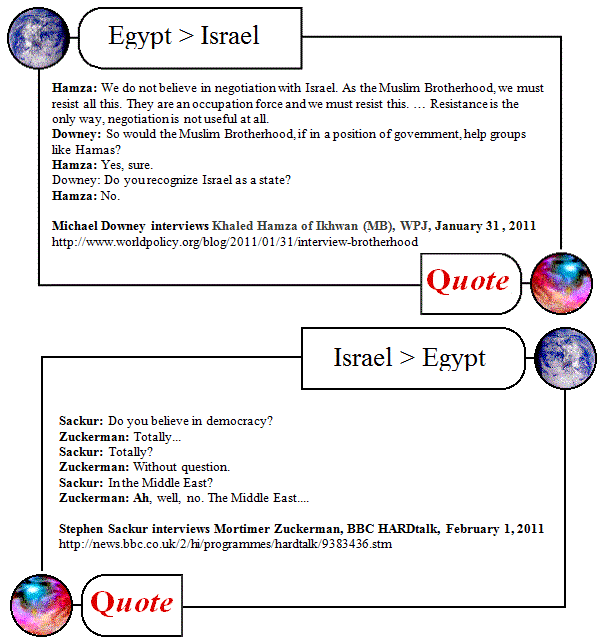
Someone posted an excerpt from an interview with Khaled Hamza, the webmaster of the Muslim Brotherhood, as a comment on an earlier post of mine on ChicagoBoyz, where I also blog, and I was interested enough to track the original interview down, and have presented the key points of the excerpt here in Quote #1.

I am pairing it, in Quote #2, with an excerpt from an interview the BBC recently conducted with Mortimer Zuckerman – because I find the two quotes taken together suggest something of the complexity of the breaking situation in the Middle East.

*

I’d like to float a trial balloon / try a though experiment, if I might. And since I’m more “tail” than “left” or “right wing”, I’ll be posting this in more than one place, and hope to get comments from all sides…

On the face of it, Zuckeman is applying what’s arguably a racist double-standard. He advocates democracy, “totally” and “without question” – but not for the Egyptians, or at least not today or tomorrow.

On the face of it, the Egyptian public seems distinctly unenthused by Mubarak’s regime and will, in a democratic election, presumably vote in a fair number of Muslim Brotherhood representatives – though it’s by no means clear that they would be in the majority, and their present ideology in any case is closer to the processes of electoral politics than those of violent jihad.

So there is reason for Israel to be concerned, and reason for those who support democracy to see some hope for democracy, in the ongoing events in Egypt.

Let me put it this way: Quote #1 illustrates why Zuckerman might make the remarks quoted in Quote #2, while Quote #2 illuminates why Hamza might make the remarks quoted in Quote #1.

*

And here’s the thought experiment — I’d like to come at this from a Maslovian angle.

Maslow’s Hierarchy of Needs

I’d like to suggest that “democracy” is an ideal, or to get away from that word with its somewhat ambiguous political connotations, an activity of the “the better angels of our nature” – and thus, from a Maslovian perspective, an aspect of a group or nation’s “self-actualization” level of interest, whereas “stability” would fall under “safety” or even “physiological”.

If that’s right, Zuckerman is at least arguably articulating a “stability first, eventual democracy would be ideal” position.

Does that “Maslovian” formulation throw any additional light on the situation?

*

The problem with the position I just described is nicely articulated by Mohammad Fadel at the very end of a Foreign Policy post, Can Black Swans lead to a sustainable Arab-Israeli peace? — and it’s only his conclusion I’m quoting here:

Tunisia and Egypt have demonstrated categorically that any peace which relies on the stability of police states is doomed from the outset.

If a butterfly flapping its wings in Brazil can in theory cause a tornado in Texas – heaven alone knows what someone blinking in Cairo or Jerusalem or Washington can do.

Myself, I pray for empathy, which seems a reasonable request, I hope for wisdom, which seems a great deal more chancy — and I long for peace.

In the current environment of hatred and mistrust, that seems entirely beyond the capacity of anyone’s present thinking to achieve.

Vive la France!

Thursday, December 31st, 2009

The French equivalent of the Supreme Court reveals the extent to which global warming alarmism was always intended as a justification for a sophisticated tax-farming rip-off of normal people by oligarchical elites:

….The tax, which would have started on Jan. 1, was set at 17 euros ($24.38) per ton of carbon-dioxide emissions, President Nicolas Sarkozy said in September. To make the tax more palatable, he partially or fully exempted power plants, public transport, airlines, farming and fishing, as well as 1,018 older cement, steel and glass factories.

In all, 93 percent of all industrial carbon emissions in France would have avoided paying the full tax, the constitutional court said in a decision published on its Web site. The tax would have fallen disproportionately on fuel for heating and cars, it said.

Emphasis mine. 

Jesus, 93 %? Was anybody with connections paying the tax?  Warmer, colder, who cares?  Just so long as widows, hotel maids and slum dwellers are paying through the nose in carbon taxes while Total S.A. skates! That is to say, the burden is on the ignorant peasantry who did not go to Ecole Nationale d’Administration.

Or on our side of the pond, Harvard.

ADDENDUM:

Science Daily No Rise of Atmospheric Carbon Dioxide Fraction in Past 160 Years, New Research Finds

Saturday, February 3rd, 2007

THE LOST WORLD OF THE ANGLO-SAXONS

Lexington Green has an interesting post “Do we really owe it all to the geography of the Norwegian fjords?” at Chicago Boyz that traces the culture of Anglo-American notions of political liberty to the nuclear families of the Norwegian fjords:

Here is a whole corpus of writing about which I knew nothing. I have in the meantime obtained a copy of the translation of the Demolins book, Anglo-Saxon Superiority, To What is it Due? (1907). The beginning of it is a summary of the writing of M. de Tourville, which discusses how the Saxons came to dominate all the other invaders, Angles, Danes, Normans, because of their cultural practices, particularly nuclear families, which Tourville calls “particularist” social structure. The Saxons generated a unique type of state apparatus as a result, operating large states on a federal-type basis. For example, note this passage:

We know how, under Egbert, the Heptarchy fell under the domination of the Saxons. But the latter did not give the Angles a Saxon government, nor did they foist Saxon officials on them, for the good reason that their political development was most limited, their strength lying more in private than in public life. They never dreamt of administering conquered peoples in the fashion adopted by the Romans, and later by the Spaniards and the French. Their idea was rather — and has remained — a Federation. Thus were started by the Saxons that former United States of England. So little did they aim at constituting the model of a large empire, that their king continued to call himself simply ‘King of the Saxons of the West’. Yet he was sovereign over the whole island.

Remarkable if true. We see the Saxons at the earliest possible date showing the genius for distributed power and federal arrangements that we in the Anglosphere still have today. Unfortunately, the Demolins book, which I am halfway through, is more focused on reform in France a century ago, with the English case only as a background
.”

Very intriguing. At the time the Demolins book was published, the troubled Third Republic was deeply split politically, socially and culturally. There was, to an extent, in France, a sense of anxiety over the might of the “Anglo-Saxon powers”, rising America and reigning Great Britain and paranoia about the aforementioned power’s distant Teutonic cousins in Wilhelmine Germany. On the other hand, admiration for British political institutions was not unusual among French intellectuals prior to the 20th century – Montesquieu and Voltaire being the most famous examples of that tradition.


Switch to our mobile site