zenpundit.com » Afghanistan

Archive for the ‘Afghanistan’ Category

Recruitment, poetry and tears

Thursday, January 31st, 2013

[ by Charles Cameron — Hegghammer on testing and trusting as precursors to AQ recuitment ]
.

I’ve been having trouble finding any of the anasheed Ibn Siqilli was posting on his site, many of which have been taken down — but this one, found in a comment of his on Leah Farrall‘s site, has somehow survived:

Craftsmanship in search of emotion, in service to the jihad.

Thomas Hegghammer has a fascinating article out titled The recruiter’s dilemma: Signalling and rebel recruitment tactics from which I’ll only tease you with the bits of special interest to me, viz those that speak to religion (roughly, scripture and ritual), and culture (narrative, music and poetry).

**

First, matters clearly involving religious piety and its expressions:

At the same time, personal piety at the time of recruitment was certainly a necessary condition for joining. Failure to observe any of the basic rituals or engaging in sinful behaviour – by skipping prayers, smoking, or watching Hollywood films – would have constituted a very negative sign. Moreover, even at the far end of the piety spectrum there were small signs that distinguished the extremely pious from the very pious. These signs were not in material objects such as clothes, but rather in body language and habits. QAP martyrdom biographies would highlight the piety of some but not of others, which suggests some variation. Judging from texts and videos, the behaviours that were appreciated included reading the Qur’an at every available spare moment, weeping while reciting the Qur’an, frequent minor pilgrimages (umra) to Mecca, efforts to acquire religious knowledge, etc. However, to observe these signs, recruiters needed to already be in direct contact with the recruit.

Piety, however, was not enough. Recruiters would also need to see signs of ideological commitment of a more political nature, in particular approval of violent activism.

Particularly interesting to me here is the sentence, These signs were not in material objects such as clothes, but rather in body language and habits.

**

And then, culture…

To find out whether a person had really been abroad for jihad, recruiters would solicit signs of jihad experience, either by engaging the recruit in conversation, or if in a larger group, steer the conversation toward the topic of foreign jihad fronts. They would presumably look for displays of three types of knowledge, the combination of which would be very hard to acquire for a person who had not been to any of the major battlefronts.

The first was knowledge of people, places and events specific to the conflict in which the recruit claimed to have taken part. [ more … ]

The second type of distinctive knowledge was weapons expertise. [ more … ]

The third type was familiarity with ‘jihad culture’, a set of peculiar practices and artistic expressions that emerged in the Arab Afghan community in the 1980s and developed in subsequent jihad fronts. One important component was anashid, battle hymns sung a capella during training and socializing. A similar component was poetry. Arab fighters in Afghanistan, Bosnia and Chechnya would continuously compose new poems and recite them in the camps. Veterans would be familiar with at least part of this material and would share it during social gatherings in the kingdom. Yet another aspect of jihad culture was the telling of war stories from the time of the Prophet Muhammad and his immediate successors. While some of these stories were part of the basic religious education of most Saudis, it required extra effort to learn many or all of them, and to be able to cite them verbatim, as custom required. In the training camps and the trenches, such stories were told all the time (Nasiri, 2006), so jihad veterans typically knew many more such stories than the average Saudi.

Of course, non-veterans could acquire some of this knowledge if they wanted to, but to mimic jihad experience, impostors would need to emit large and consistent clusters of correct signs – a considerable challenge.

I’m reminded of Abdullah Azzam‘s book The signs of Ar-Rahmaan in the Jihad of Afghanistan, which I quoted in an earlier post Of war and miracle: the poetics, spirituality and narratives of jihad.

**

Here’s how bad we are at learning the local mores of the various war zones we keep dropping in on, in the words of FPRI’s Adam Garfinkle, in Mali: Understanding the Chessboard, posted recently:

As the article says, when the Tuareg rebellion in Mali gained steam after the denouement of the Libya caper, greatly stimulated by the return of heavily armed Tuareg brethren from that fight, these three Tuareg commanders defected to the rebels, bringing soldiers, vehicles, ammunition and more to the anti-government side. Anyone who was surprised by this is at the very least a terminal ignoramus. And anyone in the U.S. military who failed to understand the ethnic composition of the country’s politico-military cleavages, such that he let U.S. Special Forces training be lavished on Tuareg commanders, was clearly insufficiently trained to do his job. And believe me, that’s about as nice a way to put that as I can summon.

How do things like this (still) happen, after what we should have learned from years of dealing with Iraqis and Afghans and others on their home turf? I happen to know someone who teaches in the U.S. military education system, and this person happens to be a field-experienced Harvard Ph.D. in anthropology. This person tries very hard to clear away the thick fog created by the innocent Enlightenment universalism that pervades the American mind—the toxic fog that tries to convince us that all people, everywhere, are basically the same, have the same value hierarchies, the same habits of moral and tactical judgment, and mean the same things by roughly comparable translated words.

Now imagine how good we’d be at infiltration, getting the anasheed, poetry and stories right…
Mourning the loss of Monte Cassino

Friday, January 18th, 2013

[ by Charles Cameron — destruction of sacred spaces ]
.

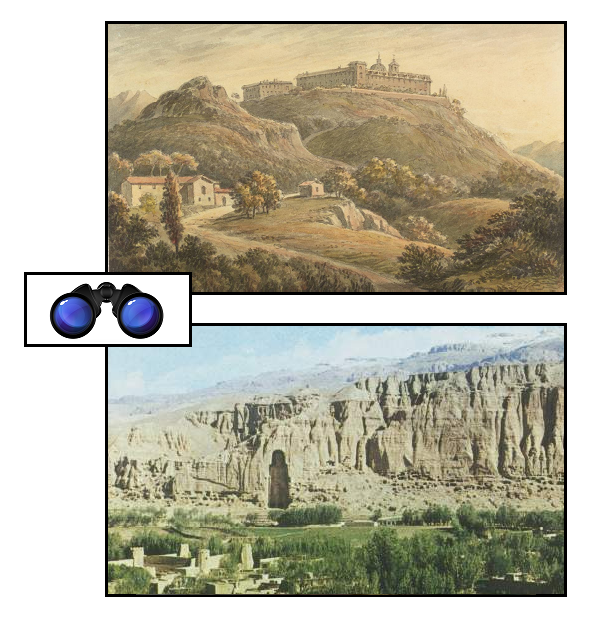
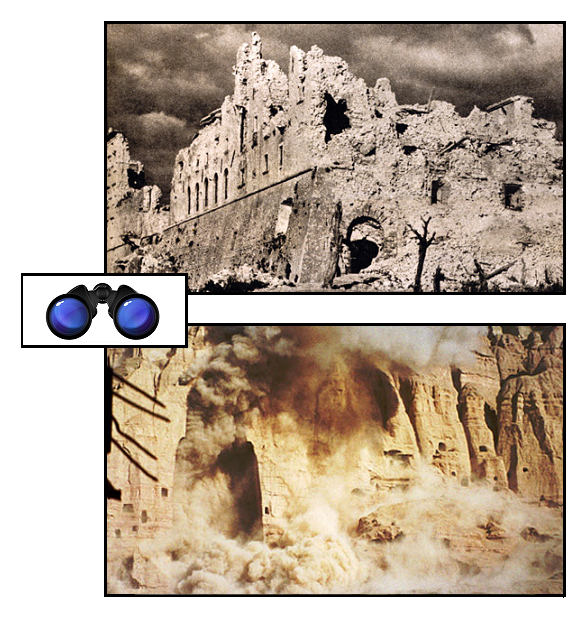
Do we grieve the destruction of the Abbey of Monte Cassino as we grieve the destruction of the Bamiyan Buddhas?

**

With playful and appropriate scholarly tongue-in-cheek, Umberto Eco describes the importance of monasteries — and of the Benedictine Order specifically — in preserving culture, literacy, the arts and sciences through dark ages in his novel, The Name of the Rose:

“Monasterium sine libris,” the abbot recited, pensively, “est sicut civitas sine opibus, castrum sine numeris, coquina sine suppellectili, mensa sine cibis, hortus sine herbis, pratum sine floribus, arbor sine foliis. … And our order, growing up under the double command of work and prayer, was light to the whole known world, depository of knowledge, salvation of an ancient learning that threatened to disappear in fires, sacks, earthquakes, forge of new writing and increase of the ancient. … Mundus senescit. If God has now given our order a mission, it is to oppose this race to the abyss, by preserving, repeating, and defending the treasure of wisdom our fathers entrusted to us.

Monte Cassino is the spiritual home of the Benedictine monastic order. It was here that Saint Benedict of Subiaco built a retreat in 529 CE, here that he wrote his Regula Monachorum or monastic Rule, the central text of western monasticism, and though the monastery had been previously sacked by the Lombards in 585, the Saracens in 884, and the Normans in 1046, it was devastated anew during the Battle of Monte Cassino 1944, an American artillery commander telling his men:

I don’t give a damn about the monastery. I have Catholic gunners in this battery and they’ve already asked me for permission to fire on it…

Harold Bond, in his book Return to Cassino A Memoir of the Fight for Rome, describes the scene as 256 American heavy bombers began dropping 576 tons of munitions on the abbey in waves, in words echoes by the video below:

There was no anti-aircraft fire from the Germans, either, just the drone of the big planes. They were very close now, and the first formation flew in over the abbey, releasing the bombs. We could see them fall, looking at this distance like little black stones, and then the ground all around us shook with gigantic shocks as they exploded. Another formation flew in, and then another, each followed by thunderous detonations. Now where the abbey had been there was only a huge cloud of smoke and dust which concealed the entire hilltop.

**

The bombing appears to have been authorized on the basis of a mistranslation. An intelligence intercept of the question “Ist Abt in Kloster?” — “is the Abbot in the Monastery” — was translated by the US as though Abt was short for Abteil, “Is the HQ in the Abbey?” The recorder answer “Ja” then led to the bombing.

Three days after the bombing, the Abbot was interviewed in person by the commander of XIV Panzer Corps, himself a lay brother of the Benedictine order, and reported:

Until the moment of the destruction of the Monte Cassino abbey there was within the area … neither a German soldier, nor any German weapon, nor any German military installation.

Thankfully, the abbey was restored and reconsecrated in 1964 by Pope Paul VI and remains to this day the mother house of the Order of St. Benedict.

**

I hope to review relevant portions of Peter Caddick-AdamsMonte Cassino: Ten Armies in Hell, available in the UK and due to be released in the US in April 2013, later this year. A review copy has been my source for details of the Battle of Monte Cassino described above.

Image sources, upper pair:

Destruction of the taller Bamiyan Buddha, CNN via Wikipedia
Montecassion destroyed, from Monte Cassino Tour

Image sources, lower pair:

Bamiyan Buddhas, from Random Walks
Monte Cassino by John `Warwick’ Smith, from the Tate

A recurrent fashion in explosive headgear?

Thursday, December 6th, 2012

[ by Charles Cameron — two Taliban “peace” envoys who blow themselves up, and two bombs in two turbans ]
.

I didn’t catch this at the time, but there’s a curious echo of the most celebrated of the Jyllands-Posten cartoons

in the killing of Burhanuddin Rabbani, head of the Afghan High Peace Council.

I picked up on this detail today because I was checking back on Rabbani’s killing in light of today’s assassination attempt on Asadullah Khalid, head of the Afghan National Directorate of Security by a “Taliban suicide bomber posing as a peace envoy” — the same MO used in the Rabbani assassination.

Taliban “peace envoys” intent on destroying their partners in negotiation — that’s one recurrent pattern here.

**

And the other…

Is it just that there are only so many pieces of clothing in which a bomb can be hidden, and a turban is one of them — or is there some deliberate irony at work here, taking the cartoon’s metaphorical bomb, making it real and pointing it back ?

Parallelisms are always worth a little extra consideration.

Ashura: the Passion of Husayn

Sunday, November 25th, 2012

[ by Charles Cameron — today’s solemn commemorations in Iraq, Afghanistan, Pakistan and India in comparative religious perspective ]
.

I was listening to Mozart‘s Requiem last night, and it is rich in grief shot through with glory. That’s the thing about mourning celebrations in which death is accompanied by the “sure and certain hope of the Resurrection into eternal life”.

One such observance is found in Shia Islam, and falls this year on the 25th of November — today. It is the day of Ashura, the 10th day of Muharram in the Islamic calendar, and its epicenter is at Karbala in Iraq. As the saying goes:

Every day is Ashura and every land is Karbala.

For the Shia, Ashura commemorates the martyrdom of Husayn, grandson of the Prophet, at the Battle of Karbala, when he refused to give allegiance to the Umayyad caliph Yazid. Husayn’s martyrdom is dramatized in Ta’zieh, passion plays, giving us a hint that the martyrdom of Husayn at Ashura figures in the devotional life of the Shia much as the passion and death of Christ figures within Christianity, both in passion plays such as that at Oberammergau and in Catholic rituals such as the Stations of the Cross. This may seem a far-fetched analogy to some of my readers, but both deaths are viewed as redemptive. As another saying has it:

A single tear shed for Husayn washes away a hundred sins.

**

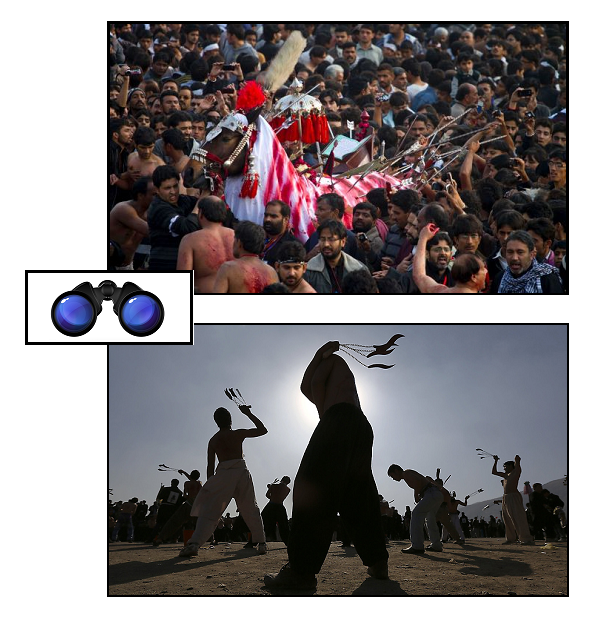
As you can see depicted in the lower panel above, Shiite mourning can include flagellation with chained blades, not something that sits easily with most westerners — yet as Roy Mottahedeh has said (quoted in SA Hayder, Reliving Karbala: Martyrdom in South Asian Memory):

Self-mutilation in emulation of the “passion” of heroes who are human yet divine is no stranger to the West: flagellants who whipped themselves both in penance and in remembrance of the scourging and crucifixion of Jesus appeared in almost every western European country in the Middle Ages…

The upper panel above depicts Husayn’s horse, riderless and bloody, and can perhaps give us some sense of the dark ceremonial beauty of the occasion for those whose grief transcends time and unites them in aspiration with Husayn himself — their flagellation attesting to their wish that they themselves could have stood beside him on that day so long ago, standing for truth against an army of injustice.

**

Their grief may be trans-temporal, but the possibility of dying for their faith persists to this day, for Sunni militants of the jihadist sort view Ashura differently — primarily as a day of fasting first performed by Moses and continued by Muhammad — and detest the breakaway sect of the Shia as rafidun, heretics.

In Iraq, Ashura there has seen millions of pilgrims visiting Karbala this year, with comparatively little violence:

Millions of Shiites flooded the Iraqi shrine city of Karbala on Sunday for the peak of Ashura rituals, which have been largely spared the attacks that struck pilgrims in past years. A bomb wounded 10 pilgrims in Diyala province, north of Baghdad, but it was the first such attack since a car bomb against pilgrims killed three people on November 17.

Farther afield, what the Pakstani police describe as a “major terror plot to attack the Muharram processions in Karachi” was avoided this year when “large amounts of explosive material, two suicide jackets and grenades” were confiscated during a raid, with the Minister for Religious Affairs declaring that the Tehreek-e-Taliban were behind the plots. Elsewhere in Pakistan:

At least five persons were killed and over 70 others injured on Sunday when a Shia procession was targeted with a bomb at Dera Ismail Khan in Pakistan’s restive northwest, the second such attack in the city in as many days.

Meanwhile in Kabul:

For the past week, the Afghan capital has been draped with black cloth arches and festooned with huge colored banners. Mournful, pounding chants pour from loudspeakers across the city, filling the air with slow martial intensity.

The dramatic display is all part of Muharram and the 10-day Shiite festival that commemorates the slaying of Imam Hussein, a 7th-century holy figure and early champion of Islam. But it is also a symbol of the growing religious and political freedom that Afghanistan’s long-ostracized Shiites have had in the past decade.

That’s from a Washington Post piece yesterday titled Afghan’s Shiite minority fears a return to old ostracism — and the next two paragraphs bear out the title:

Now, as Western military forces prepare to leave the country by 2014, Afghan Shiites, most of whom are from the Hazara ethnic minority, fear that their window of opportunity may slam shut again, leaving larger rival ethnic groups as well as Taliban insurgents, who are radical Sunni Muslims, dominating power.

“Everything we have achieved, our ability to come out and participate in society, has been in the shade of the international community and forces,” said Mohammed Alizada, a Hazara Shiite who was elected to parliament in 2009. “We are very concerned that once they leave, the fundamentalists will reemerge, ethnic issues will return, and we will lose what we have gained.”

Tribal politics, sectarian issues, the impending departure of US forces, the Taliban, cross-border alliances — and the sheer power of devotion — all these are intricately intertwined in today’s Afghanistan and its future. We may do well to understand something of the meaning of this day of Ashura, in our own calendar, 25th November 2012.

**

Annemarie Schimmel, the great Harvard scholar of Islamic mysticism, has a fine essay on the poetry of Ashura, encompassing both Sunni and (strongly Shia-influenced) Sufi traditions, Karbala and the Imam Husayn in Persian and Indo-Muslim literature. The mindset is very different from contemporary secular westernism, seeing death itself — and the grief that accompanies it — as a prelude to resurrection, and thus part of the timeless love-play of God with those who love him:

In having his beloved suffer, the divine Beloved seems to show his coquetry, trying and examining their faith and love, and thus even the most cruel manifestations of the battle in which the ‘youthful heroes’, as Shah Latif calls them, are enmeshed, are signs of divine love.

The earth trembles, shakes; the skies are in uproar;
This is not a war, this is the manifestation of Love.

The poet knows that affliction is a special gift for the friends of God, Those who are afflicted most are the prophets, then the saints, then the others in degrees’, and so he continues:

The Friend kills the darlings, the lovers are slain,
For the elect friends He prepares difficulties.
God, the Eternal, without need what He wants, He does.

**

The spirit here is not too far from that of the Greek philosopher Plotinus, who wrote in his Enneads [III.ii.15]:

Men directing their weapons against each other- under doom of death yet neatly lined up to fight as in the pyrrhic sword-dances of their sport- this is enough to tell us that all human intentions are but play, that death is nothing terrible, that to die in a war or in a fight is but to taste a little beforehand what old age has in store, to go away earlier and come back the sooner.

together with that of the early Christian Father, Origen, who wrote [De Martyrio, 39]:

And let each of us remember how many times we have been in danger of an ordinary death, and then let us ask ourselves whether we have not been preserved for something better, for the baptism in blood which washes away our sins and allows us to take our place at the heavenly altar together with all the companions of our warfare.

**

In India, indeed, the martyrdom of Husayn takes on an interfaith character in some places, as Hindus and Christians join Muslims in Ashura commemorations, as Naim Naqvi relates:

One can observe the richness and beauty of the diversity of Indian Culture at the occasion of Muharram. Since the martyrdom of Imam Hussain, Muharram ceremonies are observed all over the world including India. Hindus take part in them with great reverence and devotion. The tragedy of Karbala has become the harbinger for interfaith understanding in the Indian sub-continent. Participation of Hindus in the mourning rituals of Imam Hussain has been a feature of Hinduism for centuries in large parts of India. Hindus, Sikhs, Jains and even Christians observe Muharram. In the city of Varanasi which is the holiest city for Hindus many Hindu families participate in Muharram processions.

Describing the participation of one such Hindu family in Orissa, we read:

District police chief Lalit Das said Padhihary family has been doing this every year for the last 338 years, adding other local Hindu families also participate in the procession.

Muslims said it reflected the perfect harmony between the two communities in the area.

Strategy, Power and Diffusion

Monday, November 19th, 2012

“….and therefore, two kinds of reactions are possible on the defending side, depending whether the attacker is to perish by the sword or by his own exertions.

                                                               – Carl von Clausewitz,  On War

 “Again, if the campaign is protracted, the resources of the State will not be equal to the strain.”

                                                                 – Sun Tzu,  The Art of War 

A recent estimate for the cost of the war in Afghanistan by the Congressional Research Office is $443 billion dollars to occupy and fight a Pakistani-supported insurgency in a primitive country whose annual GDP is a mere $ 27 billion. A  figure that itself inflated by $ 3-4 billion is remittances, $ 4 billion in NGO aid and $14 billion in direct US aid (2010 figure); when you then subtract opium smuggling ($ 4 billion), Afghanistan’s legitimate economic activity may only be a miniscule GDP of  $ 2 – 3 billion.

This does not, of course, include the cost of ten years of lavish bribes for Pakistan, a portion of which was used by the ISI to support the Taliban  killing American and ISAF  soldiers  and Afghan civilians.

This is not a cost-effective or strategic way to run a war. In fact, even for a nation as wealthy as the United States there is nothing in Afghanistan worth such an expenditure of blood and treasure, especially when the bulk of our enemies appear to be based in Pakistan, not Afghanistan. You can approach a strategic problem directly or indirectly but to do so indirectly in the most expensive way logistically possible makes little sense. For example:

….Since the ‘war to end all wars’, however, war has not exactly stood still.  Although the US Defense Logistics Agency rather quaintly describes its mission in terms of a supply chain extending ‘from factory to foxhole’, it is, above all, the mobility of military violence that is central to the conduct of late modern war.  But Creveld is adamant that since 1945 the operational freedom of modern ground forces has not markedly increased, not least because their prized mobility is absolutely dependent on supplies of petrol and gasoline.  Since the end of the Second World War the use of petroleum-based fuels by the US military has soared, and as its stripped-down forces have been expected to do more with less (through technological change and outsourcing) so the fuel expended per soldier has increased by 175 per cent to an average of 22 gallons (83 litres) per day. [viii]  As Obama had US forces ‘surge’ into Afghanistan in 2009 so ISAF’s daily fuel consumption rocketed from two million to over four million litres a day. Given these volumes, it is scarcely surprising that the death-dealing capacities of the US military and its allies should have been tied in knots by ‘umbilical cords’ far more convoluted than Creveld could ever have imagined.

There are three main supply networks to be disentangled in turn.  All of them are ground lines of communication.  Air transportation is extremely, usually prohibitively expensive, and only four airports in Afghanistan are accessible to non-military aircraft, so that until 2011 only 20 per cent of cargo was flown in.  Similarly, onward delivery to combat outposts and forward operating bases has usually only involved airdrops if other options are too dangerous. Still, by the start of 2010 around 30-40 per cent of bases were being supplied by air because the Taliban controlled much of Highway 1, the ring road that loops between Afghanistan’s major cities, and its IED attacks on NATO and Afghan forces were increasingly effective.  The high cost of airdropping pallets of fuel, ammunition, water and supplies has imposed all sorts of fuel economies on the military as it attempts to reduce its carbon footprint – ‘troops have learned to sip, not guzzle’ – but it is still the case that, as one US pilot put it, ‘we’re going to burn a lot of gas to drop a lot of gas’.  According to some estimates it can cost up to $400 a gallon to deliver fuel by air. [ix] 

Neither war nor strategy are a hard science like physics. That said, there are fields of study and investigation that while not being a science are, like physics, inherently about systems or systemic relationships. Economics  and engineering are two such examples, strategy is another.  Because of this similarity, it is often profitable to employ metaphors or analogies from physics to illustrate strategic problems, as Clausewitz famously did in On War with “friction” and “center of gravity“.

Diffusion” might be another analogy for statesmen and soldiers to keep in mind.

Military force, or more broadly, national power marshaled and employed toward a vital objective represents a potent concentration of energy like a red hot iron bar. Thrust deeply into a trough of ice water, the surface of the water yields to the mass and heat of the iron bar in a furious burst of steam and boiling turbulence. Keep the bar submerged and every erg of heat will be sapped out of it by the water and the iron will emerge cold, tempered by the experience and inert. Keep the bar submerged long enough and the water will begin to rust the iron away until nothing is left.

Vast spaces, hostile populaces and deeply impoverished environments are like ice water to the molten heat of an invading power, as we have discovered in Afghanistan.

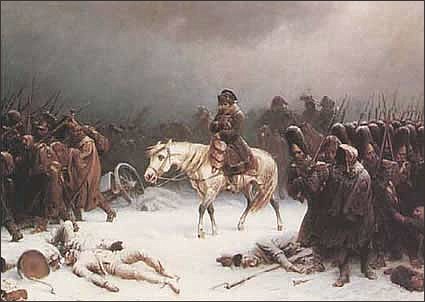
There are already old military maxims that express a warning about the risks of diffusion, notably “Don’t get into a land war in Asia” or “Don’t invade Russia in winter”.  Napoleon Bonaparte marched his vast and fabled Grand Armee of 600,000 men into the endless steppes of Tsar Alexander’s Russia. Everything gave way before Napoleon’s legions, but the Russians were not the Austrians or Prussians, they retreated, savagely burning and destroying as they went:

….Alexander’s proclamation to his people, issued at the time of the French invasion, appealed to these deep seated feelings: Napoleon had come to destroy Russia; the entire nation must rise against ‘this Moloch’ and his ‘legions of slaves’. ‘Let us drive this plague of locusts out! Let us carry the Cross in our hearts and steel in our hands!’ The proclamation was read in all the churches, and the priests supplemented it with embellishments of their own. The Comte de Segur, at this time an aide-de-camp to Napoleon, wrote: ‘They convinced these peasants we were a legion of devils commanded by the Antichrist, infernal spirits, horrible to look upon, and whose very touch defiled”

In Moscow, the city in flames, even Napoleon the Conqueror, the master of Europe, did not have enough men, or material or speed of movement to either digest and rule the immense spaces of Russia or compel Alexander to come to terms:

….Throughout the fall of 1812, Napoleon waited in vain for Alexander’s peace proposals to arrive in the Kremlin. When none came, he made overtures of his own, but Alexander sent no reply. As the days stretched into weeks, Napoleon came to see that he, not Alexander, faced a truly desperate situation, for Russia’s armies grew stronger by the day while his own dwindled from desertions and the ravages of disease. He faced the hopeless prospect of wintering in Russia without adequate food, shelter, or supplies, surrounded by a people so hostile that they burned their grain rather than sell it for French gold. As winter approached, and as the Russian partisans stepped up their attacks on his rear, Napoleon saw that his line of communications, which relied upon a perilously vulnerable corps of couriers who raced from Paris to Moscow in fourteen days, must soon collapse.

Of the Grand Armee, only five thousand returned home from the snowy wastes of Russia alive.

The Wehrmacht did little better. Hitler’s imagined drive to the Urals without a surrender and territorial concession by Stalin was a fantastical ambition. The far-flung distance, roadless mud and icy snow alone were too much for panzer armies and Luftwaffe air wings that proceeded to break down with statistical certainty. Supply lines were too long; gasoline and replacement parts were too few, as were replacements for the men for whom the Eastern Front was a grave. To the dogged resistance of the Red Army, the Germans needlessly added the people’s rage of the Russian partisans by demonstrating to the peasantry that the NKVD held no monopoly on atrocity.  Imperial Japan’s coterminous war in China tells exactly the same unhappy tale.

William Lind and the 4GW school used to like to make the point, regarding your moral and political legitimacy, that ” If you fight the weak, you become weak”. The corollary to that is economic: “If you fight the poor, you become poor”.

Grinding poverty itself  is a tax upon the invading force. There are no resources for your army to comandeer or buy, no skilled manpower to requisition or hire, no infrastructure for them to use. All of that must be imported and built at great expense by the invader whose troops are accustomed to far less spartan environs. The local population is usually malnourished, illiterate, ignorant, suspicious of outsiders and  rife with disease; their living habits and water sources unsanitary and endanger the troops. Caring for the locals, even minimal administration of humanitarian aid, becomes a bureaucratic and logistical burden consuming time and diverting resources away from urgent military needs.

The United States under George Bush the Elder, entered into Somalia, a land beset by violent anarchy and it’s people in the grip of a terrible famine and was driven out shortly thereafter under Bill Clinton. The last scenes there being the emaciated Somali followers of  a two-bit warlord,Mohammed Farah Aidid, gleefully swarming over and looting our military’s former…. garbage dump.

When the enemy has a land so poor that he treasures and makes use of the crap you throw away, the economic spillover of your logistical supply lines will fund his war against you. Used to surviving on bare subsistence, the invader’s presence becomes an economic bonanza for resistance and collaborator alike. Sort of a highly kinetic form of military Keynesianism. The war itself and the occupation become an irreplaceable cornerstone of their economy. They hate you being there, but can’t afford to defeat you and drive you out either – making a “quagmire” irregular conflict their ideal economic equilibrium to maintain.

What lessons can we draw here?

  • Keep your national power concentrated – don’t diffuse it with unmanageable, ill-defined, tasks of unlimited scope
  • Military power is to be used for a clear and articulated policy end with a defined political settlement in mind
  • If a political settlement is impossible because the problem is intractable, avoid involvement.
  • If you cannot avoid getting involved (i.e. -you were attacked) your best option is to engage in a punitive expedition to destroy the war-making capacity of the enemy and impose  ruinous costs and then immediately leave.
  • Keep campaigns short. In operation, military power is a terrible, swift sword and you should sheathe it just as quickly. 
  • Ruling over enemy population is a wasteful, thankless, burden not to be undertaken except in extremis (Reconstruction and occupation of Germany and Japan were in extremis cases).
  • Maximum gains accrue from the most effective use of the smallest possible force in the shortest period of time.
  • Make an army large enough and the enemy will become a secondary or tertiary concern of its leaders.


Switch to our mobile site