zenpundit.com » Afghanistan

Archive for the ‘Afghanistan’ Category

The Black Banners of Blackwater

Wednesday, September 21st, 2011

[ by Charles Cameron — minor, curious post on apocalyptic, conspiracism, jihad, graphics ]

.

blackwater-black-banner.jpg

There’s a long, conspiracist post on the “wake up project” that (among other things) declares that President Ahmadinejad is the “flag bearer of Imam Madhi’s army, insha’allah” andquotes a hadith of Imam Ali (with present-day comment in parens):

He that meets with Al Hashimi (i.e Hasan Nasrullah of Hezbollah)
with the Black Banners at his front is Shuayb, the son of Salih
who will engage As-Sufyani at the Gate of Istakhr —

and with a footnote that declares, “President Ahmadinejad is also the Tamimi Youth, al Mansur and the disputed Abdullah of the hadiths.”

So there’s something of a Shi’a perspective here, no?

What caught my eye, however, focused as I am on this black banner business, is the distinction the writer makes between two sets of black banners, the first of which apparently feature Blackwater:

“Before your treasure, three will kill each other —
all of them are sons of a different caliph but none will be the recipient.
Then the Black Banners will appear from the East
and they will kill you in a way that has never before been done by a nation.”

IT IS THE FIRST SET OF BLACK BANNERS (I.E BLACKWATER/XE) WHO WILL COME OUT FROM AFGHANISTAN AND THE HADITH SAYS THEY WILL KILL YOU LIKE NO ONE ELSE HAVE KILLED YOU BEFORE.

And in case we’re in any doubt, there’s a helpful link to the Blackwater/Xe banner (see at top of this post).

Thus more or less confirming the link between the Dajjal / Antichrist and Blackwater / Xe made in the Urdu book, Dajjal ka Lashkar – Blackwater / The Army of Antichrist: Blackwater to which Ibn Siqilli pointed us in 2009:

blackwater-anti-christ-ibn-siqilli.JPG

Ali Soufan: AQ, Khorasan and the Black Banners

Saturday, September 17th, 2011

[ by Charles Cameron — yet more black banners, Khorasan, Jerusalem and Armageddon, with the usual strategic implications ]
.
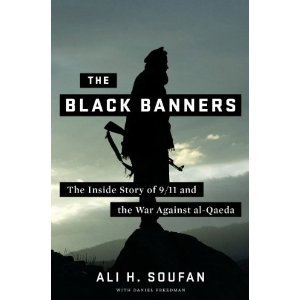
soufan-book-cover.jpg
.

It’s beginning to be embarrassing how obvious the Khorasan / black banner / Mahdism meme is getting these days.  Earlier this week I pointed it out as the basic through-line of Syed Saleem Shahzad‘s Inside Al-Qaeda and the Taliban: Beyond bin Laden and 9/11. Today it’s Ali Soufan‘s turn.

In his book, The Black Banners: The Inside Story of 9/11 and the War Against Al-Qaeda — which I hope to review here — Soufan too makes the apocalyptic significance of AQ’s jihad painfully apparent. Take his title, for instance

Black banners, eh?

Those would presumably be the ones mentioned to Soufan by Abu Jandal, who began to quote the hadith:

If you see the black banners coming from Khurasan, join that army, even if you have to crawl over ice; no power will be able to stop them —

at which point Soufan broke in and completed the hadith for him:

— and they will finally read Baitul Maqdis [Jerusalem], where they will erect their flags.

And in case you missed it, that’s an explicitly end-times, Mahdist hadith, as you can see from (eg) this Hizb-ut-Tahrir-associated site:

Messenger of Allah said: “If you see the Black Banners coming from Khurasan go to them immediately, even if you must crawl over ice, because indeed amongst them is the Caliph, Al Mahdi.” [Narrated on authority of Ibn Majah, Al-Hakim, Ahmad]

Soufan goes on to say:

I was to hear that reputed hadith from many al-Qaeda members I interrogated. It was one of al-Qaeda’s favorites.

Khurasan is a term for a historical region spanning northeastern and eastern Iran and parts of Turkmenistan, Uzbekistan, Tajikistan, Afghanistan, and northwestern Pakistan. Because of the hadith, jihadists believe that this is the region from which they will inflict a major defeat against their enemies — in the Islamic version of Armageddon. Bin Laden’s 1996 declaration of war against the United States – a main text for al-Qaeda members – ends with the dateline “Friday, August 23, 1996, in the Hindu Kush, Afghanistan.” It’s not a coincidence that bin Laden made al-Qaeda’s flag black; he also regularly cited the hadith and referenced Khurasan when recruiting, motivating, and fundraising. Al-Qaeda operatives I interrogated were often convinced that, by joining al-Qaeda, they were fulfilling the words of the Prophet.

It is an indication of how imperfectly we know our enemy that to most people in the West, and even among supposed al-Qaeda experts, the image of the black banners means little…

I could go on, but that’s surely enough.

*

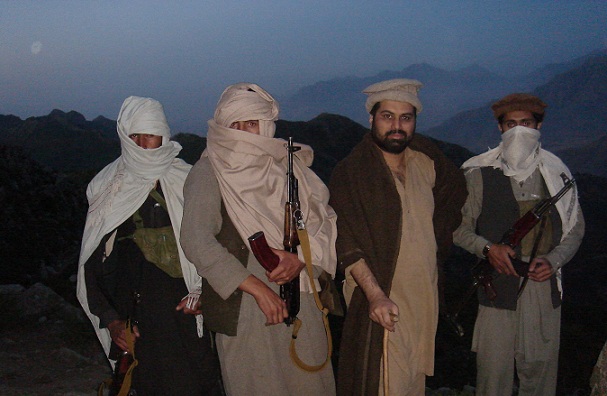
And by the way, who is that man on the cover, anyway?

banners-mafa-juxtaposed.png

Syed Saleem Shahzad: AQ, Khorasan and the Mahdi

Thursday, September 15th, 2011

[ by Charles Cameron — Mahdism and Khorasan, strategic implications re Afghanistan, Pakistan, India and the West ]

.

kunar.jpg

photo:  http://www.syedsaleemshahzad.com

Syed Saleem Shahzad, the recently murdered Pakistani reporter (above) profiled by Dexter Filkins in The New Yorker a couple of days ago, recently published a book with Pluto Press titled Inside Al-Qaeda and the Taliban: Beyond bin Laden and 9/11.

Reading the New Yorker piece, I was struck by the explicitly Mahdist tenor of the book’s final paragraph, which Filkins quoted, and a quick glance at pages available on the Amazon site makes it clear that Shazad’s sense of AQ strategy (a) is strongly eschatological, (b) includes India in its scope, and (c) leads from greater Khorasan to Jerusalem.

Since I’ve been harping on (a) and (c) for some while now, and (b) “fits” well enough with a few other loose ends, analytically speaking, I’ll be very interested to read (and hopefully review) the whole thing. For now, I’d just like to draw your attention to the opening and closing paragraphs of the book…

Shahzad begins his Prologue (p. xiii) with these words :

The 9/11 attacks in 2001 aimed to provoke a war in South Asia. The 26/11 Mumbai assaults in 2008 warned that Al-Qaeda was expanding its war to the east, from Central Asian republics to India and Bangladesh, and that many more such actions would follow. In the ideological perspective of Al-Qaeda, this was to be a preparation for the “End of Time” battles which were referred to by the Prophet Muhammad (in what is now known as the Hadith). These pointed to parts of modern-day Iran, Afghanistan, Pakistan, and Central Asia as ancient Khurasan. Khurasan was to be the first battleground for the End of Time battles, before a decisive confrontation against the West, with the last battle being fought in the Middle East for the liberation of Palestine and all occupied Muslim lands.

In the meantime, Al-Qaeda aimed to trap the world’s most powerful states in the impossible terrain of Afghanistan. The aim was to lead them to exhaust their energies there, before the expansion of the theater of war against the West from Central Asia to Bangladesh…

His book closes (pp. 225-26) with these words:

However, the saga of Al-Qaeda’s One Thousand and One Nights tales continues with new strategies and new characters. For Al-Qaeda these are just measures to keep the West running from pillar to post until it exhausts itself and Al-Qaeda can announce victory in Afghanistan. Al-Qaeda next aims to occupy the promised land of ancient Khurasan, with its boundaries stretching all the way from Central Asia to Khyber Paktoonkhwa throiugh Afghanistan, and then expand the theater of war to India.

The promised messiah, the Mahdi, will then rise in the Middle East and Al Qaeda will mobilize its forces from Ancient Khurasan for the liberation of Palestine, where a final victory will guarantee the revival of a Global Muslim Caliphate.

Shahzad was not always the most reliable of reporters by all accounts – but certainly one of the most intrepid, and one with unparalleled contacts among the major players. The fact that he pitches his book along so clear a Mahdist through-line should give us all pause.

Book Review: Architect of Global Jihad by Brynjar Lia

Thursday, August 18th, 2011

Architect of Global Jihad by Brynjar Lia

Architect of Global Jihad: The Life of al Qaida Strategist Abu Mus’ab al-Suri is Brynjar Lia’s definitive biography of the shadowy terror theorist, Islamist intellectual and sometime jihadi, Mustafa bin Abd al Qadir Sitt Maryam.

Sitt Maryam, who went by al-Suri in jihadi circles, was a red haired, fair-skinned Syrian renegade from the Muslim Brotherhood who was trained in military tactics and explosives in Saddam Hussein’s terrorist camps, passing on his skills to fellow “Arab Afghans” during and after the Soviet War. Attracted to secular military theory, guerrilla warfare tactics and strategy rather than theological disputes, hating the West but despising Salafist radicals, Lia’s Abu al-Suri is an isolated and anomalous figure in “the jihadi current” of the 1990’s and post-9/11 era.

“A born critic” with a grim and unsmiling demeanor who entangled himself in acrimonious personal feuds with leading jihadis, including Osama bin Laden, al-Suri failed to win many adherents to his insightful “system not organization” (nizam la tanzim) theory of jihad until his arrest caused his writings, especially his magnum opus The Global Islamic Resistance Call to go viral in the Islamist darknet.

A true intellectual, widely read in western literature and military writings, al-Suri crafted a stategy of jhad that adapted arguments of 4GW, “leaderless resistance” and classical Maoist insurgency to suit Islamist purposes and conditions while rejecting secret, hierarchical, organizations and al-Qaida’s “Tora Bora mentality” as historical failures. Self-radicalization and “sudden jihad syndrome” among alienated Western Muslims was the stuff from which al-Suri hoped to build a massively decentralized, open source, self-sustaining campaign of terrorism.

A hundred and forty some pages of text in Architect of Global Jihad are devoted exclusively to excerpts from al-Suri’s 1,600 page treatise on terrorism operations and strategy. He was a serious and determined opponent of Western civilization’s core values, despite having enjoyed long stretches of reasonably comfortable Western exile in Spain and “Londonistan” to such a degree that al-Suri was in no particular hurry to rejoin the jihad and even acquired the unenviable (and inaccurate) reputation of only being a “pen jihadi”.

Musab al-Suri, who is likely dead at the hands of Baathist jailers, is best described as an Islamist parallel to Vladimir Lenin before the Bolshevik Revolution. The similarities are striking, the irascible temperment, formidible intelligence, the frustrating politics of exiled revolutionary communities, the ideological marginalization both men endured as radicals in a community of already extreme activists and the embrace of terrorism (tactically in Lenin’s case, strategically in al-Suri’s). al-Suri and Lenin, despite wide ideological differences, as revolutionaries represent the psychological type Eric Hoffer termed “true believers” – pitiless, absolutely committed, intellectually rigid on matters of principle but tactically flexible and creative in terms of method.

Such men are dangerous, to themselves as well as to society.

Strong recommendation:

ADDENDUM:

Related posts on or including Abu Musab al-Suri

Lexington GreenAbu Musab al-Suri: Theorist of Modern Jihad and The Networked Jihad: Parasitic on Developed World Technology, Information, Ideas

Charles CameronA Terrorist’s Call to Global Jihad: Deciphering Abu Musab al-Suri’s Islamic Jihad Manifesto

John RobbSURI: nizam, la Tanzim (system, not organization) – Global Guerrillas

The Jamestown FoundationThe Jamestown Foundation: Al-Suri’s Adaptation of Fourth  , The Jamestown Foundation: Al-Suri’s Doctrines for Decentralized  and The Jamestown Foundation: Abu Mus’ab al-Suri and the Third

Jihadica Abu Mus`ab Suri: Architect of Global Jihad Neglected? and Training for the Lone Jihadi

The Hoover InstitutionThe Terror Fringe

Bing West on COIN and Afghanistan Strategy

Tuesday, August 2nd, 2011

From SWJ Blog:

Where we have been. According to US counterinsurgency doctrine, our soldiers and marines were expected to be “nation-builders.” Afghanistan, however, was the wrong war for that strategy of democratic nation building – for three reasons.

First, a foreign power cannot build a democratic nation, while having no control over that nation’s authoritarian leaders. In 2002, the US and the UN handed full sovereignty to Afghan leaders who proved to be venal and selfish. We conceded all leverage over Afghan leadership. That was a fatal mistake.

Second, a duplicitous Pakistan has maintained a 1500-mile long sanctuary. The recent decision to give Pakistan money only on a transactional basis – do this if you want to be paid – is commendable. It will influence behavior, because Pakistani officials cannot maintain their comfortable life styles without American money.

Third, our benign counterinsurgency strategy did not win the commitment of the people. In Iraq, the Sunni tribes did eventually reject the insurgency. In Afghanistan, the Pashtun tribes have not done so. Most Pashtun villagers survive by being chameleons; they expect the Taliban to return.

By giving away $18 billion over ten years, we created a culture of entitlement. Afghans from President Karzai down to village elders came to expect that we would fight for them and give them money. The US military alone undertook 16,000 economic projects, as if its mission was that of a giant Peace Corps. This money resulted in no change in the war; however, it did weaken the willingness of Afghans to rely upon themselves. When you give something for nothing, you receive nothing in return…

Read the rest here:


Switch to our mobile site