zenpundit.com » Religion

Archive for the ‘Religion’ Category

Scenario planning and prophecy

Friday, October 14th, 2011

[ by Charles Cameron — futurism, prediction, Christian and Islamic apocalyptic traditions, fiction ]
.
clancy-rosenberg.jpg

Two new thrillers.  And what caught my eye — fascinated as I am by the whole business of prophecy and prediction, scenario planning and science fiction — was Wolf Blitzer‘s pronouncement about Tom Clancy on his CNN blog today:

Sometimes nonfiction seems to follow fiction, especially, it seems, in the case of Tom Clancy and his spy novels.

Here’s Blitzer’s supporting evidence:

In 1994, he wrote a thriller called “Debt of Honor.” Long before the terrorist attacks of 9/11, Clancy had a character fly a Boeing 747 into the U.S. Capitol. Clancy’s “The Teeth of the Tiger,” published in 2003, features a man named Mohammed who has a network of Colombian drug cartel thugs who plot evil deeds against the U.S. His newest book is entitled “Against All Enemies.” A major plot line has Taliban terrorists joining hands with Mexican drug cartel killers to launch attacks in the United States. A friend who’s read all the Clancy books alerted me to this when he heard of the Obama administration’s accusations that Iran plotted to have members of a Mexican drug cartel kill Saudi Arabia’s ambassador to the United States, Adel al-Jubeir. “Seems like terrorists are big Clancy fans,” my friend suggested…

Not so fast, Wolf and Wolf’s friend. They might equally well have been reading Joel Rosenberg (also, or instead).

Clancy does this sort of stuff because he’s a scenario planner turned novelist — Rosenberg does it because he’s a student of prophecy turned novelist.  Come to that, I rather like the idea that prophecy and scenario planning might be related.

Here’s an excerpt from Wikipedia’s current article about Rosenberg:

Nine months before the September 11th attacks, Rosenberg wrote a novel with a kamikaze plane attack on an American city. Five months before the 2003 invasion of Iraq, he wrote a novel about war with Saddam Hussein, the death of Yasser Arafat eight months before it occurred, a story with Russia, Iran, and Libya forming a military alliance against Israel occurring the date of publishing, the rebuilding of the city of Babylon, Iran vowing to have Israel “wiped off the face of the map forever” five months before Iranian President Ahmadinejad used similar language, and the discovery of huge amounts of oil and natural gas in Israel (a major gas discovery occurred in January 2009).

Neat, hunh?

Or of course, they could just all be playing Steve Jackson‘s 1995 Illuminati card game

illuminaticardgametowers.jpg

I suppose we should add role-playing and card-reading to our list of prognostic activities…

*

In any case…

I enjoy Joel Rosenberg’s books.  His thrillers are full of Christian and Islamic apocalyptic elements, of course, which are of continuing interest to me — especially when they cross over into each others’ territories.  I’ve been meaning to write up my review of the first book in his current series for months now — my copy must have a hundred or so little colored flags in it, marking passage of interest, plot points and so on.

And there are things Rosenberg gets seriously wrong that are important. It’s dangerous when someone who influences thousands through his Epicenter conferences and his appearances with Glenn Beck is unable to distinguish the Hojjatiyeh Society (a small group that may not even exist at this point) from Twelver (ie orthodox Shi’ite) Islam.

But it’s because I think:

  • that Islamic apocalyptic is important and all too often overlooked,
  • that he thinks so, too,
  • that his tying it in with policy proposals carries some weight,
  • that the brisk pace of his novels reaches readers who have not much other access to ideas about the Mullahs, the Twelfth Imam or Mahdi, and the issue of the Iranian nuclear program, and
  • that there are scholars in a position to clarify and correct some of his mistakes and misconceptions,

that I still hope to review the first book in the current series, The Twelfth Imam, and his new book, The Tehran Initiative, right alongside it.

Heck, I’d be more than happy to review the new Clancy, too.

Arab Spring and apocalyptic dawn

Sunday, October 2nd, 2011

[ by Charles Cameron — Mahdism and the Arab Spring, depth of apocalyptic expectation not limited to militant circles ]

.

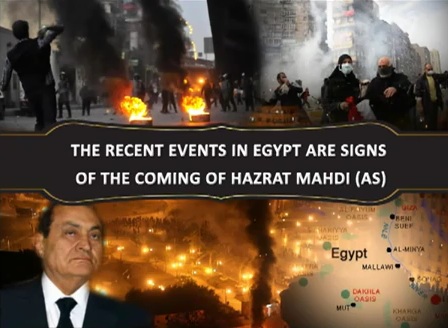
recent-events.jpg

screen-cap from a Feb 2011 video associated with Harun Yahya, see below

I’ve been holding back on posts about Shi’ite apocalypticism, because it seems to me that President Ahmadinejad‘s influence is on the wane for reasons not entirely disconnected from his keen and oft-expressed expectation of the soon coming of the Hidden Imam.

I have posted a couple of times recently on Sunni apocalyptic — but there my focus has been on AQ, Taliban and the black banners of Khorasan, as illuminated recently by the books of Syed Saleem Shahzad and Ali Soufan. My next forays will hopefully concern another strand of militant Sunni apocalyptic– the traditions of jihad against India (Ghazwa-ul-Hind) — and I’d also very much like to turn my attention some more to some of the eschatological issues in current Christian circles in the US.

But first: a quick glimpse of apocalyptic expectation in the Arab Spring.

1.

Under the title Mubarak’s fall spawns End of Times prophecies, Yasmine Fathi recently reported in Egypt’s Al Ahram online:

The idea of Mubarak as Anti-Christ has caught fire on social networking sites, with many users presenting Muslim Hadiths, sayings of the Prophet, in support of the theory. While others dispute the notion, they nevertheless posit Mubarak’s very existence as a sign that the end is indeed nigh.

One website noted that, according to certain Islamic beliefs, doomsday will come after Egypt is ruled by a leader whose first name is “Mohamed” and second name is “Hussein,” of which “Hosni” – Mubarak’s middle name – is a variation. This, say doomsday-watchers, constitutes further proof that his existence – and recent fall – represented a sign that the end of time can be expected any day now.

One theory currently making the rounds on the web suggests that the world will end on 26 September – this Monday – due to massive earthquakes caused by a rare planetary alignment. The quakes, believers say, will make Japan’s recent disaster look like a walk in the park.

Even Egypt’s Coptic Patriarch, Pope Shenouda III, referred to the prediction, joking at the end of his last weekly sermon, “We’ll meet again next Wednesday after the earthquake, God willing.”

After the theory was savaged by local and international scientists, however, the public’s attention has shifted again to the year 2012 – only three months away – which many fatalists fear will be our last year on earth, since the Mayan calendar ends on 21 December of next year.

The first point to note here is that apocalyptic sentiment is alive and thriving in the Arab world — and not just in the militant jihadist circles of AQ and the like — or Hamas — either.

That’s a significant datum — and our cue for another reading of JP Filiu‘s Apocalypse in Islam.

2.

The number and variety of strands converging in these few brief paragraphs is impressive:

social networking
apocalyptic expectation catching fire
Mubarak’s name as a sign
a date certain — a week from now
cross-religious banter from Pope Shenouda

— and there’s even a reference to the “Mayan” chronology with its 2012 end-date — which (though Fathi doesn’t mention it) just happens to coincide with the Saudi dissident Sheikh Safar al-Hawali‘s ETA for the return of Jerusalem to Islam on the final page of his pamphlet, The Day of Wrath.

3.

Let’s go back to Fathi for a more nuanced — and theologically informed — view:

But according to Amena Nosseir, professor of Islamic theology and philosophy at Cairo’s Al-Azhar University, the true date of the “final hour” will never be revealed to mankind.

“God has not bestowed knowledge of the final hour to any of his prophets or worshippers, and there’s a holy wisdom behind his decision to withhold this information,” she said. “God created humans to create life on this planet, so it doesn’t make sense that he would give them the knowledge of when the end of time will be.”

Even al-Hawali qualifies his suggested date thus:

Therefore, the end -or the beginning of the end- will be 1967 + 45 = 2012, or in lunar years 1387 + 45 = 1433.

This is what we hope will happen, but we do not declare it to be absolutely certain, but if the fundamentalists would like to bet with us, as Quraysh did with Abu Bakr concerning the Qur’anic prophecy concerning the Romans, then without doubt they will lose, although we cannot guarantee that it will be that exact year!

Setting a date for time to end may be the most reliable method yet devised for proving oneself unreliable.

4.

There are other stirrings.

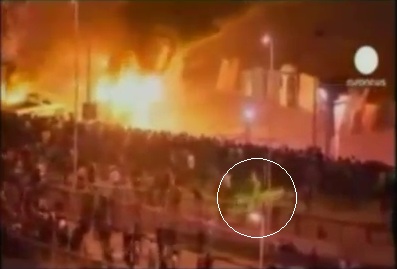
Harun Yahya, an influential Turkish figure, reports that a green horse and rider can be discerned in a recent Cairo video, and proposes that the rider is Khidr — the teacher of Moses in Sura 18 of the Qur’an (which the great scholar Louis Massignon terms “the apocalypse of Islam”) and a mysterious figure of inspiration in Islamic lore…

khidr-in-egyptian-video.jpg

He also “reads” Mubarak as an eschatological figure — the Rook — and indeed, this entire video — only five minutes long and readily available on YouTube — is worth watching, to get a visceral sense of how strong this narrative current is:

BTW: see Halverson, Goodall and Corman‘s Master Narratives of Islamist Extremism for a sense of how significant “narrative” is… and then, yes, reread Filiu!

*

Hat-tip for a hot tip to Bryan Alexander.

Dead Sea Scrolls & Nag Hammadi Codices online

Wednesday, September 28th, 2011

[ by Charles Cameron — archaeology, Biblical scholarship, eschatology, digital literacy ]

.

Both the Dead Sea scrolls from Qumran and the Gnostic and associated codices from Nag Hammadi are now available for study online:

quo-codices.jpg

The Nag Hammadi Archive can be explored via the Claremont Colleges Digital Library, and the Digital Dead Sea Scrolls via the Israel Museum, Jerusalem.

Here’s a description of the War Scroll from Qumran, which “is dated to the late first century BCE or early first century CE”:

Against the backdrop of a long biblical tradition concerning a final war at the End of Days (Ezekiel 38-39; Daniel 7-12), this scroll describes a seven stage, dualistic confrontation between the “Sons of Light” (the term used by Community members to refer to themselves), under the leadership of the “Prince of Light” (also called Michael, the Archangel) – and the “Sons of Darkness” (a nickname for the enemies of the Community, Jews and non-Jews alike), aided by a nation called the Kittim (Romans?), headed by Belial. The confrontation would last 49 years, terminating in the victory of the “Sons of Light” and the restoration of the Temple service and sacrifices. The War Scroll describes battle arrays, weaponry, the ages of the participants, and military maneuvers, recalling Hellenistic and Roman military manuals.

You can see why I’m interested.

The Nag Hammadi texts are a little less well known but include — along with a variety of other texts, some of them self-described as “apocalypses” — the now celebrated Gospel of Thomas, which Bart Erhman reads as continuing a “de-apocalypticizing” of Jesus’ message which he finds beginning in Luke and continuing in John:

In the Gospel of Thomas, for example, written somewhat later than John, there is a clear attack on anyone who believes in a future Kingdom here on earth. In some sayings, for example, Jesus denies that the Kingdom involves an actual place but “is within you and outside you” (saying 3); he castigates the disciples for being concerned about the end (saying 18); and he spurns their question about when the Kingdom will come, since “the Kingdom of the Father is spread out on the earth and people do not see it” (saying 113).

Again, you can see why I am delighted that these texts are becoming available to a wider scholarly audience…

In both the Nag Hammadi codices and Qumran scrolls, we have texts that were lost for almost two thousand years and discovered, somewhat haphazardly, in 1945 and 1947 respectively, providing us with rich insights into the religious ferment around a time and place that have been pivotal for western civilization.

Now, more than half a century later, the web — as it becomes our global museum and our in-house library — brings us closer to both…

Benedict XVI — a reading between the lines

Friday, September 23rd, 2011

[ by Charles Cameron — Benedict XVI, Lutherans, ecumenism, C Peter Wagner’s “new paradigm” of Christianity ]
.
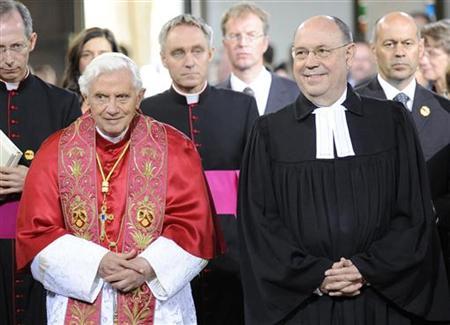
ukreuterscom.jpg
Photo: Pope Benedict XVI and Nikolaus Schneider (R), Chairman of the Council of the Evangelical Church in Germany (EKD) attend the Ecumenical Service of the World in the church of the Augustinian Monastery in Erfurt, September 23, 2011.  Credit: Reuters / Norbert Neetz / Pool

Earlier today, Pope Benedict visited the cloister in Erfurt which once housed Martin Luther, for an ecumenical meeting with leaders of the Evangelical Church in Germany (EKD), a mainline Protestant coalition of Lutheran, Unified and Calvinist churches.

In the course of his presentation, the Pope made clear his admiration for Luther himself:

As the Bishop of Rome, it is deeply moving for me to be meeting representatives of Council of the EKD here in the ancient Augustinian convent in Erfurt. This is where Luther studied theology. This is where he was ordained a priest in 1507. Against his father’s wishes, he did not continue the study of Law, but instead he studied theology and set off on the path towards priesthood in the Order of Saint Augustine. On this path, he was not simply concerned with this or that. What constantly exercised him was the question of God, the deep passion and driving force of his whole life’s journey. “How do I receive the grace of God?”: this question struck him in the heart and lay at the foundation of all his theological searching and inner struggle. For him theology was no mere academic pursuit, but the struggle for oneself, which in turn was a struggle for and with God.

“How do I receive the grace of God?” The fact that this question was the driving force of his whole life never ceases to make an impression on me. For who is actually concerned about this today – even among Christians?

That’s a striking utterance from the holder of the office that Martin Luther so often assailed, writing (for instance):

St. Paul calls Antichrist the man of sin and the son of perdition, because through his precepts and laws he will turn all the world from God and prevent God and the world from coming together; he shall be a master of sin and all iniquity, and yet will retain the name and appearance of Christ and call himself Sanctissimus and Vicarius Dei and Caput Ecclesiae [“most holy one; vicar of God; head of the Church”], and persecute all who will not obey him. It is easy to recognize that the pope more than fits this description.

Things have clearly changed since that time, and the US branch of Lutheran World Ministries has proposed to its member churches:

That they officially declare that the Lutheran commitment to the Confessions does not involve the assertion that the pope or the papacy in our day is the anti-Christ.

It is not, therefore, the Evangelical Churches (ie mainstream Protestants like the Lutheran and Reformed churches) that Benedict is thinking of when he raised an issue that obviously disturbs him, saying:

The geography of Christianity has changed dramatically in recent times, and is in the process of changing further. Faced with a new form of Christianity, which is spreading with overpowering missionary dynamism, sometimes in frightening ways, the mainstream Christian denominations often seem at a loss. This is a form of Christianity with little institutional depth, little rationality and even less dogmatic content, and with little stability.

The matter seems urgent to Benedict, precisely because, as he had just said:

It was the error of the Reformation period that for the most part we could only see what divided us and we failed to grasp existentially what we have in common in terms of the great deposit of sacred Scripture and the early Christian creeds. The great ecumenical step forward of recent decades is that we have become aware of all this common ground and that we acknowledge it as we pray and sing together, as we make our joint commitment to the Christian ethos in our dealings with the world, as we bear common witness to the God of Jesus Christ in this world as our undying foundation.

Catholics and Lutherans may still have their differences – but on “the great deposit of sacred Scripture and the early Christian creeds” they have much in common – and it is of this common ground that Benedict says, “The risk of losing this, sadly, is not unreal” immediately before speaking of the new “form of Christianity with little institutional depth, little rationality and even less dogmatic content, and with little stability”.

The Pope continues:

This worldwide phenomenon poses a question to us all: what is this new form of Christianity saying to us, for better and for worse? In any event, it raises afresh the question about what has enduring validity and what can or must be changed – the question of our fundamental faith choice.

The Pope is a diplomat, and he is expressing his concern as diplomats do, in a carefully worded, highly generalized and eminently tactful way. But can we read between the lines? What does the Pope mean by “this new form of Christianity”?

The “world” of Christianity is changing very rapidly, both demographically and doctrinally, and that’s putting things mildly. I hope to address some of these changes in a series of future posts on ZP — but for now, let me just say we should watch Pope Benedict’s future utterances closely for further signs of exactly what worries and what encourages him.

*

I cannot image, for instance, that Benedict would be altogether comfortable with what C Peter Wagner of the new Apostolic Reformation refers to in his forward to Bishop Bill Hamon‘s book Apostles, Prophets and the Coming Moves of God: End Times Plan for His Church on Planet Earth as

my “paradigm shift” from traditional Christianity to an openness to the person and to the full ministry of the Holy Spirit.

This “full ministry of the Holy Spirit” includes, as the title of Harmon’s book suggests, the idea that Apostles and Prophets will arise in our times, which are the End Times.

In his book Apostles Today: Biblical Government for Biblical Power, Wagner states:

We are now living in the midst of one of the most epochal changes in the structure of the Church that has ever been recorded. I like to call it the “Second Apostolic Age.”

Wagner goes on to say, “The Second Apostolic Age is a phenomenon of the twenty-first century” and then identifies four “notable movements of the Spirit of God” that “have been building the foundation of the Second Apostolic Age for several decades.” These are (pp. 8-9):

  • The African Independent Churches
  • The Chinese House Churches
  • The Latin American Grassroots Churches
  • The U.S. Independent Charismatic Movement.

Is any of this beginning to sound like the “new form of Christianity, which is spreading with overpowering missionary dynamism” that Benedict mentioned – a “form of Christianity with little institutional depth, little rationality and even less dogmatic content”?

Let’s turn back to Bishop Bill Harmon for a moment. Hamon himself appears to be clear that he is both an apostle and prophet. In the body of the book which I linked to above – and not on the dust jacket, where over-the-top praise from an author’s friend is commonly found — he quotes one of his supporters, Dr Henry Ramaya of Grace Assembly, Fasan, Malaysia, who writes:

The global recognition and acceptance of bishop Bill Harmon as Father of the Apostolic-Prophetic movement speaks for itself.

and refers to Harmon as “the Apostle Prophet Statesman”.

Dr. Ramaya’s description of the apostolic and prophetic functions, also quoted by Harmon in his book, puts both the missionary and apocalyptic elements of this movement together in a nutshell:

The apostle is God’s vehicle of invasion like light invading darkness, and the prophet is God’s ultimate weapon of warfare. This end-time Apostolic-Prophetic Movement will climax into the apocalypse with a spontaneous outburst of joy because the missionary mandate will be fulfilled.

And one last quote, if I may.

According to notes published on the Elijah List, a listserve that supports the New Apostolic Reformation agenda, Bill Harmon told an “International Gathering of Apostles and Prophets” back in 1999:

We are seeing prophets and apostles coming forth for a strategic reason. … We are about to move from the dispensation of grace to the dispensation of dominion. We are about to see Jesus, not as the suffering lamb that was slain, but the roaring Lion who is King!

If we’d be well-advised to follow Pope Benedict’s further utterances, we should also take note of sources like the Elijah list, and critical considerations of the movement, like those posted on such Evangelical sites as Herescope.

*

Please note that I am not saying that Benedict’s remarks were directed specifically at the New Apostolic Reformation — they were diplomatic and highly generalized for good reason — merely that the NAR is a prominent, if not the preeminent, manifestation of the kind of shift that Benedict is talking about. The second section of this analysis, in other words, is simply one person’s attempt to “read between the lines”…

And did I really just promise to write a series of posts on demographic and doctrinal shifts within Christianity?

Also in the pipeline, a series on the psychological impact of ritual and ceremonial, whether of state, military or religious origin, and a series on the “other wing” of AQ’s jihad, the Ghazwa-e-Hind hadith, Pakistan’s ISI and related matters.

Ali Soufan: AQ, Khorasan and the Black Banners

Saturday, September 17th, 2011

[ by Charles Cameron — yet more black banners, Khorasan, Jerusalem and Armageddon, with the usual strategic implications ]
.
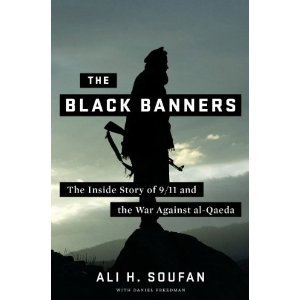
soufan-book-cover.jpg
.

It’s beginning to be embarrassing how obvious the Khorasan / black banner / Mahdism meme is getting these days.  Earlier this week I pointed it out as the basic through-line of Syed Saleem Shahzad‘s Inside Al-Qaeda and the Taliban: Beyond bin Laden and 9/11. Today it’s Ali Soufan‘s turn.

In his book, The Black Banners: The Inside Story of 9/11 and the War Against Al-Qaeda — which I hope to review here — Soufan too makes the apocalyptic significance of AQ’s jihad painfully apparent. Take his title, for instance

Black banners, eh?

Those would presumably be the ones mentioned to Soufan by Abu Jandal, who began to quote the hadith:

If you see the black banners coming from Khurasan, join that army, even if you have to crawl over ice; no power will be able to stop them —

at which point Soufan broke in and completed the hadith for him:

— and they will finally read Baitul Maqdis [Jerusalem], where they will erect their flags.

And in case you missed it, that’s an explicitly end-times, Mahdist hadith, as you can see from (eg) this Hizb-ut-Tahrir-associated site:

Messenger of Allah said: “If you see the Black Banners coming from Khurasan go to them immediately, even if you must crawl over ice, because indeed amongst them is the Caliph, Al Mahdi.” [Narrated on authority of Ibn Majah, Al-Hakim, Ahmad]

Soufan goes on to say:

I was to hear that reputed hadith from many al-Qaeda members I interrogated. It was one of al-Qaeda’s favorites.

Khurasan is a term for a historical region spanning northeastern and eastern Iran and parts of Turkmenistan, Uzbekistan, Tajikistan, Afghanistan, and northwestern Pakistan. Because of the hadith, jihadists believe that this is the region from which they will inflict a major defeat against their enemies — in the Islamic version of Armageddon. Bin Laden’s 1996 declaration of war against the United States – a main text for al-Qaeda members – ends with the dateline “Friday, August 23, 1996, in the Hindu Kush, Afghanistan.” It’s not a coincidence that bin Laden made al-Qaeda’s flag black; he also regularly cited the hadith and referenced Khurasan when recruiting, motivating, and fundraising. Al-Qaeda operatives I interrogated were often convinced that, by joining al-Qaeda, they were fulfilling the words of the Prophet.

It is an indication of how imperfectly we know our enemy that to most people in the West, and even among supposed al-Qaeda experts, the image of the black banners means little…

I could go on, but that’s surely enough.

*

And by the way, who is that man on the cover, anyway?

banners-mafa-juxtaposed.png


Switch to our mobile site