zenpundit.com » Writing

Archive for the ‘Writing’ Category

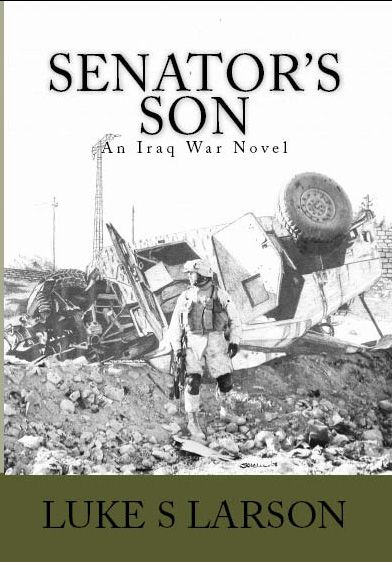
Review: Senator’s Son by Larson

Monday, March 15th, 2010
larson.jpg

Senator’s Son: An Iraq War Novel by Luke S. Larson

Fiction is not a genre that I usually review here, or get an opportunity to read often, but I received a courtesy review copy of a book Senator’s Son, by Iraq war vet, Marine officer and new novelist Luke Larson and was curious. The Iraq War and the War on Terror have produced a fine array of thoughtful books by veterans, war reporters and military thinkers like FiascoOne Bullet Away  and The Strongest Tribe, all of which were non-fiction memoirs, journalistic histories and quasi-policy books. By virtue of writing Senator’s Son as a novel, Larson was taking a different path in explaining his war.

There are two books at once in Senator’s Son. The first, is of course, a story, with characters and a plot and rising action, action, tragedy and theme – all the usual aspects of literature which I am not especially practiced at evaluating here. The second part is a contextual explanation of COIN by an author who lived the Iraq War. To his credit, Larson contacted me personally to request a “No bulls**t review”, so I will give the man what he asked for.

As an explanation of COIN, I think the book is a must read for anyone unfamiliar with the subject and the nuanced complexities that COIN entails. The gritty, unforgiving, human suffering and moments of triumph of soldiers waging “pop-centric” COIN that gets lost in powerpoint slides, in the dry abstractions of journal articles and blogospheric arguments far removed from the ground is present in ample measure in Senator’s Son. Many times, I paused in a passage and thought, “hmmm….I did not consider that”. Or “This is what the soldiers bear up under without complaint”. More people need to read that and digest what we ask of our men and women in Iraq and Afghanistan.

Senator’s Son also lays out, fairly methodically, how COIN theory may have been interpreted and debated by soldiers outside the wire, including cameo appearances or mention of real life COIN leaders woven into the story. The characters Bama, Cash, Rogue, Isaac, Gonzo the Iraqi and more, resist and adapt, struggling with their environment, unseen enemies and the political pressures of higher authorities, registering both frustration and progress in executing the mission of Golf Company. There’s even diagrams. If Senator’s Son is not on official COIN reading lists, it should be.

As a pure novel, judged on literary standards, Senator’s Son reflects its’ status as a “first novel” of a talented author whose vision of the craft is emerging. Larson excels at creating scenarios, staccato vignettes for the characters to act ( Larson may also have a future as a screenwriter – his book naturally flows in the mind like a movie). There’s always a believable, environmental, “texture” present that exceeds that of short story and science fiction writers, yet as a novelist, Larson leaves enough to the reader’s imagination so that the story moves at a dramatic pace.

Characterization in Senator’s Son is uneven. It takes a while for the individual personalities of the characters to shine beyond their common “Marine-ness” and we get only the briefest glimpse of the malign nature of the enemy, and that secondhand through the eyes of an Iraqi character. That probably is an accurate representative of the experience of most US soldiers and Marines in Iraq who are not interrogators; furthermore, having the antagonist that the characters struggle against be the total environment is perfectly legitimate. It would have been interesting for me to have seen how Larson would develop and utilize a figure who was the focus of evil; however that task would be fairly incompatible with getting an effective message across regarding COIN, success of which does not hinge on the defeat of super-villains or the resolution of black-white moral absolutes but is complexity written in shades of gray.

Finally, as an avid reader, I found Senator’s Son to be a page-turner. Several times, I looked at the clock while reading for what seemed to me a short time, noted it was 1:30 am and was regretful that I had to put it on my bedstand ( I always finished the chapter first though 🙂 ) only to repeat the process the following night.  Strongly recommended.

ADDENDUM – OTHER REVIEWS of SENATOR’S SON by:
Thomas P.M. Barnett 

Shrinkwrapped 

Shane Deichman

Senator’s Son

Wednesday, February 17th, 2010

larson.jpg

Senator’s Son: An Iraq War Novel  by Luke S. Larson

Just received a review copy of new author Luke Larson’s novel Senator’s Son. I can probably count on the fingers of one hand the number of works of fiction that I have reviewed at ZP, but two things caught my attention about Senator’s Son:

First, the novel is historical realism with a theme of COIN. Secondly, the author Luke Larson is a decorated Marine officer with two tours in Iraq under his belt. Flipping the pages reveals a gritty, sometimes humorous, staccato writing style and military/strategy/policy issues that are discussed here, or at SWJ or Abu Muqawama come to life through the eyes of still learning practitioners. I’m looking forward to reading Senator’s Son and reviewing it in full in late February or early March ( need to finish Carr’s Inside Cyber Warfare first).

Setting aside the book itself, something else occurred to me – that we have reached the point where the war is now appearing not as news, but as literature; Iraq and Afghanistan are proving to be culturally transformative wars for America in ways that the Gulf War or the Korean War were not.

If you consider WWI, the Great War represented an existential crisis for Western Civilization that found expression in the Lost Generation and, in Germany, the polar opposite novels All Quiet on the Western Front and Storm of Steel as well as Hemingway’s A Farewell to ArmsThe Spanish Civil War electrified international opinion, foreshadowing as it did the ideological death-match of the 20th century, and yielded Orwell’s Homage to Catalonia. WWII and the Vietnam War have generated an ocean of histories down to the minutest detail, as well as their share of novels, short stories and movies. It is noteworthy, that most of the time, literature and history followed the conclusion of peace, be it in victory or defeat.

In our time, the books on the war in Iraq, or Afghanistan or against terrorism are arriving while the conflict is still in full throttle, in time to shape the perceptions of policymakers and the public to an unprecedented extent. Something is happening out there, an inchoate need for answers or reassurance that writers are attempting to answer. Most of these books so far have been non-fiction, journalistic instant histories salted with examples of policy analysis and war memoirs.

Senator’s Son marks a new turn toward a wave of fiction addressing the crucible of America’s current wars. Literature can shape a nation’s psyche more profoundly than even the most soberly researched work of history.

Three Questions With Steve Pressfield

Wednesday, November 25th, 2009

I’ve enjoyed a sporadic conversation with Steve Pressfield , author of Gates of Fire and Killing Rommel, ever since he started his Tribes site. While most of our discussions had to do with COIN, tribalism, ancient history and Afghanistan, Steve is also generous with his time and advice with those who aspire to become better writers. Pressfield distilled his philosophy of writing, learned from the school of hard knocks, into a short handbook, The War of Art which I heartily recommend. Steve also features a “Writing Wednesdays” as a weekly tutorial in the writer’s craft and the acquisition of a professional mindset.

In the spirit of “Writing Wednesday”, Steve invited me to pose three questions to him based on my impressions of The War of Art. Here are my questions and Steve’s answers:

ZP: You write in The War of Art about “the muse”and Socrates‘ “heaven-sent madness”. It sounds very much like the “flow” described by creativity theorist Mihaly Csikszentmihalyi. Does the intensity of that experience ever lead the artist astray ?

SP: In my experience, Mark, the writing process bounces back and forth between two poles.  One is the let-‘er-rip mode, which could be called “flow,” or “Dionysian.”  That’s the one when the Muse possesses a writer and he just goes with it.  But yes, as you suggest, it can lead you astray.  It’s the like the great ideas you have at three in the morning after two too many tequilas.  This mode has to be balanced by a saner-head mode, which sometimes to me almost feels like a different person–an editor, a reviser.  That’s really when you put yourself in imagination in the place of the reader and ask yourself, as you’re reading the stuff that this “other guy” wrote: “Does this make any sense?  Is this any good?  Have I got it in the right place, in the right form?  Should I cut it, expand it, modify it, dump it entirely.”  Then you become cold-blooded and professional.  You get ruthless with your own work.  This is the time, I think, when “formula” wisdom can help, when you can ask yourself questions like, “What is my inciting incident?” or “What is my Act Two mid-point.”  Not when you’re in the flow, or you’ll censor yourself and second-guess yourself.  But now, when you’re rationally evaluating what you produced when you were in flow.

This back-and-forthing, I imagine, would be true in any artistic or entrepreneurial venture.  It’s great to let it rip and really get down some wild, skatting jazz riffs.  But then we have to come back and ask ourselves, “Is this working for the audience?  Is this working for the work itself?”

ZP: Amateurs reach a tipping point where they “Turn pro”. Is turning professional more from innate character or from the lessons of experience?

SP: Some people are born “pro.”  I have two friends, identical twins, who are both tremendous producers of excellent work and they’ve never suffered a minute of Resistance in their lives.  The lucky bastards.  For the rest of us though (at least this is my experience), only after many painful hard knocks … really when it becomes simply too excruciating to continue living as an amateur (and thereby suffering the agonies of never completing anything, always screwing up, forever feeling inadequate in our own eyes and just plain not respecting ourselves) do we finally, out of sheer emotional self-preservation, say to ourselves, “This crap has gotta stop!  We gotta get our act together!”

ZP: Artists run straight into hierarchies, filled with gatekeepers, between ourselves and a goal. Go through or go around?

SP: There’s an axiom in Hollywood that if you write a truly great script, it will not go unrecognized.  I think this is true.  What I mean by that is that gatekeepers can be our friends.  They can open gates as well as close them.  In fact, I vote for jettisoning the term “gatekeeper.”  It’s negative and self-defeating–and it’s an insult, I think, to the editors, agents, publishers and development executives whose agenda is not to exclude us, the artists.  In fact they’d like nothing more than to discover fresh talent, a hot new manuscript, a great pitch or biz proposal.  In my own experience, I got shot down again and again when my stuff wasn’t ready and wasn’t good.  But once I had done the work and elevated my material to the professional level, I found open doors and helping hands.

All that is not to say that “going around” can’t be a good idea too.  Look at Seth Godin, who’s the poster boy for damning the torpedoes and taking his stuff straight to the marketplace with incredible success.  In my own career though–now that you’ve made me think about it, Mark–I realize I’ve always gone the traditional route.  And the “gatekeepers” I’ve met have become, almost within exception, great friends and allies–and I’ve wound up helping them, in other ways, almost as much as they’ve helped me.

Thanks Steve!

The Other Prince of Darkness

Wednesday, August 19th, 2009

Robert D. Novak, 1931 -2009

During the Reagan era, two conservatives shared the title “the Prince of Darkness” as an epithet from liberal Democrats and Washington insiders. The first was nominal Democrat turned Reagan administration assistant secretary of Defense Richard Perle, a neoconservative activist who was castigated for his ultra-hardline anti-Soviet views and skepticism about the value of arms control. The second was veteran Chicago Sun-Times reporter and columnist Robert “Bob” Novak, who passed away today at age 78.

While Novak shared many of Perle’s foreign policy views regarding the malevolence of the Soviet Union and Henry Kissinger and was (with Jude Wanniski) a firey media advocate for the emerging school of  Supply-Side economics, what made him and the Evans & Novak column a political force to be reckoned with was that Bob Novak was a dogged, old-fashioned, working reporter who regularly unearthed new information from his vast collection of sources. Most people under thirty only know of Bob Novak from the Valerie Plame affair, which began in Novak’s column,but Robert Novak had been creating havoc for politicians, and not just liberal ones, for decades:

The fact is that Novak, as he would disclose in his autobiography, actually admired very few politicians. He wrote that he found the first politicians he covered less impressive than the athletic coaches he had covered as a young reporter — “an impression of the political class that did not change appreciably in a half-century of sustained contact.”But then, many big-time politicians didn’t like Novak. Pat Buchanan relates a priceless story of being with Richard Nixon in the mid-’60s in a high-school gym in Indiana. Nixon peeked through the stage curtain, finding Novak in the first row of the press section. “Look at him,” Nixon commanded. “That’s Bob Novak. That’s the enemy.”

Not only did I read Novak growing up ( later I realized that Novak would shoehorn his pet theories on to the facts he uncovered regardless of whether it made any sense, the facts though, were always useful) but I watched him pioneer the Left vs. Right shoutfest template on CNN’s “Crossfire”, first sparring with Tom Braden then, more famously, with Michael Kinsley. When Novak did it, the concept was refreshing because the whole idea of a show that actually had political balance by including conservatives on equal terms with liberal talking heads was revolutionary at the time. Unfortunately, when Crossfire went from a clever niche on a feisty cable news station to a transmogrified, dumbed-down, infotainment as an industry standard, a lot of damage was done to public discourse and reportedly, Novak shared that view to an extent ( though he also cashed the checks – CNN helped make Robert Novak exceptionally wealthy).

Robert Novak represented the last of a generation of hard-nosed reporters who learned journalism as a craft rather than as a product of graduate school theories, who could come from any ( but usually modest) background rather than having a distinctly “bicoastal” cultural worldview and a ranking system based on what “good school” you attended. The news business, I note, has not prospered from becoming more insular.

The media could use more Robert Novaks.

ADDENDUM:

I see Lexington Green beat me to the punch with his obit post.

Robert Young Pelton

Tuesday, June 23rd, 2009

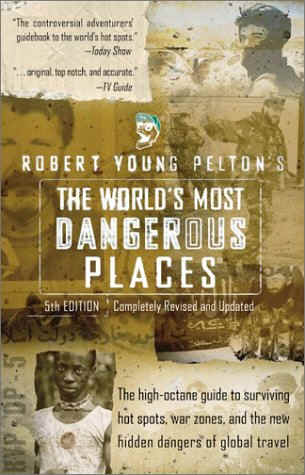
The author of  The World’s Most Dangerous Places: 5th Edition  and Licensed to Kill: Hired Guns in the War on Terror was nice enough to drop by in the comment section and discuss his firsthand view of special operators in Afghanistan. During the course of the discussion, in response to a question from Lexington Geen, RYP offered up a couple of links that I think readers will find worthwhile. Here is a quote from one of them:

….The next morning, about 60 Afghan cavalry came thundering into the compound. Ten minutes later, another 40 riders galloped up. General Abdul Rashid Dostum had arrived.

“Our mission was simple,” another soldier says. “Support Dostum. They told us, ‘If Dostum wants to go to Kabul, you are going with him. If he wants to take over the whole country, do it. If he goes off the deep end and starts whacking people, advise higher up and maybe pull out.’ This was the most incredibly open mission we have ever done.”

“Dostum” is the mercurial, ex-Communist, Uzbek Afghan warlord,  General Abdul Rashid Dostum.

Here are the links:

The Legend of Heavy D and the Boys: In the Field With an Afghan Warlord

Inside the Afghan War Machine

Incidentally, I read The World’s Most Dangerous Places in an earlier edition, back when Pelton’s uber-violence list was topped by Algeria, Colombia and several, broken down, West African nations. It’s a great book and a fun read that I have lent out to many of my students who had an all too idealistic and  parochial view of the world. It cured a few of them.


Switch to our mobile site