zenpundit.com » Perception

Archive for the ‘Perception’ Category

Mapping our interdependencies and vulnerabilities [with a glance at Y2K]

Wednesday, September 28th, 2011

[ by Charles Cameron — mapping, silos, Y2K, 9/11, rumors, wars, Boeing 747s, Diebold voting machines, vulnerabilities, dependencies ]


www.fun1001.com | Send this image to your friend

The “bug” of Y2K never quite measured up to the 1919 influenza bug in terms of devastating effect — but as TPM Barnett wrote in The Pentagon’s New Map:

Whether Y2K turned out to be nothing or a complete disaster was less important, research-wise, than the thinking we pursued as we tried to imagine – in advance – what a terrible shock to the system would do to the United States and the world in this day and age.

1.

My own personal preoccupations during the run-up to Y2K had to do with cults, militias and terrorists — any one of which might have tried for a spectacle.

As it turned out, though, Al Qaida’s plan to set off a bomb at Los Angeles International Airport on New Year’s Eve, 1999 was foiled when Albert Ressam was arrested attempting to enter the US from Canada — so that aspect of what might have happened during the roll-over was essentially postponed until September 11, 2001. And the leaders of the Ugandan Movement for the Restoration of the Ten Commandments of God, acting on visionary instructions (allegedly) from the Virgin Mary, announced that the end of the world had been postponed from Dec 31 / Jan 1 till March 17 — at which point they burned 500 of their members to death in their locked church. So that apocalyptic possibility, too, was temporarily averted.

2.

Don Beck of the National Values Center / The Spiral Dynamics Group, commented to me at one point in the run-up:

Y2K is like a lightening bolt: when it strikes and lights up the sky, we will see the contours of our social systems.

— and that quote from Beck, along with Barnett’s observation, pointed strongly to the fact that we don’t have anything remotely resembling a decent global map of interdependencies and vulnerabilities.

What we have instead is a PERT chart for this or that, Markov diagrams, social network maps, railroad maps and timetables… oodles and oodles of smaller pieces of the puzzle of past, present and future… each with its own symbol system and limited scope. Our mapping, in other words, is territorialized, siloed, and disconnected, while the world system which is integral to our being and survival is connected, indeed, seamlessly interwoven.

I’ve suggested before now that our mapping needs to pass across the Cartesian divide from the objective to the subjective, from materiel to morale, from the quantitative to the qualitative, and from rumors to wars. It also needs a uniform language or translation service, so that Jay Forrester system dynamic models can “talk” with PERT and Markov and the rest, Bucky Fuller‘s World Game included.

I suppose some of all this is ongoing, somewhere behind impenetrable curtains, but I wonder how much.

3.

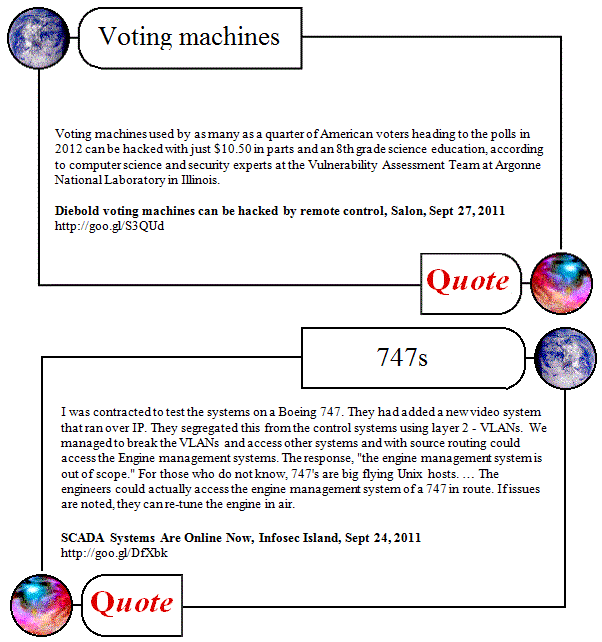
In the meantime, and working from open source materials, the only kind to which I have access – here are two data points we might have noted a litle earlier, if we had decent interdependency and vulnerability mapping:

quo-vulnerabilities.gif

Fear-mongering — or significant alerts?  I’m not tech savvy enough to know.

4.

Tom Barnett’s point about “the thinking we pursued as we tried to imagine – in advance – what a terrible shock to the system would do to the United States and the world in this day and age” still stands.

Y2K was what first alerted me to the significance of SCADAs.

Something very like what Y2K might have been seems to be unfolding — but slowly, slowly.

Are we thinking yet?

The Lion of Judah, Jesus and Jihad

Tuesday, September 27th, 2011

[ by Charles Cameron – a meander from Narnia via Roke and the stars to Jihad –  too religious, perhaps, or too literary — a lightweight post of no significance ]

.
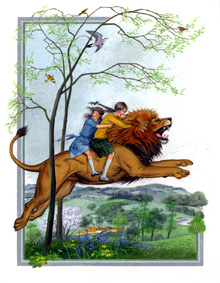
lww-1991-03-small.jpg
illustration credit: Pauline Baynes
.

In my previous post, I quoted the prophet and apostle Bill Harmon:

We are about to move from the dispensation of grace to the dispensation of dominion. We are about to see Jesus, not as the suffering lamb that was slain, but the roaring Lion who is King!

Dominion is a keyword that’s getting a lot of attention right now – it has significantly different meanings for different strands in the theological mix — but as usual I’m at least as interested in the symbols and imagery people use as I am in their doctrinal expressions.

This post, then, will explore the imagery of the Lion.

1.

Having recently written that post with the Harmon quote from 1999, I was struck to read the following account on the Elijah list just yesterday :

I had a profound encounter recently before going to bed. I think it is just like God to get you right before you fall asleep. I had to get out of bed to make a record of this! I felt it important to share with you. We see Jesus in many different expressions in the Scriptures. He is the Good Shepherd, the Lamb of God, the Lord of Hosts, the Angel of the Lord and many other looks. But one night recently He came to me as the Lion who is ready to roar. As you read, ask the Lord to reveal this aspect of His nature in your life.

I had a vision where I found myself on the back of this giant Lion with a huge mane. Then I realized it was the Lord. As the Lion turned His head, I could see His mouth open as if He was getting ready to roar. It is time to ride on the Lion of Judah. It is as if He has been waiting for this season. There is something fresh and new in the air. The breath of His mouth will destroy the enemy.

In this vision I was also running my fingers through the mane of the Lion. This represents the intimacy with God that is the foundation for our authority. Our intimacy is for a purpose – it is to establish the Kingdom of God for the King. The Lion is symbolic in that it is the “King of the Jungle”. The world is that jungle. Jesus is coming as the Lion to rule in the jungle bringing His power to set people free.

The Lord carries us into that jungle with His authority. When we are riding on the Lion we can be assured that we will succeed in all He calls us to do. He is massive, larger than life. He is ready to conquer and demonstrate His power.

In my encounter, I was suddenly on this Lion and He was of full age and postured for action. This will be a time where God will do things suddenly. It will take us by surprise. The sons of the Kingdom will advance the Kingdom for His purposes and with His power.

John Belt, Live In His Presence Ministries

2.

To be honest, it strikes me that that’s straight out of CS Lewis and his wonderful books for children – but without Lewis’ grace as a writer. Compare:

That ride was perhaps the most wonderful thing that happened to them in Narnia. Have you ever had a gallop on a horse? Think of that; and then take away the jingle of the bits and imagine instead the almost noiseless padding of the great paws. Then imagine instead of the black or gray or chestnut back of the horse the soft roughness of golden fur, and the mane flying back in the wind. And then imagine you are going about twice as fast as the fastest racehorse. But this is a mount that doesn’t need to be guided and never grows tired. He rushes on and on, never missing his footing, never hesitating, threading his way with perfect skill between tree trunks, jumping over bush and briar and the smaller streams, wading the larger, swimming the largest of all. And you are riding not on a road nor in a park nor even on the downs, but right across Narnia, in spring, down solemn avenues of beech and across sunny glades of oak, through wild orchards of snow-white cherry trees, past roaring waterfalls and mossy rocks and echoing caverns, up windy slopes alight with gorse bushes, and across the shoulders of heathery mountains and along giddy ridges and down, down, down again into wild valleys and out into acres of blue flowers.

— CS Lewis, The Lion, the Witch and the Wardrobe (illustration above by Pauline Baynes)

That captures the “riding the Lion” idea a great deal more powerfully, and it’s imaginative fiction.

3.

The other idea present in Belt’s narrative is the Lion’s roar. Again, it seems to me that what Belt offers us is a less gracious version of Lewis, who wrote:

The Lion opened his mouth, but no sound came from it; he was breathing out, a long, warm breath; it seemed to sway all the beasts as the wind sways a line of trees. Far overhead from beyond the veil of blue sky which hid them the stars sang again; a pure, cold, difficult music. Then there came a swift flash like fire (but it burnt nobody] either from the sky or from the Lion itself, and every drop of blood tingled in the children’s bodies, and the deepest, wildest voice they had ever heard was saying: “Narnia, Narnia, Narnia. Awake. Love. Think. Speak. Be walking trees. Be talking beasts. Be divine.”

It was of course the Lion’s voice.

— CS Lewis, The Magician’s Nephew

4.

Commenting on Lewis’ version of the Lion’s roar, Paul Ford writes:

This passage is remarkable for the intense breath image and the addition of the fire image (from the first conferral of the Holy Spirit in the New Testament on Pentecost; see the Acts of the Apostles 2:3-4).

— Paul F. Ford, Companion to Narnia

With in turn refers us to this passage:

And suddenly there came a sound from heaven as of a rushing mighty wind, and it filled all the house where they were sitting. And there appeared unto them cloven tongues like as of fire, and it sat upon each of them. And they were all filled with the Holy Ghost, and began to speak with other tongues, as the Spirit gave them utterance.

— Acts 2:3-4

5.

TS Eliot was notably moved by the same passage, and we can see how a poet deals with the same wind and fire in one of the final sections of “Little Gidding”:

The dove descending breaks the air
With flame of incandescent terror
Of which the tongues declare
The one discharge from sin and error.
The only hope, or else despair
Lies in the choice of pyre or pyre —
To be redeemed from fire by fire.

Who then devised the torment? Love.
Love is the unfamiliar Name
Behind the hands that wove
The intolerable shirt of flame
Which human power cannot remove.
We only live, only suspire
Consumed by either fire or fire.

— TS Eliot, “Little Gidding”, Four Quartets

6.

It’s the wind of inspiration that brings tongues of flame here, many tongues, many languages…

The wind bloweth where it listeth, and thou hearest the sound thereof, but canst not tell whence it cometh, and whither it goeth: so is every one that is born of the Spirit.

John 3:8

And the Greek is really quite wonderful here, as Phillip Comfort among others points out

In John 3:8, there is a metaphor which is purposefully polyvalent, in that Jesus was speaking of wind, spirit, and breath at the same time (inasmuch as pneuma can mean all three)

Philip Comfort, Encountering the manuscripts: an introduction to New Testament paleography, p 235

And circling back for a moment to CS Lewis — because there is really only one universe of discourse…

It must always be remembered … that the various senses we take out of an ancient word by analysis existed in it as a unity.

CS Lewis, The Allegory of Love, p 365

7.

I said earlier that CS Lewis’ writing seemed to me to have notably more grace than John Belt’s — and I think that grace has to do with the theological virtue of the same name too, that beauty is an indicator of Grace if you like.

Here’s another author, also writing for children, whose prose is a marvel of purity — describing the music of the stars of which Lewis also spoke — Ursula Le Guin:

It is no secret. All power is one in source and end, I think. Years and distances, stars and candles, water and wind and wizardry, the craft in a man’s hand and the wisdom in a tree’s root: they all arise together. My name, and yours, and the true name of the sun, or a spring of water, or an unborn child, all are syllables of the great word that is very slowly spoken by the shining of the stars. There is no other power. No other name.

Ursula Le Guin, Wizard of Earthsea

Ursula would, I think, describe herself as a Taoist: the traditions may differs, grace is still grace.

8.

Well, you might not think it would be easy to get from Narnia and CS Lewis to jihad in a single bound, but it has been done, and Jarret Brachman posted the proof a while back…

The jihadist propaganda lion:
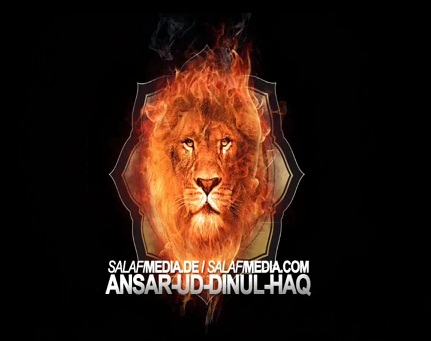
screenshot.jpg

was in fact swiped from the Narnia lion:
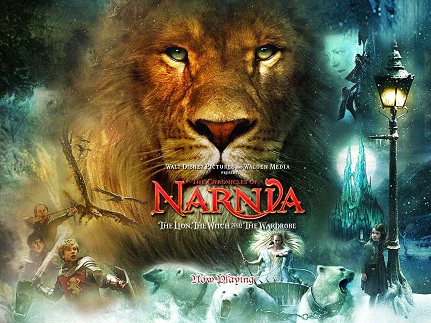
narnia.jpg

— as Brachman elegantly demonstrated:
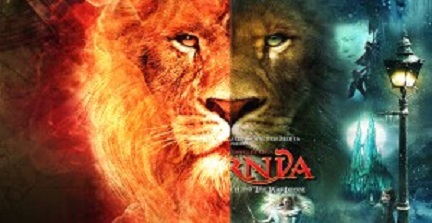
composite.jpg

all three images credit: Jarret Brachman, Cronus Global

9

Well, that’s funny — but not uplifting.

So I’ll leave you with another flight — that of the king of the birds this time in the words of Isaiah:

But they that wait upon the LORD shall renew their strength; they shall mount up with wings as eagles; they shall run, and not be weary; and they shall walk, and not faint.

Isaiah 40:31

Idle thoughts: on wars, justice and banking

Sunday, September 18th, 2011

[ by Charles Cameron — reality, appearance and virtuality ]

.

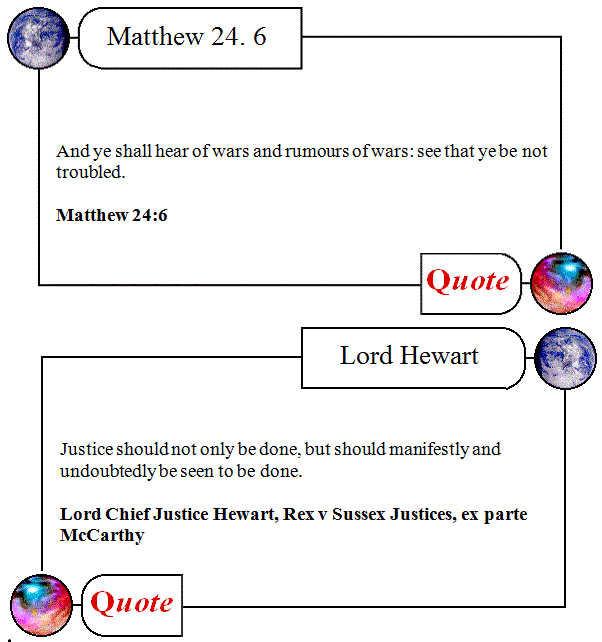
quo-functions.gif

These two phrases, wars and rumors of wars and done and seen to be done have apparently been rattling around in my head for long enough that they finally dodged all the other stuff about Mahdis and Glass Bead Games and met.

Okay, I’d already thought of the first one in terms of “Cameron’s Function”:

f(x) = x + rumors of x           (i)

because it seemed to “apply” to other things than war — the instance that gave me that insight was the run-up to the Year 2000, during which it became abundantly clear that rumors of bank runs were precisely what bank runs themselves were about — which in turn became my classic instance of the need for mapping that “crossed over” between the subjective and objective realms — or morale and materiel, as I called them in a recent post.

And so here comes “Cameron’s Function #2”:

f(x) = x + seen to be x         (ii)

What I’m wondering now is whether the two of them are essentially the same “function” — any thoughts? They’re twins — but are they identical?

A bouquet from Breivik

Thursday, September 15th, 2011

[ by Charles Cameron — Breivik, network analysis, graphical presentation, morale and materiel, hard problem in consciousness ]

.

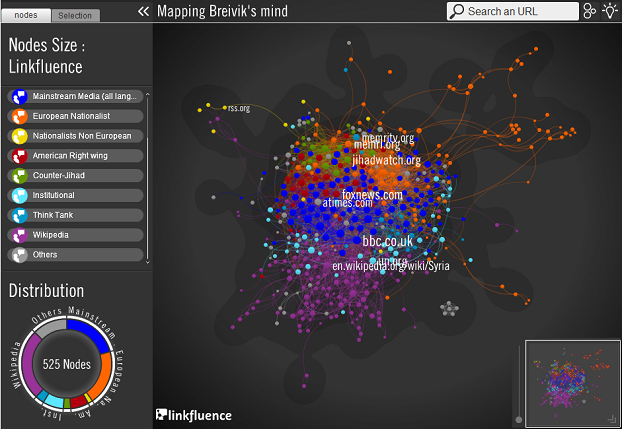
breivik-mind-map.png

If I might wax over-the-top lyrical for just a moment…

Like an early morning bouquet of wildflowers appearing out of the mists —

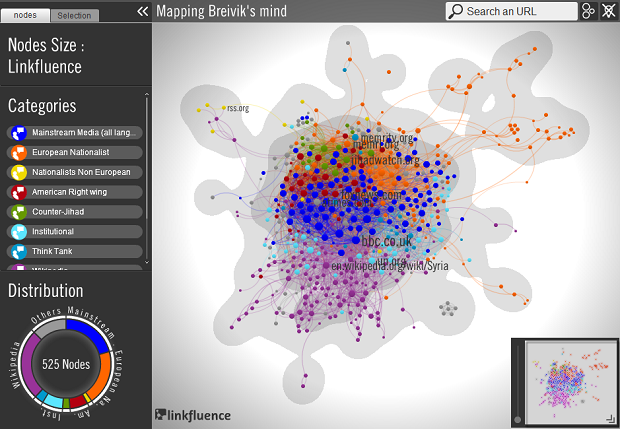
breivik-mind-map-02.png

or like some translucent sea creature perhaps, with galaxies in its veins and tendrils — the mind of Anders Breivik is imaged here by Britain’s Guardian datablog in a graphical mapping of the hyperlinks found in his 1500 page manifesto, and the links between the sites he links to.

Beautiful, no? Like an early morning bouquet?

*

Three things:

  • mapping Breivik’s online links for us is a valuable service.
  • the glamour of high-tech graphical interfaces can be deceptive.
  • there’s no map of the link between concept and act.

That last one, if you ask me, is the real bouquet.

We can know quite a bit about what Breivik read, and even figure out some of how he “connected the dots” – but the move from thinking about to taking action is the one that matters most – and we don’t have much of a handle on it.

It’s not on the map.

*

Such lacunae bother me.

A lot of our maps and models move between one quantity and another, and a lot of our thinking, correspondingly, has to do with materiel rather than morale — but nowhere is there a map or model of how quantity and quality affect each other, or how morale “force multiplies” materiel — even though “real life” moves seamlessly between (subjective, qualitative) mind and (objective, quantifiable) brain.

We have no map to walk us through the hard problem in consciousness — except our own insight.

And x-rays do not an insight make.

The imagery of religion and war

Friday, September 9th, 2011

[ by Charles Cameron — graphical analysis, selling bibles to teenage boys, tge Mass in time of war ]

.

Following on from my post on the work of Al Farrow, and leading towards a series of posts on ritual and ceremonial, I’d like to show you two very different images at the overlap of war and religion.

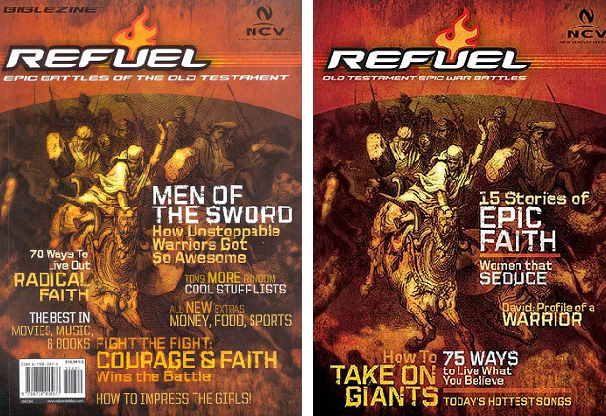
The first shows two different covers of the books of Joshua, Judges, Ruth, I & II Samuel, I & II Kings, Ezra and Nehemiah, as featured in a “biblezine” edition of the New Century Version of the Bible pitched at teenage testosterone.

double.png

Each of will have our own sense of whether that’s fun, stupid,  Biblical, unBiblical, enticing, disgusting or simply uninteresting — but whatever your aesthetic and/or belief-based response, there’s a powerful lesson there in the choice of subtitles:

how unstoppable warriors got so awesome…
courage and faith wins the battle…
how to impress the girls!
how to take on giants!
women that seduce…
tons more random cool stuff lists…

I’m not a fan of this kind of thing myself, but I picked up a copy when I saw one at the thrift the other day — the one with Men of the Sword on the cover — and as someone who has done a fair amount of copy-editing in my day, was surprised to see “courage and faith wins the battle” (sic) had slipped past the editorial eyes at Nelson Books

The New Testament in the same series is a bit better — the cover still features “dynamic stories of daring men” –but the, ahem, romantic element has been toned down a bit, with the catch phrase “class act: how to attract godly girls” replacing the Old Testament’s “how to impress the girls”.

* * *

Okay, I’m not as young as I once was, and maybe I’ve been mean enough at the expense of these people who want to market the Bible as though it was an invitation to warfare washed down with sex.

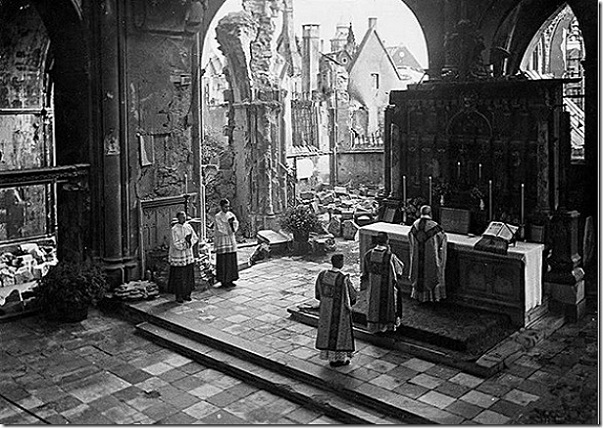
The other image I found recently comes a great deal closer to my own taste, and will serve as an excellent introduction to the idea of religious ceremonial as an oasis of peace in time of war:

missa_thumb3.jpg

Again, I suppose there may be some who will find the idea of religious ritual boring and irrelevant rather than beautiful — but it is its capacity to move us at a deep level — even (and perhaps particularly) when high tides of  circumstance and emotion are breaking over us — that I wish to focus on and, to the extent that it is possible, explore and explain in  some upcoming posts.

In my view, it was this kind of beauty, verging on the austere and the timeless, rather than the snazzy and faddish “impress the girls — draw in the kids” kind, that Pope Benedict XVI had in mind when he said:

Like the rest of Christian Revelation, the liturgy is inherently linked to beauty: it is veritatis splendor. The liturgy is a radiant expression of the paschal mystery, in which Christ draws us to himself and calls us to communion. As Saint Bonaventure would say, in Jesus we contemplate beauty and splendor at their source.

* * *

I am not a Catholic, though my sympathies run in that direction, and my examples of ceremonial will not be drawn only from Catholic or Christian sources — part of what i want to explore is the universal quality of ritual as a powerful source of motivation and inspiration, while another aspect has to do with the interweaving of military, religious and state symbols, but the point I would most like to make in each case is the profound impact that such symbols and rituals can have on the receptive heart.

I hope to touch on a wide range of ritual expressions, from the Requiem for a departed princely Habsburg to the Lakota sweat lodge, and from to the fire-walking ceremonial of the Mt Takei monks of Japan to the Spanish bull-fight, with a close look at the ritual surrounding coronation in my own British tradition.

For those who would like to peer deeper into these matters, I would suggest these four books:

Victor Turner, The Ritual Process
Geoffrey Wainwright, Eucharist and Eschatology
William Cavanaugh, Torture and Eucharist
Josepha Zulaika, Basque Violence: Metaphor and sacrament

The first explains “how ritual works” from an anthropological point of view, the second deals with the purposeful interweaving, accomplished within ritual, of time with the timeless, the third with the way in which sacramental transcendence is the very antithesis of torture, and the fourth with the impact of a sacramental sensibility within terrorism.

Each one is a masterpiece of intelligence and profound feeling.


Switch to our mobile site