[ by Charles Cameron — on two viral videos of children ]
.
Malala Yousafzai has been in many hearts and minds recently, and deservedly so. Her speech before the United Nations Youth Assembly, like her John Stewart interview, went viral on YouTube– here’s a version that has the grace to include her opening invocation of the Name of God:
Thinking idly about her the other day I was reminded of anither video of a schoolchild that went viral just a few months ago — this one the more off-the-cuff speech of a boy, Ali Ahmed, interviewed on the street. He’s twelve, Malala spoke at the UN on her sixteenth birthday, but he testifies eloquently to Malala’s point by his own obvious clarity and intelligence:
I think it’s worth holding these two video clips in mind together, the young woman and the young man, she almost fatally wounded and now recovered, he happening to be at the right spot on the right moment to be interviewed, her words reaching us directly in her fluent English, his coming to us only via sub-titles, as in an art-house “foreign” movie… If she has eclipsed him, let us remember him again.
The intelligence, the clarity. the education. And how many thousands more must there be, unviral and unsung, but no less intelligent?
**
Unless ye become as little children, saith the Gospel, and a little child shall lead them, saith the Prophet.
[ by Charles Cameron — two more short videos in my series of Sunday Suprises, aiming for unexpected delight & continuing Brit-USian amity ]
.
Here in a nutshell is a glimpse of why I admire and like HRH:
And I’ve chosen this example of Leonard Cohen, not for the line “where the light gets in” which has been quoted too often for its own good, but for “the holy dove, she will be caught again”.
There’s so much more in this song to learn, to take in, to “read, mark, learn, and inwardly digest” as the prayer book says.
Hoping you’ll take some pleasure in one or both of these clips this Sunday!
Pope Francis decided at the last minute not to attend a Beethoven concert last evening, Fox News and others reported. Fox News comments, “Unlike his predecessor Benedict, who was well-known as a music lover, Francis has shown scant interest in music, liturgical or otherwise.” The concert, an event long planned for the Year of Faith, included Beethoven’s 9th symphony with choir and orchestra.
Pope Francis supposedly said “I am not a Renaissance prince who listens to music instead of working,” Vatican Insider first reported, later softening its report to preserve the general sense without quoting the pope directly.
— then this, from the first extended interview of Pope Francis, which has just been released.
While I’m sure plenty of others will mull over other aspects of what he has to say for himself, I’m taking my own insights into his character from the artists in whose work he finds inspiration:
I have really loved a diverse array of authors. I love very much Dostoevsky and Hölderlin. I remember Hölderlin for that poem written for the birthday of his grandmother that is very beautiful and was spiritually very enriching for me. The poem ends with the verse, ‘May the man hold fast to what the child has promised.’ I was also impressed because I loved my grandmother Rosa, and in that poem Hölderlin compares his grandmother to the Virgin Mary, who gave birth to Jesus, the friend of the earth who did not consider anybody a foreigner.
I have read The Betrothed, by Alessandro Manzoni, three times, and I have it now on my table because I want to read it again. Manzoni gave me so much. When I was a child, my grandmother taught me by heart the beginning of The Betrothed: ‘That branch of Lake Como that turns off to the south between two unbroken chains of mountains….’ I also liked Gerard Manley Hopkins very much.
Among the great painters, I admire Caravaggio; his paintings speak to me. But also Chagall, with his ‘White Crucifixion.’ Among musicians I love Mozart, of course. The ‘Et incarnatus est’ from his Mass in C minor is matchless; it lifts you to God! I love Mozart performed by Clara Haskil. Mozart fulfils me. But I cannot think about his music; I have to listen to it. I like listening to Beethoven, but in a Promethean way, and the most Promethean interpreter for me is Furtwängler. And then Bach’s Passions. The piece by Bach that I love so much is the ‘Erbarme Dich,’ the tears of Peter in the ‘St. Matthew Passion.’ Sublime. Then, at a different level, not intimate in the same way, I love Wagner. I like to listen to him, but not all the time. The performance of Wagner’s ‘Ring’ by Furtwängler at La Scala in Milan in 1950 is for me the best. But also the ‘Parsifal’ by Knappertsbusch in 1962.
We should also talk about the cinema. ‘La Strada,’ by Fellini, is the movie that perhaps I loved the most. I identify with this movie, in which there is an implicit reference to St. Francis. I also believe that I watched all of the Italian movies with Anna Magnani and Aldo Fabrizi when I was between 10 and 12 years old. Another film that I loved is ‘Rome, Open City.’ I owe my film culture especially to my parents who used to take us to the movies quite often.
Anyway, in general I love tragic artists, especially classical ones. There is a nice definition that Cervantes puts on the lips of the bachelor Carrasco to praise the story of Don Quixote: ‘Children have it in their hands, young people read it, adults understand it, the elderly praise it.’ For me this can be a good definition of the classics.
**
Mozart, Et incarnatus est:
Mozart, played by Clara Haskil:
Bach, Erbarme dich, from the Matthew Passion:
Fellini, La Strada, innocence:
Fellini, La Strada, despair:
No wonder, then, that he loves the poetry of his fellow Jesuit, the poet Gerard Manley Hopkins:
No worst, there is none. Pitched past pitch of grief,
More pangs will, schooled at forepangs, wilder wring.
Comforter, where, where is your comforting?
Mary, mother of us, where is your relief?
My cries heave, herds-long; huddle in a main, a chief
Woe, wórld-sorrow; on an áge-old anvil wince and sing —
Then lull, then leave off. Fury had shrieked ‘No ling-
ering! Let me be fell: force I must be brief.”‘
O the mind, mind has mountains; cliffs of fall
Frightful, sheer, no-man-fathomed. Hold them cheap
May who ne’er hung there. Nor does long our small
Durance deal with that steep or deep. Here! creep,
Wretch, under a comfort serves in a whirlwind: all
Life death does end and each day dies with sleep.
— nor the works of Caravaggio, whose rap sheet was impressive to say the least:
Arriving in Rome in 1595 at the age of 25, the hot-headed painter’s police dossier — hand-written in Latin and vernacular Italian and bound in great volumes that were stored in the archives until now — makes Caravaggio come across as almost compulsive in his lawlessness. For instance, the man was weapon-obsessed, sporting a sword, dagger, and pistol at various times. He was twice thrown in the clink for carrying arms without a permit, and known for beating strangers in late-night fights and pelting police with rocks.
The documents add fresh color to well-known parts of the Caravaggio legend. Regarding the 1606 brawl during which the artist killed one Ranuccio Tommassoni, leading the artist to flee Rome and causing Pope Paul V to issue a death warrant, the documents reveal that the fight was over a gambling debt, and not a woman, as some accounts have suggested.
It is all the more appropriate, then, to close this post with Caravaggio’s own meditation on the martyrdom by crucifixion of the first Pope, St Peter, whose chair Francis now holds:
h/t Damian Thompson, who tweeted “I never thought I’d hear a Pope rave about Haskil’s Mozart, Furtwängler’s Beethoven and Knappertsbusch’s legendary 62 Parsifal.”
[ by Charles Cameron — the lure of exile, of hijra, in the context of western jihadists going abroad ]
.
Whereas the Prophet’s first visionary reception of the Quran dates to 609-610 CE, and the Prophet himself was born some 40 years earlier, the Islamic reckoning of time (AH, Anno Hegirae) begins with his hijra or migration from Mecca, his home, to Medina — an event of huge Islamic consequence, with echoes in our own times.
One of the questions I have been pondering recently has to do with those echoes. I have been asking myself how strong a part in the decisions of westerners to migrate to Syria and elsewhere to participate in jihad might be played by the concept of hijra — either in the minds of recruits, or in the rhetoric of recruiters.
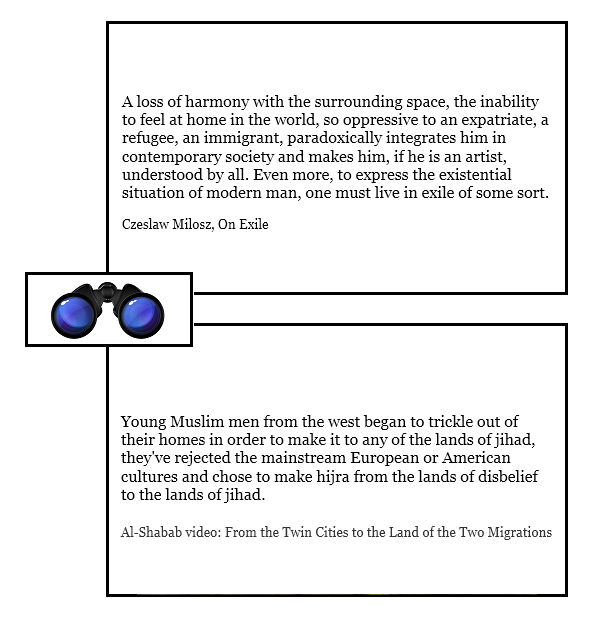
When I came across the quote from Czeslaw Milosz (above, upper panel), I recognized that I had stumbled upon the expression of a secular equivalent of that yearning — and thus perhaps an opening into our own deeper understanding of hijra (lower panel) — a sacralization and hence an intensification of the same yearning.
[Hearing] that you intend on making hijrah [emigration], I immediately wanted to contact you to tell you that my advice to you was to remainin your current position.
Here, strategic rationalism attempts to prevail over romantic yearning…
Zenpundit is a blog dedicated to exploring the intersections of foreign policy, history, military theory, national security,strategic thinking, futurism, cognition and a number of other esoteric pursuits.