[ by Charles Cameron — a quick look at the dramatis personae ]
.
And let me repeat for the record: I am neither pro nor anti Pussy Riot. I have sympathies on both sides. It comes down to this: I love both liberty and liturgy.
After pointing out that the group to which they belong strove for anonymity, the writer commented that they “have unwillingly emerged as vivid — and very different — characters.” Here’s the short form version of their differences:
One is a daring performance artist with Angelina Jolie lips and a notorious part in a filmed orgy just days before she gave birth. Another is a poet and environmentalist whose pre-Raphaelite looks project sweetness and sensitivity. Rounding out the trio is a quietly cerebral computer expert, who has applied her skills both to nuclear submarines and experimental art.
In more detail (and I’m still cutting quite a bit here to bring you the gist of the articled, and recommend you read the whole thing):
**
Nadezhda Tolokonnikova:
Tolokonnikova left her home in the frigid oil town of Norilsk at 17 to enroll in Moscow State University’s philosophy department. … “Feminism, art and politics take up all her time,” said David Abramov, who has helped Pussy Riot organize performances. “She devotes all her time to it.”
**
Maria Alyokhina:
Alekhina, an accomplished poet with long curly blonde hair, is quite a different face of Pussy Riot. Alekhina, mother of a five-year-old boy, has a long background in charity work and environmental activism. She organized protest pickets to defend Utrish, a natural reserve in Russia’s south, from developers and worked with Danilovtsy, a Russian Orthodox charity.
**
Yekaterina Samutsevich:
Samutsevich, 30, studied computers at Moscow Energy University and soon got a good job at a top research center. She was promptly hired to a job in a top secret department where she was designing software programs for Russia’s top nuclear submarine Nerpa, her father Stanislav said.
Samutsevich later quit and enrolled at the renowned Rodchenko Photography and Multimedia School to study media art. Her final project at the school was designing a web-browser which intentionally distorted and manipulated search results — an invention that was supposed to highlight society’s dependence on media and helplessness in the uncharted waters of web media.
Alexei Shulgin, a professor at the Rodchenko school … praised her as a talented artist and said that like many young people in Russia she “turned to art for answers about modern times.”
**
What if they had been a classical ensemble playing Stravinsky — might we detect a faint echoes of the Paris première of the Rite of Springjust shy of a century ago? — or, given their interest in the visual arts, Scriabin‘s 102 year old Prometheus: The Poem of Fire with its part for keyboard-for-lights, perhaps?
Michael Few is a retired military officer and former editor of the Small Wars Journal: we are honored to offer our readers this guest post by a good friend of this blog.
.
This fall, I’m hoping to begin teaching high school social studies as well as an elective on Global Issues or Wicked Problems (WPs). WPs are those messy, seemingly intractable problems that seem to evade solutions from conventional planning and decision making methods — terrorism, poverty, water rights, etc… These types of courses are already being taught in the school system where I live, and my hope is that I will be able to become a force multiplier given my experience and background.
Eventually, if this elective course takes off, then I would like the final project to be a collection of TEDx talks, where the students describe a problem, discuss past failed efforts to tame the problem, and offer coping strategies or new solutions.
As I am doing my initial reconnaissance of the student demographics, the first striking data point is their age. The incoming freshman class would have been born in 1998, and the senior class born in 1995. A second surprise that I received is the socio-ethnic backgrounds. Along with the expected mix of white, black and Hispanic children, my school district has a significant first generation Indian population, whose parents teach or work in the Research Triangle Park or surrounding universities. Moreover, there is a minority of Burmese refugees who have found a safe home after fleeing a repressive regime.
How do they see and understand the world?
The attacks of 9/11 were but a faint memory; the Cold War is ancient history. Their childhoods were formed with the Iraq and Afghanistan wars in the background, and their pop-culture heroes are Navy Seal Team Six and Call to Duty video games. Drone strikes and the intervention in Libya are normal for them.
It is the way things are. We fight terrorists in other countries in order to protect our way of life. But what is a terrorist or an insurgent? Is it simply someone that disagrees with you?
These students have much bigger problems to solve than simply pacifying villages in the remote areas of modernity. By 2040, when these students are in the prime of their lives, the world population is expected to be nearing nine billion with increased competition for basic resources as the world passes through peak oil and peak fresh water.
If the United States is to remain strong, then these children are our hope. They will be tasked with leading the nation, finding new solutions to coming crisis, and developing innovation in technology, science, governance, and medicine.
As I am developing my teaching philosophy, I am using the same process that served me well as a commander in the military. My purpose is to help develop, mentor, and coach: 1. leaders of character, 2.involved citizens in the nation who understand that rights must be complimented by responsibilities, and 3. the individual self-confidence to pursue a good life respecting themselves and others.
Initially, I want to challenge them to rethink what they’ve been taught or think they know. I want my students to think for themselves and determine what right should look like.
First, I began studying Reinhold Niebuhr. Now, I’m spending some time reading Saint Augustine’s “City of God” and rethinking Just War Theory. If we zoom up from just drone strikes and look at our continued military action across the globe, do we still have the moral high ground? I don’t know. As Saint Augustine wrote,
Whoever gives even moderate attention to human affairs and to our common nature, will recognize that if there is no man who does not wish to be joyful, neither is there anyone who does not wish to have peace. For even they who make war desire nothing but victory — desire, that is to say, to attain to peace with glory. For what else is victory than the conquest of those who resist us? And when this is done there is peace. It is therefore with the desire for peace that wars are waged, even by those who take pleasure in exercising their warlike nature in command and battle. And hence it is obvious that peace is the end sought for by war.
When I quoted Saint Augustine in a comment here, Mark Safranski, the Zen of Zen, replied,
The high ground is in the eye of the beholder. Some people cheered 9/11, including a few American radicals. With multiple-audiences watching 24/7, some will disapprove of our merely existing and bitterly resent and deny the legitimacy of our fighting back because they prefer us defeated and dead. Other audiences are more fair-minded and these are a good barometer – if we are winning them over, securing their admiration and isolating our opponents, our moral behavior in the big picture is apt to be reasonably on track. If we are repelling them, isolating ourselves, driving others to the side of our enemies, then chances are fairly good that we are going astray.
Zen’s point is well-taken, but I disagree. Following a moral life is not based on how others feel about you. It is through living a life that subscribes to your believed philosophy, spiritual norms, and values and beliefs particularly when you have to make an unpopular decision.
John Arquilla, in his most recent “Cool War,” said it best,
’It is well that war is so terrible,’ Confederate General Robert E. Lee once said, ‘lest we should grow too fond of it.’ For him, and generations of military leaders before and since, the carnage and other costs of war have driven a sense of reluctance to start a conflict, or even to join one already in progress.
Caution about going to war has formed a central aspect of the American public character. George Washington worried about being drawn into foreign wars through what Thomas Jefferson later called ‘entangling alliances.’ John Quincy Adams admonished Americans not to ‘go abroad in search of monsters to destroy.’ Their advice has generally been followed. Even when it came to helping thwart the adventurer-conquerors who started the twentieth century’s world wars, the United States stayed out of both from the outset, entering only when dragged into them.
Today, war has become too easy and not too terrible. With our global hegemony in military strength, we can force our will at any time and any place.
But, what is the right thing to do?
What is the moral high ground?
These are some of the questions that my students will eventually have to answer.
If you have any interest in the lives of the only five-star admirals to serve in the US Navy, this is the book to begin your reading. Mr. Borneman does a masterful job of describing the admirals (Leahy, King, Nimitz, and Halsey), their lives and contributions to the US victory in WWII. Borneman uses a thematic approach, beginning with short chapters describing the lives of the four subjects and how the admirals came to attend the United States Naval Academy at Annapolis, MD (which they all attended).
Borneman follows with modest chapters on the admirals’ areas of expertise, to include: battleships, submarines, and aircraft carriers. These chapters offer a glimpse into both the strengths and weaknesses of these ships following WWI and how the ships’ roles changed in the years leading up to WWII. Intermixed with the descriptions of the ships, Borneman weaves the admirals into the story illustrating their tastes in ships and their leadership methods.
Borneman follows with a fast-paced story of how these men worked together (and with other big name colleagues like Roosevelt, MacArther, Marshall, and Spruance, to name a few) to achieve victory. From the intricacies of a cogent strategy for the early days of the Pacific, to the conferences between Allied leaders (Roosevelt and Churchill, primarily), to the battles and tactics that shaped the war’s outcome, Borneman’s fine writing presents the admirals, warts and all. As mentioned previously, they were all different, but they were all talented and driven. Borneman quotes retired Vice Admiral Roland N. Smoot, who was in the thick of the Pacific war, speaking after the four had died:
“I’ve tried to analyze the four five-star Admirals that we’ve had in this Navy…You have a man like King—terrifically ‘hew to the line’ hard martinet, stony steely gentleman; the grandfather and really lovable old man Nimitz—the most beloved man I’ve ever know; the complete and utter clown Halsey—a clown but if he said ‘Let’s go to hell together,’ you’d go to hell with him; and then the diplomat Leahy—the open-handed, effluent diplomat Leahy. Four more different men never lived and tehy all got to be five-star admirals, and why?”
Borneman says, “Smoot answered his own question with one word: “leadership.” Smoot continues that each had “the ability to make men admire them one way or the other.” Borneman suggests King got there by “bluster and verve; Nimitz by putting his hand on your shoulder and saying, Let’s get this thing done; Halsey—still the fullback—by rushing through the line in such a way that everyone on the team wanted to go through with him; and Leahy by never letting his own personal feelings, or those of others, interfere with the long-range objectives and best interests of his country.”
If these men sound interesting, it is because they are; the lessons and examples they left behind could use some attention from many of today’s military leaders. The four were smart, tough, and unafraid.
The Admirals is a about 475 pages long, with lots of reference material in the multiple appendixes. Borneman’s writing is so fluid and eloquent, I was able to read in two sittings, and his fine book comes with my strongest recommendation.
UPDATE: My apologies for a post with so many typos; I was in a hurry, but wanted to get this recommendation out. That said, I’ll try to edit more carefully going forward.
[ by Charles Cameron — a warrior, a monk, and where that leaves me ]
.
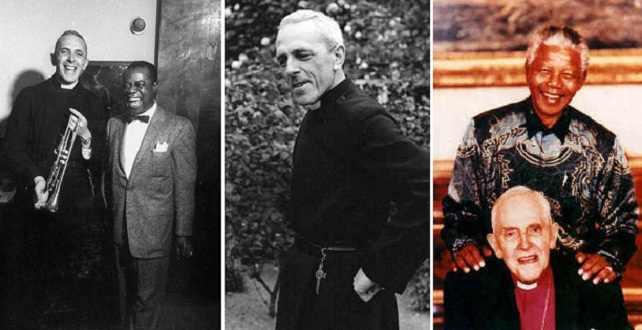
In the first part of this post I introduced you to my father, Captain OG Cameron DSC, RN, the man who fueled my keen interest in gallantry and the martial side of things. The other great influence in my early life was Fr. Trevor Huddleston CR, pictured below:
.
Trevor Huddleston CR:
Archbishop the Most Reverend Sir Ernest Urban Trevor Huddleston CR, KCMG – it’s hard even to know how to string his titles together, this monk, priest, schoolteacher, activist, archbishop, finally knighted by Her Majesty towards the end of his long and eventful life was the man who became a second father, guardian, mentor and spiritual guide to me shortly after my father died when I was nine.
That’s the man as I knew him, Father Trevor — simple, caring, intelligent, perhaps a little austere even — in the middle image above.
Austerity, simplicity: two more words to set beside gallantry in the lexicon of admiration and gratitude.
.
Satchmo:
To the left in the same image, he’s shown with Louis Armstrong — Satchmo — who has just presented him with a trumpet.
The story goes like this: as a monk in an Anglican monastic order, the Community of the Resurrection popularly known as the Mirfield Fathers, Father Trevor was sent to South Africa while still a young man, and worked in Sophiatown, just outside Johannesberg, as a priest and teacher.
A young black kid in one of his classes, Hugh, aged 12 or 13, fell ill and was taken to hospital, where Trevor Huddleston visited him. Trevor asked him what he would like more than anything in this world, what would so thrill and please him that he would have the greatest possible motive for getting better, getting out of the hospital and back to school. Hugh said, “a trumpet, Father” — so Trevor got hold of a trumpet which he then presented to the boy: now known the world over as the great jazz trumpeter, Hugh Masekela.
That wasn’t quite enough, though. A year or three later, Trevor was in the United States, and met Satchmo, who asked if there was anything he could do to help… Trevor told Satchmo he’d started a jazz band for the kids in his school, and knew a boy who would just love a trumpet…
Trevor was a hard man to refuse.
.
Hugh Masekela:
Here’s Hugh Masekela, just a little older, with the trumpet Trevor brought him from Louis Armstrong:
And here’s the sound…
When I was maybe 15, and Trevor had returned from South Africa to England, he gave me a 7″ “45” record of the Huddleston Jazz Band — now long lost. Imagine my amazed delight to be able to hear that sound again, fifty years later, through the good graces of the internet —
Hugh Masekela and the Huddleston Jazz Band play Ndenzeni na?
.
Desmond Tutu:
Another story I like to tell about Trevor and his time in South Africa has to do with a lady…
It seems this young black kid aged about 8 or 9 was sitting with his mother on the “stoop” outside his house in a South African shanty-town when a white priest walked by and doffed his hat to the boy’s mother.
The boy could hardly grasp how this had happened — his mother was a black woman, as one might say, “of no special acount”. But the priest in question was Trevor Huddleston, and it was a natural courtesy for him to lift his hat in greeting a lady…
The young boy never quite recovered from this encounter. We know him now as the Nobel Peace laureate, Archbishop Desmond Tutu.
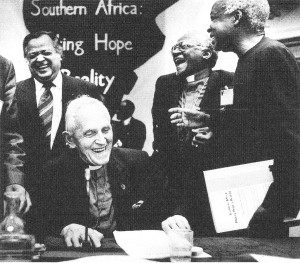
Here’s a photo of four old friends — Huddleston, Tutu, Julius Nyerere of Tanzania, and former Commonwealth Secretary General Shridath Ramphal.
.
From individuals to the world:
These are two simple stories of how Fr Trevor simply and straightforwardly loved whomever was before him, regardless of the enormous pressure at the time to discriminate between “real” and “insignificant” people — a love which made an indelible mark on those whose lives it touched.
And when Father Trevor touched you, as Lord Buckleymight say, you stayed touched.
Thus far I’ve been focusing on individuals that Trevor touched. I do not think he in fact saw more than one person at a time, and his responses to situations were geared directly to the service of his love.
It was because of this that while he was in South Africa, Trevor repeatedly and quite literally put his life on the line in defence of the very simple proposition that the color of a person’s skin was immaterial in view of the love that was possible between any two people — so perhaps here’s where I should mention some of that history and some of the honors it brought him. After all, Trevor did pretty much take on the government of the South Africa he so loved, and lived to see it change.
.
Bishop Trevor of Sophiatown
Trevor Huddleston was a founding member of the African National Congress, the author of the first non-fiction work (Naught for Your Comfort, more on that later) to critique his beloved South Africa’s apartheid policy, reviled publically for meddling in politics by an Archbishop of Canterbury who later declared he had been in error and that Fr Trevor was about as close to a saint as one could find.
In 1955, Father Trevor, along with Yusuf Dadoo and Chief Albert Luthuli, was awarded the Isitwalandwe, the highest award given by the African National Congress. He was awarded the United Nations Gold Medal in recognition of his contribution to the international campaign against apartheid, the highest awards from both Zambia and Nigeria, the Dag Hammerskjold Award for Peace, the Indira Gandhi Memorial Prize, and ten honorary doctorates, including that of his alma mater, Oxford.
Archbishop Huddleston initiated the “International Declaration for the Release of Nelson Mandela and all Political Prisoners” in 1982, took part in the televised “International Tribute for a Free South Africa” held at Wembley Stadium, London in 1990 during which he introduced the address by Nelson Mandela (see below), entered South Africa House, Trafalgar Square, London in 1994 to vote in the first South African democratic election, and was a guest at President Mandela’s inauguration in Pretoria that year.
He received the KCMG (Knight Commander of the Order of St. Michael and St. George) in the 1998 New Year Honours list, for “Services to UK-South African Relations”, and attended an Investiture at Buckingham Palace on March 24th, 1998, to receive this honour from HM the Queen.
He chose the designation, “Bishop Trevor of Sophiatown”.
.
Nelson Mandela:
But let’s go back to individuals, and to Nelson Mandela in particular.
Mandela and Trevor were comrades in the fight against apartheid from the beginning — and the richness of their friendship is visible in the photo of Mandela with his arms on Trevor’s shoulders in the right hand panel at the top of this page.
In his autobiography, Long Walk to Freedom, Mandela tells the story of a time when he and Walter Sisulu were approached by a group of South African police who had been ordered to arrest them. Trevor, who was talking with with the two of them, called out to the cops, “No, you must arrest me instead, my dears.”
It’s that “my dears” that gives the game away. I can hear those words in Trevor’s voice. Even the cops were dear to Trevor: he might be utterly opposed to what they were doing, and risk his life to oppose them – but they were children of God.
Here’s a video of Trevor’s speech introducing Mandela at Wembley — a political speech, to be sure, but one powered by religious conviction:
.
Mandela’s tribute:
I’m saving the best of what Fr. Trevor taught me for the third post in this series, and hope to wrap the series up with some of my own reflections in a fourth; here I’d like to close with the words Mandela wrote about his friend after Trevor’s death in 1998:
It is humbling for an ordinary mortal like myself to express the deep sense of loss one feels at the death of so great and venerable figure as Father Trevor Huddleston.
Father Huddleston was a pillar of wisdom, humility and sacrifice to the legions of freedom fighters in the darkest moments of the struggle against apartheid. At a time when identifying with the cause of equality for all South Africans was seen as the height of betrayal by the privileged, Father Huddleston embraced the downtrodden. He forsook all that apartheid South Africa offered the privileged minority. And he did so at great risk to his personal safety and well-being.
On behalf of the people of South Africa and anti-apartheid campaigners across the world, I convey my deepest condolences to his Church, his friends and his colleagues. Isithwalandwe Trevor Huddleston belonged to that category of men and women who make the world the theatre of their operation in pursuit of freedom and justice.
He brought hope, sunshine and comfort to the poorest of the poor. Not only was he a leader in the fight against oppression. He was also father and mentor to many leaders of the liberation movement, most of whom now occupy leading positions in all spheres of public life in our country. His memory will live in the hearts of our people.
The award -winning film HIGH GROUNDis due for release in August 2012:
Since 2002, almost 50,000 U.S. soldiers have returned home from Iraq and Afghanistan with their lives radically altered by war. With the improvement of battlefield medical treatments, these soldiers return alive yet not whole, and face long painful paths to recovery.
Full integration back into their community and the civilian world is a treacherous road, fraught with obstacles and pitfalls. After initial rehabilitation, these veterans are often left to fend for themselves, and struggle with physical and mental roadblocks, depression, and alienation.
This issue affects every aspect of society, not just families and hometown communities, but our national character and our legacy. How these wounded soldiers transition is one of the most important repercussions of these wars and an adversity with which we will contend for generations.
igh Ground was a showcase expedition bringing together disabled war veterans with world recognized mountain climbers to demonstrate what could be achieved by climbing a Himalayan giant. A key outcome of the expedition was to produce a documentary film that would tell the inspiring stories of these heroes and spread a healing message to a national audience.
This film, featuring stunning cinematography and capturing powerful emotions, will touch the hearts of concerned citizens, military families, outdoor enthusiasts and most of all, soldiers who find themselves wondering how to face the days and months and years ahead. It is an honest and gripping portrayal of our American warriors, telling an action packed story that unfolds in unexpected ways as the team makes their way high into the mountains, through the villages of Nepal, over raging rivers and up terrifying steep terrain risking injury and death for a chance at the summit.
A second and equally important goal is to continue to impact those thousands of injured soldiers in the midst of their own daunting recoveries through the use of the film at veteran’s hospitals and military bases around the United States. In the fall of 2011, a multi-city nationwide tour will be launched to welcome our soldiers home, celebrate their spirit and sacrifice, and to encourage them to pursue their dreams.
Efforts are currently underway to assess the potential of additional expeditions and to create a long-term strategy as a non-profit organization. By getting involved and supporting this project you can participate directly in this vital process and connect your company to the message that our soldiers can indeed… return home to live again.
Zenpundit is a blog dedicated to exploring the intersections of foreign policy, history, military theory, national security,strategic thinking, futurism, cognition and a number of other esoteric pursuits.